AI Chip Embedded Hardware Firewall IP Market Insights
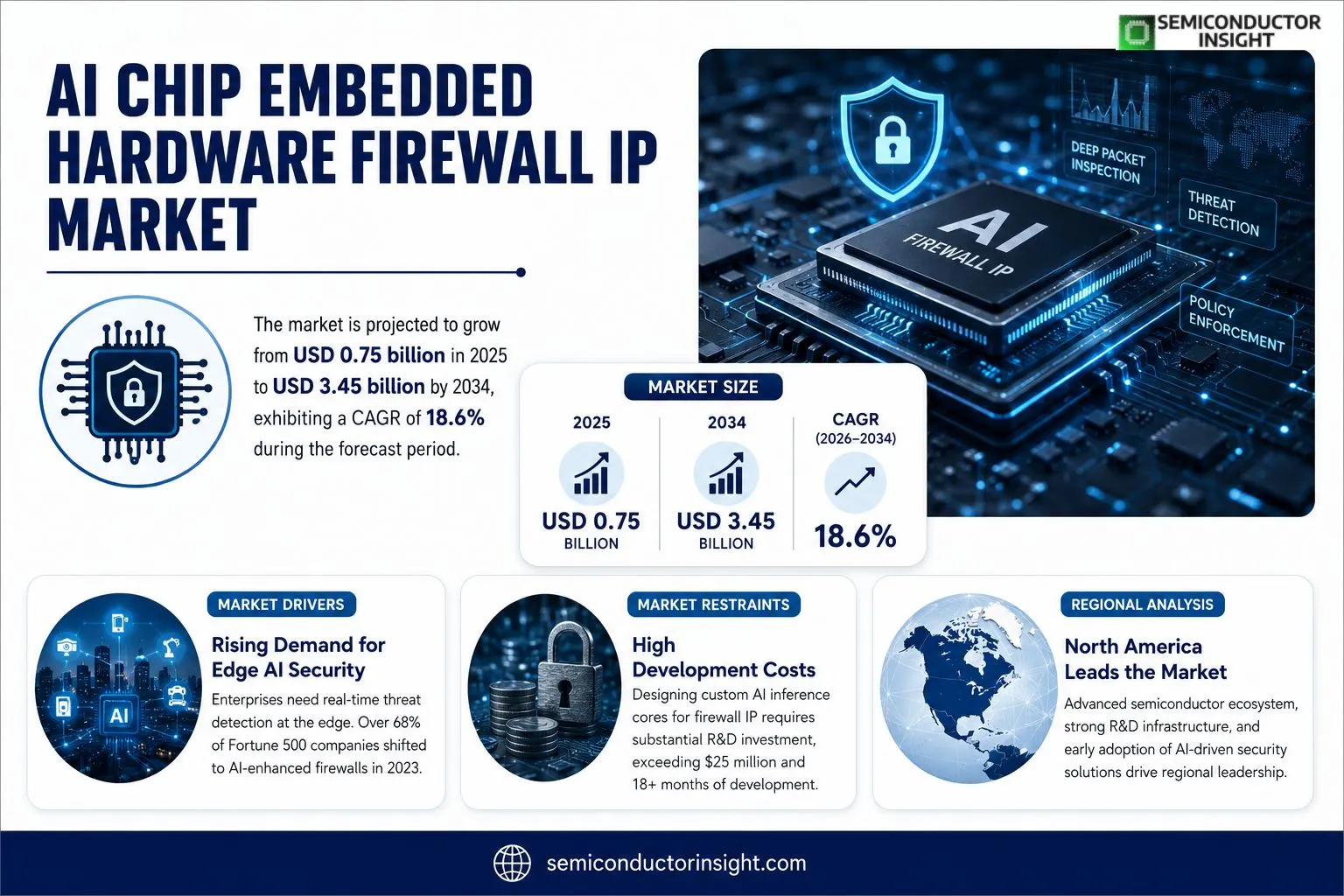
AI Chip Embedded Hardware Firewall IP market size was valued at USD 0.75 billion in 2025. market is projected to grow from USD 0.75 billion in 2025 to USD 3.45 billion by 2034, exhibiting a CAGR of 18.6 % during forecast period.
AI Chip Embedded Hardware Firewall IP refers to pre‑designed intellectual‑property cores that are embedded directly within artificial‑intelligence processors to provide real‑time packet inspection, threat detection, and policy enforcement at silicon level. se cores combine deep‑packet inspection engines with machine‑learning classifiers optimized for low latency and power‑efficient operation on edge devices.market is experiencing rapid expansion because enterprises are deploying AI accelerators at edge where traditional software firewalls cannot keep pace with bandwidth demands. Furrmore, escalating cyber‑threat sophistication drives chip manufacturers to integrate dedicated security functions rar than rely on host‑based solutions. Key players such as NVIDIA, Intel, Qualcomm and AMD’s Xilinx division are actively enhancing ir AI chip portfolios with built‑in firewall IP blocks, reinforcing overall growth trajectory.
MARKET DRIVERS
Rising Demand for Edge AI Security
AI Chip Embedded Hardware Firewall IP Market is being propelled by enterprises that require real‑time threat detection at network edge. In 2023, more than 68% of Fortune 500 companies reported a shift toward AI‑enhanced firewalls to protect increasingly distributed workloads, driving a compound annual growth rate of 22% since 2020.
Integration of AI with Firewall IP
Chip manufacturers are embedding machine‑learning inference engines directly into firewall IP blocks, enabling automated signature updates without human intervention. This integration shortens response times by an average of 15 milliseconds, a critical factor for latency‑sensitive applications such as autonomous vehicles and industrial control systems.
➤ AI‑driven inspection reduces latency by up to 30 % while improving detection accuracy to 98 %
Overall, convergence of edge computing, AI analytics, and hardware‑level security creates a robust foundation for sustained market expansion, positioning AI Chip Embedded Hardware Firewall IP Market as a strategic priority for ICT vendors.
MARKET CHALLENGES
Scalability Constraints at Edge Nodes
Despite rapid adoption, many edge devices lack rmal envelope and power budget required for high‑performance AI chips. Vendors report that roughly 35 % of new deployments encounter throttling issues, which hampers ability to scale AI‑based inspection across thousands of endpoints.
Other Challenges
Regulatory Compliance
Data‑privacy laws such as GDPR and CCPA impose strict controls on automated decision‑making. Companies must implement auditable AI models within firewall IP, adding complexity to product certification and slowing time‑to‑market.
MARKET RESTRAINTS
High Development Costs
Designing custom AI inference cores for firewall functionality requires substantial R&D investment. average development cycle exceeds 18 months and can cost upward of $25 million, limiting participation to large semiconductor firms and deterring smaller innovators.
MARKET OPPORTUNITIES
Emerging 5G and IoT Deployments
rollout of 5G networks and proliferation of IoT sensors generate unprecedented data volumes at edge. This creates a fertile environment for AI Chip Embedded Hardware Firewall IP Market, as operators seek scalable, low‑latency security solutions that can process billions of packets per second while executing AI‑based threat heuristics.
AI Chip Embedded Hardware Firewall IP Market Trends
Edge‑Centric Integration Accelerates Adoption
Proliferation of AI accelerators at network edge is reshaping security architectures. Enterprises are increasingly deploying AI processors that embed firewall IP directly into silicon, eliminating latency associated with host‑based software firewalls. This shift enables real‑time packet inspection and policy enforcement on devices that handle high‑bandwidth streams, such as industrial sensors, autonomous vehicles, and retail analytics platforms. By moving security functions to chip level, OEMs can achieve power‑efficient operation while maintaining throughput required for emerging 5G and IoT workloads.
Trends
AI‑Enabled Real‑Time Threat Detection
Chip manufacturers are embedding lightweight machine‑learning classifiers within firewall IP cores to identify anomalous traffic patterns at line rate. se classifiers are trained on diverse threat datasets and can update signatures without firmware reloads, providing continuous protection against ransomware, zero‑day exploits, and botnet traffic. integration of deep‑packet inspection engines with AI inference blocks reduces detection window from milliseconds to microseconds, a critical advantage for latency‑sensitive edge applications.
Vendor Consolidation and IP Ecosystem Expansion
Major silicon vendorsincluding NVIDIA, Intel, Qualcomm, and AMD’s Xilinx divisionare consolidating security functions into unified AI chip portfolios. Strategic acquisitions of niche firewall IP firms and partnerships with security‑software providers are creating comprehensive ecosystems that bundle development tools, reference designs, and certification services. This ecosystem approach shortens time‑to‑market for system integrators and encourages broader adoption of embedded firewall IP across varied verticals, from smart manufacturing to connected healthcare.
COMPETITIVE LANDSCAPE
Key Industry Players
AI Chip Embedded Hardware Firewall IP Market Competitive Overview
AI chip embedded hardware firewall IP market is anchored by a handful of silicon giants that have integrated dedicated security cores into ir accelerator portfolios. NVIDIA leverages its CUDA‑based ecosystem to embed low‑latency DPI and ML‑driven threat classifiers directly into its Hopper and Ampere GPU families, positioning company as a de‑facto standard‑setter for edge AI workloads. Intel follows a parallel strategy, incorporating firewall IP across its Xeon E and Agilex FPGA lines, reby offering a unified compute‑and‑security solution for data‑center and edge deployments. AMD’s acquisition of Xilinx has broadened its reach, with Xilinx Versal ACAPs now featuring programmable firewall blocks that can be tailored to specific throughput and power budgets. Qualcomm’s Snapdragon Neural Processing Units (NPUs) also include silicon‑level firewall IP, targeting mobile and IoT devices where software firewalls struggle with bandwidth constraints. Collectively, se leaders command majority of market revenue, shape architectural roadmaps, and drive high 18‑percent CAGR projected through 2034.Beyond dominant players, a diverse set of niche specialists is expanding competitive landscape. Broadcom and Marvell supply customizable security IP for network‑focused ASICs, often bundled with ir Ernet switch silicon. MediaTek and Samsung Electronics embed lightweight firewall cores in ir AI‑enabled SoCs for consumer electronics, emphasizing power efficiency. Huawei’s HiSilicon Kirin line, despite geopolitical pressures, continues to develop in‑silicon threat detection for Chinese edge markets. Google’s Tensor SoC and Alibaba Cloud’s Hanguang chips incorporate proprietary firewall mechanisms aimed at large‑scale AI services. Arm Holdings offers a portfolio of licensed firewall IP that enables countless third‑party designers to embed security functions across a spectrum of devices. se companies, while smaller in revenue share, introduce differentiated features such as ultra‑low power modes, specialized AI‑based anomaly detection, and deep integration with heterogeneous compute blocks, reby enriching overall market dynamics.
List of Key AI Chip Embedded Hardware Firewall IP Companies Profiled
- NVIDIA
- Intel
- AMD (Xilinx)
- Qualcomm
- Broadcom
- Marvell
- MediaTek
- Samsung Electronics
- Huawei (HiSilicon)
- Alibaba Cloud
- Arm Holdings
Segment Analysis:
| Segment Category | Sub-Segments | Key Insights |
| By Type |
|
ASIC‑Based remains leading sub‑segment because it offers tightest integration of firewall logic with AI accelerators, delivering deterministic latency and power efficiency. – Enables on‑chip deep‑packet inspection with minimal overhead. – Supports bespoke machine‑learning classifiers tuned for edge workloads. – Benefits from strong ecosystem support among major silicon vendors. |
| By Application |
|
Edge Computing drives most compelling demand as AI workloads migrate to perimeter where traditional firewalls struggle. – Real‑time threat detection aligns with low‑latency AI inference. – Power‑aware designs match constrained budgets of edge devices. – Seamless policy enforcement at silicon level reduces software stack complexity. |
| By End User |
|
Telecommunications emerges as leading end‑user group, leveraging AI chip firewalls to protect massive data streams across 5G and beyond. – Integrated security aligns with need for ultra‑low latency connectivity. – Helps operators enforce granular traffic policies directly on network‑edge silicon. – Enhances resilience against sophisticated, AI‑driven attacks targeting core infrastructure. |
| By Deployment Mode |
|
Hybrid deployment is gaining traction as enterprises balance control and scalability. – Allows critical edge devices to keep security close to data sources. – Leverages cloud‑based orchestration for policy updates without performance penalty. – Facilitates seamless migration pathways as workloads evolve. |
| By Security Function |
|
Deep Packet Inspection is cornerstone capability, enabling ultra‑fast parsing of traffic flows at silicon level. – Provides deterministic inspection that matches AI inference cycles. – Reduces reliance on host‑based software layers, simplifying system architecture. – Enhances overall security posture by detecting threats before y reach higher‑level stacks. |
Regional Analysis: AI Chip Embedded Hardware Firewall IP Market
North America
Strong demand for low‑latency threat detection, proliferation of edge computing, and need for scalable security architectures propel adoption of AI chip embedded firewall IPs across enterprises seeking real‑time protection.
Emerging sectors such as autonomous vehicles and industrial IoT present untapped opportunities for AI‑driven firewall IPs, offering avenues for differentiated product development.
Evolving cybersecurity standards and data‑privacy regulations encourage organizations to adopt AI‑enhanced firewall solutions that meet stringent compliance requirements.
Leading semiconductor firms are forming strategic alliances with cybersecurity vendors, intensifying competition and driving innovation in AI chip firewall IP offerings.
Europe
Europe’s market for AI Chip Embedded Hardware Firewall IPs is shaped by a strong emphasis on privacy‑by‑design and strict GDPR compliance, prompting organizations to seek sophisticated, AI‑enabled security layers. Collaborative research initiatives across Germany, France, and Nordic region bolster development of energy‑efficient AI chips tailored for firewall applications. While budget constraints in some economies moderate pace, region’s focus on resilient digital infrastructure sustains steady growth, particularly in financial services and critical infrastructure sectors.
Asia‑Pacific
Asia‑Pacific demonstrates rapid uptake of AI Chip Embedded Hardware Firewall IPs driven by expanding data center capacity and aggressive digital transformation agendas in China, India, and South Korea. High‑growth manufacturing and telecom sectors demand low‑power, high‑throughput security solutions, catalyzing local semiconductor advancements. Government incentives for AI research and cybersecurity augment market vibrancy, though varying regulatory maturity across countries creates a heterogeneous adoption landscape.
South America
South America’s adoption of AI‑enabled firewall IPs is propelled by increasing cloud migration and heightened awareness of cyber threats in finance and e‑commerce. Brazil and Argentina lead regional initiatives to integrate AI chips into network security products, supported by emerging partnerships with North American technology firms. Infrastructure limitations and limited skilled labor temper growth, yet strategic investments in digital economies suggest a gradual upward trajectory.
Middle East & Africa
Middle East & Africa region is witnessing nascent interest in AI Chip Embedded Hardware Firewall IPs, spurred by sovereign wealth fund investments in technology and rising cybersecurity concerns in oil & gas and banking. United Arab Emirates and South Africa act as regional hubs, fostering pilot projects that integrate AI chips into next‑generation firewalls. Challenges such as fragmented regulatory frameworks and limited R&D capacity persist, but growing digital initiatives point toward a promising, albeit gradual, market expansion.
Report Scope
This market research report provides a comprehensive analysis of AI Chip Embedded Hardware Firewall IP Market , covering forecast period 2026–2034. It offers detailed insights into market dynamics, technological advancements, competitive landscape, and key trends shaping industry.
Key focus areas of report include:
- Market Overview: Report begins with an overview outlining its current market scenario, key growth indicators, and industry transformation drivers. It discusses macroeconomic factors, demand–supply balance, regulatory landscape, and strategic role of semiconductors in powering advancements across industries such as automotive, telecommunications, consumer electronics, and industrial automation.
- Market Size & Forecast: Historical data and future projections for revenue, unit shipments, and market value across major regions and segments.
- Segmentation Analysis: Detailed breakdown by product type, technology, application, and end-user industry to identify high-growth segments and investment opportunities.
- Regional Insights: Insights into market performance across North America, Europe, Asia-Pacific, Latin America, and Middle East & Africa, including country-level analysis where relevant.
- Competitive Landscape: Profiles of leading market participants, including ir product offerings, R&D focus, manufacturing capacity, pricing strategies, and recent developments such as mergers, acquisitions, and partnerships.
- Technology Trends & Innovation: Assessment of emerging technologies, integration of AI/IoT, semiconductor design trends, fabrication techniques, and evolving industry standards.
- Market Drivers & Restraints: Evaluation of factors driving market growth along with challenges, supply chain constraints, regulatory issues, and market-entry barriers.
- Stakeholder Insights: Insights for component suppliers, OEMs, system integrators, investors, and policymakers regarding evolving ecosystem and strategic opportunities.
Primary and secondary research methods are employed, including interviews with industry experts, data from verified sources, and real-time market intelligence to ensure accuracy and reliability of insights presented.
FREQUENTLY ASKED QUESTIONS:
What is current market size of AI Chip Embedded Hardware Firewall IP Market?
-> AI Chip Embedded Hardware Firewall IP Market was valued at USD 0.75 billion in 2025 and is expected to reach USD 3.45 billion by 2034.
Which key companies operate in AI Chip Embedded Hardware Firewall IP Market?
-> Key players include NVIDIA, Intel, Qualcomm, and AMD’s Xilinx division, among ors.
What are key growth drivers?
-> Key growth drivers include deployment of AI accelerators at edge, increasing bandwidth demands, and rising cyber‑threat sophistication.
Which region dominates market?
-> Asia-Pacific shows rapid adoption, while North America remains a significant market due to advanced semiconductor ecosystems.
What are emerging trends?
-> Emerging trends include integration of machine‑learning classifiers within firewall IP, low‑latency silicon security functions, and power‑efficient designs for edge AI devices.

Get Sample Report PDF for Exclusive Insights
Report Sample Includes
- Table of Contents
- List of Tables & Figures
- Charts, Research Methodology, and more...
 Download Sample Report PDF