AI Building Energy Management Load Prediction MCU Market Insights
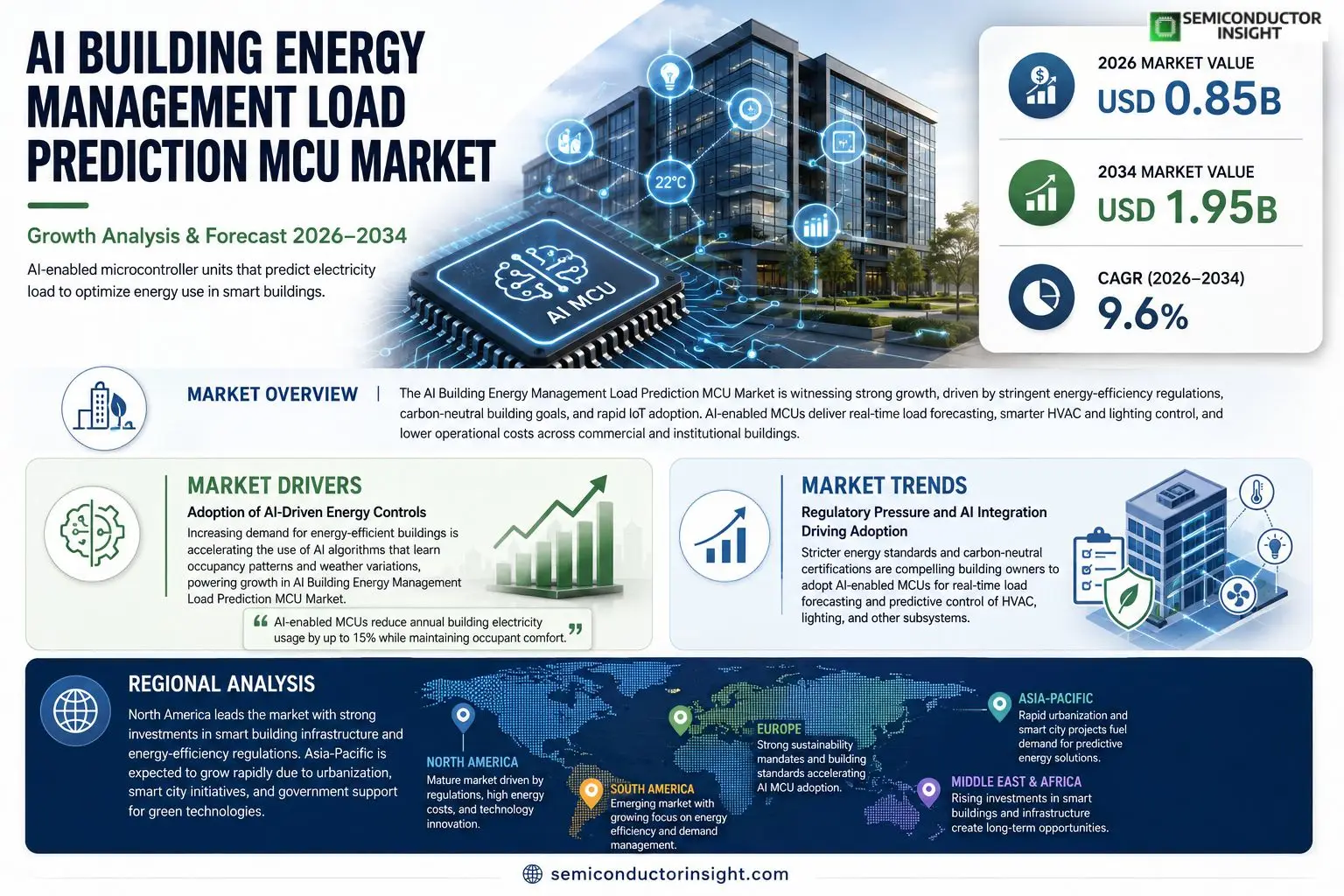
AI Building Energy Management Load Prediction MCU market size was valued at USD 0.85 billion in 2025. The market is projected to grow from USD 0.85 billion in 2025 to USD 1.95 billion by 2034, exhibiting a CAGR of 9.6 % during the forecast period.
AI Building Energy Management Load Prediction MCUs are specialized microcontroller units that embed lightweight artificial‑intelligence models for real‑time electricity‑load forecasting within smart‑building ecosystems. These devices combine sensor fusion, edge inference and low‑power processing to enable predictive control of HVAC, lighting and other subsystems while operating autonomously on limited energy budgets.The market is experiencing rapid growth because of stricter energy‑efficiency regulations worldwide, escalating demand for carbon‑neutral building certifications, and expanding deployment of Internet‑of‑Things sensors that feed rich datasets into predictive algorithms. Furthermore, manufacturers are accelerating integration of dedicated AI accelerators into MCUs, reducing latency and cost for end users. Key players such as Siemens AG, Schneider Electric and Texas Instruments are launching next‑generation families that support on‑device learning, thereby fueling adoption across commercial real‑estate portfolios.
MARKET DRIVERS
Adoption of AI‑Driven Energy Controls
The increasing demand for energy‑efficient buildings has accelerated the integration of AI algorithms that continuously learn occupancy patterns and weather variations. This trend directly fuels growth in AI Building Energy Management Load Prediction MCU Market as manufacturers embed predictive micro‑controllers in HVAC, lighting, and power distribution systems.
Regulatory Pressure for Sustainability
Stringent building codes and carbon‑reduction targets in major economies require real‑time load forecasting to optimize energy consumption. Companies that offer AI‑powered MCUs gain a competitive edge by helping clients meet compliance without over‑engineering hardware.
➤ “AI‑enabled MCUs reduce annual building electricity usage by up to 15 % while maintaining occupant comfort,”
In addition, the declining cost of semiconductor fabrication and the rise of edge‑AI platforms enable scalable deployment, making predictive load management a financially viable solution for both new constructions and retrofits.
MARKET CHALLENGES
Data Quality and Integration Issues
Accurate load prediction depends on high‑resolution sensor data and seamless integration with legacy building management systems. In many older facilities, inconsistent data streams hinder the effectiveness of AI models, posing a barrier to widespread adoption.
Other Challenges
Talent Gap in Embedded AI Development
The scarcity of engineers skilled in both low‑power MCU design and machine‑learning optimization slows product rollout, especially for bespoke solutions required in complex commercial properties.
MARKET RESTRAINTS
High Initial Capital Expenditure
While long‑term savings are evident, the upfront investment for AI‑enabled MCUs, including hardware upgrades and software licensing, can be prohibitive for small‑to‑mid‑size building owners, limiting market penetration in cost‑sensitive segments.
MARKET OPPORTUNITIES
Edge‑AI Expansion in Smart Cities
Urban development initiatives are increasingly incorporating smart‑grid compatible infrastructure. This creates a sizable opportunity for AI Building Energy Management Load Prediction MCU Market to supply edge‑processing units that enable real‑time demand response and grid‑balancing functions.
Growth in Renewable‑Integrated Buildings
As on‑site solar and storage become common, predictive MCUs are essential for harmonizing intermittent generation with load forecasts, positioning AI‑driven controllers as a cornerstone technology for future‑proofed, low‑carbon building portfolios.
AI Building Energy Management Load Prediction MCU Market Trends
Regulatory Pressure and AI Integration Driving Adoption
As governments tighten energy‑efficiency standards and introduce carbon‑neutral building certifications, AI Building Energy Management Load Prediction MCU Market is experiencing a clear acceleration. Mandates that require measurable reductions in electricity use are compelling owners to replace legacy control logic with predictive microcontroller units capable of forecasting load at sub‑hour intervals. The on‑device AI models analyse real‑time sensor inputs, allowing HVAC, lighting and auxiliary systems to be pre‑emptively adjusted before peak demand spikes. Early deployments in commercial office towers have demonstrated average energy savings of 10‑12 % versus static set‑point control, while maintaining indoor environmental quality. The combined effect of regulatory compliance and operational cost reduction is positioning AI‑enabled MCUs as essential components of next‑generation building management strategies.
Other Trends
IoT Sensor Proliferation Expands Data Foundations
The rapid diffusion of low‑cost IoT temperature, occupancy, ambient light and power meters is enriching the data environment that fuels edge AI inference. Dense sensor networks provide granular context, enabling load‑prediction algorithms to capture micro‑climate variations across large campuses. Studies from pilot projects show that increasing sensor density to one device per 250 m² can cut forecast error variance by roughly 30 %, translating into more precise demand‑response actions. This data‑rich ecosystem not only improves model accuracy but also shortens the time required to calibrate new deployments, making retrofits faster and less disruptive.
Edge AI Accelerators Reduce Latency and Power Consumption
Leading manufacturersincluding Siemens AG, Schneider Electric and Texas Instrumentshave introduced MCUs that embed dedicated AI accelerators. These specialized cores execute inference cycles in under 5 ms while consuming less than 200 mW, a performance envelope that supports battery‑powered or energy‑harvesting installations in legacy buildings lacking robust power rails. By lowering latency, accelerators enable real‑time corrective actions such as staggered compressor cycling in HVAC systems, which further trims peak demand. The low‑power profile also aligns with sustainability goals, as the controllers themselves add minimal overhead to overall building energy consumption. Market analysts anticipate that as accelerator integration becomes standard, the adoption curve will steepen, driving broader diffusion across commercial real‑estate portfolios.
COMPETITIVE LANDSCAPEKey Industry Players
AI Building Energy Management Load Prediction MCU Market Competitive Landscape
AI Building Energy Management Load Prediction MCU Market is currently dominated by a handful of large multinational semiconductor and systems firms that leverage extensive R&D budgets and deep integration capabilities. Siemens AG leads the sector by embedding AI‑enhanced MCUs into its digital building platform, coupling real‑time load forecasting with predictive HVAC control across commercial portfolios. Schneider Electric follows closely, offering its EcoStruxure‑compatible MCU families that incorporate on‑device learning modules for carbon‑neutral certification compliance. Texas Instruments (TI) capitalizes on its analog‑centric MCU expertise, delivering low‑power AI accelerators that enable edge inference while maintaining cost‑effectiveness for large‑scale deployments. These three incumbents shape market structure through tiered product lineups, strategic OEM partnerships, and aggressive roadmap announcements aimed at capturing both retrofit and new‑construction segments.Beyond the leading trio, a diverse set of niche players contributes specialized capabilities that enrich the competitive ecosystem. STMicroelectronics focuses on ultra‑low‑power AI MCUs targeting smart‑lighting and IoT sensor fusion, whereas NXP Semiconductors emphasizes secure edge computing for building automation. Infineon Technologies and Renesas Electronics provide robust automotive‑grade MCUs repurposed for high‑reliability building applications. Microchip Technology, Analog Devices, and ROHM Semiconductor deliver modular MCU platforms with flexible AI inference libraries, catering to regional system integrators. Emerging firms such as Samsung Electronics and Sony Semiconductor Solutions are entering the space with high‑density AI cores, intensifying innovation pressure across the value chain.
List of Key AI Building Energy Management Load Prediction MCU Companies Profiled
- Siemens AG
- Schneider Electric
- Texas Instruments
- STMicroelectronics
- NXP Semiconductors
- Infineon Technologies
- Renesas Electronics
- Microchip Technology
- Analog Devices
- ROHM Semiconductor
- Toshiba Electronic Devices
- Samsung Electronics
- Sony Semiconductor Solutions
- Cypress Semiconductor (Infineon)
- Renesas Electronics
Segment Analysis:
| Segment Category | Sub-Segments | Key Insights |
| By Type |
|
Edge‑AI Inference MCUs
|
| By Application |
|
HVAC Load Prediction
|
| By End User |
|
Facility Operations Engineers
|
| By Integration Architecture |
|
Distributed MCU Networks
|
| By Deployment Scale |
|
Enterprise‑Portfolio Rollouts
|
Regional Analysis: AI Building Energy Management Load Prediction MCU Market
North America
Strong policy incentives for energy‑efficient construction, coupled with escalating utility costs, push building owners to adopt AI‑driven load prediction MCUs. The convergence of IoT sensor data and edge AI further fuels demand for real‑time analytics.
Advances in low‑power AI accelerators, neuromorphic computing, and 5G connectivity enable MCUs to process complex load models locally, reducing latency and dependence on cloud services.
Updated building codes, such as the 2024 International Energy Conservation Code, mandate predictive energy management, prompting widespread integration of AI MCUs in new construction and retrofits.
Rapid growth in data‑center campuses and smart campuses presents a sizeable niche for AI load prediction MCUs, especially where demand response programs are actively pursued.
Europe
Europe’s market is characterized by a strong sustainability agenda, with the European Green Deal catalyzing adoption of AI‑enhanced building management. Nations such as Germany, France, and the Nordic countries lead pilot projects that embed MCUs into existing HVAC networks, enabling adaptive load shifting based on real‑time occupancy patterns. The region benefits from harmonized standards like EPBD, which encourage predictive analytics to meet stringent energy‑performance targets. Collaborative research initiatives across the EU foster open‑source AI frameworks, reducing entry barriers for smaller firms. While the market is less capital‑intensive than North America, the depth of regulatory support ensures steady growth in AI Building Energy Management solutions.
Asia‑Pacific
In Asia‑Pacific, rapid urbanization and rising commercial real‑estate stock create a fertile ground for AI Building Energy Management Load Prediction MCUs. Countries such as China, Japan, and Singapore are investing heavily in smart city infrastructures, integrating AI MCUs with building automation to optimize energy use in high‑rise office towers. Government subsidies for green technologies and aggressive carbon‑reduction commitments accelerate market penetration. However, fragmented standards and varying levels of technical expertise across the region pose integration challenges, prompting local players to form strategic alliances with AI chip manufacturers to accelerate deployment.
South America
South America’s adoption of AI‑driven energy management is emerging, driven by Brazil’s expanding commercial sector and Chile’s focus on renewable integration. The region faces infrastructure constraints, yet increasing access to cloud platforms and edge computing hardware is lowering adoption costs. Energy‑intensive industries are beginning to pilot AI MCUs to manage peak demand and align with utility demand‑response programs. Market growth is expected to be incremental but supported by regional initiatives aimed at improving building energy efficiency and reducing operational expenditures.
Middle East & Africa
The Middle East & Africa exhibit a nascent yet promising market for AI Building Energy Management Load Prediction MCUs, particularly in the Gulf Cooperation Council (GCC) states where iconic high‑rise developments demand sophisticated energy control. Investments in ultra‑efficient cooling solutions and smart grids are driving interest in AI‑enabled MCUs that can predict thermal loads under extreme climate conditions. In Africa, emerging commercial hubs are beginning to explore AI‑based energy solutions to mitigate unreliable grid supply. Despite economic variability, targeted government incentives and partnerships with multinational technology firms are laying the groundwork for future expansion.
Report Scope
This market research report provides a comprehensive analysis of the AI Building Energy Management Load Prediction MCU Market , covering the forecast period 2026–2034. It offers detailed insights into market dynamics, technological advancements, competitive landscape, and key trends shaping the industry.
Key focus areas of the report include:
- Market Overview: The report begins with an overview outlining its current market scenario, key growth indicators, and industry transformation drivers. It discusses macroeconomic factors, demand–supply balance, regulatory landscape, and the strategic role of semiconductors in powering advancements across industries such as automotive, telecommunications, consumer electronics, and industrial automation.
- Market Size & Forecast: Historical data and future projections for revenue, unit shipments, and market value across major regions and segments.
- Segmentation Analysis: Detailed breakdown by product type, technology, application, and end-user industry to identify high-growth segments and investment opportunities.
- Regional Insights: Insights into market performance across North America, Europe, Asia-Pacific, Latin America, and the Middle East & Africa, including country-level analysis where relevant.
- Competitive Landscape: Profiles of leading market participants, including their product offerings, R&D focus, manufacturing capacity, pricing strategies, and recent developments such as mergers, acquisitions, and partnerships.
- Technology Trends & Innovation: Assessment of emerging technologies, integration of AI/IoT, semiconductor design trends, fabrication techniques, and evolving industry standards.
- Market Drivers & Restraints: Evaluation of factors driving market growth along with challenges, supply chain constraints, regulatory issues, and market-entry barriers.
- Stakeholder Insights: Insights for component suppliers, OEMs, system integrators, investors, and policymakers regarding the evolving ecosystem and strategic opportunities.
Primary and secondary research methods are employed, including interviews with industry experts, data from verified sources, and real-time market intelligence to ensure the accuracy and reliability of the insights presented.
FREQUENTLY ASKED QUESTIONS:
What is the current market size of AI Building Energy Management Load Prediction MCU Market?
-> AI Building Energy Management Load Prediction MCU Market was valued at USD 0.85 billion in 2025 and is expected to reach USD 1.95 billion by 2034, representing a CAGR of 9.6 % during the forecast period.
Which key companies operate in AI Building Energy Management Load Prediction MCU Market?
-> Key players include Siemens AG, Schneider Electric, and Texas Instruments, among others.
What are the key growth drivers?
-> Key growth drivers include stricter energy‑efficiency regulations, rising demand for carbon‑neutral building certifications, expanding deployment of IoT sensors, and the integration of dedicated AI accelerators into MCUs.
Which region dominates the market?
-> The source does not specify a single dominant region; adoption is observed ly, with notable activity in North America, Europe, and Asia‑Pacific.
What are the emerging trends?
-> Emerging trends include on‑device learning capabilities, AI‑accelerated MCU architectures, and tighter integration of AI/IoT for predictive building energy management.

Get Sample Report PDF for Exclusive Insights
Report Sample Includes
- Table of Contents
- List of Tables & Figures
- Charts, Research Methodology, and more...
 Download Sample Report PDF