AI-Based Thermal Simulation for 3D-ICs Market Insights
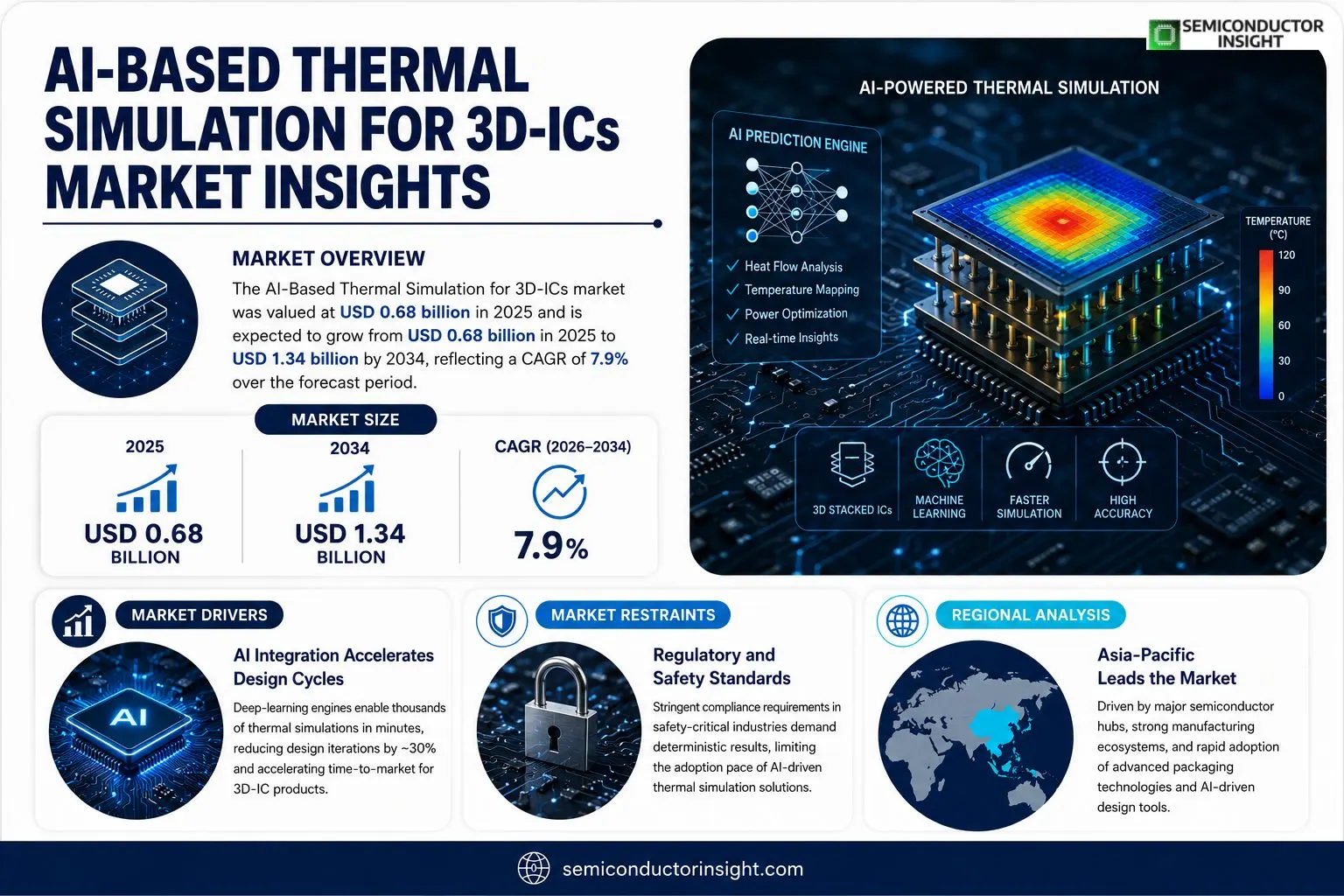
AI-Based Thermal Simulation for 3D‑ICs market size was valued at USD 0.68 billion in 2025. The market is expected to grow from USD 0.68 billion in 2025 to USD 1.34 billion by 2034, reflecting a CAGR of 7.9% over the forecast period.
AI‑based thermal simulation merges machine‑learning techniques with physics‑based heat transfer models to predict temperature gradients across stacked silicon layers within three‑dimensional integrated circuits (3D‑ICs). By delivering rapid yet accurate assessments of heat flow paths, these solutions allow designers to optimise floorplan density, material choices and cooling strategies before tape‑out.The sector is gaining momentum because semiconductor manufacturers confront rising power densities and ever tighter form‑factor limits that render traditional thermal analysis too slow or imprecise.Moreover, broader adoption of heterogeneous integration and chiplet architectures heightens demand for predictive thermal insight.Key vendors such as Synopsys, Cadence Design Systems and ANSYS are broadening their offerings through strategic acquisitions and partnerships that embed deep‑learning engines into established simulation suites.A notable development occurred in March 2024 when Cadence announced a collaboration with NVIDIA’s GPU‑accelerated AI platform, underscoring how ecosystem alliances accelerate solution deployment.
MARKET DRIVERS
AI Integration Accelerates Design Cycles
The emergence of deep‑learning inference engines has transformed how thermal behavior is predicted in stacked die architectures. Engineers can now run thousands of simulations in the time previously required for a single finite‑element analysis, cutting design iterations by roughly 30 % and delivering products to market faster. This efficiency gain is a primary catalyst for broader adoption of AI‑Based Thermal Simulation for 3D‑ICs Market solutions.
Cost Pressures Drive Predictive Accuracy
Manufacturers face tightening profit margins as wafer yields dip below 70 % on advanced nodes. By leveraging AI models trained on historical failure data, firms can pinpoint hotspot formation before silicon is fabricated, reducing rework costs by an estimated 15 %. The tangible financial upside reinforces investment in intelligent simulation platforms.
➤ “AI‑augmented thermal tools are reshaping the risk profile of 3D‑IC projects, turning what was once a speculative exercise into a data‑driven decision.”
Beyond pure economics, the capacity to simulate thermal interactions across heterogeneous layers enables new product categoriessuch as high‑performance compute modules for edge AIthat would have been prohibitive under legacy workflows. The strategic importance of maintaining thermal integrity while pushing power densities higher fuels continued growth in this niche.
MARKET CHALLENGES
Data Scarcity Limits Model Robustness
AI models rely on large, high‑quality datasets to learn complex heat‑transfer patterns. In many emerging process nodes, the quantity of recorded thermal events remains limited, which hampers model generalization and forces engineers to supplement AI predictions with conventional simulations.
Other Challenges
Talent Gap
Deploying and fine‑tuning AI‑based thermal solvers requires expertise that blends semiconductor physics with machine‑learning engineering. Companies often spend up to 20 % of project budgets on training or hiring specialists, creating a bottleneck for rapid rollout.
MARKET RESTRAINTS
Regulatory and Safety Standards
Thermal compliance in safety‑critical applicationsautomotive, aerospace, medicalremains governed by stringent certification regimes. Regulators often require deterministic simulation results, which can be difficult to reconcile with the probabilistic nature of AI outputs. This regulatory friction slows the pace at which AI‑Based Thermal Simulation for 3D‑ICs Market technologies can be fully trusted in high‑risk sectors.
MARKET OPPORTUNITIES
Edge AI and 5G Infrastructure
The confluence of edge‑computing demand and 5G rollout is generating dense, multi‑chip modules that operate under constrained thermal envelopes. AI‑enhanced simulation tools can deliver real‑time thermal forecasting, allowing system architects to implement dynamic power‑management schemes that preserve performance without over‑designing cooling hardware. This creates a fertile market segment for vendors that can integrate predictive thermal intelligence directly into electronic design automation (EDA) suites.
AI-Based Thermal Simulation for 3D-ICs Market Trends
Accelerating Design Validation through AI‑Enhanced Thermal Analysis
Design teams are turning to AI‑based thermal simulation to shorten the validation loop for stacked silicon architectures. By embedding machine‑learning estimators into physics‑driven heat‑transfer solvers, engineers obtain temperature maps within minutes rather than hours. This speed advantage permits iterative exploration of floor‑plan density, interconnect materials, and micro‑cooling concepts early in the schematic stage, reducing the risk of costly redesign after tape‑out. The shift reflects practical pressure from rising power densities that make conventional finite‑element approaches cumbersome for the multi‑layer heat paths typical of 3D‑ICs.
Other Trends
Strategic Alliances and Platform Integration
Leading EDA vendors have deepened collaborations with hardware‑accelerated AI providers to embed neural‑network inference directly into simulation kernels. A notable announcement in early 2024 detailed a joint effort between a major design‑software company and an AI‑hardware firm to fuse GPU‑level parallelism with thermal‑prediction models. Such partnerships accelerate time‑to‑market for new simulation releases and broaden the user base to include chiplet integrators who require fast feedback on heterogeneous stack temperatures.
Expansion of Heterogeneous Integration Use Cases
As chiplet‑based system‑in‑package solutions proliferate, the need for precise thermal insight across disparate die becomes more pronounced. AI‑based tools are being adapted to handle the varied thermal conductivities of mixed materialssilicon, silicon‑on‑insulator, and organic substrateswithin a single computational flow. This adaptability enables designers to assess cooling requirements for AI accelerators, high‑bandwidth memory, and power‑management ICs co‑located in compact footprints, thereby supporting the broader industry move toward modular, high‑performance packaging.
COMPETITIVE LANDSCAPE
Key Industry Players
AI‑Based Thermal Simulation for 3D‑ICs: Competitive Landscape
Synopsys anchors the upper tier of the market, leveraging its extensive portfolio of verification tools to embed deep‑learning thermal kernels within its custom IC Design Compiler. Cadence follows closely, bolstered by a 2024 alliance with NVIDIA that marries GPU‑accelerated inference with its Virtuoso suite, dramatically shortening iteration cycles for chiplet‑centric layouts. ANSYS, long‑standing in multiphysics, has converted its core solver into an AI‑enhanced engine, allowing designers to balance accuracy and speed without sacrificing fidelity. These three firms dominate revenue streams, control key IP blocks, and set pricing benchmarks that shape the purchasing decisions of large foundries and system integrators. Their strategic acquisitions of boutique AI startups have created a consolidation trend that narrows the competitive field while raising the entry barrier for newcomers.Beyond the major EDA houses, a constellation of niche specialists injects diversity into the ecosystem. Siemens EDA (formerly Mentor) offers a physics‑first thermal module that couples with its digital twin framework, appealing to manufacturers focused on predictive maintenance. Altair introduces hyper‑parameter‑tuned models within its HyperWorks environment, targeting automotive silicon that must meet strict thermal envelopes. COMSOL supplies a flexible multiphysics platform that enables custom AI adapters, attracting research‑heavy organizations. Smaller innovators such as ThermalIO, NanoSim, and QFlow deliver plug‑and‑play AI inference services that integrate via REST APIs, allowing agile startups to augment legacy flows without large capital outlays. The presence of these players pressures incumbents to continuously enhance usability and to open up licensing models, thereby expanding the overall addressable market.
List of Key AI-Based Thermal Simulation for 3D‑ICs Companies Profiled
- Synopsys
- Cadence Design Systems
- ANSYS
- Siemens EDA (Mentor)
- Altair Engineering
- COMSOL
- ThermalIO
- NanoSim Technologies
- QFlow
- ESI Group
- Dassault Systèmes (CST Studio Suite)
Segment Analysis:
| Segment Category | Sub-Segments | Key Insights |
| By Type |
|
Physics‑Based AI Hybrid emerges as the dominant approach because it preserves the rigor of physics‑based heat transfer equations while leveraging machine learning to accelerate convergence. • Designers appreciate the interpretability of hybrid models, enabling clear linkage between material properties and temperature distribution. • The synergy reduces iteration cycles, allowing rapid exploration of floorplan density and package materials without sacrificing predictive confidence. • Integration pathways with established EDA suites simplify adoption across design teams. |
| By Application |
|
Chiplet Integration drives the most compelling use‑case because thermal coupling between heterogeneous chiplets dictates system reliability. • AI‑enhanced simulation surfaces hot‑spot interactions early, guiding placement of high‑performance compute and memory blocks. • Designers can evaluate alternative interposer materials and micro‑bump configurations with immediate feedback. • The approach aligns with industry trends toward modular architectures, where rapid thermal validation shortens time‑to‑market. |
| By End User |
|
Semiconductor Foundries are the primary beneficiaries as they must validate thermal performance across multiple customers’ designs. • Foundry‑level AI simulation platforms embed predictive models into the design‑for‑manufacturability flow, reducing costly silicon re‑spins. • The ability to run high‑fidelity thermal checks in parallel with other verification steps improves overall fab yield. • Collaborative ecosystems with EDA vendors amplify the value proposition for foundry customers. |
| By Design Phase |
|
Early‑Stage Layout is critical because thermal considerations introduced at this point influence all downstream decisions. • AI‑driven predictive tools inform silicon stack height and interconnect density before physical implementation. • Early insights prevent costly redesigns by aligning thermal budgets with power‑delivery constraints. • The approach fosters a culture of thermal‑first design, improving overall system robustness. |
| By Deployment Model |
|
Cloud‑Based AI Services are gaining traction due to scalable compute resources and easy integration with collaborative design environments. • Teams can access the latest AI engines without upfront hardware investment, fostering rapid experimentation. • Continuous model updates from service providers keep simulation fidelity aligned with emerging process technologies. • Seamless API connectivity supports automated design loops across engineering sites. |
Regional Analysis: AI-Based Thermal Simulation for 3D-ICs Market
North America
The region’s firms embed deep‑learning inference engines directly into thermal solvers, shortening iteration cycles. Early adopters leverage cloud‑native AI services to scale simulation workloads, allowing design teams to explore more packaging variants without linear increases in compute cost.
Tight coupling between EDA vendors and AI startups creates a plug‑in architecture that lets engineers pull predictive heat maps into layout editors. This modular approach reduces friction when integrating new algorithms into legacy design flows.
Federal grants earmarked for advanced packaging and AI research encourage joint projects that focus on thermal reliability. State‑level incentives for chip fabs further reinforce the region’s position as a hub for high‑performance simulation tools.
Automotive and data‑center manufacturers demand tighter thermal budgets, pushing North American design houses to adopt AI‑enhanced simulation early. Their feedback drives roadmap decisions for tool providers, steepening the adoption curve across adjacent sectors.
Europe
European chip designers emphasize compliance with stringent environmental directives, which influences how AI‑Based Thermal Simulation for 3D‑ICs Market solutions are packaged. Collaborations between German engineering firms and French AI research laboratories yield simulation frameworks that prioritize energy efficiency alongside accuracy. The region’s fragmented market, with numerous mid‑size players, encourages the development of interoperable toolchains that can be customized for niche applications such as aerospace and medical devices. Moreover, EU funding mechanisms target sustainable manufacturing, prompting vendors to highlight the carbon‑reduction benefits of AI‑driven thermal optimization. These dynamics foster a nuanced adoption pattern where firms balance regulatory rigor with the need for rapid design turnover.
Asia‑Pacific
Asia‑Pacific benefits from a scale‑driven manufacturing base complemented by aggressive AI adoption strategies. Leading foundries in Taiwan and South Korea embed machine‑learning models into their thermal prediction pipelines to handle massive wafer volumes. At the same time, emerging Indian startups focus on low‑cost AI inference chips, offering affordable simulation services to regional design houses. Cultural emphasis on speed-to‑market drives continuous refinement of AI algorithms, often through open‑source contributions that accelerate community learning. The result is a market where technological depth coexists with cost‑sensitivity, shaping vendor roadmaps that prioritize both performance and affordability.
South America
South American participation remains nascent, yet local semiconductor assemblers are beginning to explore AI‑Based Thermal Simulation for 3D‑ICs Market tools to improve yield in modest‑scale production lines. Partnerships with North American research institutes provide access to advanced AI models, while regional universities develop proprietary thermal datasets reflective of tropical operating conditions. These initiatives are motivated by a desire to reduce dependence on imported design services and to cultivate a home‑grown talent pool capable of supporting future packaging innovations.
Middle East & Africa
In the Middle East & Africa, governmental programs aimed at diversifying economies away from hydrocarbons have earmarked resources for semiconductor design hubs. Pilot projects in the United Arab Emirates employ AI‑enhanced thermal simulation to validate high‑density interconnects for defense and renewable‑energy applications. African tech centers, though smaller, are leveraging cloud‑based AI platforms to access cutting‑edge simulation capabilities without heavy capital outlays. The overarching theme is a strategic push to build technical expertise that can feed into broader digital‑transformation goals across the region.
Report Scope
This market research report provides a comprehensive analysis of the AI-Based Thermal Simulation for 3D-ICs Market , covering the forecast period 2026–2034. It offers detailed insights into market dynamics, technological advancements, competitive landscape, and key trends shaping the industry.
Key focus areas of the report include:
- Market Overview: The report begins with an overview outlining its current market scenario, key growth indicators, and industry transformation drivers. It discusses macroeconomic factors, demand–supply balance, regulatory landscape, and the strategic role of semiconductors in powering advancements across industries such as automotive, telecommunications, consumer electronics, and industrial automation.
- Market Size & Forecast: Historical data and future projections for revenue, unit shipments, and market value across major regions and segments.
- Segmentation Analysis: Detailed breakdown by product type, technology, application, and end-user industry to identify high-growth segments and investment opportunities.
- Regional Insights: Insights into market performance across North America, Europe, Asia-Pacific, Latin America, and the Middle East & Africa, including country-level analysis where relevant.
- Competitive Landscape: Profiles of leading market participants, including their product offerings, R&D focus, manufacturing capacity, pricing strategies, and recent developments such as mergers, acquisitions, and partnerships.
- Technology Trends & Innovation: Assessment of emerging technologies, integration of AI/IoT, semiconductor design trends, fabrication techniques, and evolving industry standards.
- Market Drivers & Restraints: Evaluation of factors driving market growth along with challenges, supply chain constraints, regulatory issues, and market-entry barriers.
- Stakeholder Insights: Insights for component suppliers, OEMs, system integrators, investors, and policymakers regarding the evolving ecosystem and strategic opportunities.
Primary and secondary research methods are employed, including interviews with industry experts, data from verified sources, and real-time market intelligence to ensure the accuracy and reliability of the insights presented.
FREQUENTLY ASKED QUESTIONS:
What is the current market size of AI-Based Thermal Simulation for 3D-ICs Market?
-> AI-Based Thermal Simulation for 3D-ICs Market was valued at USD 0.68 billion in 2025 and is expected to reach USD 1.34 billion by 2034.
Which key companies operate in AI-Based Thermal Simulation for 3D-ICs Market?
-> Key players include Synopsys, Cadence Design Systems, ANSYS, among others.
What are the key growth drivers?
-> Key growth drivers include rising power densities in semiconductor devices, increased adoption of heterogeneous integration and chiplet architectures, and the need for faster, more accurate thermal analysis.
Which region dominates the market?
-> Asia-Pacific is a fast‑growing region due to major semiconductor manufacturing hubs, while North America remains a dominant market in terms of technology leadership.
What are the emerging trends?
-> Emerging trends include integration of AI‑driven predictive models with GPU acceleration, collaborations between EDA vendors and AI hardware providers, and advanced multi‑physics simulation platforms.
Get Sample Report PDF for Exclusive Insights
Report Sample Includes
- Table of Contents
- List of Tables & Figures
- Charts, Research Methodology, and more...
 Download Sample Report PDF