AI-Based Process Window Discovery and Optimization Software Market Insights
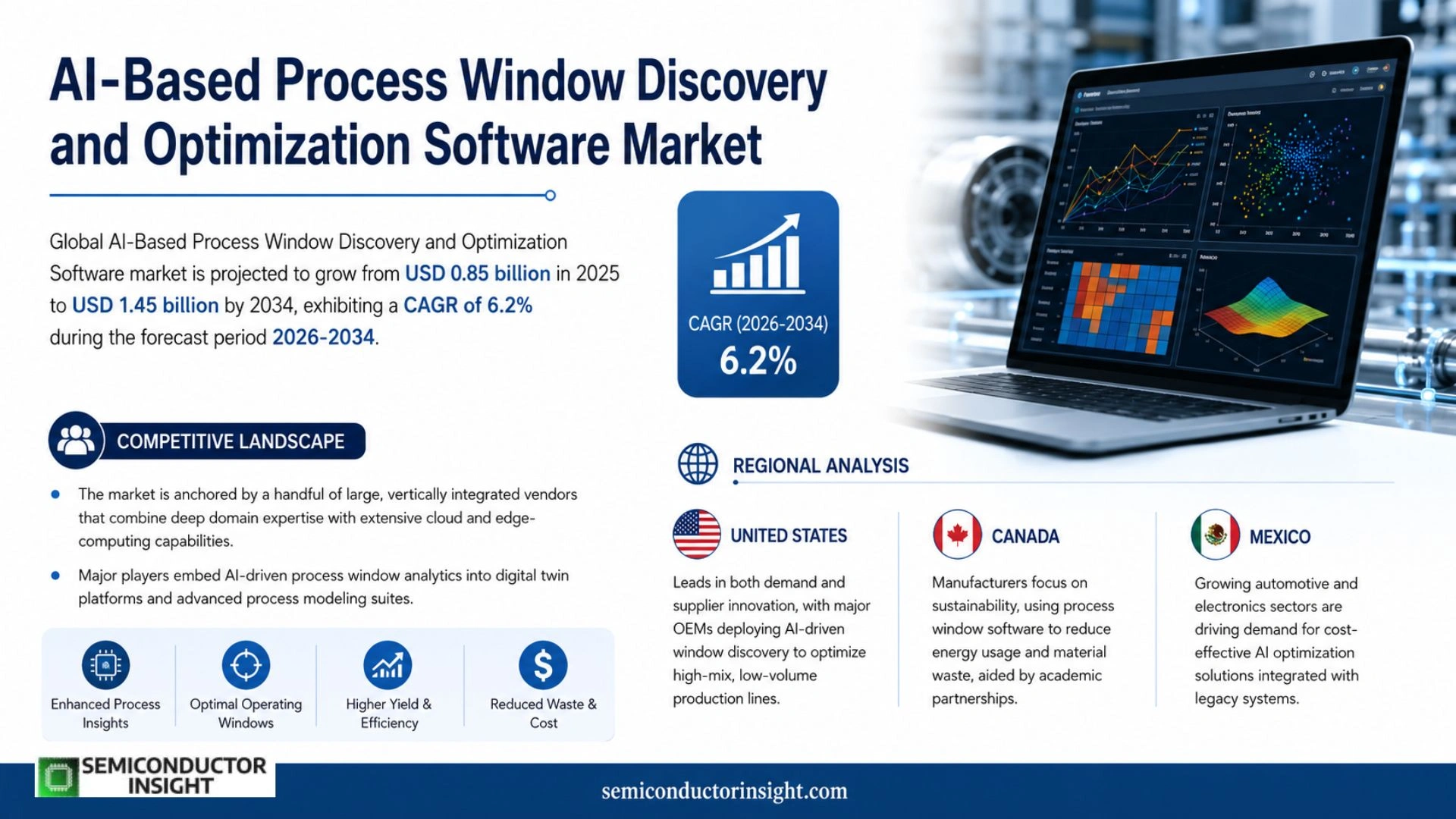
Global AI-Based Process Window Discovery and Optimization Software market size was valued at USD 0.85 billion in 2025. The market is projected to grow from USD 0.85 billion in 2025 to USD 1.45 billion by 2034, exhibiting a CAGR of 6.2% during the forecast period.
AI-Based Process Window Discovery and Optimization Software utilizes advanced machine‑learning models to analyze manufacturing data streams, identify optimal process windows, and recommend real‑time adjustments that maximize yield while minimizing waste. The solutions integrate statistical process control with predictive analytics, enabling operators to anticipate deviations before they impact production.
The market is accelerating because manufacturers are embracing Industry 4.0 initiatives and seeking higher efficiency across semiconductor, pharmaceutical, and chemical sectors.
Furthermore, rising demand for digital twins and the proliferation of IoT sensors are driving adoption of these intelligent platforms.
MARKET DRIVERS
Accelerating Digital Transformation in Manufacturing
AI-Based Process Window Discovery and Optimization Software Market is being propelled by manufacturers’ urgent need to digitize production lines. Companies are adopting AI solutions to collect real‑time sensor data, enabling predictive adjustments that keep processes within optimal windows while minimizing downtime.
Advanced AI Algorithms for Yield Improvement
Next‑generation machine‑learning models now incorporate multi‑objective optimization, allowing users to balance throughput, quality, and energy consumption simultaneously. This capability delivers measurable gains in product yield, which drives further investment in the software ecosystem.
➤ AI‑driven process window discovery reduces cycle time by up to 30 % in high‑mix production environments.
Regulatory pressure for traceability and sustainability also reinforces adoption, as AI platforms can automatically log process parameters and flag deviations that impact environmental compliance.
MARKET CHALLENGES
Integration Complexity with Legacy Systems
Many plants still rely on proprietary control architectures that lack standard interfaces. Connecting these legacy devices to modern AI engines requires custom middleware, which elevates project costs and extends deployment timelines.
Other Challenges
Data Quality and Labeling
Accurate model training depends on high‑quality historical data. Inconsistent labeling or missing sensor streams can degrade algorithm performance, leading to sub‑optimal window recommendations.
MARKET RESTRAINTS
High Initial Capital Expenditure
Implementing AI‑based discovery platforms often requires substantial upfront investment in sensors, edge computing hardware, and software licenses. Small‑to‑mid‑size manufacturers may postpone adoption until clear ROI metrics are demonstrated.
Additionally, the scarcity of skilled data‑science professionals in the manufacturing sector limits the ability of firms to fine‑tune algorithms internally, creating reliance on external consultants and increasing overall project costs.
MARKET OPPORTUNITIES
Expansion into Emerging Industries
Beyond traditional semiconductor and automotive production, sectors such as pharmaceuticals, renewable energy, and advanced composites are beginning to explore AI‑driven process window optimization. Their stringent quality standards open new revenue streams for solution providers.
Cloud‑native deployment models further accelerate market penetration by lowering the barrier to entry; companies can subscribe to scalable AI services without the need for extensive on‑premise infrastructure.
Strategic partnerships between AI vendors and equipment manufacturers promise integrated, turn‑key offerings that simplify implementation and shorten time‑to‑value for end users.
AI-Based Process Window Discovery and Optimization Software Market Trends
Adoption Accelerates with Industry 4.0 Integration
AI-Based Process Window Discovery and Optimization Software Market is experiencing a clear shift toward broader enterprise adoption. Valued at USD 0.85 billion in 2025, the market is projected to reach USD 1.45 billion by 2034, reflecting a compound annual growth of roughly 6 percent. This trajectory is driven primarily by manufacturers in the semiconductor, pharmaceutical and chemical sectors that are embedding advanced analytics into their production lines. The software’s ability to fuse statistical process control with predictive modeling enables real‑time adjustments that raise yield while curbing waste. The proliferation of IoT sensors and the rise of digital twin initiatives further reinforce the value proposition, allowing operators to simulate process variations before they occur. As a result, enterprises are allocating larger portions of their digital transformation budgets to these platforms, accelerating deployment cycles across global facilities.
Other Trends
Digital Twin and IoT Synergy
One of the most tangible trends is the convergence of digital twin environments with AI‑driven window discovery tools. By ingesting high‑frequency sensor data, the software constructs dynamic process simulations that mirror physical equipment. This capability lets manufacturers test parameter changes virtually, reducing trial‑and‑error on the shop floor. The synergy also supports predictive maintenance, as early signs of drift are flagged before they translate into quality loss. Companies such as Siemens Digital Industries Software and Aspen Technology have introduced integrated suites that couple digital twin models with optimization algorithms, delivering a single pane of glass for process engineers. The result is a measurable reduction in cycle time and an improvement in overall equipment effectiveness.
Strategic Partnerships Expand Platform Capabilities
Major suppliers are reinforcing their market position through collaborations that broaden functionality and cloud accessibility. Honeywell Forge and Dassault Systèmes, for instance, have announced joint ventures focused on cloud‑native deployment, enabling rapid scaling across multinational operations. These alliances facilitate the inclusion of pre‑built industry templates, shortening implementation timelines and lowering the skill barrier for end users. Moreover, the emergence of SaaS licensing models provides flexible consumption options, allowing smaller firms to benefit from the same advanced analytics without heavy upfront investment. As these strategic moves mature, AI-Based Process Window Discovery and Optimization Software Market is poised to deliver increasingly granular insights, fostering a new era of data‑driven manufacturing excellence.
COMPETITIVE LANDSCAPE
Key Industry Players
Global AI-Based Process Window Discovery and Optimization Software Market Competitive Overview
The market is anchored by a handful of large, vertically integrated vendors that combine deep domain expertise with extensive cloud and edge‑computing capabilities. Siemens Digital Industries Software leverages its broader Digital Twin portfolio to embed process‑window analytics into factory‑floor orchestration tools, while Aspen Technology’s Aspen Mtell and Aspen Process Analyst suites provide high‑resolution predictive models for semiconductor and chemical processes. Honeywell Forge integrates real‑time sensor fusion with advanced control loops, positioning it as a preferred supplier for high‑volume manufacturers seeking end‑to‑end optimization. Dassault Systèmes extends its 3DEXPERIENCE platform to include AI‑driven window discovery, allowing customers to simulate process variations before physical trials. Collectively, these leaders account for the majority of the projected USD 1.45 billion market in 2034 and drive the 6.2 % CAGR through recurring SaaS subscriptions, strategic OEM partnerships, and aggressive R&D investment.
Beyond the core quartet, a diverse set of niche innovators is expanding the competitive frontier. Schneider Electric’s EcoStruxure Analytics delivers modular, plug‑and‑play modules for pharma and specialty chemicals, emphasizing ease of integration. Rockwell Automation’s FactoryTalk Analytics focuses on discrete‑manufacturing environments, while Accenture’s Applied Intelligence practice offers consulting‑driven implementations that tailor generic AI models to individual process constraints. Emerging specialists such as KLA Corporation, PTC, and IBM Watson IoT provide highly specialized image‑processing or asset‑management capabilities that complement broader platforms. These companies differentiate through industry‑specific algorithms, tighter integration with existing PLC ecosystems, or bespoke cloud‑native services, enriching the overall value chain and creating opportunities for strategic alliances.
List of Key AI-Based Process Window Discovery and Optimization Software Companies Profiled
- Siemens Digital Industries Software
- Aspen Technology
- Honeywell Forge
- Dassault Systèmes
- Schneider Electric
- Rockwell Automation
- Accenture Applied Intelligence
- KLA Corporation
- PTC
- IBM Watson IoT
- Microsoft Azure Manufacturing Insights
- Honeywell Process Solutions
Segment Analysis:
| Segment Category | Sub-Segments | Key Insights |
| By Type |
|
Hybrid Approaches
|
| By Application |
|
Semiconductor Manufacturing
|
| By End User |
|
Large‑Scale Manufacturers
|
| By Industry |
|
Pharmaceutical
|
| By Deployment Model |
|
Hybrid
|
Regional Analysis: AI-Based Process Window Discovery and Optimization Software Market
The United States leads in both demand and supplier innovation, with major OEMs deploying AI‑driven window discovery to optimize high‑mix, low‑volume production lines. Emphasis on data‑centric culture and sizeable investment in cloud infrastructure supports rapid scaling of optimization platforms across multiple sectors.
Canadian manufacturers prioritize sustainability, using process window software to lower energy consumption and material waste. Partnerships with academic institutes accelerate algorithmic advances, particularly in aerospace and medical device manufacturing.
Mexico’s growing automotive and electronics supply chain creates demand for cost‑effective optimization tools. Local firms are increasingly integrating AI solutions with legacy control systems to improve yield without extensive capital outlays.
Strong emphasis on digital transformation, availability of high‑quality process data, and a competitive vendor landscape drive adoption. Tightening environmental regulations also compel manufacturers to seek efficient, AI‑enabled production windows.
Europe
Europe exhibits a balanced growth trajectory, with German and French manufacturers leading pilot deployments of AI‑based window discovery. The region’s focus on energy efficiency and compliance with stringent EU standards encourages firms to adopt optimization software that can demonstrably reduce emissions. Collaborative research programs, often funded by the European Union, foster cross‑border innovation, especially in the chemicals and pharmaceutical sectors. Although budget constraints slow full‑scale rollouts, a strong emphasis on data privacy and cybersecurity shapes solution design, ensuring that AI models respect GDPR requirements while delivering performance gains.
Asia‑Pacific
The Asia‑Pacific market is characterized by rapid industrial expansion and a strong appetite for cost‑reduction technologies. Chinese and Indian manufacturers are integrating AI‑driven process window tools to manage large‑scale batch processes, targeting higher yields in petrochemicals and textiles. Japan’s advanced robotics sector adds a layer of precision, using optimization software to synchronize machine parameters with AI insights. While talent gaps pose challenges, regional universities and tech hubs are producing a steady pipeline of data scientists, accelerating adoption across both established and emerging economies.
South America
In South America, Brazil and Argentina lead the adoption curve, driven primarily by the need to enhance competitiveness in commodity‑intensive industries. Companies are leveraging AI‑based optimization to improve batch consistency in food processing and biofuels, where slight variations can impact product quality. Economic volatility tempers large‑scale investments, prompting firms to opt for modular, subscription‑based solutions that offer quick ROI. Growing awareness of sustainability also motivates manufacturers to adopt technology that minimizes waste and energy usage.
Middle East & Africa
The Middle East & Africa region shows selective uptake, with oil‑and‑gas operators in the Gulf adopting AI window discovery to maximize refinery throughput and reduce downtime. In Africa, South Africa’s aerospace and mining sectors are early adopters, seeking to balance high operational costs with efficiency gains. Limited digital infrastructure in several markets slows broader diffusion, yet strategic partnerships with global vendors and targeted government initiatives are laying the groundwork for future expansion.
Report Scope
This market research report provides a comprehensive analysis of the AI-Based Process Window Discovery and Optimization Software Market , covering the forecast period 2026–2034. It offers detailed insights into market dynamics, technological advancements, competitive landscape, and key trends shaping the industry.
Key focus areas of the report include:
- Market Overview: The report begins with an overview outlining its current market scenario, key growth indicators, and industry transformation drivers. It discusses macroeconomic factors, demand–supply balance, regulatory landscape, and the strategic role of semiconductors in powering advancements across industries such as automotive, telecommunications, consumer electronics, and industrial automation.
- Market Size & Forecast: Historical data and future projections for revenue, unit shipments, and market value across major regions and segments.
- Segmentation Analysis: Detailed breakdown by product type, technology, application, and end-user industry to identify high-growth segments and investment opportunities.
- Regional Insights: Insights into market performance across North America, Europe, Asia-Pacific, Latin America, and the Middle East & Africa, including country-level analysis where relevant.
- Competitive Landscape: Profiles of leading market participants, including their product offerings, R&D focus, manufacturing capacity, pricing strategies, and recent developments such as mergers, acquisitions, and partnerships.
- Technology Trends & Innovation: Assessment of emerging technologies, integration of AI/IoT, semiconductor design trends, fabrication techniques, and evolving industry standards.
- Market Drivers & Restraints: Evaluation of factors driving market growth along with challenges, supply chain constraints, regulatory issues, and market-entry barriers.
- Stakeholder Insights: Insights for component suppliers, OEMs, system integrators, investors, and policymakers regarding the evolving ecosystem and strategic opportunities.
Primary and secondary research methods are employed, including interviews with industry experts, data from verified sources, and real-time market intelligence to ensure the accuracy and reliability of the insights presented.
FREQUENTLY ASKED QUESTIONS:
What is the current market size of AI-Based Process Window Discovery and Optimization Software Market?
-> AI-Based Process Window Discovery and Optimization Software market is projected to grow from USD 0.85 billion in 2025 to USD 1.45 billion by 2034.
Which key companies operate in AI-Based Process Window Discovery and Optimization Software Market?
-> Key players include Siemens Digital Industries Software, Aspen Technology, Honeywell Forge, and Dassault Systèmes.
What are the key growth drivers?
-> Key growth drivers include adoption of Industry 4.0 initiatives, demand for digital twins, proliferation of IoT sensors, and the need for higher efficiency in semiconductor, pharmaceutical, and chemical manufacturing.
Which region dominates the market?
-> North America shows strong adoption due to advanced manufacturing ecosystems, while Europe and Asia‑Pacific are also notable markets.
What are the emerging trends?
-> Emerging trends include integration of AI‑driven predictive analytics with digital‑twin platforms, cloud‑based service models, and enhanced real‑time process control through edge computing.
Get Sample Report PDF for Exclusive Insights
Report Sample Includes
- Table of Contents
- List of Tables & Figures
- Charts, Research Methodology, and more...
 Download Sample Report PDF