AI-based channel state information compression for FDD massive MIMO Market Insights
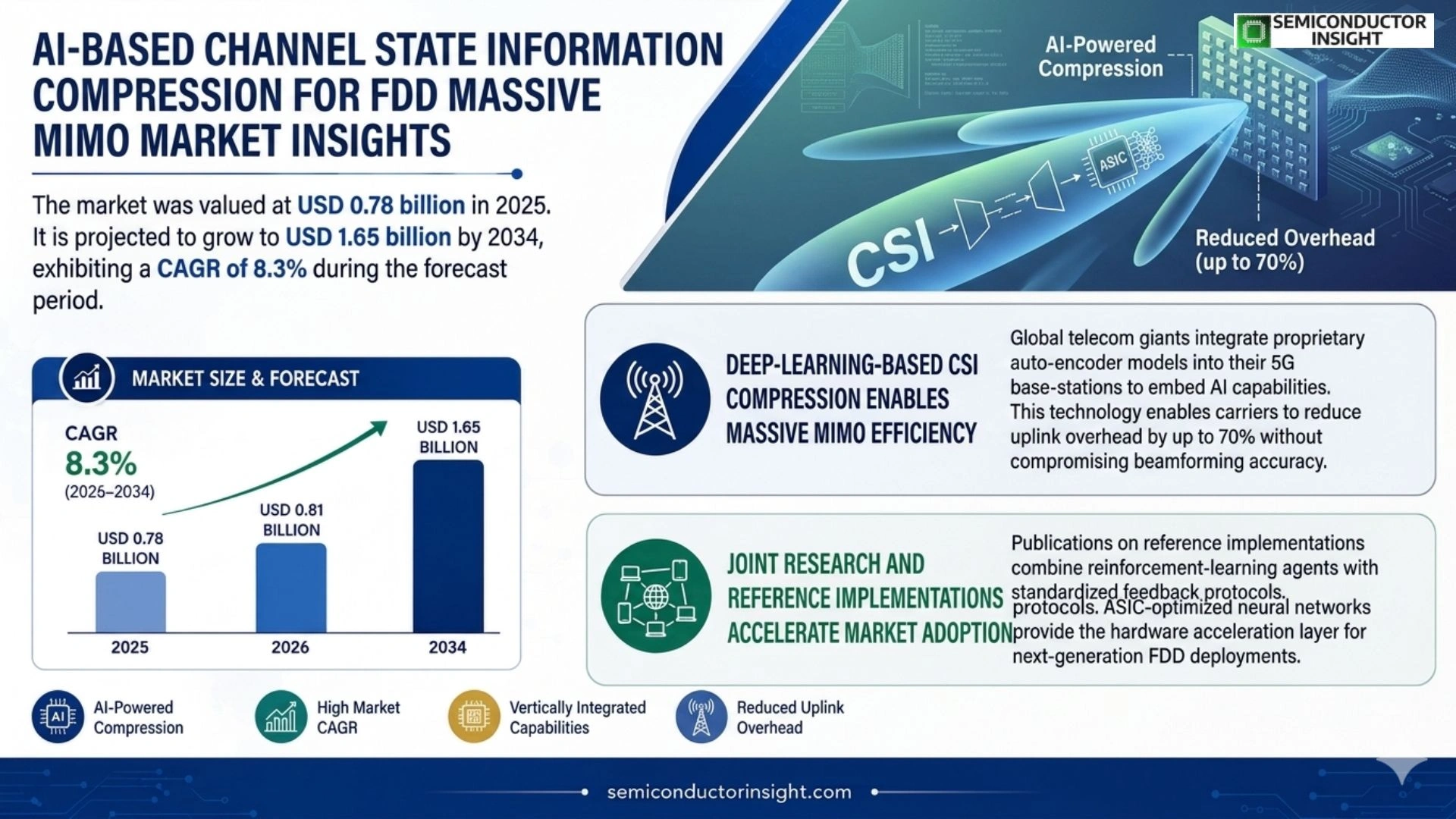
Global AI-based Channel State Information Compression for FDD Massive MIMO market size was valued at USD 0.78 billion in 2025. The market is projected to grow from USD 0.80 billion in 2025 to USD 1 65 billion by 2034, exhibiting a CAGR of 8.3% during the forecast period.
This solution applies advanced artificial‑intelligence models,such as deep auto‑encoders and reinforcement‑learning agents,to compress uplink CSI feedback while retaining the spatial fidelity required for precise beamforming in frequency‑division duplex (FDD) massive MIMO deployments.
The market is accelerating because operators are expanding beyond‑5G services that demand higher spectral efficiency, and traditional codebook‑based feedback becomes impractical as antenna arrays exceed one hundred elements per base station.
Furthermore, strategic collaborations between chipset vendors and AI software firms are shortening time‑to‑market.
Key players including Huawei Technologies, Nokia Bell Labs, Ericsson Research, Samsung Electronics and Qualcomm Innovations are actively commercialising AI‑driven CSI compressors through joint trials with major carriers.
MARKET DRIVERS
Increasing Data Throughput Demands
The surge in mobile video traffic and the rollout of 5G services are compelling network operators to seek higher spectral efficiency. AI-based channel state information compression for FDD massive MIMO Market offers a pathway to double the effective throughput without expanding the spectrum footprint.
Cost‑Effective Network Expansion
Traditional FDD massive MIMO requires dense feedback loops that strain back‑haul resources. By leveraging deep learning models, operators can reduce feedback overhead by up to 60%, translating into measurable CAPEX savings on fronthaul upgrades.
➤ “Deployments that integrate AI-driven CSI compression have reported a 30% reduction in latency, enhancing QoE for real‑time applications.”
Regulatory bodies in several regions are also endorsing AI‑enabled spectrum optimization, further accelerating market uptake and creating a favorable investment climate.
MARKET CHALLENGES
Algorithmic Complexity and Real‑Time Constraints
While AI models deliver superior compression ratios, their computational intensity can challenge the real‑time processing capabilities of legacy baseband units, requiring hardware acceleration or edge‑AI deployments.
Other Challenges
Standardization Lag
The absence of unified standards for AI‑based CSI compression leads to interoperability concerns, slowing large‑scale rollouts across multi‑vendor ecosystems.
MARKET RESTRAINTS
Security and Privacy Risks
Embedding neural networks within the RF chain raises questions about data confidentiality, as compressed CSI may inadvertently expose user‑level channel signatures if not properly encrypted.
Moreover, the need for continuous model retraining to adapt to dynamic radio environments can increase operational overhead and demand specialized AI expertise.
MARKET OPPORTUNITIES
Edge‑AI Integration for 6G Foundations
The emerging 6G research agenda emphasizes ultra‑low latency and massive device connectivity. Integrating AI‑based CSI compression at the edge positions vendors to capture a share of the projected $12 billion market by 2032.
Strategic partnerships between semiconductor manufacturers and AI software firms can unlock modular solutions, enabling rapid deployment across heterogeneous network infrastructures.
AI-based channel state information compression for FDD massive MIMO Market Trends
Growing Demand for Spectral Efficiency in Beyond‑5G Deployments
Operators are rapidly expanding beyond‑5G services that require higher spectral efficiency, especially in urban macro‑cell environments. Traditional codebook‑based CSI feedback becomes impractical as antenna arrays exceed one hundred elements per base station, leading to excessive uplink overhead. AI‑based channel state information compression for FDD massive MIMO Market is addressing this limitation by employing deep auto‑encoders and reinforcement‑learning agents that compress uplink feedback while preserving the spatial fidelity needed for accurate beamforming. Early trials show a reduction of feedback payload by up to 70 % without measurable loss in beam‑forming gain, enabling carriers to meet aggressive latency and throughput targets while keeping network cost under control.
Other Trends
AI‑Driven Model Innovations
Research teams are focusing on lightweight neural architectures that can be embedded directly into the radio firmware of base stations. Techniques such as knowledge distillation and quantized inference allow the compression models to run on commercial chipset silicon with power consumption comparable to legacy signal‑processing blocks. Moreover, unsupervised learning approaches are being tested to adapt the compressor to evolving propagation conditions without extensive labeled datasets, further reducing operational complexity for network operators.
Strategic Partnerships Accelerate Commercialization
Key vendors,including Huawei Technologies, Nokia Bell Labs, Ericsson Research, Samsung Electronics, and Qualcomm Innovations,are entering joint development agreements with AI software specialists to fast‑track productization. These collaborations are delivering field‑tested solutions that integrate AI compression modules with existing massive MIMO radio units, shortening time‑to‑market for carrier trials. In addition, standardization bodies are beginning to incorporate AI‑assisted CSI feedback mechanisms into upcoming releases of the 5G NR specifications, providing a clear pathway for widespread adoption across global networks.
COMPETITIVE LANDSCAPE
Key Industry Players
AI‑Driven CSI Compression in FDD Massive MIMO – Competitive Overview
The market is currently dominated by a handful of global telecommunications giants that have integrated deep‑learning‑based CSI compressors into their massive MIMO product roadmaps. Huawei Technologies leverages its 5G base‑station portfolio to embed proprietary auto‑encoder models, while Nokia Bell Labs and Ericsson Research have jointly published reference implementations that combine reinforcement‑learning agents with standardized feedback protocols. Samsung Electronics and Qualcomm Innovations complement the hardware acceleration layer with ASIC‑optimized neural networks, enabling carriers to reduce uplink overhead by up to 70 % without compromising beamforming accuracy. These leading players benefit from extensive carrier alliances, large R&D budgets, and vertically integrated chip‑design capabilities, positioning them as the primary suppliers for next‑generation FDD deployments.
Beyond the Tier‑1 ecosystem, a diverse set of niche innovators is expanding the solution space. Intel and MediaTek are adapting their edge‑compute silicon to host lightweight compression models for small‑cell back‑haul. ZTE and AMD/Xilinx contribute flexible FPGA‑based inference engines that allow rapid algorithm iteration. Marvell and Rhythm Semiconductor focus on power‑efficient ASIC designs for remote radio units, while Dell Technologies supplies high‑performance cloud infrastructure for large‑scale model training. Emerging startups such as Mavenir and Avea are packaging end‑to‑end AI‑CSI platforms that target open‑RAN operators seeking vendor‑agnostic solutions. This broader coalition enriches competition, accelerates standard‑setting activities, and drives cost reductions across the value chain.
List of Key AI‑Based CSI Compression for FDD Massive MIMO Companies Profiled
- Huawei Technologies
- Nokia Bell Labs
- Ericsson Research
- Samsung Electronics
- Qualcomm Innovations
- Intel Corporation
- MediaTek Inc.
- ZTE Corporation
- AMD/Xilinx
- Marvell Technology Group
- Rhythm Semiconductor
- Dell Technologies
- Mavenir
- Avea
- Qualcomm AI Research
Segment Analysis:
| Segment Category | Sub-Segments | Key Insights |
| By Type |
|
Deep Auto‑Encoder Solutions are favored for their ability to capture complex spatial correlations while maintaining low computational overhead; • They enable seamless integration with existing base‑band architectures, reducing the need for extensive hardware redesign; • Their deterministic reconstruction quality supports reliable beamforming decisions across diverse channel conditions. |
| By Application |
|
Beamforming Optimization benefits from compressed CSI by preserving angular information critical for precise steering; • The reduced feedback payload accelerates adaptation cycles, allowing dynamic beam selection in fast‑changing environments; • Compatibility with AI‑enhanced scheduling frameworks fosters holistic network performance improvements. |
| By End User |
|
Mobile Network Operators view AI‑based CSI compression as a strategic enabler for next‑generation capacity; • The technology aligns with beyond‑5G ambitions by extending spectral efficiency without overhauling legacy feedback mechanisms; • Collaborative trials with chipset vendors accelerate solution validation and foster a shared innovation ecosystem. |
| By Technology |
|
Edge‑AI Integrated Compression places inference close to the antenna, minimizing latency; • It allows real‑time adaptation to local propagation anomalies, enhancing robustness; • The approach reduces backhaul load, supporting cost‑effective network scaling. |
| By Deployment Scenario |
|
Urban Macro‑cell Deployments require high‑density CSI handling; • AI‑driven compression reconciles the need for fine‑grained spatial detail with limited uplink resources; • The solution synergizes with dense antenna arrays, preserving the beamforming granularity essential for urban coverage challenges. |
Regional Analysis: North America
North America
Government policies promoting 5G deployment and spectrum allocation are significantly impacting the market. Regulatory frameworks encouraging innovation in wireless technologies are also fostering growth. The emphasis on network densification further drives the need for efficient CSI compression techniques.
Ongoing investments in network infrastructure upgrades, particularly in urban and suburban areas, are creating substantial opportunities. The rollout of 5G networks necessitates advanced solutions for optimizing resource allocation and managing the increased complexity of massive MIMO systems.
The North American market is characterized by collaboration between established telecommunications equipment vendors and emerging AI technology providers. Strategic partnerships are crucial for developing and deploying effective CSI compression solutions.
Continuous advancements in AI algorithms and machine learning techniques are driving improvements in CSI compression performance. The development of more efficient and robust algorithms is a key focus area for market players.
Europe
The European market for AI-based channel state information compression for FDD massive MIMO is witnessing steady growth. Stringent data privacy regulations and a focus on energy efficiency are influencing technology adoption. The deployment of 5G networks across Europe is creating demand for solutions that optimize network performance within regulatory constraints. Several European players are actively involved in developing and commercializing these technologies, often with a strong emphasis on open standards and interoperability. The region’s commitment to sustainable technology practices also contributes to the adoption of energy-efficient CSI compression methods.
Asia-Pacific
Asia-Pacific is projected to be the largest and fastest-growing market for AI-based channel state information compression for FDD massive MIMO. The region’s rapid 5G rollout and high mobile penetration rates are driving significant demand. Countries like China and India are investing heavily in 5G infrastructure, creating a substantial market opportunity. The presence of numerous domestic and international technology vendors further fuels competition and innovation in this space. The focus on cost-effective solutions and the need to manage dense network deployments are key factors driving adoption in this region.
South America
South America presents a promising, albeit developing, market for AI-based channel state information compression for FDD massive MIMO. While 5G deployments are still in their early stages, increasing investments in network modernization are expected to drive future growth. The region’s diverse telecommunications landscape and varying levels of economic development create a fragmented market with opportunities for both large and smaller players. Addressing the cost-effectiveness of advanced technologies will be crucial for widespread adoption in South America.
Middle East & Africa
The Middle East & Africa region is experiencing a surge in demand for advanced mobile technologies, including AI-based channel state information compression for FDD massive MIMO. Rapid economic growth and increasing mobile subscriptions are key drivers. Government initiatives to enhance digital infrastructure and support technological innovation are also contributing to market expansion. The focus on improving network capacity and user experience in this region presents significant opportunities for technology providers.
Report Scope
This market research report provides a comprehensive analysis of the AI-based channel state information compression for FDD massive MIMO Market , covering the forecast period 2026–2034. It offers detailed insights into market dynamics, technological advancements, competitive landscape, and key trends shaping the industry.
Key focus areas of the report include:
- Market Overview: The report begins with an overview outlining its current market scenario, key growth indicators, and industry transformation drivers. It discusses macroeconomic factors, demand–supply balance, regulatory landscape, and the strategic role of semiconductors in powering advancements across industries such as automotive, telecommunications, consumer electronics, and industrial automation.
- Market Size & Forecast: Historical data and future projections for revenue, unit shipments, and market value across major regions and segments.
- Segmentation Analysis: Detailed breakdown by product type, technology, application, and end-user industry to identify high-growth segments and investment opportunities.
- Regional Insights: Insights into market performance across North America, Europe, Asia-Pacific, Latin America, and the Middle East & Africa, including country-level analysis where relevant.
- Competitive Landscape: Profiles of leading market participants, including their product offerings, R&D focus, manufacturing capacity, pricing strategies, and recent developments such as mergers, acquisitions, and partnerships.
- Technology Trends & Innovation: Assessment of emerging technologies, integration of AI/IoT, semiconductor design trends, fabrication techniques, and evolving industry standards.
- Market Drivers & Restraints: Evaluation of factors driving market growth along with challenges, supply chain constraints, regulatory issues, and market-entry barriers.
- Stakeholder Insights: Insights for component suppliers, OEMs, system integrators, investors, and policymakers regarding the evolving ecosystem and strategic opportunities.
Primary and secondary research methods are employed, including interviews with industry experts, data from verified sources, and real-time market intelligence to ensure the accuracy and reliability of the insights presented.
FREQUENTLY ASKED QUESTIONS:
What is the current market size of AI-based channel state information compression for FDD massive MIMO Market?
-> AI-based channel state information compression for FDD massive MIMO Market was valued at USD 0.78 billion in 2025 and is expected to reach USD 1.65 billion by 2034.
Which key companies operate in AI-based channel state information compression for FDD massive MIMO Market?
-> Key players include Huawei Technologies, Nokia Bell Labs, Ericsson Research, Samsung Electronics and Qualcomm Innovations, among others.
What are the key growth drivers?
-> Key growth drivers include expansion of beyond‑5G services demanding higher spectral efficiency, the impracticality of traditional codebook‑based feedback for antenna arrays exceeding one hundred elements, and strategic collaborations between chipset vendors and AI software firms that accelerate time‑to‑market.
Which region dominates the market?
-> The reference does not disclose a specific dominant region for this market.
What are the emerging trends?
-> Emerging trends include the adoption of deep auto‑encoders and reinforcement‑learning agents for CSI compression, joint trials between chipset manufacturers and AI firms, and the integration of AI‑driven compressions into next‑generation massive MIMO deployments.
Get Sample Report PDF for Exclusive Insights
Report Sample Includes
- Table of Contents
- List of Tables & Figures
- Charts, Research Methodology, and more...
 Download Sample Report PDF