
AI-Assisted Post-CMP Clean Chemistry Optimization Market Insights
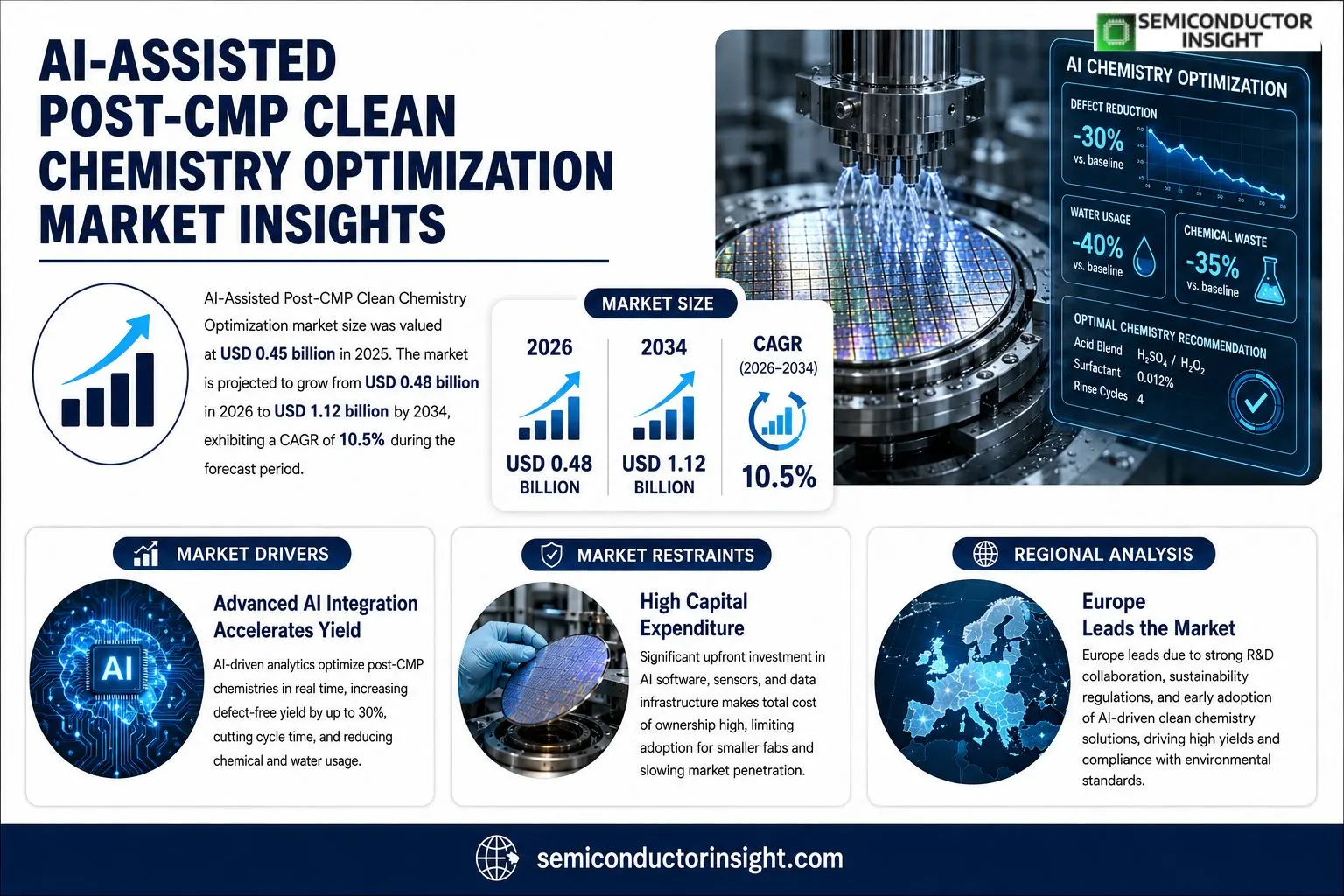
AI-Assisted Post-CMP Clean Chemistry Optimization market size was valued at USD 0.45 billion in 2025. The market is projected to grow from USD 0.48 billion in 2026 to USD 1.12 billion by 2034, exhibiting a CAGR of 10.5% during the forecast period.
This market encompasses advanced software platforms that integrate machine‑learning algorithms with post‑chemical‑mechanical polishing (Post‑CMP) data to predict optimal cleaning chemistries, reduce defectivity, and minimize water usage. By modeling surface interactions at the molecular level, the solutions enable semiconductor manufacturers to fine‑tune acid blends, surfactant concentrations, and rinse cycles without extensive trial‑and‑error experimentation.The sector is expanding rapidly because semiconductor nodes are shrinking below 3 nm, driving demand for ultra‑clean wafer surfaces and tighter defect budgets. Moreover, heightened environmental regulations push fabs toward greener chemistries, while AI‑driven analytics shorten development cycles and lower operational costs. Leading equipment suppliers such as Applied Materials, Lam Research and ASML have begun bundling these optimization tools with their CMP hardware, further accelerating adoption across major foundries.
MARKET DRIVERS
Advanced AI Integration Accelerates Yield
The adoption of deep‑learning algorithms for post‑chemical mechanical polishing (CMP) cleanup has enabled semiconductor fabs to increase defect‑free yield by up to 30 %. By continuously analyzing process data, AI‑assisted solutions optimize reagent selection and concentration, reducing cycle time and material waste. Manufacturers report faster time‑to‑market for advanced nodes, directly boosting the AI‑Assisted Post‑CMP Clean Chemistry Optimization Market.
Regulatory Push Toward Green Manufacturing
Environmental regulations in the United States, Europe, and Asia now require lower chemical footprints for wafer processing. AI‑driven chemistry platforms provide precise dosing that cuts hazardous discharge by 40 % while maintaining surface integrity. This compliance advantage is prompting tier‑1 fabs to invest in next‑generation clean‑chemistry tools, creating a clear growth catalyst.
➤ “AI‑enabled chemistry control is becoming the baseline for sustainable semiconductor production,” says a senior executive at a leading equipment supplier.
The convergence of AI scalability, tighter sustainability standards, and the need for higher throughput is establishing a virtuous cycle. Companies that embed intelligent chemistry optimization early are positioning themselves to capture a larger share of the emerging market landscape.
MARKET CHALLENGES
Complex Data Integration Across Toolsets
Fabs operate a heterogeneous mix of CMP tools from multiple vendors, each generating proprietary data formats. Integrating these streams into a unified AI model requires significant engineering effort and raises concerns about data latency. Without seamless integration, the promised predictive accuracy may remain elusive, slowing adoption rates.
Other Challenges
Talent Scarcity
The niche expertise needed to bridge semiconductor chemistry with machine‑learning engineering is limited. Companies often must upskill existing staff or compete for a small pool of specialists, which can increase project timelines and costs.
MARKET RESTRAINTS
High Capital Expenditure
Deploying AI‑assisted clean‑chemistry solutions entails substantial upfront investment in sensors, data infrastructure, and licensing. Smaller fab operators may find the total cost of ownership prohibitive, especially when ROI is projected over a multi‑year horizon.Additionally, legacy equipment that lacks modern connectivity cannot be retrofitted easily, compelling firms to either replace capital assets or accept sub‑optimal performance, both of which restrain market expansion.Financing constraints are further amplified by the cyclical nature of semiconductor demand, causing some investors to defer long‑term technology upgrades until market outlook stabilizes.
MARKET OPPORTUNITIES
Emergence of Edge AI for Real‑Time Optimization
Edge‑deployed AI processors can analyze sensor data on‑the‑fly, enabling instantaneous adjustments to cleaning chemistries without relying on cloud latency. This capability opens doors for ultra‑high‑volume production lines where every second saved translates into measurable profit.Moreover, collaborative ecosystems between equipment manufacturers, AI software firms, and chemical suppliers are forming standardized APIs. Such interoperability reduces integration complexity and accelerates time‑to‑value for new adopters.Finally, the growing focus on 3‑nm and sub‑3‑nm node development intensifies the need for ultra‑clean surfaces, positioning the AI‑Assisted Post‑CMP Clean Chemistry Optimization Market to address a critical bottleneck in next‑generation chip fabrication.
AI-Assisted Post-CMP Clean Chemistry Optimization Market Trends
Integration of AI with Post‑CMP Data for Chemistry Optimization
The industry is witnessing a rapid shift toward platforms that marry machine‑learning algorithms with detailed post‑CMP process data. By continuously analyzing defectivity patterns, rinse‑cycle efficiency, and acid‑blend performance, these solutions generate predictive models that recommend optimal chemistry formulations. This data‑driven approach eliminates much of the trial‑and‑error traditionally required to fine‑tune surfactant concentrations and rinse parameters, leading to measurable reductions in water consumption and chemical waste. Semiconductor manufacturers consequently achieve tighter defect budgets while preserving throughput, a balance that has become increasingly critical as fab lines pursue higher yields and lower cost per die.
Other Trends
Node Scaling Below 3 nm Drives Stringent Cleanliness Requirements
As process nodes shrink below the 3 nm threshold, surface imperfections that were previously tolerable now threaten device performance and reliability. The reduced feature dimensions amplify the impact of even minor particle contamination, prompting fabs to demand ultra‑clean wafer surfaces after each polishing step. AI‑assisted optimization tools respond by delivering chemistry recipes that target molecular‑level interactions, ensuring that acid‑based cleans remove sub‑nanometer residues without attacking delicate structures. The precision enabled by these tools not only protects yield but also shortens the development cycle for next‑generation devices, as engineers can rely on validated chemistry sets rather than iterative experimentation.
Environmental Regulations and Green Chemistry Adoption
environmental policies are tightening limits on hazardous chemical discharge and water usage in semiconductor manufacturing. In response, many fabs are transitioning to greener cleaning chemistries that reduce the reliance on strong acids and volatile organic compounds. AI‑driven platforms accelerate this transition by modeling the efficacy of alternative surfactants and moderate‑strength solutions, predicting performance outcomes before physical testing. Leading equipment suppliers such as Applied Materials, Lam Research, and ASML have begun bundling these optimization modules with their CMP hardware, offering an integrated pathway for customers to meet regulatory standards while preserving process efficiency. This convergence of regulatory pressure and advanced analytics is shaping a market trajectory that favors sustainable, high‑precision chemistry management.
COMPETITIVE LANDSCAPE
Key Industry Players
AI‑Assisted Post‑CMP Clean Chemistry Optimization – Competitive Overview
The market is currently dominated by the major semiconductor equipment manufacturers that have integrated AI‑driven chemistry‑optimization modules into their CMP tool suites. Applied Materials leads with its “CleanChem AI” platform, which couples real‑time defect monitoring with predictive modeling to automatically adjust acid blends and rinse parameters. Lam Research follows closely, offering the “SmartClean” add‑on that leverages machine‑learning from historic post‑CMP data across its customers’ fabs. ASML, while primarily known for lithography, has entered the niche through strategic partnerships that embed AI‑based clean‑up algorithms into its metrology solutions, thereby creating a semi‑closed ecosystem that ties CMP hardware, inspection, and chemistry control together. These three firms command the bulk of revenue, setting pricing benchmarks and establishing the core technology standards that shape downstream adoption.Beyond the incumbents, a cohort of specialist software vendors and niche equipment providers is gaining traction by focusing on algorithmic transparency and sustainability. KLA’s “ChemInsight” suite provides defect‑to‑chemistry analytics that are highly valued by leading foundries seeking to meet aggressive environmental targets. Tokyo Electron and Hitachi High‑Tech have introduced modular AI tools that can be retrofitted to existing CMP lines, appealing to mid‑size fabs. Entegris supplies high‑purity chemical delivery hardware that now incorporates AI‑controlled dosing to reduce waste. Additional players such as Nanometrics, Teradyne, Bosch, Synopsys, and Siemens contribute complementary AI analytics, simulation, or automation capabilities that enhance the overall value chain without directly competing in the hardware space. Collectively, these niche firms diversify the competitive landscape and drive innovation through specialized use‑cases.
List of Key AI‑Assisted Post‑CMP Clean Chemistry Optimization Companies Profiled
- Applied Materials
- Lam Research
- ASML
- KLA Corporation
- Tokyo Electron
- Hitachi High‑Tech
- Entegris
- Nanometrics
- Teradyne
- Bosch Semiconductor Solutions
- Synopsys (AI‑Chemistry Software)
- Siemens Digital Industries Software
Segment Analysis:
| Segment Category | Sub-Segments | Key Insights |
| By Type |
|
Deep Learning Predictive Models
|
| By Application |
|
Wafer Surface Cleaning Optimization
|
| By End User |
|
Dedicated Foundries
|
| By Chemistry Focus |
|
Neutral‑pH Green Chemistries
|
| By Integration Level |
|
Full‑Suite Digital Twin Platforms
|
Regional Analysis: AI-Assisted Post-CMP Clean Chemistry Optimization Market
Europe
The European Union’s REACH and RoHS extensions are being adapted to address novel solvents used in post‑CMP cleaning. Regulators are working closely with industry consortia to define permissible limits for emerging chemical classes, fostering a climate where AI‑driven formulation tools can be safely deployed at scale.
AI platforms are increasingly embedded within fab automation suites, enabling predictive adjustment of cleaning parameters. Early adopters report reductions in cycle time and defectivity, reinforcing the technology’s value proposition across 28‑nm and finer nodes.
Leading equipment makers have launched joint‑venture labs with European universities to refine machine‑learning models that correlate chemical composition with surface integrity, accelerating the rollout of next‑generation cleaning solutions.
The regional emphasis on sustainability is reshaping supply chains, with vendors prioritizing bio‑based precursors that are compatible with AI‑optimized dosing strategies, thereby lowering environmental footprints while maintaining performance.
North America
North America remains a competitive arena, driven chiefly by the United States’ concentration of leading semiconductor fabs and research institutions. While AI integration is advancing, the market navigates a patchwork of state‑level environmental regulations that influence adoption speed. Companies are leveraging cloud‑based analytics to harmonize cleaning chemistry across multiple sites, aiming to balance cost efficiencies with the rising demand for greener processes. Collaborative projects between academia and industry are cultivating a talent pipeline skilled in both chemoinformatics and process control, supporting incremental market expansion.
Asia‑Pacific
The Asia‑Pacific region, anchored by manufacturing powerhouses in Taiwan, South Korea, and Japan, exhibits rapid scaling of AI‑Assisted Post‑CMP Clean Chemistry Optimization. High volume production pressures encourage firms to embrace data‑driven cleaning solutions that can shave seconds off each cycle. Although sustainability mandates are emerging, they are less prescriptive than in Europe, allowing firms to experiment with a broader range of chemistries. Strategic investments in AI research hubs are fostering localized expertise, positioning the region for sustained growth as next‑generation node adoption accelerates.
South America
South America’s semiconductor ecosystem is still nascent, yet growing interest in AI‑enhanced cleaning processes reflects broader efforts to attract advanced manufacturing. Brazil’s emerging fab initiatives are supported by government incentives that emphasize low‑impact chemical usage. Partnerships with European technology providers are introducing predictive cleaning platforms, though adoption is tempered by limited local expertise and infrastructure constraints. The region’s outlook hinges on successful knowledge transfer and the development of cost‑effective AI tools tailored to smaller‑scale operations.
Middle East & Africa
In the Middle East & Africa, market activity centers around pilot projects in the United Arab Emirates and South Africa, where governments are promoting high‑tech diversification. Early deployments of AI‑driven cleaning optimization aim to showcase the environmental benefits of reduced chemical waste, aligning with regional sustainability agendas. While the talent pool for advanced data analytics remains limited, collaborations with European research institutions are beginning to bridge the gap, setting the stage for incremental market penetration over the coming years.
Report Scope
This market research report provides a comprehensive analysis of the AI-Assisted Post-CMP Clean Chemistry Optimization Market , covering the forecast period 2026–2034. It offers detailed insights into market dynamics, technological advancements, competitive landscape, and key trends shaping the industry.
Key focus areas of the report include:
- Market Overview: The report begins with an overview outlining its current market scenario, key growth indicators, and industry transformation drivers. It discusses macroeconomic factors, demand–supply balance, regulatory landscape, and the strategic role of semiconductors in powering advancements across industries such as automotive, telecommunications, consumer electronics, and industrial automation.
- Market Size & Forecast: Historical data and future projections for revenue, unit shipments, and market value across major regions and segments.
- Segmentation Analysis: Detailed breakdown by product type, technology, application, and end-user industry to identify high-growth segments and investment opportunities.
- Regional Insights: Insights into market performance across North America, Europe, Asia-Pacific, Latin America, and the Middle East & Africa, including country-level analysis where relevant.
- Competitive Landscape: Profiles of leading market participants, including their product offerings, R&D focus, manufacturing capacity, pricing strategies, and recent developments such as mergers, acquisitions, and partnerships.
- Technology Trends & Innovation: Assessment of emerging technologies, integration of AI/IoT, semiconductor design trends, fabrication techniques, and evolving industry standards.
- Market Drivers & Restraints: Evaluation of factors driving market growth along with challenges, supply chain constraints, regulatory issues, and market-entry barriers.
- Stakeholder Insights: Insights for component suppliers, OEMs, system integrators, investors, and policymakers regarding the evolving ecosystem and strategic opportunities.
Primary and secondary research methods are employed, including interviews with industry experts, data from verified sources, and real-time market intelligence to ensure the accuracy and reliability of the insights presented.
FREQUENTLY ASKED QUESTIONS:
What is the current market size of AI-Assisted Post-CMP Clean Chemistry Optimization Market?
-> AI-Assisted Post-CMP Clean Chemistry Optimization Market was valued at USD 0.45 billion in 2025 and is expected to reach USD 1.12 billion by 2034.
Which key companies operate in AI-Assisted Post-CMP Clean Chemistry Optimization Market?
-> Key players include Applied Materials, Lam Research, and ASML, among others.
What are the key growth drivers?
-> Key growth drivers include the continued scaling of semiconductor nodes below 3 nm, the need for ultra‑clean wafer surfaces, tighter defect budgets, stricter environmental regulations encouraging greener chemistries, and AI‑driven analytics that accelerate development cycles and lower operational costs.
Which region dominates the market?
-> The reference material does not specify a single dominant region for this market.
What are the emerging trends?
-> Emerging trends include the integration of machine‑learning algorithms with post‑CMP data to model surface interactions at the molecular level, the development of greener and more efficient cleaning chemistries, and the bundling of AI‑optimization tools with CMP hardware by major equipment suppliers.
Get Sample Report PDF for Exclusive Insights
Report Sample Includes
- Table of Contents
- List of Tables & Figures
- Charts, Research Methodology, and more...
 Download Sample Report PDF


