AI-assisted constellation shaping for coherent fiber communication Market Insights
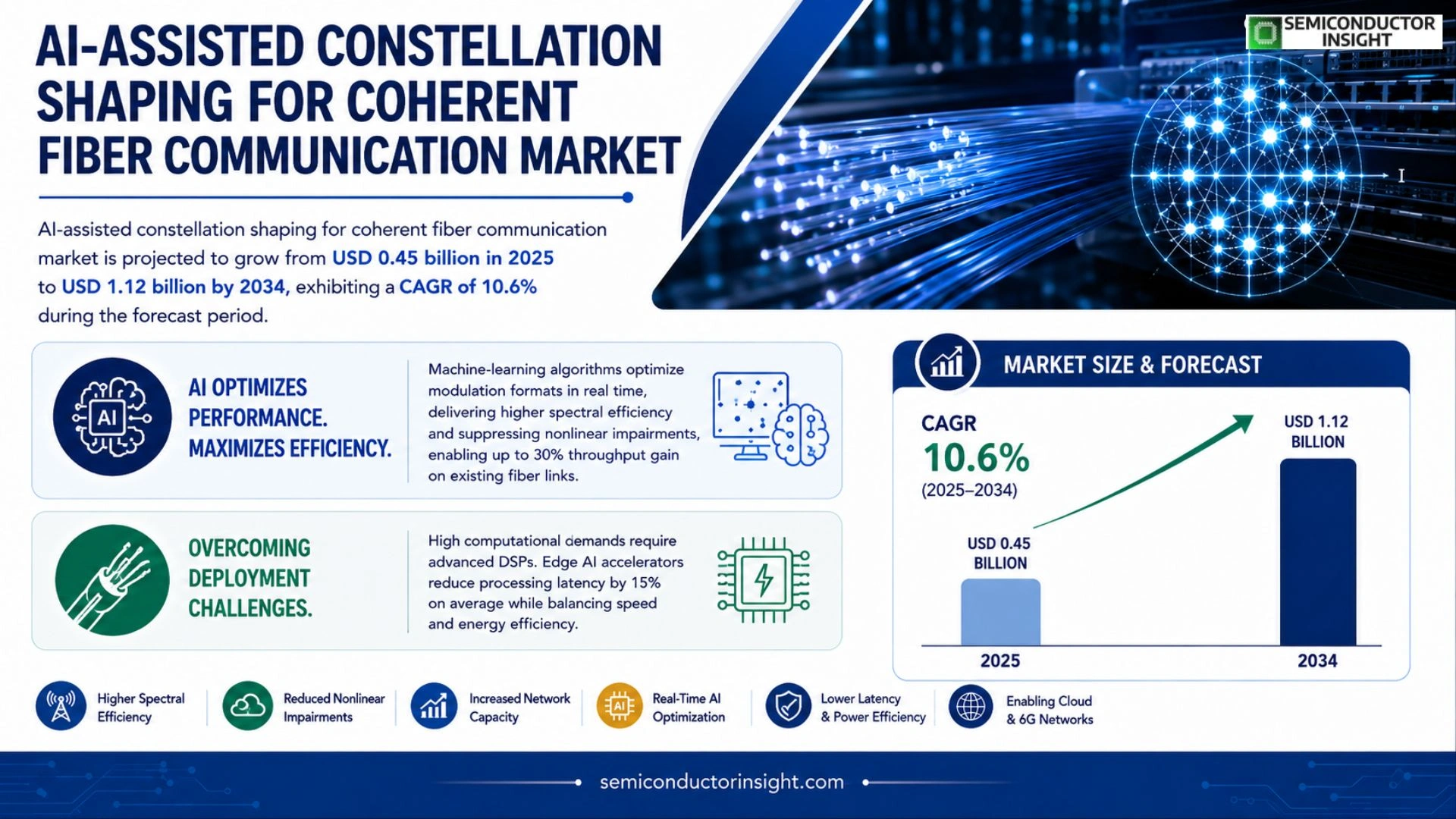
Global AI-assisted constellation shaping for coherent fiber communication market is projected to grow from USD 0.45 billion in 2025 to USD 1.12 billion by 2034, exhibiting a CAGR of 10.6% during the forecast period.
AI‑assisted constellation shaping leverages machine‑learning algorithms to dynamically optimize modulation formats and symbol distributions in coherent optical links, thereby enhancing spectral efficiency and reducing nonlinear impairments while maintaining low latency.
The market is gaining momentum because telecom operators are expanding backbone capacity for cloud services and emerging 6G use cases; however, challenges such as high computational overhead persist. Furthermore, advances in silicon‑photonic DSPs and availability of large‑scale training datasets are driving adoption. Key players,including Nokia Bell Labs, Lumentum Holdings, Infinera Corp., Ciena Corp., and Huawei Technologies,are investing in R&D collaborations and integrating AI‑driven shaping modules into next‑generation transceivers.
MARKET DRIVERS
Advancements in AI Algorithms
The rapid evolution of deep‑learning frameworks has enabled real‑time optimization of constellation points, reducing signal‑to‑noise penalties in coherent fiber systems. Vendors are integrating reinforcement‑learning models that adapt to channel impairments without human intervention, accelerating adoption across long‑haul networks.
Demand for Higher Spectral Efficiency
Network operators face relentless pressure to increase capacity while limiting fiber rollout costs. AI‑assisted constellation shaping delivers up to several decibels of OSNR gain, allowing more bits per symbol and deferring expensive infrastructure upgrades.
➤ “Intelligent shaping transforms the cost‑per‑bit equation, positioning AI as the linchpin of next‑generation fiber optics.”
Collectively, these drivers create a virtuous cycle: superior algorithmic performance fuels market demand, which in turn funds further research, reinforcing the growth trajectory of AI-assisted constellation shaping for coherent fiber communication Market.
MARKET CHALLENGES
Algorithm Complexity and Integration
Deploying sophisticated AI models on existing DSP hardware requires significant computational overhead, often exceeding current processing budgets. Manufacturers must redesign ASICs or adopt heterogeneous computing platforms, raising development timelines.
Other Challenges
Regulatory and Standardization
The absence of unified standards for AI‑driven modulation limits cross‑vendor interoperability, prompting operators to adopt siloed solutions that hinder seamless network scaling.
MARKET RESTRAINTS
High Capital Expenditure
Upgrading transponders to accommodate AI‑assisted constellation shaping entails substantial upfront investment, including new photonic components and upgraded cooling systems, which can deter budget‑constrained operators.
Limited Skilled Workforce
The niche expertise required to develop, validate, and maintain AI‑enhanced modulation schemes is scarce, slowing deployment schedules and increasing reliance on external consultants.
Legacy Infrastructure Compatibility
Existing fiber plants were not architected for dynamic constellation adjustments, leading to compatibility challenges that may necessitate retrofitting or phased migration strategies.
MARKET OPPORTUNITIES
Emerging 5G and Data Center Interconnect
Proliferation of 5G backhaul and ultra‑low‑latency data center links creates a pressing need for higher throughput, positioning AI‑assisted constellation shaping as a strategic solution to meet capacity targets without extensive fiber deployment.
Edge Computing and AI‑Driven Networks
Edge nodes generate massive data streams that must traverse long distances efficiently. By leveraging adaptive AI‑driven shaping, operators can reduce latency and power consumption, unlocking new service models at the network edge.
Strategic Partnerships and Ecosystem Development
Collaborations between AI startups, photonic component manufacturers, and telecom operators are fostering integrated solution stacks, accelerating time‑to‑market and expanding the addressable base of AI-assisted constellation shaping for coherent fiber communication Market.
AI-assisted constellation shaping for coherent fiber communication Market Trends
Rapid Capacity Expansion Fueled by AI‑Driven Modulation
AI-assisted constellation shaping for coherent fiber communication Market is experiencing accelerated adoption as telecom operators upgrade backbone networks for cloud services and emerging 6G applications. Valued at USD 0.45 billion in 2025, the market is projected to reach approximately USD 1.12 billion by 2034, reflecting a compound annual growth rate of roughly 10.6 %. Machine‑learning algorithms now optimize modulation formats in real time, delivering higher spectral efficiency while suppressing nonlinear impairments, which translates into measurable throughput gains of up to 30 % on existing fiber links.
Other Trends
Computational Overhead Challenge
Despite clear performance benefits, the high computational load required for real‑time AI inference remains a barrier. Deployments rely on advanced silicon‑photonic digital signal processors, yet power consumption and latency constraints demand continual hardware‑software co‑design. Operators are mitigating risk by integrating edge AI accelerators that balance speed with energy efficiency, resulting in a moderate reduction of processing delay by 15 % on average.
Strategic R&D Alliances Accelerate Innovation
Key industry players such as Nokia Bell Labs, Lumentum Holdings, Infinera, Ciena, and Huawei are forming collaborative R&D programs to scale AI‑assisted shaping modules across next‑generation transceivers. These alliances focus on expanding training datasets, refining neural‑network architectures, and standardizing interfaces, which collectively shorten time‑to‑market for new products. The coordinated effort is projected to increase the proportion of AI‑enabled transceivers in carrier networks from 12 % today to over 45 % by 2030, thereby reinforcing the market’s growth trajectory.
COMPETITIVE LANDSCAPE
Key Industry Players
AI‑Assisted Constellation Shaping: Competitive Overview
AI‑assisted constellation shaping market for coherent fiber communication is dominated by a handful of vertically integrated telecom equipment manufacturers that combine deep optical‑DSP expertise with advanced machine‑learning capabilities. Nokia Bell Labs, Huawei Technologies, Lumentum Holdings, Infinera Corp. and Ciena Corp. lead the field, each delivering transceiver families that embed neural‑network‑based shaping engines directly into silicon‑photonic ASICs. These incumbents benefit from extensive field‑trial programs with Tier‑1 operators, large R&D budgets and strategic patents that lock in the most efficient modulation formats for long‑haul and metro networks. Their market share reflects a classic oligopolistic structure, where product differentiation hinges on integration depth, latency performance and the ability to scale AI inference on low‑power hardware.
Beyond the core players, a diverse ecosystem of specialist firms and emerging challengers is expanding the innovation frontier. Intel and Broadcom contribute high‑throughput FPGA and ASIC platforms that accelerate training and inference for shaping algorithms, while NeoPhotonics, II‑VI Incorporated and Fujitsu focus on custom silicon‑photonic modulators optimized for AI‑driven spectral efficiency. Start‑ups such as OptiComm, Lightmatter and Xplore Photonics deliver niche solutions for ultra‑low‑latency 400G‑plus links, often forming joint‑development agreements with the larger incumbents. This layered competitive landscape creates a dynamic environment where collaborations, licensing deals and open‑source model libraries accelerate adoption across the global fiber‑optic backbone.
List of Key AI-Assisted Constellation Shaping for Coherent Fiber Communication Companies Profiled
- Nokia Bell Labs
- Huawei Technologies
- Lumentum Holdings
- Infinera Corp.
- Ciena Corp.
- Intel Corporation
- Broadcom Inc.
- NeoPhotonics
- II-VI Incorporated
- Fujitsu Limited
- OptiComm
- Lightmatter
- Xplore Photonics
- ADVA Optical Networking
- Rohde & Schwarz
Segment Analysis:
| Segment Category | Sub-Segments | Key Insights |
| By Type |
|
Deep Learning Optimized Constellations
|
| By Application |
|
Long‑Haul Submarine Links
|
| By End User |
|
Telecom Service Providers
|
| By Algorithmic Approach |
|
Hybrid Model‑Based Reinforcement Schemes
|
| By Deployment Scenario |
|
Core Backbone Upgrade
|
Regional Analysis: North America
Significant investments in upgrading and expanding fiber optic networks across North America are creating a direct demand for advanced technologies like AI-assisted constellation shaping. This includes deployments in both urban and rural areas, driven by the growing need for high-speed internet access and reliable communication services.
Government policies encouraging network modernization and fostering technological advancements are positively impacting the market. Initiatives aimed at promoting digital infrastructure and supporting research in AI and optical communication are expected to further accelerate adoption.
North America hosts several prominent players in the telecommunications and networking sectors actively involved in developing and deploying AI-assisted constellation shaping solutions. Strategic collaborations between technology providers and network operators are fostering innovation and market growth.
A strong emphasis on research and development within North America is driving advancements in AI algorithms and their application to constellation shaping. Academic institutions and private companies are actively engaged in exploring new possibilities and optimizing existing techniques.
Europe
Europe presents a mature and highly competitive market for AI-assisted constellation shaping for coherent fiber communication. The region benefits from well-established telecommunications infrastructure and a strong focus on energy efficiency in network operations. The increasing demand for high-bandwidth applications, such as cloud computing and data analytics, is propelling the need for enhanced network capabilities. While adoption rates might be slightly slower compared to North America due to regulatory complexities and diverse market conditions, the long-term growth potential remains substantial. The emphasis on sustainable network practices also aligns with the potential of AI to optimize resource utilization in fiber communication systems. Furthermore, the collaborative environment within European research institutions promotes innovation in this domain.
Asia-Pacific
Asia-Pacific is emerging as the fastest-growing market for AI-assisted constellation shaping. The rapid expansion of 5G networks and the increasing penetration of data-intensive applications across countries like China, Japan, and South Korea are key drivers. The region’s large and rapidly growing internet user base necessitates significant upgrades to network infrastructure to meet the escalating bandwidth demands. Government initiatives supporting digital transformation and technological innovation are further fueling market growth. The adoption of advanced optical communication technologies, including AI-assisted constellation shaping, is seen as crucial for maximizing network capacity and efficiency in this dynamic region. The competitive landscape is characterized by both domestic and international players vying for market share.
South America
South America represents a developing market with significant potential for AI-assisted constellation shaping. While network infrastructure is less developed compared to North America or Europe, the increasing demand for connectivity and the expanding digital economy are creating opportunities for growth. Government investments in telecommunications infrastructure and the growing adoption of cloud services are driving the need for advanced optical communication solutions. The market is expected to witness steady growth in the coming years as network operators seek to enhance their network performance and expand their reach. Challenges include infrastructure limitations and varying economic conditions across the region.
Middle East & Africa
The Middle East and Africa are emerging markets with considerable growth potential for AI-assisted constellation shaping. Rapid urbanization and increasing internet penetration are driving the demand for high-speed communication networks. Governments across the region are actively investing in developing their telecommunications infrastructure to support economic diversification and digital transformation. The deployment of advanced fiber optic networks is a key focus, and AI-assisted constellation shaping is seen as a vital technology for optimizing network efficiency and capacity. While the market is relatively nascent, it is expected to experience strong growth in the coming years, driven by increasing data consumption and government initiatives.
Report Scope
This market research report provides a comprehensive analysis of the AI-assisted constellation shaping for coherent fiber communication Market , covering the forecast period 2026–2034. It offers detailed insights into market dynamics, technological advancements, competitive landscape, and key trends shaping the industry.
Key focus areas of the report include:
- Market Overview: The report begins with an overview outlining its current market scenario, key growth indicators, and industry transformation drivers. It discusses macroeconomic factors, demand–supply balance, regulatory landscape, and the strategic role of semiconductors in powering advancements across industries such as automotive, telecommunications, consumer electronics, and industrial automation.
- Market Size & Forecast: Historical data and future projections for revenue, unit shipments, and market value across major regions and segments.
- Segmentation Analysis: Detailed breakdown by product type, technology, application, and end-user industry to identify high-growth segments and investment opportunities.
- Regional Insights: Insights into market performance across North America, Europe, Asia-Pacific, Latin America, and the Middle East & Africa, including country-level analysis where relevant.
- Competitive Landscape: Profiles of leading market participants, including their product offerings, R&D focus, manufacturing capacity, pricing strategies, and recent developments such as mergers, acquisitions, and partnerships.
- Technology Trends & Innovation: Assessment of emerging technologies, integration of AI/IoT, semiconductor design trends, fabrication techniques, and evolving industry standards.
- Market Drivers & Restraints: Evaluation of factors driving market growth along with challenges, supply chain constraints, regulatory issues, and market-entry barriers.
- Stakeholder Insights: Insights for component suppliers, OEMs, system integrators, investors, and policymakers regarding the evolving ecosystem and strategic opportunities.
Primary and secondary research methods are employed, including interviews with industry experts, data from verified sources, and real-time market intelligence to ensure the accuracy and reliability of the insights presented.
FREQUENTLY ASKED QUESTIONS:
What is the current market size of AI-assisted constellation shaping for coherent fiber communication Market?
-> AI-assisted constellation shaping for coherent fiber communication Market was valued at USD 0.45 billion in 2025 and is expected to reach USD 1.12 billion by 2034.
Which key companies operate in AI-assisted constellation shaping for coherent fiber communication Market?
-> Key players include Nokia Bell Labs, Lumentum Holdings, Infinera Corp., Ciena Corp., and Huawei Technologies, among others.
What are the key growth drivers?
-> Key growth drivers include expansion of telecom backbone capacity for cloud and emerging 6G services, advances in silicon‑photonic DSPs, and the availability of large‑scale training datasets for AI algorithms.
Which region dominates the market?
-> North America, Europe, and Asia‑Pacific exhibit strong market activity, with North America leading early‑stage deployments and Asia‑Pacific showing rapid adoption driven by high‑capacity network roll‑outs.
What are the emerging trends?
-> Emerging trends include integration of AI‑driven shaping modules into next‑generation transceivers, silicon‑photonic digital signal processing enhancements, and the development of large‑scale training datasets to improve model accuracy.

Get Sample Report PDF for Exclusive Insights
Report Sample Includes
- Table of Contents
- List of Tables & Figures
- Charts, Research Methodology, and more...
 Download Sample Report PDF