
Market Insights
Global Absolute Heavy Duty Encoders Market size was valued at USD 138 million in 2025. The market is projected to grow from USD 145 million in 2026 to USD 200 million by 2034, exhibiting a CAGR of 5.6% during the forecast period.
Absolute heavy-duty encoders are advanced position sensors designed to provide precise and reliable rotational position data in harsh and demanding environments. Unlike incremental encoders, which only provide relative position changes, absolute encoders offer a unique position value for every point in their range of motion, allowing them to accurately determine the exact position of a rotating or linear object at any time.
The market growth is driven by increasing automation in industrial applications, particularly in sectors such as steel manufacturing, oil and gas, and heavy machinery. These industries require robust solutions capable of withstanding extreme conditions while maintaining high accuracy. Furthermore, advancements in encoder technology, including improved sealing against dust and moisture as well as enhanced signal processing capabilities, are expanding their adoption across diverse industrial applications.
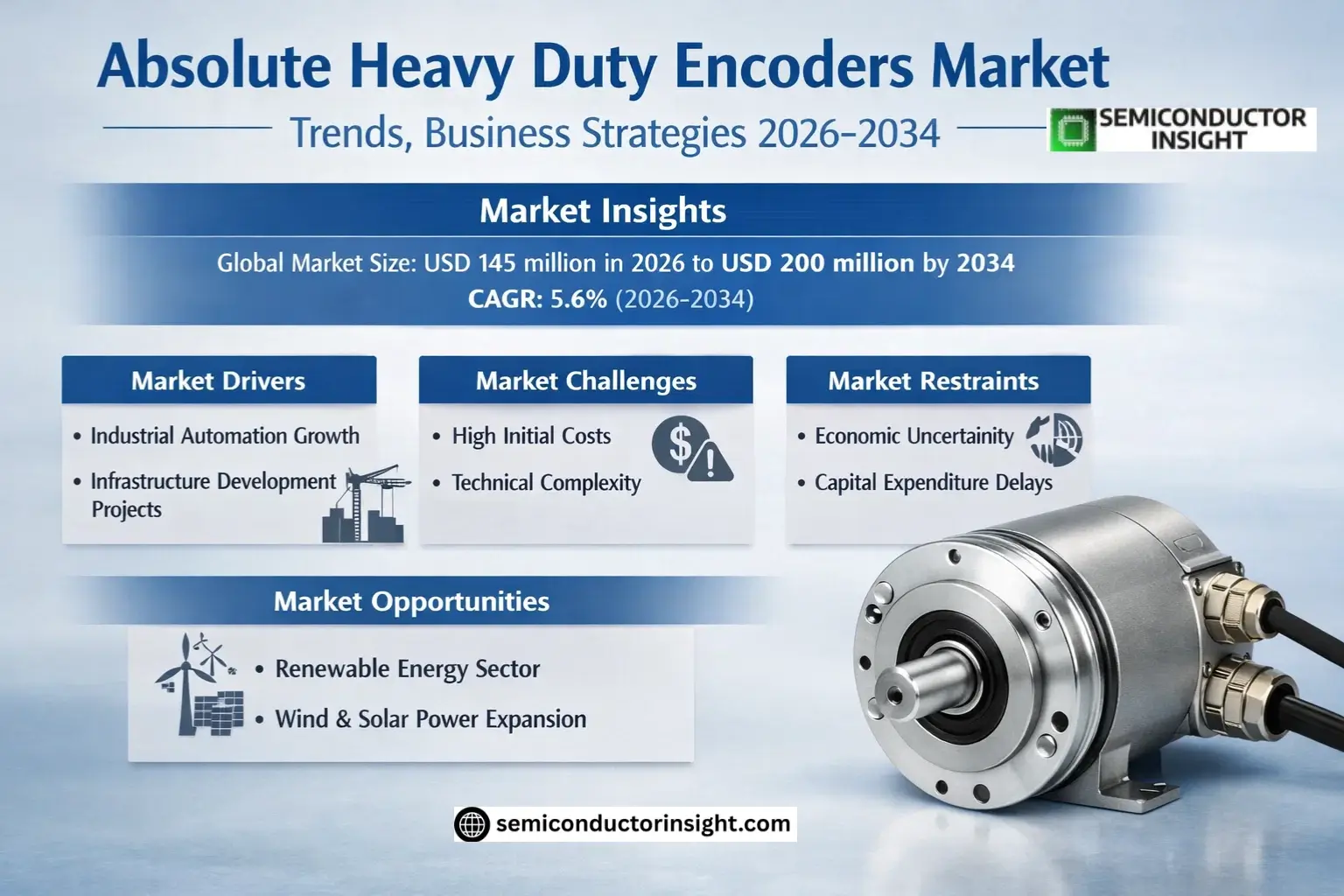
MARKET DRIVERS
Industrial Automation Expansion Fuels Demand
Absolute Heavy Duty Encoders Market is experiencing robust growth driven by increasing adoption in industrial automation. Manufacturers are investing heavily in precise motion control systems, with absolute encoders becoming critical components in heavy machinery. The market has grown approximately 8.2% annually since 2020 as factories upgrade to Industry 4.0 standards.
Infrastructure Development Projects Accelerate Adoption
Global infrastructure spending exceeding USD 4 trillion annually creates substantial opportunities for Absolute Heavy Duty Encoders in construction equipment. These devices provide reliable position feedback for cranes, excavators, and other heavy machinery operating in harsh environments. Emerging markets account for over 35% of new installations.
Stringent safety regulations in material handling and energy sectors further drive adoption. Absolute Heavy Duty Encoders help companies comply with SIL-3 safety standards while maintaining operational efficiency in critical applications.
MARKET CHALLENGES
High Initial Costs Limit Market Penetration
While Absolute Heavy Duty Encoders offer superior performance, their premium pricing remains a barrier for small and medium enterprises. The average unit cost is approximately 40% higher than incremental encoders, affecting adoption in price-sensitive segments. Manufacturers face pressure to reduce costs without compromising ruggedness.
Other Challenges
Technical Complexity
Integration with legacy systems requires specialized expertise, increasing total deployment costs by 15-20% in retrofit applications.
MARKET RESTRAINTS
Economic Uncertainty Impacts Capital Expenditures
Recent global economic volatility has caused some manufacturers to delay equipment upgrades. Absolute Heavy Duty Encoders Market saw a 5% contraction in order volumes during recent quarters as companies prioritized essential spending. However, analysts project this as a temporary setback rather than a long-term trend.
MARKET OPPORTUNITIES
Renewable Energy Sector Presents Growth Potential
The expanding wind energy market represents a significant opportunity for Absolute Heavy Duty Encoders. Each modern wind turbine requires multiple high-performance encoders for pitch and yaw control, with the sector projected to grow at 9.4% CAGR through 2030. Encoder manufacturers are developing specialized products to withstand extreme weather conditions.
Absolute Heavy Duty Encoders Market Trends
Growing Demand for Industrial Automation Drives Market Growth
Absolute Heavy Duty Encoders Market is experiencing significant growth due to increasing industrial automation across manufacturing sectors. These robust encoders provide critical position feedback in heavy machinery applications where reliability under harsh conditions is paramount. Industries such as steel production, oil & gas, and paper manufacturing increasingly adopt absolute encoders for their superior accuracy and maintenance-free operation compared to incremental alternatives.
Other Trends
Optical Encoder Technology Dominates Market Share
Optical absolute heavy duty encoders maintain leadership in global revenue share due to their high-resolution capabilities and durability. Manufacturers continue investing in sealed optical designs that resist contaminants like dust, moisture, and vibration – key requirements in industrial environments. Recent technological advancements have improved optical encoder reliability in extreme temperature ranges from -40°C to 120°C.
Asia-Pacific Emerges as High-Growth Region
The Asia-Pacific Absolute Heavy Duty Encoders Market shows the fastest regional growth, driven by expanding manufacturing bases in China, India, and Southeast Asia. Regional demand particularly concentrates in steel production and elevator manufacturing applications. Major encoder manufacturers are establishing local production facilities to better serve this growing market while reducing delivery lead times.
Increased Integration with Industrial IoT Systems
Modern Absolute Heavy Duty Encoders now frequently incorporate industrial communication protocols like PROFINET, EtherCAT, and EtherNet/IP. This connectivity enables real-time monitoring of machinery performance and predictive maintenance capabilities through Industry 4.0 implementations. Encoder manufacturers report 35% of new orders specify networked connectivity options.
Competitive Landscape Consolidation
Global Absolute Heavy Duty Encoders Market features consolidation among key players through strategic acquisitions. Leading manufacturers focus on expanding product portfolios and geographic reach to serve multinational industrial customers. Recent partnerships between encoder specialists and automation solution providers aim to deliver complete motion control packages rather than standalone components.
COMPETITIVE LANDSCAPE
Key Industry Players
Consolidated Market with Top 5 Players Holding Significant Share
Absolute Heavy Duty Encoders Market features a moderately concentrated competitive landscape, with the top five manufacturers collectively holding substantial market share. Dynapar Corporation emerges as a clear leader, renowned for its rugged encoder solutions designed for extreme environments. The company has strengthened its position through continuous R&D investments and strategic acquisitions in motion control technologies. Following closely are European specialists Leine & Linde and Baumer Group, both offering high-precision encoders with robust IP ratings for heavy industrial applications.
Several niche players maintain strong positions in specific encoder technologies. Kubler Group dominates in magnetic encoder solutions, while Pepperl+Fuchs excels in explosion-proof encoder designs for hazardous areas. Asian manufacturers like OMRON and Nidec Industrial Solution have gained traction through cost-competitive offerings, particularly in APAC markets. Specialized players such as TR-Electronic and SCANCON focus on high-resolution optical encoders for mission-critical applications.
List of Key Absolute Heavy Duty Encoders Companies Profiled
- Dynapar Corporation
- Leine & Linde
- Baumer Group
- BEI Sensors (Sensata Technologies)
- Kubler Group
- Pepperl+Fuchs
- Nidec Industrial Solution
- OMRON Corporation
- TR-Electronic
- SCANCON Encoders
- Hohner Automaticos
- Encoder Products Company
- Yuheng Optics
- Lika Electronic
- Heidenhain Corporation
Segment Analysis:
| Segment Category | Sub-Segments | Key Insights |
| By Type |
|
Optical Absolute Encoders dominate the segment due to their superior precision and reliability in harsh environments.
|
| By Application |
|
Steel Industrial represents the most demanding application environment:
|
| By End User |
|
Industrial OEMs demonstrate the strongest growth trajectory:
|
| By Protection Level |
|
IP67 protection level sees widespread adoption across industries:
|
| By Communication Protocol |
|
Ethernet-based protocols are transforming industrial connectivity:
|
Regional Analysis: Absolute Heavy Duty Encoders Market
North America
US automotive and aerospace manufacturers increasingly integrate absolute heavy duty encoders in robotic welding systems and CNC machinery, requiring IP67-rated solutions for metalworking environments.
Canadian oil fields deploy explosion-proof encoder variants for pump jack monitoring, while US wind farms utilize heavy duty absolute encoders for precise blade pitch control in extreme weather conditions.
Leading North American encoder manufacturers develop hybrid optical-magnetic absolute encoders that combine durability with high resolution, particularly for steel mill applications.
Regional distribution networks ensure rapid availability of replacement absolute encoders for mission-critical industrial equipment, minimizing downtime in continuous production environments.
Europe
European markets demonstrate strong adoption of absolute heavy duty encoders in renewable energy and maritime applications, with German manufacturers leading encoder innovation. The region’s focus on sustainable energy drives demand for robust encoders in offshore wind turbines and wave energy converters. Strict EU machinery directives enforce encoder reliability standards across heavy industries, particularly in mining and material handling equipment. Mediterranean ports implement absolute encoder solutions for container crane automation, requiring salt fog-resistant designs.
Asia-Pacific
Asia-Pacific emerges as the fastest-growing region for absolute heavy duty encoders, fueled by rapid industrialization and infrastructure development. Chinese manufacturers progressively upgrade from incremental to absolute encoder systems in metal fabrication plants. Japanese robotics integrators specify high-vibration-resistant absolute encoders for earthquake-prone areas. Australian mining operations adopt intrinsically safe absolute encoders for underground equipment positioning systems with hazardous area certifications.
South America
South American markets show increasing absolute heavy duty encoder adoption in hydropower and mining sectors. Brazilian mining operations utilize high-temperature absolute encoders for ore processing equipment. Chilean copper mines implement absolute encoder systems capable of operating in high-altitude, low-oxygen conditions. Regional manufacturers focus on cost-effective encoder solutions suitable for tropical climates with high humidity levels.
Middle East & Africa
Middle Eastern oil refineries drive demand for explosion-proof absolute encoders in hazardous processing areas. African mining operations implement heavy duty absolute encoders in conveyor belt splicing machinery. UAE’s smart city initiatives incorporate absolute encoders in automated waste management systems. Regional challenges include adapting encoder designs for high ambient temperatures and sand ingress protection.
Report Scope
This market research report provides a comprehensive analysis of the Absolute Heavy Duty Encoders Market, covering the forecast period 2025–2034. It offers detailed insights into market dynamics, technological advancements, competitive landscape, and key trends shaping the industry.
Key focus areas of the report include:
- Market Overview:The report begins with an overview outlining its current market scenario, key growth indicators, and industry transformation drivers. It discusses macroeconomic factors, demand–supply balance, regulatory landscape, and the strategic role of encoders in powering industrial automation across sectors.
- Market Size & Forecast: Historical data and future projections for revenue, unit shipments, and market value across major regions and segments.
- Segmentation Analysis: Detailed breakdown by product type (optical, magnetic, inductive), application (steel, paper, oil & gas), and end-user industries.
- Regional Insights: Insights into market performance across North America, Europe, Asia, South America, and Middle East & Africa, including country-level analysis.
- Competitive Landscape: Profiles of leading manufacturers, including their product offerings, market share, pricing strategies, and recent developments.
- Technology Trends: Assessment of emerging encoder technologies, durability innovations, and integration with industrial IoT systems.
- Market Drivers & Restraints: Evaluation of factors driving market growth along with challenges, supply chain constraints, and regulatory issues.
- Stakeholder Insights: Strategic inputs for component suppliers, OEMs, system integrators, and investors regarding market opportunities.
Primary and secondary research methods are employed, including manufacturer interviews, industrial surveys, and verified market intelligence sources.
FREQUENTLY ASKED QUESTIONS:
What is the current market size of Absolute Heavy Duty Encoders Market?
-> Absolute Heavy Duty Encoders Market size was valued at USD 138 million in 2025. The market is projected to grow from USD 145 million in 2026 to USD 200 million by 2034, exhibiting a CAGR of 5.6% during the forecast period.
Which key companies operate in Absolute Heavy Duty Encoders Market?
-> Key players include Dynapar, Leine & Linde, BEI Sensor, Baumer, Kubler, Pepperl+Fuchs, Nidec Industrial Solution, OMRON, TR-Electronic, and SCANCON.
What are the key growth drivers?
-> Key growth drivers include industrial automation demands, harsh environment applications in steel/paper/oil industries, and precision measurement requirements.
Which region dominates the market?
-> Asia shows strongest growth potential with China as key market, while North America and Europe maintain significant shares.
What are the key product segments?
-> Primary segments are Optical Absolute Encoders, Magnetic Absolute Encoders, and Inductive Absolute Encoders, with optical encoders projected for highest growth.

Get Sample Report PDF for Exclusive Insights
Report Sample Includes
- Table of Contents
- List of Tables & Figures
- Charts, Research Methodology, and more...







