Rolling Shutter CMOS Image Sensor Market Insights
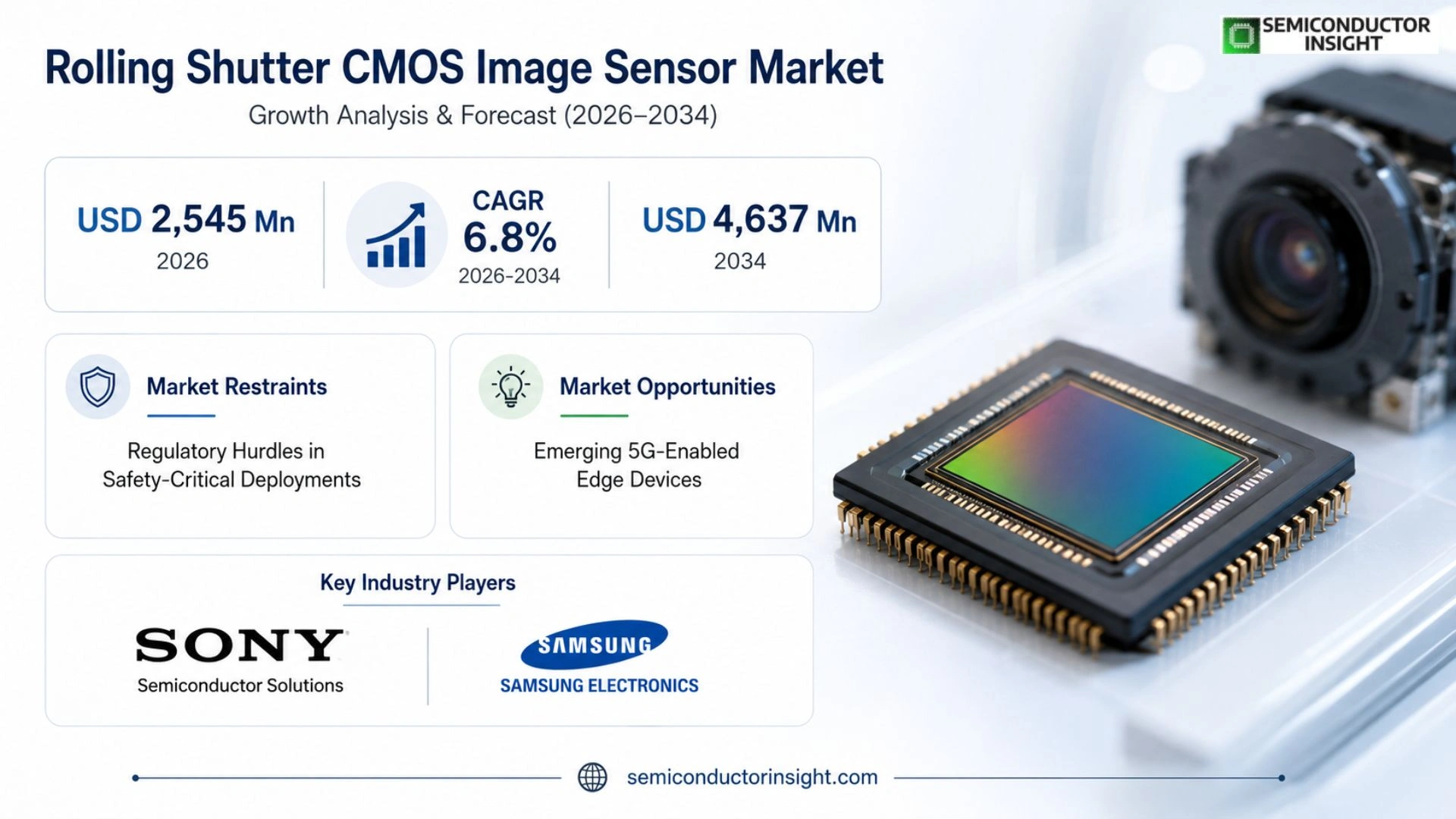
Rolling Shutter CMOS Image Sensor market is projected to grow from USD 2,545 million in 2026 to USD 4,637 million by 2034, exhibiting a CAGR of 6.8% during the forecast period.
A Rolling Shutter CMOS Image Sensor (Rolling Shutter CIS) is a type of CMOS image sensor that reads out pixel rows sequentially, offering low‑cost and low‑power operation compared with global‑shutter designs that expose all pixels simultaneously.
The industry chain follows a vertical hierarchy,from upstream core materials and lithography equipment through midstream design, wafer fabrication and packaging to downstream integration across consumer electronics, automotive and industrial applications,creating high technical barriers and concentrating profitability among a limited set of equipment suppliers and sensor designers.
MARKET DRIVERS
Increasing Adoption in Automotive Imaging
Vehicle manufacturers are integrating Rolling Shutter CMOS Image Sensor technology to meet strict functional‑safety standards for driver‑assistance systems. The sensor’s ability to capture crisp frames under motion reduces motion blur, which translates into more reliable lane‑keeping and pedestrian‑detection algorithms. Manufacturers that embrace this capability gain a competitive edge in a segment where safety perception directly influences brand equity.
Expansion of Industrial Vision Applications
Factories upgrading to smart‑factory architectures rely on high‑speed line‑scan cameras that favor rolling‑shutter sensors for their superior readout speed. The shift toward automated inspection of fast‑moving parts creates a measurable uplift in component demand, compelling sensor suppliers to expand capacity. Investments in wafer fabs are justified by the clear return on performance improvements in production yield.
➤ Analysts note that the convergence of autonomous vehicle testing and Industry 4.0 initiatives is compressing the product development cycle, making sensor latency a decisive factor for OEMs.
The combined pressure from automotive safety mandates and the quest for higher throughput in manufacturing plants is accelerating capital allocation toward Rolling Shutter CMOS Image Sensor Market players, prompting a surge in R&D budgets aimed at miniaturization and power efficiency.
MARKET CHALLENGES
Supply Chain Volatility
Recent disruptions in semiconductor wafer production have exposed the fragility of the upstream supply chain. Limited access to 200‑mm silicon substrates forces sensor makers to prioritize high‑margin contracts, leaving smaller system integrators with elongated lead times. The resulting bottleneck heightens inventory costs and forces end‑users to reconsider design roadmaps.
Other Challenges
Cost Sensitivity
While performance advantages are clear, the incremental expense of rolling‑shutter architectures compared with global‑shutter alternatives remains a hurdle for price‑conscious OEMs. Margins are squeezed in commodity‑driven segments such as consumer electronics, where cost overruns can jeopardize market entry strategies.
MARKET RESTRAINTS
Regulatory Hurdles in Safety‑Critical Deployments
Compliance with functional‑safety standards such as ISO 26262 and IEC 61508 imposes rigorous validation cycles on sensor suppliers. Certification timelines often exceed product development sprints, discouraging smaller players from entering the market. These procedural barriers limit the pool of viable vendors, consolidating market power among a handful of established manufacturers.
MARKET OPPORTUNITIES
Emerging 5G‑Enabled Edge Devices
The rollout of 5G networks enables low‑latency edge computing platforms that process video streams in real time. Rolling Shutter CMOS Image Sensors, with their fast frame rates and lower power draw, are well‑suited for these deployments, ranging from smart city surveillance to augmented‑reality wearables. Companies that align sensor design with edge‑AI processors stand to capture a growing slice of Rolling Shutter CMOS Image Sensor Market.
Rolling Shutter CMOS Image Sensor Market Trends
Automotive Integration Accelerates Sensor Adoption
Rolling Shutter CMOS Image Sensor Market is seeing a marked shift as vehicle manufacturers embed multiple cameras for driver‑assistance and autonomous functions. Engineers prioritize sensors that can sustain high temperatures, resist electromagnetic interference, and deliver a dynamic range exceeding 120 dB. As each new vehicle platform incorporates between eight and sixteen imaging units, suppliers are forced to adjust their product roadmaps rapidly, emphasizing ruggedization and compact packaging. This transition creates a clear incentive for semiconductor fabs to align process nodes with automotive qualification standards, thereby reshaping the cost structure of the upstream‑downstream value chain.
Other Trends
Supply Chain Consolidation Fuels Innovation
The upstream segment of the ecosystem,core materials and lithography equipment,remains dominated by a handful of global vendors. Recent strategic alliances between equipment manufacturers and leading IP firms have shortened the time required to transition from design specification to silicon delivery. Because the photolithography stage dictates pixel pitch and sensor resolution, tighter cooperation accelerates the rollout of sub‑micron pixel architectures. Meanwhile, the concentration of IP ownership around pixel stack designs compels fabless players to negotiate broader licensing arrangements, a development that is already influencing pricing models for downstream customers.
Consumer Electronics Shifts Toward Higher Pixel Density
In the consumer arena, the demand for ultra‑high‑resolution imaging continues to outpace the saturation of smartphone shipments. Manufacturers are pursuing sensor formats that support 100 MP+ resolutions while keeping module thickness below 1 mm. The challenge lies in balancing pixel‑size reduction with acceptable signal‑to‑noise ratios, prompting a surge in research on back‑illuminated and stacked sensor technologies. As camera modules become a differentiator for premium devices, vendors that can deliver a reliable supply of high‑precision rolling‑shutter CIS are likely to secure long‑term design wins, reinforcing their position within the broader Rolling Shutter CMOS Image Sensor Market.
COMPETITIVE LANDSCAPE
Key Industry Players
Rolling Shutter CMOS Image Sensor Competitive Overview
In the rolling‑shutter segment, Sony Semiconductor Solutions and Samsung Electronics dominate the value chain through fully integrated device manufacturing (IDM) models. Their control over wafer fabrication, advanced BSI stacking, and in‑house packaging enables rapid iteration of pixel architectures and maintains a margin advantage that smaller rivals struggle to match. Both firms leverage deep R&D budgets to push pixel sizes below 0.8 µm while keeping unit costs around US $2.7, a price point that sustains volume demand across smartphones and automotive cameras. The concentration of design talent and proprietary IP within these two companies creates a de‑facto barrier for new entrants, compelling the market to co‑exist around a few high‑performance platforms.
Beyond the two giants, a cohort of specialized players adds depth to the ecosystem. OmniVision (a subsidiary of ON Semiconductor) focuses on cost‑efficient sensors for consumer wearables and IoT devices, exploiting a fabless design approach paired with foundry partners such as TSMC. GalaxyCore, based in China, has carved a niche in low‑to‑mid‑range automotive modules by optimizing yield on mature 45 nm lines. STMicroelectronics and Panasonic supply automotive‑grade rolling‑shutter CIS to Tier‑1 OEMs, emphasizing reliability certifications (AEC‑Q100) and high dynamic range. Emerging firms like SmartSens Technology, CANON, SOI, Himax, and Sharp contribute innovative pixel‑stacking or AI‑enabled imaging pipelines, often targeting security‑camera and industrial vision markets where bespoke specifications outweigh scale economies. Collectively, these niche players sustain competitive pressure, force incumbents to diversify product portfolios, and keep the overall market responsive to divergent end‑user requirements.
List of Key Rolling Shutter CMOS Image Sensor Companies Profiled
- Sony Semiconductor Solutions
- Samsung Electronics
- OmniVision Technologies
- ON Semiconductor
- GalaxyCore
- STMicroelectronics
- Panasonic
- SmartSens Technology
- Canon
- SOI
- Himax Technologies
- Sharp
- Pixelworks (via licensing)
Segment Analysis:
| Segment Category | Sub-Segments | Key Insights |
| By Type |
|
Back‑Illuminated Structure drives sensor performance with several qualitative advantages:
|
| By Application |
|
Automotive emerges as the most compelling application segment:
|
| By End User |
|
Vehicle Manufacturers drive sensor evolution through:
|
| By Industry Chain |
|
Midstream Design & Fabrication is the value‑adding core:
|
| By Technology Trend |
|
Stacked Sensor Architecture shapes future product roadmaps:
|
Regional Analysis: Rolling Shutter CMOS Image Sensor Market
OEMs in the United States prioritize sensors that deliver crisp imagery under high‑speed motion, pushing Tier‑1 suppliers to embed rolling‑shutter CMOS chips in advanced driver‑assist prototypes. The trend fuels a feedback loop where safety‑centric standards accelerate sensor adoption beyond niche models.
Smartphone manufacturers exploit rolling‑shutter designs to lower power draw while preserving frame rates, a balance critical for high‑resolution video capture on mid‑tier devices targeting cost‑conscious buyers.
Near‑shoring initiatives in Mexico reduce dependency on Asian fabs, granting North American firms greater control over component lead times and inventory buffers, which is especially valuable during product launches.
Universities and research labs in Canada and the U.S. collaborate with industry partners, focusing on pixel‑level noise reduction techniques that enhance low‑light performance, a key differentiator for security‑camera integrations.
Europe
European manufacturers benefit from strong automotive heritage, especially in Germany and France, where legacy vehicle platforms are being retrofitted with advanced imaging solutions. The region’s emphasis on sustainability drives integration of rolling‑shutter sensors into electric‑vehicle platforms, where compact form factors reduce weight and energy consumption. Additionally, stringent privacy regulations push camera‑based systems toward on‑chip processing, reinforcing the attractiveness of sensors that can deliver high‑frame‑rate data without extensive downstream bandwidth.
Asia‑Pacific
Asia‑Pacific remains a hotbed for volume production, with Taiwan and South Korea hosting leading fabs that churn out rolling‑shutter CMOS dies at scale. The cost advantage derived from massive wafer capacity allows regional OEMs to price sensors competitively for mass‑market smartphones and entry‑level drones. However, the market is fragmenting as local players chase niche applications such as robotics and industrial inspection, where low latency outweighs sheer resolution.
South America
In South America, Brazil’s growing automotive assembly sector is prompting local suppliers to source rolling‑shutter sensors that align with regional safety mandates. While the overall market size remains modest, the region’s shift toward locally assembled electric vehicles creates a nascent demand for compact imaging modules that fit tighter vehicle architectures. Partnerships with North American Tier‑1 firms are emerging as a pathway to technology transfer.
Middle East & Africa
The Middle East & Africa sees incremental adoption of rolling‑shutter sensors primarily in security‑camera deployments across smart‑city initiatives. Harsh environmental conditions drive a preference for sensors capable of handling rapid motion without excessive motion artifacts. Meanwhile, emerging aerospace projects in the United Arab Emirates are experimenting with lightweight imaging stacks, opening a peripheral avenue for sensor manufacturers willing to tailor specifications for high‑altitude platforms.
Report Scope
This market research report provides a comprehensive analysis of the Rolling Shutter CMOS Image Sensor Market , covering the forecast period 2026–2034. It offers detailed insights into market dynamics, technological advancements, competitive landscape, and key trends shaping the industry.
Key focus areas of the report include:
- Market Overview: The report begins with an overview outlining its current market scenario, key growth indicators, and industry transformation drivers. It discusses macroeconomic factors, demand–supply balance, regulatory landscape, and the strategic role of semiconductors in powering advancements across industries such as automotive, telecommunications, consumer electronics, and industrial automation.
- Market Size & Forecast: Historical data and future projections for revenue, unit shipments, and market value across major regions and segments.
- Segmentation Analysis: Detailed breakdown by product type, technology, application, and end-user industry to identify high-growth segments and investment opportunities.
- Regional Insights: Insights into market performance across North America, Europe, Asia-Pacific, Latin America, and the Middle East & Africa, including country-level analysis where relevant.
- Competitive Landscape: Profiles of leading market participants, including their product offerings, R&D focus, manufacturing capacity, pricing strategies, and recent developments such as mergers, acquisitions, and partnerships.
- Technology Trends & Innovation: Assessment of emerging technologies, integration of AI/IoT, semiconductor design trends, fabrication techniques, and evolving industry standards.
- Market Drivers & Restraints: Evaluation of factors driving market growth along with challenges, supply chain constraints, regulatory issues, and market-entry barriers.
- Stakeholder Insights: Insights for component suppliers, OEMs, system integrators, investors, and policymakers regarding the evolving ecosystem and strategic opportunities.
Primary and secondary research methods are employed, including interviews with industry experts, data from verified sources, and real-time market intelligence to ensure the accuracy and reliability of the insights presented.
FREQUENTLY ASKED QUESTIONS:
What is the current market size of Rolling Shutter CMOS Image Sensor Market?
-> Rolling Shutter CMOS Image Sensor market is projected to grow from USD 2,545 million in 2026 to USD 4,637 million by 2034, exhibiting a CAGR of 6.8%
Which key companies operate in Rolling Shutter CMOS Image Sensor Market?
-> Key players include Sony, Samsung, OmniVision, STMicroelectronics, On Semi, GalaxyCore, Panasonic, Smartsens Technology, Canon, SOI.
What are the key growth drivers?
-> Key growth drivers include rising demand for automotive ADAS and camera systems, expansion of consumer‑electronics imaging requiring higher resolution and lower power, growth in industrial and security monitoring applications, and technological advances such as stacked and back‑illuminated sensor architectures.
Which region dominates the market?
-> Asia dominates the market, driven by strong downstream demand in China and leading upstream and midstream capabilities in Japan, South Korea, the United States, and Taiwan.
What are the emerging trends?
-> Emerging trends include stacked BSI sensor development, integration of AI/edge processing within CIS, higher dynamic range solutions for automotive ADAS, and continued miniaturization for IoT, wearables, and drone imaging.

Get Sample Report PDF for Exclusive Insights
Report Sample Includes
- Table of Contents
- List of Tables & Figures
- Charts, Research Methodology, and more...
 Download Sample Report PDF