Key Statistics
Key Takeaways
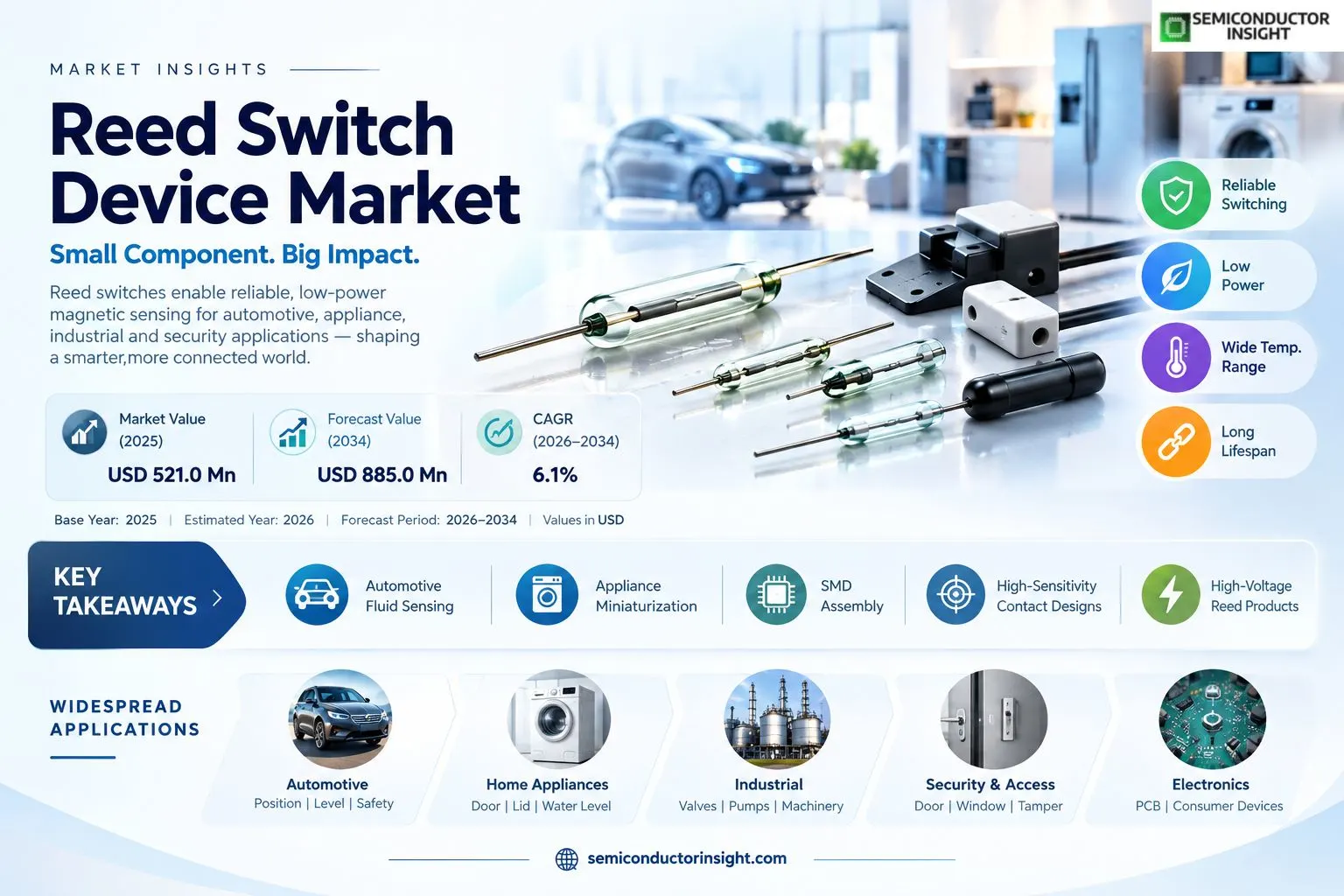
- Market size and growth: the market is valued at USD 521.0 million in 2025 and is projected to reach USD 885.0 million by 2034, representing a 6.1% CAGR over 2026–2034.
- Form A – Normally Open leads by type because normally open reed switches offer the simplest, lowest-power architecture for position, level, door and proximity sensing across high-volume applications.
- Magnetic Sensors leads application demand because contactless position, fluid-level and door-state detection uses the reed switch’s hermetic contacts, zero standby power and simple magnetic actuation.
- Asia Pacific is the largest regional market, while Asia Pacific has the strongest incremental growth profile.
- Primary driver: automotive, appliance and industrial systems continue to need simple low-power magnetic position and level sensing with long qualified lifecycles
- Principal restraint: solid-state Hall sensors offer contactless operation, richer digital outputs and higher switching endurance in applications where standby power is acceptable
Market Overview
The reed switch device market was valued at USD 521.0 million in 2025 and is projected to reach USD 885.0 million by 2034, expanding at a 6.1% CAGR over 2026–2034. Asia Pacific leads in 2025, while the market is being reshaped by automotive fluid sensing, appliance miniaturization, SMD assembly, high-sensitivity contact designs and higher-voltage reed products for industrial and energy systems.. For Reed Switch Device suppliers, the commercial implication is that product performance must translate into a measurable system benefit, not only a stronger component specification.
Reed switches are magnetically actuated electromechanical devices in which ferromagnetic contacts are sealed inside a glass envelope, providing a simple isolated switch with no standby power at the contact element. Littelfuse, Standex and PIC all position reed technology for proximity, position, level and security sensing because the sealed contact system can operate across wide temperature ranges and harsh environments. The basic architecture remains mature, but product differentiation increasingly comes from sensitivity, package size, contact material, switching voltage, mechanical robustness and suitability for automated surface-mount assembly.
Automotive and appliance applications are expanding the value of integrated reed sensors rather than bare switches alone. Littelfuse offers molded position and fluid-level sensors built around reed contacts, while PIC provides custom sensors for e-mobility, appliances and industrial equipment. These products combine a qualified reed element with a housing, cable or connector so OEMs can integrate magnetic sensing without developing the mechanical interface themselves. This shifts part of the market from commodity component pricing toward application-specific assemblies with stronger engineering content and longer qualification cycles.
Reed devices remain competitive against Hall-effect sensors because they do not need power to maintain the switching state and provide galvanically isolated metallic contacts, although Hall devices offer solid-state durability and easier multi-axis integration. HSI Sensing continues to develop high-power and shock-resistant reed products, while Comus offers a broad portfolio of switches and sensors for industrial control, security and fluid-level applications. The technology therefore retains a durable niche where low leakage, simple circuitry, wide environmental tolerance and long shelf life outweigh mechanical switching speed or cycle-count limitations.
Segment Analysis: By Type
By type, the market is segmented into Form A – Normally Open, Form B – Normally Closed, Form C – Changeover (SPDT), Other Configurations. Form A – Normally Open holds the leading position because normally open reed switches offer the simplest, lowest-power architecture for position, level, door and proximity sensing across high-volume applications. Procurement decisions in the Reed Switch Device market therefore increasingly consider qualification evidence, integration effort, lifecycle support and supply continuity alongside unit price. As adoption broadens, vendors that combine repeatable manufacturing with application engineering and documented reliability should be better positioned for long production programs.
| Type | Function / role | Market position |
|---|---|---|
| Form A – Normally Open | Contacts close when a magnetic field exceeds the operate threshold. | Leading configuration for proximity, position, door and level detection. |
| Form B – Normally Closed | Contacts open when exposed to a sufficient magnetic field. | Used where fail-safe or inverse logic is preferred. |
| Form C – Changeover (SPDT) | One common contact transfers between normally closed and normally open terminals. | Higher-value configuration for state selection and control circuits. |
| Other Configurations | Includes latching, miniature, high-voltage and custom reed structures. | Specialized segment addressing power, space or bistable requirements. |
Commercial implications by type
Form A dominates because it provides the simplest magnetic switch function and can be integrated into very compact molded sensors, PCB modules or cylindrical level probes. Form B and Form C devices address applications that need inverse logic or a transfer contact, while latching reeds can preserve state without continuous magnetic presence. Suppliers differentiate through operate sensitivity measured in ampere-turns, contact resistance, release ratio, switching power and shock resistance. These electrical and mechanical parameters often matter more than the basic contact form once an OEM begins production qualification.
Segment Analysis: By Application
By application, the market includes Reed Relays, Magnetic Sensors, Security and Access Control, Other Niche Uses. Magnetic Sensors leads demand because contactless position, fluid-level and door-state detection uses the reed switch’s hermetic contacts, zero standby power and simple magnetic actuation. As adoption broadens, vendors that combine repeatable manufacturing with application engineering and documented reliability should be better positioned for long production programs. This makes design support and field-proven integration increasingly important because the cost of requalification can exceed the incremental saving from a lower-priced component.
| Application | Demand characteristics |
|---|---|
| Reed Relays | Reed contacts inside coils provide galvanic isolation and low leakage for test, telecom and instrumentation switching. |
| Magnetic Sensors | Largest use across position, level, speed and presence detection in automotive, appliance and industrial equipment. |
| Security and Access Control | Door, window and tamper sensors use simple magnet-actuated state detection with no standby contact power. |
| Other Niche Uses | Medical, metering, marine, white goods and specialty controls create long-life application demand. |
By End User
| End User | Commercial relevance |
|---|---|
| Automotive | Fluid level, seat, door, brake and position functions use qualified reed sensors. |
| Home Appliance | Water level, lid, door and mechanism sensing support high-volume demand. |
| Industrial Control | Cylinders, valves, pumps and machinery use robust magnetic position feedback. |
| Security Systems | Door and access sensors value low standby power and simple wiring. |
By Function
| Function | Commercial relevance |
|---|---|
| Monostable | Returns to the normal state when the magnetic field is removed. |
| Bistable / Latching | Retains state until an opposite magnetic field resets the device. |
| High-Sensitivity | Low operate ampere-turns support weaker magnets or greater sensing distance. |
| High-Power / High-Voltage | Optimized contacts handle larger loads or higher switching voltage. |
By Package
| Package | Commercial relevance |
|---|---|
| Bare Glass Reed | Lowest-cost element for custom sensor assemblies. |
| SMD Reed Switch | Supports automated PCB placement and compact electronics. |
| Molded Sensor Assembly | Adds housing, cable, connector and magnet geometry for direct OEM use. |
Regional Analysis
Asia Pacific leads the market because China, Japan and broader Asia Pacific combine high-volume appliance, automotive, electronics and industrial manufacturing with a large regional reed-switch supplier base. Asia Pacific has the strongest growth profile through vehicle electrification, appliance automation and industrial sensing continue to expand magnetic position and fluid-level applications across regional manufacturing hubs. This makes design support and field-proven integration increasingly important because the cost of requalification can exceed the incremental saving from a lower-priced component.
How does regional demand differ across this market?
Asia Pacific leads volume because appliance, automotive and electronics manufacturing consume large quantities of reed switches and molded sensor assemblies. Europe is important in automotive, industrial and specialist sensor engineering, while North America has strong security, industrial and relay demand supported by suppliers such as Standex, Littelfuse and HSI Sensing. South America and the Middle East & Africa remain more import-dependent, where reed technology is adopted through appliances, vehicles, metering and industrial equipment. Across regions, reliability and mechanical integration often outweigh the very low unit cost of the bare contact.
| Region | Position | Growth outlook | Demand profile | Supplier selection |
|---|---|---|---|---|
| Asia Pacific | Largest | Fastest | Automotive, appliance and electronics scale | Cost, miniaturization, high-volume quality |
| North America | Second | Strong | Industrial, security and relay demand | Reliability, qualification, engineering support |
| Europe | Third | Strong | Automotive and industrial sensing | Automotive qualification, precision, lifecycle |
| South America | Smaller | Moderate | Automotive and appliance assembly | Cost, import availability, service |
| Middle East & Africa | Emerging | Moderate | Infrastructure, security and industrial systems | Ruggedness, availability, low power |
Competitive Landscape
Competition combines large global component vendors with specialized reed-switch manufacturers that differentiate through sensitivity, contact metallurgy, package design and application-specific sensor assemblies. For Reed Switch Device suppliers, the commercial implication is that product performance must translate into a measurable system benefit, not only a stronger component specification. Procurement decisions in the Reed Switch Device market therefore increasingly consider qualification evidence, integration effort, lifecycle support and supply continuity alongside unit price. As adoption broadens, vendors that combine repeatable manufacturing with application engineering and documented reliability should be better positioned for long production programs.
Littelfuse and Standex provide broad portfolios that range from bare reed elements to molded position and fluid-level sensors, allowing them to address both component buyers and OEMs seeking ready-to-install assemblies. Littelfuse’s MDRR and 59000-series products illustrate the breadth from miniature switches to packaged sensors, while Standex publishes detailed reed-switch technical resources and custom solutions. This breadth creates a competitive advantage because OEMs can qualify one supplier across several sensor geometries while receiving application support for magnet choice, operate distance, mounting tolerance and environmental sealing.
PIC GmbH, HSI Sensing and Comus compete strongly in specialized and customized applications. PIC emphasizes reed sensors for automotive, industrial and e-mobility systems, while HSI offers shock-resistant and high-power devices for demanding switching. Comus covers switches, sensors and custom assemblies across industrial, security and level-sensing applications. These companies can differentiate from large catalog vendors by adapting lead form, sensitivity, housing, cable, connector or magnetic geometry to one customer’s mechanism. Customization is commercially important because the mechanical relationship between reed and magnet often determines field reliability more than the switch alone.
The competitive threat comes primarily from Hall-effect and magnetoresistive sensors rather than from another mechanical contact technology. Solid-state devices support higher switching frequency, richer diagnostics and smaller multi-axis packages, but reed switches retain advantages in isolation, near-zero standby contact power and very low leakage. Suppliers therefore focus on applications where the electrical simplicity of a hermetic contact creates real system value. High-voltage, latching, miniature and surface-mount designs extend the technology into use cases that conventional low-cost Form A reeds could not address as effectively.
| Competitive tier | Representative participants | Competitive focus |
|---|---|---|
| Global diversified suppliers | Littelfuse, Standex Electronics | Broad switch and sensor portfolios with automotive and industrial support |
| Reed specialists | PIC GmbH, HSI Sensing, Comus | Custom sensitivity, high-power and application-specific designs |
| Regional component suppliers | Nippon Aleph, RMCIP, Xurui and others | High-volume standard and localized sensor products |
Companies Profiled
Littelfuse, Standex Electronics, PIC GmbH, HSI Sensing, Comus International, Nippon Aleph, RMCIP, Xurui. The set reflects companies directly active in products, process technology, manufacturing or the supporting application ecosystem rather than an evaluative ranking. Procurement decisions in the Reed Switch Device market therefore increasingly consider qualification evidence, integration effort, lifecycle support and supply continuity alongside unit price. As adoption broadens, vendors that combine repeatable manufacturing with application engineering and documented reliability should be better positioned for long production programs.
Production Capacity Analysis
Manufacturing capacity depends on contact stamping, ferromagnetic blade preparation, precious-metal contact plating, glass-to-metal sealing, magnetic sensitivity sorting and high-volume electrical and mechanical test. For Reed Switch Device suppliers, the commercial implication is that product performance must translate into a measurable system benefit, not only a stronger component specification. Procurement decisions in the Reed Switch Device market therefore increasingly consider qualification evidence, integration effort, lifecycle support and supply continuity alongside unit price. As adoption broadens, vendors that combine repeatable manufacturing with application engineering and documented reliability should be better positioned for long production programs.
Reed-switch production looks simple externally but depends on tight control of contact alignment, blade metallurgy and glass sealing. The two ferromagnetic reeds must be positioned with a precise gap so the operate and release magnetic thresholds remain within specification across temperature and mechanical shock. Hermetic sealing protects the contacts from contamination, but the glass-to-metal interface must also survive lead forming and assembly stress. High-volume suppliers therefore invest heavily in automated sorting because sensitivity variation directly changes sensing distance in the customer’s final magnet-and-housing design.
Molded sensor assemblies add another manufacturing layer beyond the bare switch. Suppliers may integrate the reed with a magnet, plastic housing, cable, connector, float or threaded body, then validate sealing, pull strength, shock and environmental performance. This creates more value per unit but also increases tooling and customer-specific inventory. Surface-mount devices require pick-and-place-compatible packages and reflow stability, while high-power reeds need larger contacts and specialized metallurgy. Effective capacity therefore depends as much on application-specific assembly and testing as on glass reed production itself.
Market Dynamics
The market is mature at the basic switch level but continues to gain value through custom sensor assemblies, automotive qualification, SMD formats and specialized high-power or latching designs. For Reed Switch Device suppliers, the commercial implication is that product performance must translate into a measurable system benefit, not only a stronger component specification. Procurement decisions in the Reed Switch Device market therefore increasingly consider qualification evidence, integration effort, lifecycle support and supply continuity alongside unit price.
Reed switches compete by solving a narrow set of sensing and switching problems extremely well rather than by replacing all solid-state magnetic sensors. Their sealed metallic contact, simple two-wire interface and negligible standby power remain difficult to match in low-duty or fail-safe systems. At the same time, Hall and magnetoresistive sensors continue to take share in applications that need precise analog position, high switching speed or digital diagnostics. The market therefore rewards suppliers that move beyond commodity reeds into application-specific mechanical integration and high-reliability qualification.
Market Drivers
Drivers Impact Analysis
| Driver | Impact | Commercial mechanism |
|---|---|---|
| Automotive fluid and position sensing | High | Vehicles contain many magnetic sensing points in fluid reservoirs, doors, seats, latches and auxiliary mechanisms. Reed sensors are attractive where a simple discrete state is enough and where zero standby contact power or galvanic isolation provides system value. Littelfuse and PIC both market molded automotive-oriented reed sensors, demonstrating that the opportunity is increasingly in complete assemblies rather than bare contacts. Electric vehicles add cooling and thermal-management circuits that create further opportunities for robust level and position sensing around pumps, tanks and actuators. |
| Home-appliance automation | High | Washing machines, dishwashers, refrigerators, coffee machines and other appliances use magnetic sensing for doors, lids, floats and mechanism position. The reed switch is inexpensive, electrically simple and easy to isolate from moisture when packaged inside a molded housing. Large appliance volumes support standardized Form A devices, while miniaturized SMD or custom assemblies can reduce manual wiring. As appliances add electronic controls, the number of sensing points increases even when the basic mechanism remains mechanical, sustaining a large installed base for reed technology. |
| Industrial reliability | Medium | Pneumatic cylinders, valves, pumps, machine guards and process equipment need dependable position feedback in environments where dust, vibration or electrical noise can complicate other sensor types. Hermetically sealed reed contacts and wide-temperature packages remain attractive for simple binary detection, particularly when equipment platforms stay in production for many years. Specialized vendors offer shock-resistant and high-power products that extend use beyond conventional proximity sensing. Long industrial qualification cycles also make incumbent design wins durable once the magnet geometry and sensor package have been validated. |
| Low-power security sensing | Medium | Door, window and tamper detectors often need years of operation with minimal power consumption. A reed contact can remain in one state without drawing sensor current, leaving only the monitoring circuit or wireless node to consume power. This makes the technology well suited to alarm systems, battery sensors and simple access detection. Solid-state alternatives can add intelligence, but the reed’s passive switching behavior, low leakage and established installation practices preserve demand where the system only needs reliable open-or-closed state information. |
Automotive fluid and position sensing
Vehicles contain many magnetic sensing points in fluid reservoirs, doors, seats, latches and auxiliary mechanisms. Reed sensors are attractive where a simple discrete state is enough and where zero standby contact power or galvanic isolation provides system value. Littelfuse and PIC both market molded automotive-oriented reed sensors, demonstrating that the opportunity is increasingly in complete assemblies rather than bare contacts. Electric vehicles add cooling and thermal-management circuits that create further opportunities for robust level and position sensing around pumps, tanks and actuators.
Home-appliance automation
Washing machines, dishwashers, refrigerators, coffee machines and other appliances use magnetic sensing for doors, lids, floats and mechanism position. The reed switch is inexpensive, electrically simple and easy to isolate from moisture when packaged inside a molded housing. Large appliance volumes support standardized Form A devices, while miniaturized SMD or custom assemblies can reduce manual wiring. As appliances add electronic controls, the number of sensing points increases even when the basic mechanism remains mechanical, sustaining a large installed base for reed technology.
Industrial reliability
Pneumatic cylinders, valves, pumps, machine guards and process equipment need dependable position feedback in environments where dust, vibration or electrical noise can complicate other sensor types. Hermetically sealed reed contacts and wide-temperature packages remain attractive for simple binary detection, particularly when equipment platforms stay in production for many years. Specialized vendors offer shock-resistant and high-power products that extend use beyond conventional proximity sensing. Long industrial qualification cycles also make incumbent design wins durable once the magnet geometry and sensor package have been validated.
Low-power security sensing
Door, window and tamper detectors often need years of operation with minimal power consumption. A reed contact can remain in one state without drawing sensor current, leaving only the monitoring circuit or wireless node to consume power. This makes the technology well suited to alarm systems, battery sensors and simple access detection. Solid-state alternatives can add intelligence, but the reed’s passive switching behavior, low leakage and established installation practices preserve demand where the system only needs reliable open-or-closed state information.
Market Restraints
Restraints Impact Analysis
| Restraint | Impact | Commercial mechanism |
|---|---|---|
| Hall-effect substitution | High | Hall and magnetoresistive sensors have no moving contacts, can switch very rapidly and can provide analog or digital information beyond a binary open or closed state. Their cost has fallen while integration has improved, making them attractive in compact electronics and automotive systems with available power. Reed switches retain advantages in isolation and passive operation, but they can lose designs where cycle life, multi-axis sensing, programmability or diagnostic feedback matters more than standby current. Suppliers must therefore target applications where the contact architecture creates a clear system benefit. |
| Mechanical cycle limits | Medium | Although reed contacts can achieve very long life at low electrical loads, they are still mechanical devices and can wear, stick or degrade if switching current, inrush or arcing exceeds the contact rating. Load type therefore matters significantly; inductive or capacitive loads can impose much higher stress than nominal steady-state current suggests. High-power reed products and contact coatings extend capability, but customers still need proper suppression and derating. This creates a design burden that solid-state sensors avoid when they provide only a logic signal. |
| Magnet and tolerance dependence | Medium | A reed switch does not determine sensing distance by itself because the operate point depends on magnet strength, orientation, mechanical tolerance and the switch’s ampere-turn sensitivity. Small changes in housing or magnet supplier can shift the field at the contacts and create intermittent operation. OEMs therefore need tolerance analysis and often custom sensitivity sorting. This mechanical dependency can lengthen qualification and complicate second sourcing, especially in automotive or appliance mechanisms where assembly stack-up varies across millions of units. |
| Commodity price pressure | Medium | Standard Form A reeds are mature components with many regional suppliers, creating strong price competition in appliances, security and simple industrial sensing. Bare-switch margins can therefore be low, particularly when customers can qualify several sources with similar magnetic sensitivity and package geometry. Leading suppliers respond by offering molded sensors, high-voltage designs, SMD packages and engineering support that are harder to commoditize. The market’s value growth consequently depends more on specialized assemblies and qualified applications than on unit growth in the simplest glass reed devices. |
Hall-effect substitution
Hall and magnetoresistive sensors have no moving contacts, can switch very rapidly and can provide analog or digital information beyond a binary open or closed state. Their cost has fallen while integration has improved, making them attractive in compact electronics and automotive systems with available power. Reed switches retain advantages in isolation and passive operation, but they can lose designs where cycle life, multi-axis sensing, programmability or diagnostic feedback matters more than standby current. Suppliers must therefore target applications where the contact architecture creates a clear system benefit.
Mechanical cycle limits
Although reed contacts can achieve very long life at low electrical loads, they are still mechanical devices and can wear, stick or degrade if switching current, inrush or arcing exceeds the contact rating. Load type therefore matters significantly; inductive or capacitive loads can impose much higher stress than nominal steady-state current suggests. High-power reed products and contact coatings extend capability, but customers still need proper suppression and derating. This creates a design burden that solid-state sensors avoid when they provide only a logic signal.
Magnet and tolerance dependence
A reed switch does not determine sensing distance by itself because the operate point depends on magnet strength, orientation, mechanical tolerance and the switch’s ampere-turn sensitivity. Small changes in housing or magnet supplier can shift the field at the contacts and create intermittent operation. OEMs therefore need tolerance analysis and often custom sensitivity sorting. This mechanical dependency can lengthen qualification and complicate second sourcing, especially in automotive or appliance mechanisms where assembly stack-up varies across millions of units.
Commodity price pressure
Standard Form A reeds are mature components with many regional suppliers, creating strong price competition in appliances, security and simple industrial sensing. Bare-switch margins can therefore be low, particularly when customers can qualify several sources with similar magnetic sensitivity and package geometry. Leading suppliers respond by offering molded sensors, high-voltage designs, SMD packages and engineering support that are harder to commoditize. The market’s value growth consequently depends more on specialized assemblies and qualified applications than on unit growth in the simplest glass reed devices.
Market Opportunities
EV thermal-management sensing
Electric vehicles contain complex coolant loops, pumps, reservoirs and thermal-management systems for batteries, power electronics and cabins. Reed-based float or position sensors can provide simple, robust level detection without continuous sensor power. The opportunity is strongest where a binary state is sufficient and the sensor can be sealed from fluid and environmental exposure. Automotive qualification creates high barriers to entry, but once a molded sensor is validated for one reservoir or actuator design, the long vehicle platform life can generate stable multi-year volume.
Surface-mount reed switches
SMD packages allow reed technology to participate in automated electronics assembly rather than requiring through-hole leads or hand-mounted glass components. Littelfuse and specialist suppliers offer compact parts that can be placed on PCBs for meters, controls and appliance modules. This reduces assembly cost and helps reed devices compete in modern compact products. Continued improvements in reflow stability, package strength and low ampere-turn sensitivity can extend the technology into space-constrained applications where traditional glass reeds would be mechanically awkward or too large.
Latching and bistable sensors
Latching reed configurations retain their state until exposed to an opposite magnetic field, enabling memory-like mechanical behavior without continuous coil or sensor power. This can be useful in metering, battery equipment, position indicators and low-power control systems where the last mechanical state must remain known after power is removed. The niche is smaller than standard Form A sensing, but it supports higher value because magnetic design and contact behavior are more specialized. Custom housing and magnet assemblies can further differentiate supplier offerings.
High-voltage and high-power switching
Specialized reed switches can handle substantially higher voltage or load than ordinary sensor contacts, opening opportunities in test equipment, battery systems, instrumentation and industrial control. HSI Sensing and other specialists market products designed for elevated switching stress, while reed relays use the same contact principle for low-leakage isolated switching. As electrification expands, these niches can grow where semiconductor leakage, off-state capacitance or galvanic isolation makes a mechanical contact advantageous despite slower switching and finite cycle life.
Supply Chain Analysis
Ferromagnetic reeds and precious-metal contact coatings
Hermetic envelope formation and sensitivity control
Housing, cable, connector, float or magnet integration
Automotive, appliance, industrial, security and relay systems
Contact materials
Reed blades require magnetic properties that allow reliable attraction under the target field while also providing low contact resistance and stable spring behavior. Contact surfaces may use rhodium, ruthenium or other coatings selected for switching load, corrosion resistance and life. The metallurgy must be controlled closely because surface contamination or inconsistent plating can change contact resistance and wear. Specialized high-power reeds use different blade dimensions or contact structures than miniature sensor products, creating distinct material and stamping requirements.
Glass sealing
The glass envelope provides hermetic protection and fixes the contact spacing, making sealing one of the most critical production steps. Thermal expansion between metal and glass must be compatible so the seal does not crack during cooling, lead forming or field temperature cycling. The final gap and blade overlap determine magnetic sensitivity and release behavior, so manufacturers test and sort parts after sealing. High-volume automation is essential because sensitivity distribution affects how much magnet strength and mechanical tolerance the customer’s assembly must accommodate.
Sensor assembly
Bare reeds are often integrated into molded packages, threaded level sensors, cable assemblies or PCB housings before reaching the final OEM. This stage adds mechanical protection and controls the physical relationship between magnet and switch, which can materially improve field reliability. Custom assemblies require tooling, sealing, connector sourcing and application-specific environmental testing. Suppliers that can provide both the reed element and the finished sensor capture more value while reducing the OEM’s need to manage magnetic geometry, housing design and secondary assembly.
OEM integration
The final application determines magnet size, sensing distance, switching load, environmental exposure and expected cycle life. Automotive and appliance manufacturers typically validate the entire sensor mechanism rather than the bare reed alone, while industrial customers may prefer standardized threaded or cylinder sensors for easier replacement. Security systems value simple two-wire operation and low standby consumption. The supply chain therefore depends heavily on application engineering because a technically adequate reed switch can still fail if the magnet, load suppression or mechanical tolerances are not engineered correctly.
Recent Developments
Current — Littelfuse maintains broad miniature and molded reed-sensor families<pstyle=”margin:5px 0 0″>Current products cover bare switches, position sensors, fluid-level devices and automotive-oriented magnetic sensing. Source
Current — Standex expands technical and custom reed-switch resources
The company’s current technical library addresses operate sensitivity, contact protection, high-voltage use and application design. Source
Current — PIC develops custom reed sensors for e-mobility and industrial systems
PIC’s current portfolio includes standard and customized reed sensors, switches and magnet assemblies. Source
Report Scope & Segmentation
| Attribute | Coverage |
|---|---|
| Market | Reed Switch Device |
| Base Year | 2025 |
| Estimated Year | 2026 |
| Forecast Period | 2026–2034 |
| 2025 Market Size | USD 521.0 million |
| 2026 Estimated Size | USD 552.6 million |
| 2034 Forecast Size | USD 885.0 million |
| CAGR | 6.1% (2026–2034) |
| By Type | Form A – Normally Open, Form B – Normally Closed, Form C – Changeover (SPDT), Other Configurations |
| By Application | Reed Relays, Magnetic Sensors, Security and Access Control, Other Niche Uses |
| By End User | Automotive, Home Appliance, Industrial Control, Security Systems |
| By Function | Monostable, Bistable / Latching, High-Sensitivity, High-Power / High-Voltage |
| By Package | Bare Glass Reed, SMD Reed Switch, Molded Sensor Assembly |
| Regions | Asia Pacific, North America, Europe, South America, Middle East & Africa |
| Companies Profiled | Littelfuse, Standex Electronics, PIC GmbH, HSI Sensing, Comus International, Nippon Aleph, RMCIP, Xurui |
Frequently Asked Questions
What is the reed switch device market size in 2025?
The market is valued at USD 521.0 million in 2025.
What is the projected market size by 2034?
The market is projected to reach USD 885.0 million by 2034.
What is the CAGR from 2026 to 2034?
The market is expected to expand at a 6.1% CAGR.
Which region leads the market?
Asia Pacific is the largest regional market in 2025.
Which type leads the market?
Form A – Normally Open is the leading type.
Which application leads demand?
Magnetic Sensors is the leading application.
What is the main growth driver?
automotive, appliance and industrial systems continue to need simple low-power magnetic position and level sensing with long qualified lifecycles.
What is the principal restraint?
solid-state Hall sensors offer contactless operation, richer digital outputs and higher switching endurance in applications where standby power is acceptable.
Where are the strongest opportunities?
EV fluid sensing, SMD reed switches, high-power reeds, latching sensors and custom molded assemblies for appliances and industrial equipment.
Which companies are active in the market?
Littelfuse, Standex Electronics, PIC GmbH, HSI Sensing, Comus International, Nippon Aleph, RMCIP, Xurui.
Research Sources & Evidence Base
View primary, official and technical evidence used in this overview
- Littelfuse: MDRR-DT Miniature Reed Switch — Miniature Form A/Form B device characteristics and magnetic switching.
- Littelfuse: 59170 Miniature Flange Mount Sensor — Packaged position-sensor construction and application coverage.
- Littelfuse: 59020 Reed Sensor — Molded magnetic sensing for industrial and appliance applications.
- Littelfuse: Reed Switch Selection Guide — Contact form, sensitivity, switching and application-selection guidance.
- Littelfuse: Fluid Level Sensor Solutions — Automotive and equipment fluid-level sensing applications.
- Standex Electronics: Reed Switch Products — Standard, miniature, high-voltage and application-specific reed switches.
- Standex Electronics: Reed Switch Technical Library — Technical material on switching, protection, sensitivity and reliability.
- PIC GmbH: Reed Switches and Sensors — Company reed-switch and sensor technology overview.
- PIC GmbH: Reed Sensors — Automotive, appliance, industrial and customized sensor applications.
- PIC GmbH: Reed Switch FAQ — Operate sensitivity, function and application guidance.
- HSI Sensing: Reed Switch Products — High-reliability and specialized reed-switch product portfolio.
- Comus International: Reed Switches — Reed-switch, magnetic-sensor and industrial application portfolio.
Get Sample Report PDF for Exclusive Insights
Report Sample Includes
- Table of Contents
- List of Tables & Figures
- Charts, Research Methodology, and more...
 Download Sample Report PDF