Piezoresistive Micro-Force Sensors Market Insights
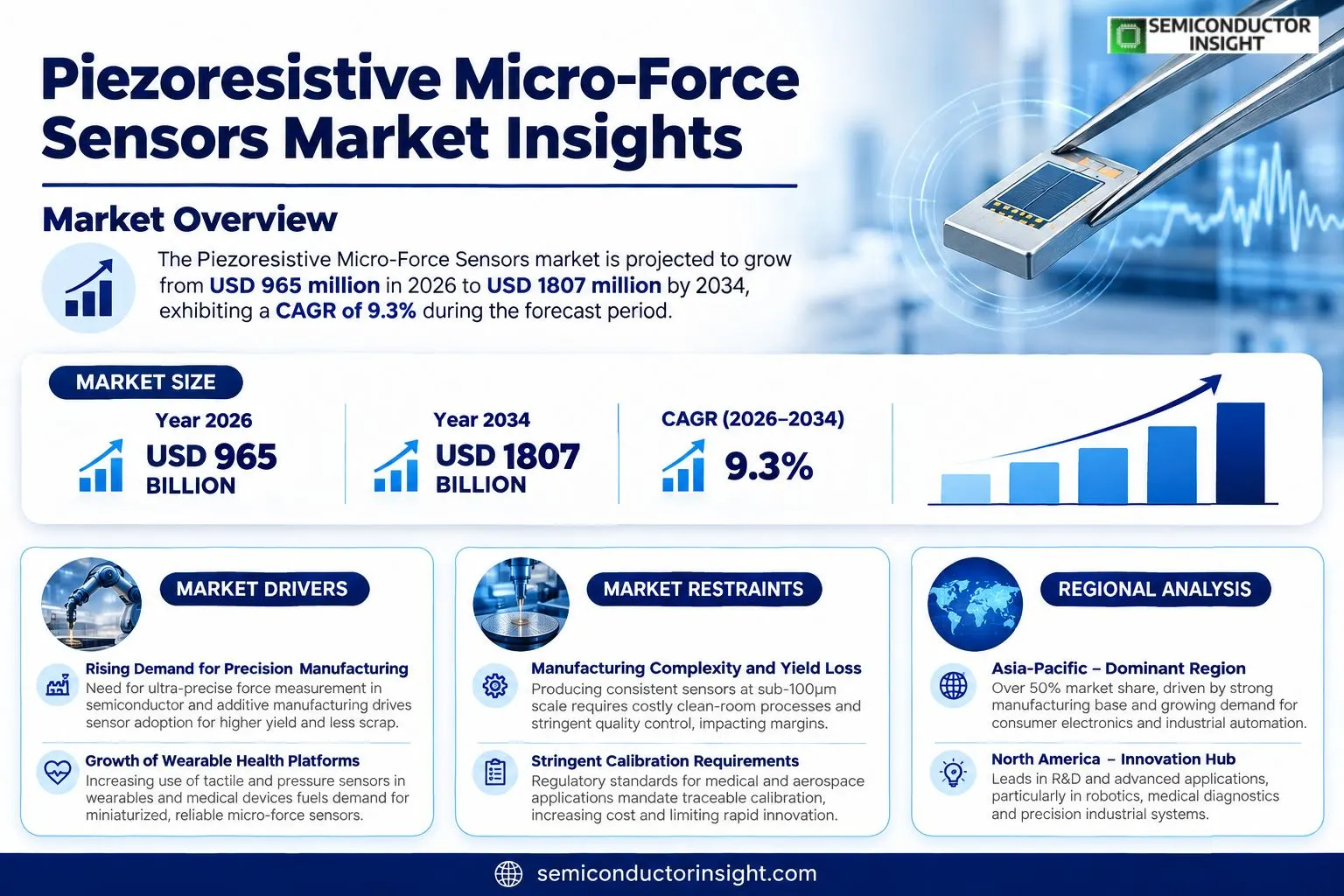
Piezoresistive Micro-Force Sensors market size was valued at USD 965 million in 2025. The market will increase from USD 965 million in 2025 to USD 1807 million by 2032, delivering a CAGR of 9.3% over the period.
Piezoresistive Micro-Force Sensors are devices that convert mechanical pressure into electrical signals through a force‑sensitive resistor whose resistance varies with applied load. Core components include the resistor element, a substrate such as PET or polyimide, and signal‑processing circuitry that translates resistance changes into voltage or current outputs.Growth is fueled by expanding demand for tactile sensing in consumer electronics, automotive systems, medical equipment, and robotics. Manufacturers benefit from low‑cost production, fast response times, and compatibility with miniaturized hardware, while regional hubsNorth America for high‑end R&D, Europe for precision automation, and Asia‑Pacific for volume manufacturingstrengthen supply chains.
MARKET DRIVERS
Increasing Demand for Precision Manufacturing
The rise of semiconductor fabrication and additive‑manufacturing techniques has heightened the need for sensors capable of measuring forces in the micronewton range. Manufacturers are turning to Piezoresistive Micro-Force Sensors to verify tool wear and to maintain tight tolerances, thereby reducing scrap rates and improving yield.
Growth of Wearable Health Platforms
Wearable devices that monitor tactile feedback, pulse transit time, or skin‑contact pressure rely on miniature force transducers. The surge in consumer‑focused health gadgets pushes sensor developers to embed piezoresistive elements that deliver stable output despite temperature fluctuations.
➤ “Over the past 12 months, sensor shipments to medical‑device firms have risen by roughly 18 %, reflecting tighter integration of micro‑force measurement in diagnostic tools.”
These two forceshigh‑precision production and biometric wearablescreate a dual‑track pull that is reshaping the supply chain. OEMs that secure early access to advanced piezoresistive designs can command premium pricing while expanding into adjacent applications such as robotics and haptic interfaces.
MARKET CHALLENGES
Manufacturing Complexity and Yield Loss
Producing consistent piezoresistive elements at sub‑100 µm dimensions demands clean‑room processes that are both costly and vulnerable to particulate contamination. Even minor deviations in doping concentration can cause drift, forcing manufacturers to implement extensive quality‑control loops that erode margins.
Other Challenges
Supply‑Chain Volatility
The reliance on high‑purity silicon wafers and specialty alloys means that geopolitical shifts or raw‑material shortages can quickly translate into lead‑time extensions, complicating delivery commitments for end‑users.
MARKET RESTRAINTS
Stringent Calibration Requirements
Regulatory frameworks for aerospace and medical equipment mandate traceable calibration against national standards. The expense of maintaining accredited calibration labs discourages smaller players from entering the niche, consolidating market power among established manufacturers.The calibration burden also discourages rapid product iteration; firms must allocate significant engineering resources to prove that each new sensor version meets the same stringent accuracy thresholds.Consequently, the market experiences a slower turnover of innovative form factors, as the cost‑benefit calculus favors incremental improvements over radical redesigns.
MARKET OPPORTUNITIES
Integration with AI‑Driven Predictive Maintenance
Embedding piezoresistive micro‑force sensors in industrial equipment enables real‑time data streams that feed machine‑learning models. These models can anticipate bearing failure or tool breakage days before a breakdown occurs, delivering measurable cost savings for manufacturers.Companies that package sensor hardware with analytics platforms stand to capture a larger share of the value chain, as they transition from pure component suppliers to solutions providers.Additionally, the emergence of flexible substrate technologies opens pathways for conformal sensors on curved surfaces, expanding application horizons into soft robotics and next‑generation prosthetics.
Piezoresistive Micro-Force Sensors Market Trends
Accelerating Adoption in Consumer Electronics and Automotive
The integration of tiny force‑sensing elements into smartphones, wearables and in‑vehicle infotainment systems has sharpened competitive pressures on component suppliers. In 2025, unit shipments reached roughly 295 million, while the average price of about USD 3.6 k per thousand units kept profit margins in the 30‑40 % band. Manufacturers that pair the sensor core with on‑board signal‑conditioning chips are capturing a larger share of the value chain, because end‑users now demand sub‑millisecond response and multi‑axis read‑outs for gesture control and haptic feedback. This shift is not merely a volume story; it forces original equipment manufacturers to redesign PCB layouts and firmware, creating a cascade of engineering services that bolster the overall revenue environment for the Piezoresistive Micro‑Force Sensors Market.
Other Trends
Supply Chain Consolidation and Material Innovation
Upstream, the reliance on PET and polyimide substrates is being tempered by the emergence of low‑dielectric‑constant polymers that enable higher signal fidelity at reduced thickness. Suppliers such as Toray and DuPont have begun joint‑development programs with sensor firms to qualify zinc‑oxide nanowire layers that lower baseline resistance, thereby extending the measurable force range without enlarging the die. At the same time, the production line capacityspanning from tens of thousands to several hundred thousand units per shifthas been rationalized through modular equipment that can be re‑tasked across product families. This consolidation reduces inventory buffers, shortens lead times, and strengthens bargaining leverage for manufacturers aiming to sustain the current 30‑40 % gross margin envelope.
Regional Shifts: Asia‑Pacific Dominance and North American Innovation
Asia‑Pacific accounted for just over half of shipments in 2025, a share propelled by China’s expansive consumer‑electronics factories and South Korea’s advanced automotive sensor platforms. The region’s manufacturers are exploiting economies of scale to push low‑cost offerings into mass‑market devices, while Japanese firms focus on niche high‑precision segments such as semiconductor‑package force monitoring. Conversely, North America remains the hub for R&D breakthroughs, with firms like Tekscan pioneering integrated tactile‑feedback modules for robotics and surgical tools. This geographic split creates a two‑track strategic landscape: companies seeking volume growth gravitate toward APAC partnerships, whereas those targeting differentiated, high‑margin applications invest in North‑American collaborations. The divergent paths shape investment decisions, partnership models, and product roadmaps for players navigating the evolving Piezoresistive Micro‑Force Sensors Market.
COMPETITIVE LANDSCAPE
Key Industry Players
Piezoresistive Micro‑Force Sensor Market: Consolidation Amid Rapid Application Expansion
In 2025 the piezoresistive micro‑force sensor market was dominated by a handful of high‑profile manufacturers whose combined share exceeded 60 %. Nissha, with its long history of precision force measurement, leveraged a robust supply chain and an extensive contract base in automotive and industrial automation to secure the largest slice of the market. The company’s vertically integrated productionfrom raw‑material sourcing to process‑control circuitryhas delivered cost efficiency and sustainable margins ranging from 30 % to 40 %. This concentration of market power has, in turn, raised barriers for newcomers, as the incumbents command not only pricing confidence but also critical technical expertise in discrete, high‐accuracy sensor design. The resulting structure heightens the importance of cost control and ongoing product evolution, while simultaneously underscoring the centrality of established OEM relationships in sustaining revenue streams.Beyond the dominant players, a spectrum of niche suppliers continues to drive differentiation and regional demand. Hanwei Electronics Group, for example, finesses high‑precision automotive sensors that meet the stricter safety standards of the European and North American markets. NextInput, operating under the Qorvo umbrella, delivers compact, low‑power devices ideal for wearable and consumer electronics, while Memtronik and Ohmite focus on high‑reliability medical and industrial control applications. Interlink Electronics differentiates with modular sensor platforms that allow rapid integration into a variety of end‑user platforms. These smaller but technically focused firms enhance supply‑chain resiliency, support emerging product categories, and introduce incremental cost advantages that lower total ownership costs for downstream adopters.
List of Key Piezoresistive Micro‑Force Sensor Companies Profiled
- Nissha
- Tekscan
- Interlink Electronics
- NextInput (Qorvo)
- Memtronik
- Ohmite
- Hanwei Electronics Group
- Nanjing Momao Electronic Technology
- Shenzhen Ruihu Technology
- Sensitronics
- Taiwan Alpha Electronic
- LEGACT
Segment Analysis:
| Segment Category | Sub-Segments | Key Insights |
| By Type |
|
Leading Segment dominates due to simple circuitry, low cost, and fast response, enabling rapid integration into industrial automation and consumer devices. Key advantages include reduced power consumption and ease of mass production. Its prevalence supports a streamlined supply chain across OEMs. |
| By Application |
|
Leading Segment spots in consumer electronics where the need for responsive touch interfaces drives sensor adoption for smartphones and wearables. It also supports automotive driver‑assist systems, enhancing safety through precise force feedback. Robotics and medical use cases thrive on its miniaturized, low‑cost form factor. |
| By End User |
|
Leading Segment leads among OEMs who embed sensors into flagship devices, demanding durability and low power consumption. System integrators add value through calibration and custom firmware, while end‑product manufacturers prioritize cost efficiency. The collaboration network builds a robust ecosystem across industries. |
| By Sensor Technology]] |
|
Leading Segment remains Shunt Mode, favored for its direct resistance measurement and streamlined electronics, suiting high‑speed automation and consumer devices. Thru Mode offers higher sensitivity for medical and research applications but requires more complex circuitry. The market’s cost‑driven nature pushes toward the simpler Shunt approach. |
| By Shape]] |
|
Leading Segment is Circular, chosen for uniform pressure distribution on touch panels and ergonomically friendly designs in mobile devices. Rectangular shapes fit automotive dashboards and industrial panels, while other shapes support robotic grippers and specialized medical devices. Production scalability favors circular forms, driving widespread use. |
Regional Analysis: Piezoresistive Micro-Force Sensors Market
In the United States, adoption of piezoresistive micro‑force sensors shifts from niche laboratory research to mainstream manufacturing as demands for precise force measurement rise in robotics and medical diagnostics. Early adopters often integrate these devices into automated inspection lines, leveraging their low cost and high repeatability. The resultant incremental process improvements generate measurable quality gains, encouraging other firms to follow suit and further expanding deployment.
Market concentration remains moderate, with a handful of OEMs and component suppliers dominating key segments. Early entrants benefit from strong intellectual property portfolios that cover novel gauge materials and packaging techniques. Companies that partner with leading research institutions gain an advantage refining sensor performance under harsh operating conditions, enabling them to capture high‑margin applications in aerospace and biotesting.
Miniaturization and advanced packaging enable these sensors to be embedded within 3‑D printed structures and flexible electronics, opening routes to wearable diagnostics and soft robotics. Innovations in low‑loss transduction circuits preserve signal integrity at micro‑Newton levels, while digital signal processors convert analog readouts into actionable force maps in real time.
Opportunity clusters exist in emerging automated assembly lines and in‑situ health monitoring for remote workers. Companies that can translate sensor outputs into cloud‑based analytics stand to capture additional value, turning raw force data into actionable insights for predictive maintenance and patient‑specific treatment plans.
Europe
Europe’s piezoresistive micro‑force sensor market reflects a balance between established manufacturing facilities and an appetite for high‑technology healthcare solutions. Countries such as Germany and Sweden continue to invest heavily in automation, integrating sensors into assembly lines that produce precision instruments for aviation and medical equipment. At the same time, academic collaborations with national research agencies spawn new sensor designs that emphasize robustness against vibration and temperature variations. Market activity is moderated by stringent European Union safety standards, which both raise a minimum entry threshold and provide clear specifications that manufacturers can meet. The net effect is a market that shows steadybut cautiously expandingevidence of sensor adoption.
Asia-Pacific
The Asia‑Pacific region presents a heterogeneous market for piezoresistive micro‑force sensors, shaped by divergent industrial maturity across countries. In Japan and South Korea, early adoption supports high‑precision robotic surgery systems, reinforcing demand for ultra‑stable sensor arrays. Conversely, in rapidly industrializing economies such as India and Vietnam, the focus lies on cost‑effective automation for consumer electronics manufacturing. National initiatives that fund microelectronics research and provide subsidies for smart factories help bridge these segments, offering manufacturers pathways to scale production and enter regionally differentiated application spaces.
South America
In South America, adoption of piezoresistive micro‑force sensors is currently in the nascent stage, driven primarily by auto‑assembly plants seeking to improve quality control. Brazil’s automotive suppliers have begun integrating sensors to monitor grip forces during stamping processes, while smaller firms in Chile explore sensor‑powered inspection tools for aerospace components. Limited availability of local supply chains and the high cost of importing electronic components continue to curb rapid growth, yet strong fiscal incentives and growing regional capacity for electronics manufacturing hint at a potential upswing in the mid‑term.
Middle East & Africa
The Middle East and Africa market presents a fragmented landscape, where a few resource‑rich north‑east states invest in high‑end manufacturing for exports. In the Gulf Cooperation Council, advanced sensor systems are becoming integral to robotics used in petrochemical safety monitoring, whereas in South Africa the focus remains on clinical diagnostics equipment. Convincing local distributors to adopt a relatively new sensor technology requires evidence of reliability and affordability, making targeted trial programs and tiered pricing strategies essential tools for market penetration in this region.
Report Scope
This market research report provides a comprehensive analysis of the Piezoresistive Micro-Force Sensors Market , covering the forecast period 2026–2034. It offers detailed insights into market dynamics, technological advancements, competitive landscape, and key trends shaping the industry.
Key focus areas of the report include:
- Market Overview: The report begins with an overview outlining its current market scenario, key growth indicators, and industry transformation drivers. It discusses macroeconomic factors, demand–supply balance, regulatory landscape, and the strategic role of semiconductors in powering advancements across industries such as automotive, telecommunications, consumer electronics, and industrial automation.
- Market Size & Forecast: Historical data and future projections for revenue, unit shipments, and market value across major regions and segments.
- Segmentation Analysis: Detailed breakdown by product type, technology, application, and end-user industry to identify high-growth segments and investment opportunities.
- Regional Insights: Insights into market performance across North America, Europe, Asia-Pacific, Latin America, and the Middle East & Africa, including country-level analysis where relevant.
- Competitive Landscape: Profiles of leading market participants, including their product offerings, R&D focus, manufacturing capacity, pricing strategies, and recent developments such as mergers, acquisitions, and partnerships.
- Technology Trends & Innovation: Assessment of emerging technologies, integration of AI/IoT, semiconductor design trends, fabrication techniques, and evolving industry standards.
- Market Drivers & Restraints: Evaluation of factors driving market growth along with challenges, supply chain constraints, regulatory issues, and market-entry barriers.
- Stakeholder Insights: Insights for component suppliers, OEMs, system integrators, investors, and policymakers regarding the evolving ecosystem and strategic opportunities.
Primary and secondary research methods are employed, including interviews with industry experts, data from verified sources, and real-time market intelligence to ensure the accuracy and reliability of the insights presented.
FREQUENTLY ASKED QUESTIONS:
What is the current market size of Piezoresistive Micro-Force Sensors Market?
-> Piezoresistive Micro-Force Sensors Market was valued at USD 965 million in 2025 and is expected to reach USD 1807 million by 2032, at a CAGR of 9.3%.
Which key companies operate in Piezoresistive Micro-Force Sensors Market?
-> Key players include Nissha, Memtronik, Tekscan, Butler Technologies, Hanwei Electronics Group, Nanjing Momao Electronic Technology, NextInput (Qorvo), Interlink, and Ohmite, among others.
What are the key growth drivers?
-> Key growth drivers include expanding demand in consumer electronics, automotive electronics, medical devices, and robotics, along with industry automation requirements, miniaturization, and integration of AI/IoT technologies.
Which region dominates the market?
-> Asia‑Pacific dominates the market with over 50% share, followed by North America and Europe.
What are the emerging trends?
-> Emerging trends include sensor miniaturization, intelligent and flexible sensing, and development of high‑precision sensors for automotive electronics and semiconductor packaging.
Get Sample Report PDF for Exclusive Insights
Report Sample Includes
- Table of Contents
- List of Tables & Figures
- Charts, Research Methodology, and more...