
Obstacle Detection Sensor Market Insights
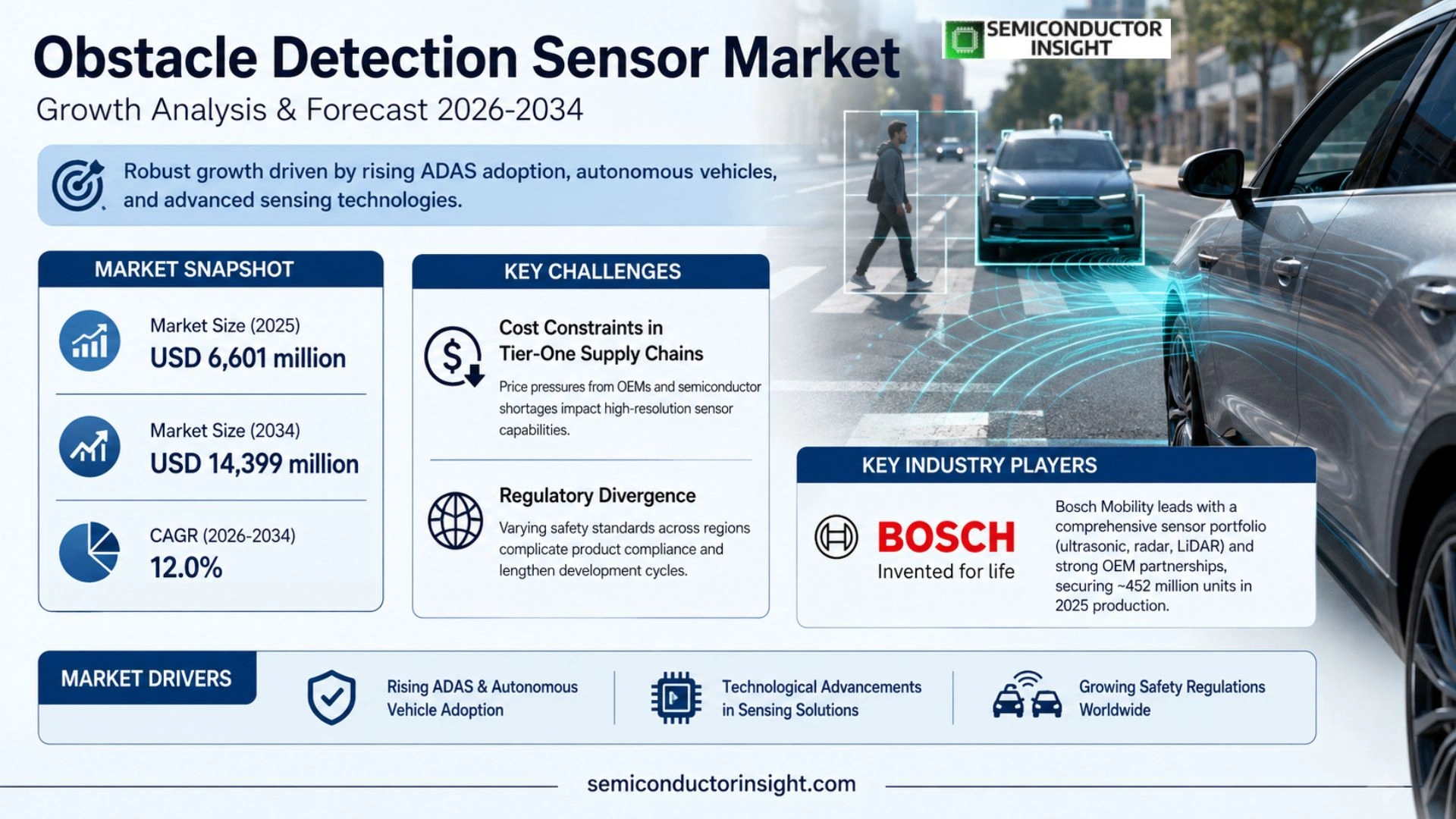
Obstacle Detection Sensor market was valued at USD 6,601 million in 2025 and is projected to reach USD 14,399 million by 2034, at a CAGR of 12.0% during the forecast period.
An obstacle detection sensor is a sensing device used to detect the presence, distance, position, or motion state of a target object. It identifies obstacles through principles such as ultrasound, photo‑electric, laser, millimetre‑wave or vision and delivers signals for avoidance, collision warning, path planning or safety protection.
From a research perspective, sensors built on mature optoelectronic or ultrasonic technologies typically achieve gross margins of 30 %–45 %, whereas safety‑laser scanners, 3D‑ToF cameras, industrial LiDAR or millimetre‑wave radar modules often command margins of 45 %–60 %. Automotive‑grade high‑volume ultrasonic or short‑range radar units face tighter pricing pressure resulting in margins around 20 %–35 %.
MARKET DRIVERS
Growing Automation in Mobility
Automakers are integrating advanced safety suites to meet stricter regulatory requirements and rising consumer expectations. Obstacle Detection Sensor Market participants benefit from the shift toward level‑2 and level‑3 driver assistance systems, where reliable detection of pedestrians, cyclists, and static objects becomes a non‑negotiable component of vehicle architecture.
Industrial Robotics Expansion
Factories adopting collaborative robots (cobots) demand sensors that can instantly recognize barriers and halt motion to protect human workers. Obstacle Detection Sensor Market growth is further reinforced by the need for precise, low‑latency sensing in high‑throughput assembly lines where downtime translates directly into lost revenue.
➤ Manufacturers that pair sensor data with edge‑processing analytics are capturing a measurable efficiency premium, often reducing collision‑related losses by double‑digit percentages.
Investors are watching the convergence of AI‑enhanced perception algorithms and miniaturized sensor packages. Companies that can deliver scalable modules for both automotive and industrial platforms are positioned to extract higher margins as integration cycles accelerate.
MARKET CHALLENGES
Cost Constraints in Tier‑One Supply Chains
While demand is robust, Tier‑One suppliers wrestle with price pressures from OEMs seeking to keep vehicle bill‑of‑materials competitive. The challenge lies in balancing material costs,especially semiconductor shortages,with the need for high‑resolution detection capabilities.
Other Challenges
Regulatory Divergence
Different safety standards across regions complicate product harmonization. Manufacturers must navigate a patchwork of functional safety certifications, which can inflate development timelines and erode economies of scale.
MARKET RESTRAINTS
Technical Barriers to Ultra‑Low‑Latency Performance
Achieving sub‑millisecond response times remains a technical hurdle for many sensor designs, particularly in adverse weather conditions. The Obstacle Detection Sensor Market therefore faces a restraint as developers invest heavily in signal‑processing hardware that can sustain reliability without inflating unit costs.
MARKET OPPORTUNITIES
Emerging Applications in Smart Infrastructure
City planners are embedding detection sensors into traffic lights, pedestrian crosswalks, and parking structures to enable real‑time hazard assessment. This creates a fresh revenue stream for firms that can adapt automotive‑grade sensors for static‑installation use cases, aligning with broader smart‑city initiatives.
Obstacle Detection Sensor Market Trends
Integration of Multi‑Modal Sensing for Safety‑Critical Applications
The 2025 production tally of roughly 452 million units, combined with an average selling price near $16, signals that manufacturers are moving beyond single‑technology offerings. Automotive OEMs, industrial robotics firms, and smart‑home providers increasingly demand sensor suites that blend ultrasound, optical, and radar modalities. This layered approach mitigates the weaknesses of any one technology,ultrasound struggles in fog, while radar can be confused by metallic reflections. By stacking complementary principles, system designers achieve higher reliability without resorting to costly over‑engineering. The consequence for Obstacle Detection Sensor Market is a shift from volume‑driven commodity sales toward solution‑oriented contracts, where the supplier’s integration expertise becomes a competitive differentiator.
Other Trends
Margin Pressure and Value‑Added Packaging
Standard optoelectronic and ultrasonic devices still generate gross margins in the 30 %‑45 % band, but the surge of safety‑laser scanners, 3D Time‑of‑Flight cameras, and millimeter‑wave radar modules is compressing returns for low‑end hardware. Suppliers that bundle firmware, calibration services, and functional‑safety certification can sustain margins of 45 %‑60 %. The data suggests that companies offering end‑to‑end packages,hardware plus sensing software,will outpace peers that focus solely on component sales. This trend urges manufacturers to invest in software development capabilities and to negotiate longer‑term support agreements with downstream integrators.
Cost Reductions and Volume Gains in LiDAR and Radar Solutions
Recent advances in Chinese production lines have driven unit costs for LiDAR and millimeter‑wave radar down by double‑digit percentages over the past two years. As price barriers erode, these higher‑resolution sensors are entering mass‑market automotive lines and mid‑range industrial robots. The resulting volume uplift is evident in the forecasted shipment growth, which will likely double the 2025 unit count by the early 2030s. For market participants, the upside lies in scaling manufacturing footprints while preserving calibration quality. Companies that can lock in affordable component sourcing without sacrificing performance are positioned to capture a larger slice of Obstacle Detection Sensor Market as end users replace legacy ultrasound‑only setups with richer perception stacks.
COMPETITIVE LANDSCAPE
Key Industry Players
Obstacle Detection Sensors: Competitive Positioning and Market Structure
The automotive segment continues to be anchored by a handful of tier‑one giants whose breadth of product portfolios and deep integration into vehicle platforms create a high barrier to entry. Bosch Mobility, for example, leverages its cross‑functional sensor suite,ultrasonic, radar and emerging LiDAR,to secure long‑term contracts with global OEMs, translating into a pronounced share of the 2025 production run of roughly 452 million units. Continental and Valeo complement this concentration by pairing hardware expertise with algorithmic safety software, enabling them to capture mid‑tier pricing tiers while still maintaining respectable gross margins. ZF rounds out the triad, focusing on modular radar modules that fit a variety of vehicle architectures, thereby reinforcing a tiered competitive hierarchy where scale, certification depth, and supply‑chain resilience dictate market power.
Beyond the automotive core, a vibrant cohort of specialist manufacturers fuels diversification across industrial automation, logistics robotics and emerging smart‑home applications. Companies such as Hesai, RoboSense and Luminar have accelerated LiDAR production, driving cost reductions that make three‑dimensional perception viable for autonomous mobile robots. In the optics‑centric niche, KEYENCE, SICK and Pepperl+Fuchs dominate high‑precision vision and ToF sensors for factory floor safety, while Banner Engineering and Balluff focus on rugged ultrasonic modules tailored for harsh environments. Smaller but technically agile firms like Benewake, wenglor and Contrinex capture market slices that demand compact millimeter‑wave radar or custom‑encapsulated sensors, often partnering with system integrators to embed their technology into AGV and AMR platforms. This layered ecosystem ensures that no single technology monopolizes the space; instead, firms compete on integration depth, application‑specific performance and the ability to offer bundled hardware‑software solutions.
List of Key Obstacle Detection Sensor Companies Profiled
- Bosch Mobility
- Continental
- Valeo
- ZF
- SICK
- OMRON
- KEYENCE
- Pepperl+Fuchs
- Hesai
- RoboSense
- Panasonic Industry
- Leuze
- Banner Engineering
- Balluff
- Baumer
- TURCK
- Luminar
- Hokuyo Automatic
- Benewake
- wenglor
- Contrinex
Segment Analysis:
| Segment Category | Sub-Segments | Key Insights |
| By Type |
|
Acoustic Sensors are widely adopted in cost‑sensitive applications and provide reliable short‑range detection. Their simplicity and mature manufacturing support rapid integration.
|
| By Application |
|
Automotive Application drives the most sophisticated sensor stacks, integrating multiple technologies for comprehensive vehicle safety.
|
| By End User |
|
Robotics Integrators value sensor flexibility to accommodate diverse workcell layouts.
|
| By Detection Range |
|
Medium Range Sensors are emerging as the sweet spot for mixed‑use scenarios.
|
| By Encapsulation Form |
|
Embedded Modules are favored for high‑integration designs where board space is premium.
|
Regional Analysis: Obstacle Detection Sensor Market
North America
OEMs accelerate integration of forward‑looking sensors to meet upcoming mandates on automatic emergency braking. Tier‑1 suppliers are reshaping their portfolios, bundling sensor fusion algorithms with hardware to reduce integration overhead for vehicle platforms.
Factories adopt compact time‑of‑flight units for collision avoidance on autonomous mobile robots, driven by a need to sustain output while minimizing downtime caused by accidental impacts.
Federal safety guidelines compel manufacturers to demonstrate measurable reductions in rear‑end collisions, prompting a surge in validation testing that directly fuels sensor procurement cycles.
Recent semiconductor shortages have spurred local sourcing initiatives, with firms establishing micro‑fab facilities in the Midwest to secure a steady flow of photonic components essential for detection modules.
Europe
European manufacturers benefit from a strong emphasis on sustainability, prompting adoption of lightweight sensor packages that reduce vehicle mass. Collaborative standards bodies across the EU are harmonising testing procedures, allowing cross‑border component certification and faster market entry. Embedded perception systems are finding traction not only in passenger cars but also in rail automation, where obstacle detection supports safe operation at higher speeds. Obstacle Detection Sensor Market therefore sees a gradual shift toward modular designs that can be repurposed across transport modalities, enhancing economies of scale for suppliers.
Asia-Pacific
In Asia‑Pacific, burgeoning smart‑city initiatives drive municipal fleets toward autonomous shuttles equipped with multi‑modal detection arrays. Domestic electronics giants leverage vertically integrated production lines to deliver cost‑effective sensors tailored for low‑speed urban environments. Meanwhile, rising consumer awareness of advanced driver‑assistance features fuels demand for retrofit kits in emerging markets. This region’s blend of high‑volume manufacturing and aggressive adoption creates a competitive landscape where price and performance are equally decisive.
South America
South American logistics operators, confronting challenging terrain and variable road conditions, are turning to ruggedized detection units to safeguard fleet operations. Government incentives for modernising public transit have opened procurement channels for sensor‑enabled buses, encouraging local assemblers to partner with global technology firms. Although overall market size remains modest, the focus on safety upgrades signals a growing appetite for sophisticated perception equipment within Obstacle Detection Sensor Market.
Middle East & Africa
Infrastructure projects across the Middle East and Africa increasingly incorporate autonomous construction equipment, demanding reliable obstacle avoidance capabilities in harsh desert climates. Suppliers are investing in dust‑tolerant sensor housings and temperature‑resilient optics to meet these conditions. Additionally, oil‑field automation pilots leverage detection arrays to prevent equipment collisions in confined spaces, illustrating the market’s expansion beyond traditional automotive applications.
Report Scope
This market research report provides a comprehensive analysis of the Obstacle Detection Sensor Market , covering the forecast period 2026–2034. It offers detailed insights into market dynamics, technological advancements, competitive landscape, and key trends shaping the industry.
Key focus areas of the report include:
- Market Overview: The report begins with an overview outlining its current market scenario, key growth indicators, and industry transformation drivers. It discusses macroeconomic factors, demand–supply balance, regulatory landscape, and the strategic role of semiconductors in powering advancements across industries such as automotive, telecommunications, consumer electronics, and industrial automation.
- Market Size & Forecast: Historical data and future projections for revenue, unit shipments, and market value across major regions and segments.
- Segmentation Analysis: Detailed breakdown by product type, technology, application, and end-user industry to identify high-growth segments and investment opportunities.
- Regional Insights: Insights into market performance across North America, Europe, Asia-Pacific, Latin America, and the Middle East & Africa, including country-level analysis where relevant.
- Competitive Landscape: Profiles of leading market participants, including their product offerings, R&D focus, manufacturing capacity, pricing strategies, and recent developments such as mergers, acquisitions, and partnerships.
- Technology Trends & Innovation: Assessment of emerging technologies, integration of AI/IoT, semiconductor design trends, fabrication techniques, and evolving industry standards.
- Market Drivers & Restraints: Evaluation of factors driving market growth along with challenges, supply chain constraints, regulatory issues, and market-entry barriers.
- Stakeholder Insights: Insights for component suppliers, OEMs, system integrators, investors, and policymakers regarding the evolving ecosystem and strategic opportunities.
Primary and secondary research methods are employed, including interviews with industry experts, data from verified sources, and real-time market intelligence to ensure the accuracy and reliability of the insights presented.
FREQUENTLY ASKED QUESTIONS:
What is the current market size of Obstacle Detection Sensor Market?
-> Obstacle Detection Sensor market is projected to reach USD 14,399 million by 2034, at a CAGR of 12.0% during the forecast period.
Which key companies operate in Obstacle Detection Sensor Market?
-> Key players include Bosch Mobility, Continental, Valeo, ZF, SICK, OMRON, KEYENCE, Pepperl+Fuchs, Hesai, RoboSense, Panasonic Industry, Leuze, Banner Engineering, Balluff, Baumer, TURCK, Luminar, Hokuyo Automatic, Benewake, wenglor, Contrinex, among others.
What are the key growth drivers?
-> Key growth drivers include continuous tightening of safety regulations and functional safety requirements, rapid expansion of logistics automation and mobile robots, cost reductions and mass‑production advances in LiDAR, ToF and millimeter‑wave radar, and increasing demand for sensor solutions that perform in harsh environments (dust, rain, fog, low‑light, reflective surfaces).
Which region dominates the market?
-> Asia is the fastest‑growing and dominant region, driven by strong automotive and industrial automation adoption as well as significant manufacturing capacity expansions in China, Japan and South Korea.
What are the emerging trends?
-> Emerging trends include the layered integration of multiple sensing modalities – ultrasound, optoelectronics, radar, LiDAR and vision – to achieve comprehensive obstacle perception, as well as the development of AI‑enabled sensor fusion algorithms and system‑level safety packages.
Get Sample Report PDF for Exclusive Insights
Report Sample Includes
- Table of Contents
- List of Tables & Figures
- Charts, Research Methodology, and more...
 Download Sample Report PDF





