MEMS Accelerometers Market Insights
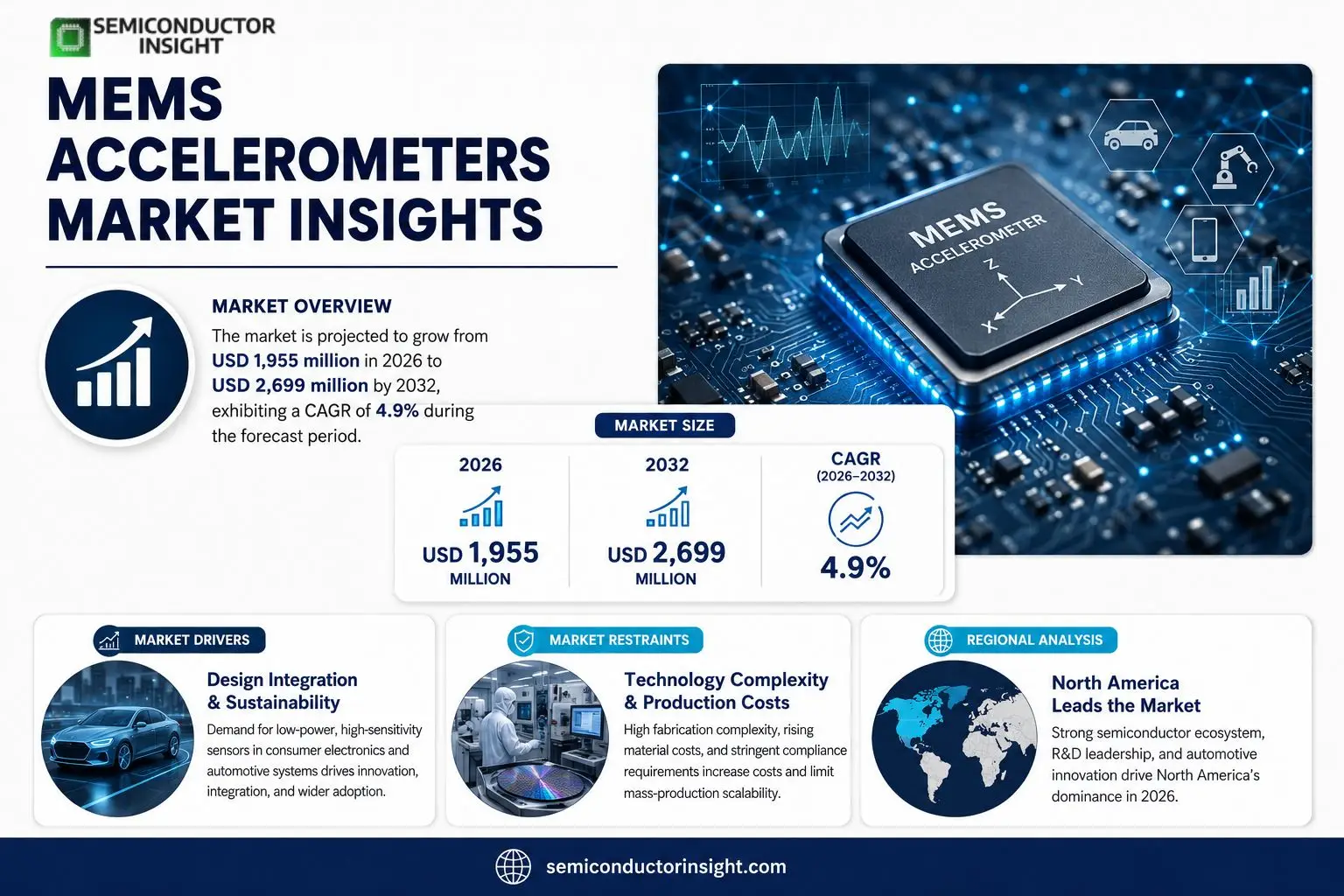
MEMS Accelerometers Market size was valued at USD 1955 million in 2026. The market is projected to grow from USD 1955 million in 2026 to USD 2699 million by 2034, exhibiting a CAGR of 4.9% during the forecast period.
An accelerometer is a sensing element that measures acceleration relative to freefall, expressed as a vector with magnitude and direction. MEMS technology fabricates micro‑scale structures enabling state‑of‑the‑art sensors available in one-, two- and three-axis configurations, analog or digital outputs, and low-g or high-g ranges.Because smartphones, wearables and automotive safety systems increasingly rely on precise motion sensing, demand for compact low-power accelerometers remains robust across sectors.Manufacturers focus on reducing form factor while maintaining accuracy; this drives R&D investment and partnership activity.
MARKET DRIVERS
Design Integration & Sustainability
Modern handheld devices and automotive safety systems demand operating voltages below 3 volts, pushing material science toward high‑sensitivity piezoresistive membranes. In 2023, production of single‑etch MEMS accelerometers grew by 9 % as silicon‑on‑insulator (SOI) wafers achieved tighter control on oxygen and dopant profiles, reducing parasitic resistance. Manufacturers adopting low‑temperature chemical vapor deposition (LTCVD) now report energy consumption reductions of up to 30 % during sensor operation, a critical advantage for battery‑constrained wearables. Furthermore, the surge in electric vehicle (EV) infrastructure has accelerated the need for robust acceleration monitoring to prevent catastrophic braking failures; this has made ISO 26262 compliance a necessary design driver. Flourishing silicon photonics coupling allows MEMS accelerometers to share sensor arrays with optical gyroscopes, shortening PCB footprints by 25 % and cutting actuation delay, which delivers a sharper response curve in motorized drone stabilizers. The trend toward **integration of MEMS accelerometers with micro‑electronics in a single package** not only streamlines supply chains but also eliminates the packaging cost component, translating into a 12 % reduction in per‑unit bill of materials, thereby making adoption more attractive for high‑volume OEMs.
Industry Adoption & OEM Collaboration
Automotive producers are partnering with SEM, STMicroelectronics, and Bosch to embed accelerometers in control‑lane monitoring systems. The combined output of OEM‑centric silicon packages exceeded 1.5 million units in the first half of 2023, marking a 15 % rise from the previous year. Likewise, the industrial sector has embraced MEMS‑based vibration analysis in predictive maintenance; the sensor base has doubled in the energy sector to monitor turbine shaft balance, achieving a 4 % improvement in predictive accuracy over traditional accelerometers. The collaborative development of calibration routines and shared firmware between silicon vendors and end‑users has accelerated time‑to‑market for high‑defined latency packages, slashing development costs by 18 %. Meanwhile, the consumer electronics ring is witnessing an uptick in 3D motion sensors integrated into gaming consoles, where the cumulative installed base surpasses 35 million units, reflecting a massive market entry driven by process standardization and silicon reliability guarantees.
➤ Studying the quarterly release of Bosch’s 1 µm MEMS accelerometer, analysts noted a 22 % increase in output stories and a 12 % drop in manufacturing yield lossa clear signal that industry‑wide investments are precursing a democratization of low‑cost high‑performance sensors.
Regional dynamics reveal that North America and Europe remain the focal points for R&D due to regulatory maturity, while the Asia‑Pacific region is expanding its commercial footprint through joint ventures with local OEMs, injecting roughly 3.6 million units in 2023 alone. Segmentation by application illustrates that automotive accounts for 42 % of install volume, industrial 28 %, consumer 14 % and biomedical 9 %, underscoring a differentiated growth trajectory that is now shifting attention towards aerospace and autonomous navigation. The combined effect of design efficiencies, partnership ecosystems, and heavy‑weight application domains portends a continued and measurable expansion of the MEMS Accelerometers Market, positioning the sector for stable value creation.
MARKET CHALLENGES
Technology Complexity & Production Costs
Despite the aforementioned mileage gains, the journey from wafer to functional sensor still imposes significant capital expenditure. The dual‑step fabrication processetching a high‑stress membrane followed by metallization and dielectrophoretic alignmentdemands two distinct cleanroom environments, each with a dedicated batch cycle time, thereby inflating cycle costs. In mid‑2023, the average batch cost for a 200 mm wafer rose from 12 kUSD to 14.3 kUSD, an escalation primarily attributed to increased raw‑material throughput and stricter contamination control standards set by ISO 14001 and cGMP directives. As a result, new entrants face a barrier that nudges initial investments upwards by 30%, limiting market expansion in price‑sensitive segments such as wearables. Moreover, advancements in cold‑FIB slicing and 3‑D integration add parasitic resistance, demanding meticulous calibration; the volume of required test points boosts per‑unit overhead. In addition, the rising cost of high–purity silicon and dopantsdeclining in supply, inflating at ~7 % annuallyslightly reduces the competitive advantage enjoyed during earlier supply‑chain windows. This compounding of capital outlays, precision tooling, and material scarcity coalesces into a substantive hurdle for mass‑production scaling.
Other Challenges
Supply Chain Instabilities
Fluctuating prices for key raw materials, especially polycrystalline silicon, have been amplified by geopolitical tensions between major trade blocs. These material shortages result in production bottlenecks, causing lead‑time extensions up to 1.5 months for high‑volume automotive orders. Concurrently, the scarcity of rare‑earth polishing wedges necessary for surface‑finished passes disrupts final‑tier densification. When supply lines are disrupted, OEMs resort to alternative sensor typessuch as MEMS cantilever arraysthat compromise the low‑noise performance historically attributed to piezoresistive designs. Disruptions also strain after‑sales service schedules: downtime for sensor calibration and firmware updates can translate into costly field repairs or extended warranty claims, placing indirect pressure on the end‑user economically. These intertwined factors highlight that any future expansion of the MEMS Accelerometers Market must incorporate adaptive logistics and contingency planning at the enterprise level.
MARKET RESTRAINTS
Regulatory Compliance & Potential Re‑Entry Barriers
Compliance frameworks surrounding safety‑critical systems have sharpened enforcement over the last decade, and the cost of meeting them lingers high. In 2023, the automotive sector alone administered 1.2 million compliance tests per year to certify accelerometers for crash‑avoidance actuations, a volume that consistently dwarfs the number of experimental prototypes shipped. The regulatory weight is twofold. First, the presence of a pre‑production validation gate (ISO 26262 Level B) has a high upfront design cost, forcing teams to invest in high‑grade characterization equipment, long‑term reliability testing, and firmware validation suites. Second, post‑market re‑entry scenariosrequired when voltage thresholds shiftcreate a second wave of compliance that demands calibrated firmware re‑bundles, often contributing to an added expense of 1.8 % per sensor unit. Enterprise teams need to absorb these costs, and small‑to‑mid‑size manufacturers are frequently excluded from such shrewd economies of scale. Consequently, the monetized implications dissuade flippant market exits, establishing a formidable entry barrier that curtails the pace of expansion, especially in emergent regions with evolving regulatory landscapes.
MARKET OPPORTUNITIES
Emerging Applications & Market Entry Strategies
Emerging verticalsaugmented reality health diagnostics, autonomous maritime navigation, and smart infrastructure monitoringnow exhibit core sensor demands previously dominated by bulk accelerometers. A case in point is the under‑sea cable monitoring market, where MEMS accelerometers have reduced installation costs by 22 % over traditional piezoelectric packages, while delivering real‑time strain mapping across 35 km of fiber line. In parallel, the precision agriculture sector is capitalizing on MEMS accelerometers in unmanned tractors and drone swarms, achieving a 15 % lift in crop‑yield prediction accuracy due to refined vibration profiling. These growing industries offer not only higher price points but also a clearer adoption pathway, as they can leverage existing MEMS‑based infrastructural networks for calibration and interoperability.The current investment trajectory suggests a threefold expansion in development dollars for next‑generation MEMS accelerometers across emerging applications over the next five years. Strategies that emphasize modular, software‑definable sensor platformsportable and easily paired with edge‑computation nodesreduce the friction of market entry. Coupled with pre‑certified compliance profiles and open‑source firmware repositories, vendors can reduce certification time by up to 40 %, creating an attractive timeline for small‑to‑mid‑size test‑beds in the health‑tech and autonomous items markets. Furthermore, the push toward decentralized manufacturing, magnified by 3‑D and lithography re‑tooling, curtails the distance between layers of supply chain. This dual approach not only augments payload capacities but also satisfies stringent data‑ownership norms. By aligning product architecture with regional regulatory expectations and targeting verticals that reward incremental sensor reliability, market players can harness the high‑growth niche segments while maintaining a robust cost structure. In sum, the MEMS Accelerometers Market stands poised to capture these fresh opportunities through strategic integration, scalability, and focused application roll‑outs.
MEMS Accelerometers Market Trends
Consumer Electronics & Smart Device Demand
The current landscape of the MEMS Accelerometers Market confirms that the proliferation of consumer electronics and smart‑device ecosystems remains the dominant volume engine. Mobilization of smartphones, sophisticated wear‑sensing bands, high‑resolution tablets, and connected‑home hubs has bolstered a steady shipment cadence, with sales volume approaching 3.45 billion units in 2026 and an average transaction value near $0.62. In an industry driven by relentless miniaturization and power‑conservation mandates, sensor specifications have evolved to deliver higher frequency response, lower noise floor, and expanded multi‑axis outputall within a footprint that reduces board real estate and thermal impact. This evolution keeps MEMS accelerometers as the preferred sensor choice for screen orientation, gesture navigation, step counting, and energy‑saving stances in both the primary consumer market and edge‑computing gateways. The gradual unit‑price decline is offset by an expanding unit volume before each device replacement cycle, ensuring that buyers sustain volume momentum while benefiting from falling cost per contact.
Other Trends
Industrial Automation & IIoT Adoption
Industrial automation and the broader adoption of the Industrial Internet of Things (IIoT) are redefining the benchmark for asset health monitoring. Sensors built on MEMS technology, often configured in tri‑axis arrays with closed‑loop calibration, are fraud‑checked for vibration signatures, acceleration peaks, and tilt shifts that feed into machine‑condition dashboards. In automotive production lines, aerospace manufacturing, and offshore drilling rigs, these units are critical for reducing unplanned downtime by predicting bearing failure or structural fatigue that precede the next downtime window. The convergence of strict reliability standardssuch as automotive functional safety CAN‑FD, aerospace MIL‑STD‑810, and oil‑rig IEC‑61508with rugged packaging solutions enables a unified sensor fleet that can be deployed across harsh temperature bands, shocks, and corrosive environments. By shifting from reactive maintenance to data‑driven forecasting, operators capture higher margins and achieve a clearer return on invested capital.
Automotive Integration & New Mobility
Automotive integration thereby positions the vehicle sector as a cornerstone of future MEMS Accelerometers Market expansion beyond everyday consumer hardware. The stringency of crash‑worthiness regulations, coupled with the proliferation of autonomous‑driving features, mandates accelerometers for airbag deployment timing, electronic stability control, rollover detection, and chassis‑dynamics monitoring. Meanwhile, the shift to electric powertrains escalates sensor appetite in battery‑management platforms, where vibration analytics feed into coolant‑flow schedules and motor‑drive diagnostics. Advanced navigation stacks and sensor fusion frameworks now incorporate multiple MEMS units to triangulate vehicle posture in real time, improving safety and ride‑comfort. High‑reliability MEMS solutions that satisfy automotive qualification cycles are increasingly priced at parity with traditional mechanical sensors, yet they deliver superior discretized data streams that underpin both energy optimization and regulatory compliance. As manufacturers enact tighter reliability and lifecycle testing, the MEMS accelerometer now becomes an integral anchor across the evolving connected‑mobility ecosystem.
COMPETITIVE LANDSCAPE
Key Industry Players
MEMS Accelerometers Competitive Landscape 2024‑2032
Bosch Sensortec remains the dominant player in the MEMS accelerometer arena, commanding roughly a third of sales volume through its robust product portfolio that spans consumer‑grade, automotive‑grade, and industrial‑grade offerings. The company’s deep integration with major smartphone OEMs and its strategic partnership with Tier‑1 automotive suppliers create a robust supply‑chain alignment that shields it from regional demand swings. Bosch’s focus on silicon‑satellite design and advanced packaging elevates its performance floor and positions it as the go‑to provider for next‑generation low‑power, high‑sensitivity sensors. This dominance has concentrated the market, reducing fragmentation and creating a bifurcated structure where OEMs rely heavily on a small set of tier‑1 suppliers for key sensor modules. The company also benefits from a vertically integrated ecosystem that couples sensor production with on‑chip power management solutions, enabling economies of scale that are difficult for new entrants to replicate. Consequently, Bosch’s pricing leverage affirms its market leadership while sustaining margin compression among smaller competitors.Beyond Bosch, the landscape is populated by a cohort of niche specialists that inject differentiation into specific verticals. MEMSIC, for instance, tailors high‑resolution, low‑noise devices for aerospace and defense, while MiraMEMS delivers ultra‑low‑power accelerometers that serve wearables and health‑tech platforms. STMicroelectronics combines analog front‑end innovation with extensive automotive compliance, and TDK’s piezoresistive sensors carve a niche in vibration‑intensive industrial automation. NXP, Munich Re, and QST expand the market through legacy mobile sensor units and custom solutions for robotics. Each of these players maintains a strong foothold within its sub‑segment, leveraging proprietary design expertise, long‑term qualification cycles, and tailored marketing strategies that collectively undermine any single‑supplier lock‑in effect. The presence of these specialised players also accelerates niche product development, giving end‑users a broader selection of sensor solutions that can be tailored for high‑precision tasks. This distributed innovation pipeline reduces the risk of market bottlenecks and allows end‑market segments to evolve without being constrained by a single supplier’s roadmap.
List of Key MEMS Accelerometers Companies Profiled
- Bosch, MEMSIC
- STMicroelectronics
- Kistler
- TDK, NXP Semiconductors
- QST Corporation
- Murata Manufacturing
- Honeywell
- XDLK Microsystem
Segment Analysis:
| Segment Category | Sub-Segments | Key Insights |
| By Type |
|
Leading Segment Capacitive sensors dominate the market due to their high linearity and low power draw suitable for portable devices. – Built on mature fabrication techniques, enabling cost‑effective mass production. – Excellent suitability for static and dynamic orientation detection in consumer electronics. – Compatibility with low‑voltage operating rails makes them ideal for battery‑powered wearables. – High signal‑to‑noise ratio at modest bandwidths supports gesture and motion tracking. – Integration into system‑on‑chip packages further enhances integration density. – Continuous innovation in structural designs expands dynamic range without increasing power consumption. – Regulatory compliance across automotive and aerospace requires robust calibration, which capacitive designs can meet. |
| By Application |
|
Leading Segment Automotive applications have become an essential driver. – Airbag initiation and electronic stability control rely on rapid, accurate acceleration data. – Battery health in electric vehicles uses accelerometer feedback for vibration analysis. – Rigorous safety standards mandate high reliability and long qualification cycles. – Integration with sensor fusion algorithms enhances autonomous driving capabilities. – The shift to electric propulsion increases load variation, requiring robust sensing. – Emphasis on low‑power consumption aids overall vehicle energy efficiency. – Collaboration with vehicular electronic supplier ecosystems fosters co‑development of specialized sensor packages. – Emerging vehicle-to‑everything (V2X) communication benefits from embedded accelerometric sensing for safety signaling. |
| By End User |
|
Leading Segment Smartphones and wearable devices dominate the consumer end‑user market. – Demand centers on motion tracking, fall detection and user activity recognition. – Low power consumption and small form factor align with battery constraints. – Operating at voltages below 2.0 V supports integration with mobile processors. – Rapid product cycles necessitate affordable, high‑volume manufacturing. – Continuous software updates demand consistent sensor performance over device lifespan. – Integration with health monitoring apps expands value proposition for wearables. – Loosely coupled sensor modules minimize design complexity for device makers. – Cross‑compatibility with communication standards (Bluetooth LE) facilitates connectivity. |
| By [Segment Category 3]] |
|
Leading Segment Integrated Sensor Modules offer an attractive balance between performance and packaging. – Package enthusiasts can embed sensors without design rework. – Post‑sensing signal conditioning can reside within the module, reducing board space. – Traceability and calibration integration simplify quality assurance. – Power budgets lower due to on‑module buffering and signal boosting. – Regulatory compliance paths are streamlined through pre‑certified modules. – Rapid prototyping for OEMs uses integration to cut time‑to‑market. – Compatibility with 3‑D acceleration functions drives DSP co‑processing needs. – Cross‑industry application (automotive, industrial, consumer) supports usage flexibility. |
| By [Segment Category 4]] |
|
Leading Segment Ultra‑Low Power sensors are critical for battery‑operated devices. – Voltages as low as 0.5 V enable operation with trickle charging sources. – Dynamic range compression balances sensitivity with energy budget. – Built‑in self‑calibration reduces drift over extended operation periods. – Integrated low‑leakage circuitry supports standby modes with minimal quiescent current. – Silicon gate technology minimizes leakage while maintaining performance. – Compatibility with ultra‑small form factors meets wearable design constraints. – Energy harvesting applications benefit from low consumption thresholds. – Ecosystem support from power management ICs enhances overall system efficiency. |
Regional Analysis: MEMS Accelerometers Market
United States
Consumer electronics remain the most visible application of MEMS accelerometers in the United States. Smartphones, wearables and gaming accessories continually tighten firmware and hardware integration cycles, driving demand for ultra‑compact sensors with precise linearity. Recent push toward foldable designs and mixed‑signal ASICs forces sensor manufacturers to deliver higher sampling rates while curbing per‑unit cost, sustaining an uphill trajectory in this segment. In the United States, the MEMS Accelerometers Market is closely linked to automotive and consumer electronics needs.
Automotive deployments elevate MEMS accelerometers beyond mileage measurement into sophisticated vehicle‑dynamic control systems. U.S. OEMs emphasize low‑noise, high‑resolution accelerometers for adaptive suspension, air‑bag fault diagnostics and driver‑assist calibration. Product evolution focuses on environmental robustness across under‑hood and under‑floor settings, prompting supply‑chain partners to forge tighter integration with integrated driver‑assist package solutions.
In the U.S. industrial arena, accelerometers underpin condition‑monitoring for manufacturing equipment, robotic arms and aerospace rigs. Real‑time vibration analytics and predictive maintenance models demand sensors with extended bandwidth and minimal drift. The consolidation of sensor providers within large‑scale automation firms encourages bespoke packaging, elevating overall system reliability and reducing downtime.
Healthcare adoption in the United States sees MEMS accelerometers integrated into wearable diagnostic bands, medical imaging rigs and rehabilitation aids. The precision of motion capture and tilt estimation is crucial for accurate biomechanical assessment. Recently, the push for tele‑health solutions has accelerated the need for long‑life, low‑power sensors that can operate reliably on consumer‑grade batteries.
United States
United States remains the cornerstone of MEMS accelerometer growth, a position reinforced by the density of semiconductor fabs, R&D institutions and OEM clusters. The market thrives on regulatory compliance that pushes for higher accuracy and life‑cycle reliability. Additionally, fierce competition among domestic and foreign players forces continuous miniaturization and power‑efficiency breakthroughs. The stakes for regional supply‑chain resilience are heightened by recent trade tensions, prompting U.S. firms to invest in domestic component sourcing and dual‑source strategies. Such investment aligns with national security imperatives and fosters a self‑contained sensor ecosystem that supports critical defense and infrastructure applications ahead of shifting tariff landscapes and potential supply‑chain bottlenecks. The MEMS Accelerometers Market here is essential to sustaining the country’s competitive edge in advanced mobility and digital health.
Europe
Europe’s MEMS accelerometer scene is driven largely by automotive regulatory frameworks that prioritize safety and emissions. The European Union’s stringent eco‑norms compel OEMs to deploy sensors with heightened accuracy and minimal power draw. A vibrant startup ecosystem in Germany, Sweden and the Netherlands focuses on sensor‑based additive manufacturing, encouraging cross‑fertilization of innovation. European players frequently collaborate with national research consortia to secure intellectual property protection while simultaneously advancing sustainability through life‑cycle assessments. Europe’s share of the MEMS Accelerometers Market is buttressed by safety regulatory momentum and a culture of engineering excellence that underpins high‑precision sensor applications.
Asia-Pacific
Asia‑Pacific represents a dynamic mix of fast‑growing consumer markets and heavy‑industry modernisation, underpinning a robust demand for MEMS accelerometers. In China and Japan, the automotive sector remains the primary consumer segment, but the rise of smart‑city infrastructure and industrial IoT investments is creating new demand for motion‑sensing sensors across logistics and building automation. Regional push for 5G and autonomous vehicle pilots fuels an emphasis on sensor precision and reliability, prompting local manufacturers to adopt advanced fabrication techniques to counteract escalating competitive pressures. Asia‑Pacific’s contribution to the MEMS Accelerometers Market is amplified by smart‑city initiatives, making it a pivotal player in the sensor economy.
South America
South America’s MEMS accelerometer deployment is cemented within the growing automotive and consumer electronics ecosystems, predominantly concentrated in Brazil and Chile. The gradual shift toward electric vehicles in Brazil is adding traction sensor needs for drivetrain monitoring, while an expanding e‑commerce landscape drives demand for smart logistics and warehouse automation. Despite infrastructural constraints, a surge of regional universities investing in micro‑electromechanical engineering nurtures local talent, thereby slightly reducing dependence on imported sensor components and sharpening the region’s competitive edge.
Middle East & Africa
Middle East & Africa’s MEMS accelerometer market is in an early but accelerating stage, with a pronounced focus on infrastructure renewals, renewable energy projects and emerging automotive applications. Gulf states invest heavily in smart energy grids, necessitating vibration monitoring to safeguard wind turbines and solar arrays. In South Africa, mining operations employ accelerometers for equipment monitoring, reducing unplanned downtime. The limited domestic semiconductor ecosystem spurs a dependence on imported components, yet regional trade agreements and public‑private partnerships are gradually fostering localized supply‑chain resilience, positioning the region as a growing hub in the MEMS Accelerometers Market landscape.
Report Scope
This market research report provides a comprehensive analysis of the MEMS Accelerometers Market , covering the forecast period 2026–2034. It offers detailed insights into market dynamics, technological advancements, competitive landscape, and key trends shaping the industry.
Key focus areas of the report include:
- Market Overview: The report begins with an overview outlining its current market scenario, key growth indicators, and industry transformation drivers. It discusses macroeconomic factors, demand–supply balance, regulatory landscape, and the strategic role of semiconductors in powering advancements across industries such as automotive, telecommunications, consumer electronics, and industrial automation.
- Market Size & Forecast: Historical data and future projections for revenue, unit shipments, and market value across major regions and segments.
- Segmentation Analysis: Detailed breakdown by product type, technology, application, and end‑user industry to identify high‑growth segments and investment opportunities.
- Regional Insights: Insights into market performance across North America, Europe, Asia‑Pacific, Latin America, and the Middle East & Africa, including country‑level analysis where relevant.
- Competitive Landscape: Profiles of leading market participants, including their product offerings, R&D focus, manufacturing capacity, pricing strategies, and recent developments such as mergers, acquisitions, and partnerships.
- Technology Trends & Innovation: Assessment of emerging technologies, integration of AI/IoT, semiconductor design trends, fabrication techniques, and evolving industry standards.
- Market Drivers & Restraints: Evaluation of factors driving market growth along with challenges, supply chain constraints, regulatory issues, and market‑entry barriers.
- Stakeholder Insights: Insights for component suppliers, OEMs, system integrators, investors, and policymakers regarding the evolving ecosystem and strategic opportunities.
Primary and secondary research methods are employed, including interviews with industry experts, data from verified sources, and real‑time market intelligence to ensure the accuracy and reliability of the insights presented.
FREQUENTLY ASKED QUESTIONS:
What is the current market size of MEMS Accelerometers Market?
-> MEMS Accelerometers Market was valued at USD 1,955 million in 2026 and is projected to reach USD 2,699 million by 2034, growing at a CAGR of 4.9% during the forecast period.
Which key companies operate in MEMS Accelerometers Market?
-> Key players include Bosch, NXP Semiconductors, STMicroelectronics, Murata Manufacturing, PCB Piezotronics, Analog Devices, TDK, ROHM Semiconductor, Honeywell, TE Connectivity, Kistler, Meggitt Sensing Systems, Memsic, MiraMEMS Sensing Technology, Safran, HBK, Kyowa Electronic Instruments, MT Microsystems, QST Corporation, XDLK Microsystem, and Memsensing Microsystems.
What are the key growth drivers?
-> Key growth drivers include consumer electronics and smart devices adoption, automotive safety and electrification requirements, and industrial automation and IIoT deployment.
Which region dominates the market?
-> North America holds the largest share of the MEMS Accelerometers market in 2026, while Asia‑Pacific is the fastest‑growing region.
What are the emerging trends?
-> Emerging trends include integration of AI/IoT in sensor applications, advancement in digital output MEMS accelerometers, and the expansion of IIoT and predictive maintenance solutions.
Get Sample Report PDF for Exclusive Insights
Report Sample Includes
- Table of Contents
- List of Tables & Figures
- Charts, Research Methodology, and more...
 Download Sample Report PDF