Isolation Drive Chip Market Insights
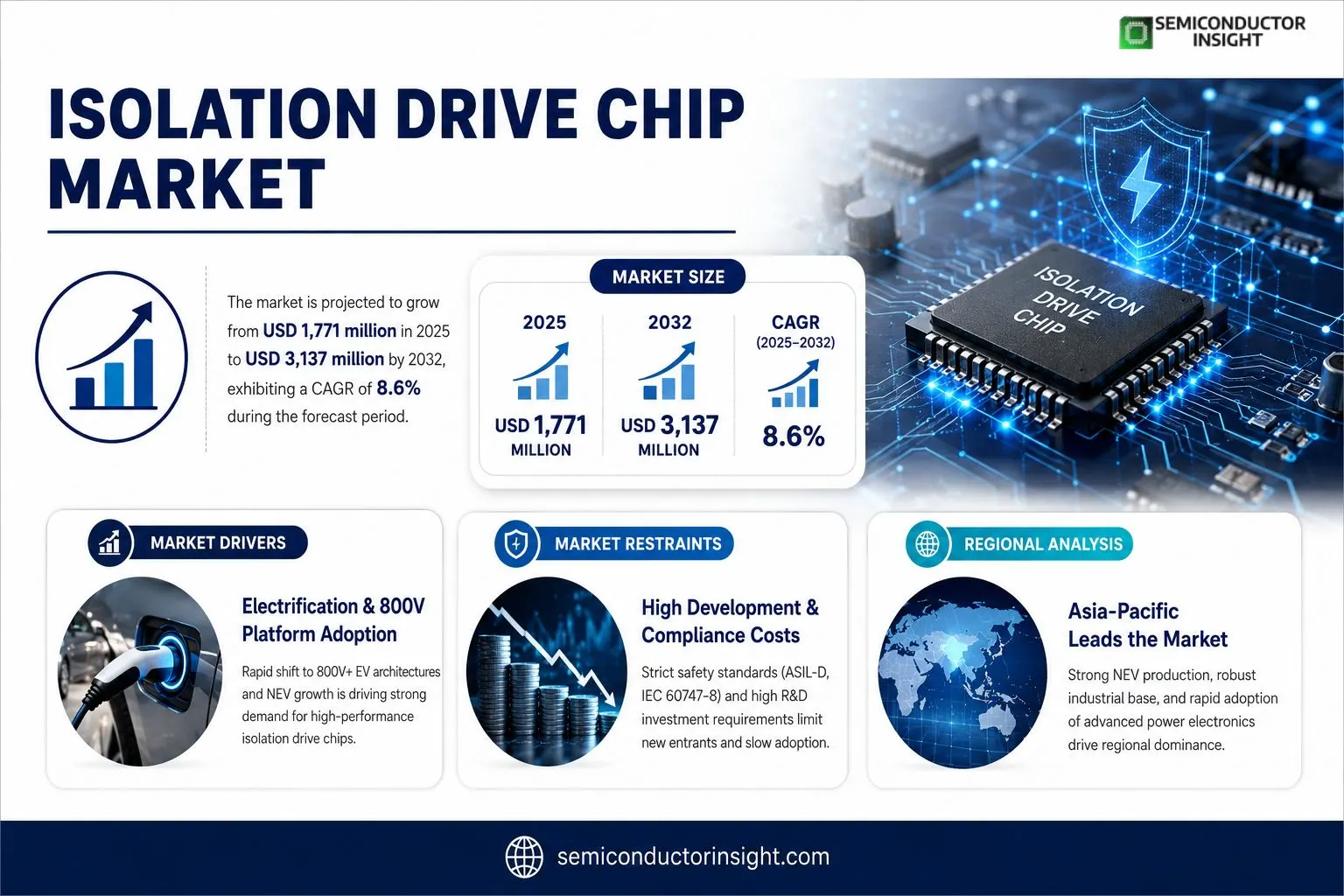
Isolation Drive Chip market size was valued at USD 1771 million in 2025. The market is projected to grow from USD 1771 million in 2025 to USD 3137 million by 2032, exhibiting a CAGR of 8.6% during the forecast period.
An Isolation Drive Chip (also called an Isolated Gate Driver) is an integrated circuit that transfers signals and power between high‑voltage power stagessuch as motor drivesand low‑voltage control logiclike microcontrollerswhile providing galvanic isolation through transformers or capacitive couplers. This barrier prevents voltage spikes, ground loops and current leakage, thereby protecting sensitive circuitry in electric vehicles, renewable‑energy inverters and industrial automation.The market’s momentum stems chiefly from the electrification of new‑energy vehicles (NEVs) and the rollout of 800 V high‑voltage platforms, which demand robust isolation drivers as “safety guardians” for on‑board chargers and electric drives. Steady demand also originates from industrial automation and photovoltaic energy storage systems. Technological trends are pushing chips toward higher voltage/frequency ratings, greater integration of driver functions and compliance with functional‑safety standards such as ASIL‑D, while legacy solutions face technical bottlenecks that limit ultra‑high‑voltage and MHz‑level switching performance.
MARKET DRIVERS
Technological Advancement in Isolation Drive Chips
The rollout of next‑generation semiconductor processes is tightening the performance envelope of isolation drive chips, allowing manufacturers to integrate higher voltage tolerances within smaller footprints. Design engineers are now able to embed these components directly onto power modules, which trims board space and reduces overall system weight. This shift is reshaping product road‑maps across industrial automation and aerospace.
Rising Need for Secure Data Transmission
As data‑centric applications become mission‑critical, the importance of electrically isolated pathways for signal integrity has intensified. Customers in sectors such as medical imaging and high‑frequency trading demand isolation drive chips that can guarantee zero‑leakage communication under extreme electromagnetic conditions. This requirement fuels incremental orders and incentivizes vendors to broaden their portfolio.
➤ “The convergence of tighter safety standards and miniaturization pressures is the primary catalyst behind the current purchasing surge.”
Overall, Isolation Drive Chip Market is being propelled by a combination of process innovation and a heightened emphasis on protected data flow, creating a fertile environment for vendors that can align engineering excellence with compliance demands.
MARKET CHALLENGES
High Development Costs
Designing isolation drive chips that meet both high‑voltage isolation and low‑latency signal transmission demands substantial R&D outlays. Small‑to‑mid‑size firms often lack the capital to sustain multi‑year development cycles, which can delay time‑to‑market and erode competitive positioning.
Other Challenges
Regulatory Hurdles
Compliance with IEC 60747‑8 and automotive functional safety standards such as ISO‑26262 imposes rigorous testing protocols. Meeting these certifications adds complexity to the product qualification process, stretching resources and extending lead times for new offerings.
MARKET RESTRAINTS
Limited Supplier Base
The pool of foundries capable of delivering the precise isolation characteristics required by advanced chips remains narrow. This concentration amplifies supply‑chain fragility; any capacity constraint at a key fab can ripple through OEM production schedules, curbing the overall market tempo.
MARKET OPPORTUNITIES
Emerging Applications in Autonomous Vehicles
Self‑driving platforms are integrating sophisticated sensor suites that rely on isolated power paths to protect high‑voltage drive circuits from noisy chassis networks. Companies that can certify isolation drive chips for automotive grade reliability stand to capture a growing slice of Isolation Drive Chip Market, as vehicle manufacturers seek to meet safety and performance benchmarks ahead of large‑scale production rollouts.
Isolation Drive Chip Market Trends
Shift to Ultra‑High Voltage Platforms
The acceleration of electric‑vehicle architectures toward 800 V and beyond is reshaping component priorities. Isolation drivers must now tolerate higher withstand voltages while preserving tight transient immunity, a combination that forces silicon‑carbide and gallium‑nitride power stages to rely on chips with faster switching edges. System designers view the isolation driver as the safety hinge that lets high‑energy converters operate without jeopardising low‑voltage control logic. Consequently, suppliers that can certify devices for the emerging voltage envelope are seeing a surge in design‑win inquiries from OEMs focused on next‑generation drive trains.
Other Trends
Integration and Smart Features
Parallel to voltage escalation, product roadmaps are consolidating multiple functions onto a single die. Modern drivers embed isolated power supplies, on‑chip fault monitoring, and even analogue‑to‑digital conversion, reducing board count and simplifying thermal management. This integration supports the industry’s push for compact power modules, especially in automotive and industrial inverters where space is premium. Vendors that embed diagnostic capabilities such as desaturation detection differentiate themselves by offering built‑in safety compliance, a factor that shortens validation cycles for end‑users.
Emerging Isolation Technologies and Supply‑Chain Shifts
Beyond traditional magnetic and capacitive coupling, research into millimetre‑wave wireless isolation is gaining traction as a means to bypass bandwidth limits inherent in classic topologies. Early prototypes demonstrate comparable isolation with markedly lower parasitic delay, hinting at a future where high‑frequency motor drives can achieve tighter control loops. At the same time, geopolitical pressures are nudging regional manufacturers to invest in domestic silicon capabilities, aiming to replace imported drivers with locally‑qualified alternatives. Companies that secure functional‑safety certifications and scale production domestically are positioned to capture market share formerly dominated by long‑established global players.
COMPETITIVE LANDSCAPE
Key Industry Players
Isolation Drive Chip Competitive Overview
The market is still dominated by a handful of multinational silicon specialists whose portfolios span automotive‑grade isolated gate drivers and ancillary power‑management IP. Texas Instruments leverages its extensive analog lineage and a deep automotive safety certification base to command a sizable share of high‑voltage EV charger designs. Analog Devices differentiates through an aggressive integration strategy, embedding isolation, fault diagnostics and digital control loops within a single die that meets ASIL‑D requirements. Infineon’s strength lies in its SiC‑compatible driver families, which align with the shift toward 800 V powertrains, while STMicroelectronics capitalises on its broad automotive customer network and a flexible product road‑map that supports both single‑channel and dual‑channel topologies. Collectively, these firms shape pricing, define performance baselines and set the bar for reliability in the most demanding segments.Beyond majors, a vibrant cohort of niche innovators is expanding the competitive set. ROHM and ON Semiconductor offer cost‑effective solutions targeting industrial automation and renewable‑energy inverters, where volume outweighs the need for ultra‑high‑voltage ratings. Skyworks and Broadcom have entered the arena by repurposing high‑frequency communication blocks for isolation‑driver applications, creating cross‑segment synergies. Chinese entrants such as Shanghai Chipanalog Microelectronics, 3PEAK, GLW and Rongmei Semiconductor are rapidly scaling production capacity and introducing proprietary capacitive‑coupling technologies that threaten to erode import dependence in domestic automotive supply chains. Their progress is especially notable in regions where regulatory pathways are being streamlined, presenting a credible alternative to the entrenched incumbents.
List of Key Isolation Drive Chip Companies Profiled
- Texas Instruments
- Analog Devices
- Infineon Technologies
- STMicroelectronics
- ROHM Semiconductor
- ON Semiconductor
- Skyworks Solutions
- Broadcom Inc.
- Shanghai Chipanalog Microelectronics
- 3PEAK
- GLW
- Rongmei Semiconductor (Shanghai)
- Novosense
- Texas Instruments
- Microchip Technology
Segment Analysis:
| Segment Category | Sub-Segments | Key Insights |
| By Type |
|
High-Performance Single‑channel Drivers are favored for compact designs where board space is at a premium.
|
| By Application |
|
Automotive Power‑train dominates strategic focus because of the shift to 800 V platforms.
|
| By End User |
|
Vehicle OEMs prioritize chips that combine high isolation voltage with compact footprint.
|
| By Integration Level |
|
Driver with Integrated Power Supply is emerging as a preferred architecture.
|
| By Functional Safety |
|
ASIL‑D Compliant Drivers are becoming the benchmark for high‑end automotive power electronics.
|
Regional Analysis: Isolation Drive Chip Market
Early adopters are leveraging advanced silicon‑on‑insulator platforms to achieve higher breakdown voltages, a shift that reflects a strategic move toward reducing failure rates in high‑stress applications.
The region’s diversified supplier base mitigates disruption risk, allowing manufacturers to source critical substrates from multiple domestic fabs, thereby sustaining production continuity.
Tightening safety certifications across automotive and aerospace sectors compel vendors to embed higher isolation standards, turning compliance into a market differentiator.
Capital inflows from venture funds targeting niche power‑management startups fuel the development of next‑generation isolation architectures tailored for electric‑drive systems.
Europe
European manufacturers are capitalizing on strong collaborative frameworks between automotive clusters and research institutes. The focus on sustainability amplifies demand for isolation chips that can support higher efficiency in electric drivetrains, prompting design houses to prioritize low‑loss materials. Moreover, rigorous EU directives on electromagnetic compatibility force component suppliers to embed robust isolation, creating a niche for firms that can certify compliance across multiple markets. The resulting ecosystem rewards players able to integrate regulatory insight early in the product development cycle.
Asia‑Pacific
Asia‑Pacific exhibits rapid maturation of its semiconductor supply chain, yet the region still grapples with heterogeneous standards across emerging economies. Local OEMs are beginning to recognize the long‑term cost benefits of higher isolation performance, especially as regional electric‑vehicle adoption accelerates. Strategic partnerships between tier‑2 foundries and original equipment manufacturers are emerging, enabling cost‑effective scaling of isolation chip volumes while maintaining quality thresholds. This evolving landscape suggests that firms which can navigate disparate regulatory expectations will capture a growing share of the market.
South America
In South America, market momentum is tied to infrastructure upgrades in energy‑intensive sectors such as mining and rail transport. Companies are seeking isolation solutions that can endure harsh environmental conditions, prompting a shift toward ruggedized chip designs. Although the region lacks the deep R&D infrastructure of its northern counterparts, localized partnerships with global suppliers are fostering technology transfer, gradually raising the technical baseline for domestic players.
Middle East & Africa
The Middle East & Africa region is marked by selective adoption driven largely by high‑value projects in oil‑&‑gas and renewable‑energy integration. Stakeholders prioritize isolation chips that can tolerate extreme temperature fluctuations, a requirement that narrows the supplier pool to those with proven field performance. Concurrently, emerging renewable initiatives encourage a modest but steady demand for reliable power‑conversion modules, positioning isolation technology as a critical enabler for future grid‑modernization efforts.
Report Scope
This market research report provides a comprehensive analysis of the Isolation Drive Chip Market , covering the forecast period 2026–2034. It offers detailed insights into market dynamics, technological advancements, competitive landscape, and key trends shaping the industry.
Key focus areas of the report include:
- Market Overview: The report begins with an overview outlining its current market scenario, key growth indicators, and industry transformation drivers. It discusses macroeconomic factors, demand–supply balance, regulatory landscape, and the strategic role of semiconductors in powering advancements across industries such as automotive, telecommunications, consumer electronics, and industrial automation.
- Market Size & Forecast: Historical data and future projections for revenue, unit shipments, and market value across major regions and segments.
- Segmentation Analysis: Detailed breakdown by product type, technology, application, and end-user industry to identify high-growth segments and investment opportunities.
- Regional Insights: Insights into market performance across North America, Europe, Asia-Pacific, Latin America, and the Middle East & Africa, including country-level analysis where relevant.
- Competitive Landscape: Profiles of leading market participants, including their product offerings, R&D focus, manufacturing capacity, pricing strategies, and recent developments such as mergers, acquisitions, and partnerships.
- Technology Trends & Innovation: Assessment of emerging technologies, integration of AI/IoT, semiconductor design trends, fabrication techniques, and evolving industry standards.
- Market Drivers & Restraints: Evaluation of factors driving market growth along with challenges, supply chain constraints, regulatory issues, and market-entry barriers.
- Stakeholder Insights: Insights for component suppliers, OEMs, system integrators, investors, and policymakers regarding the evolving ecosystem and strategic opportunities.
Primary and secondary research methods are employed, including interviews with industry experts, data from verified sources, and real-time market intelligence to ensure the accuracy and reliability of the insights presented.
FREQUENTLY ASKED QUESTIONS:
What is the current market size of Isolation Drive Chip Market?
-> Isolation Drive Chip Market was valued at USD 1,771 million in 2025 and is expected to reach USD 3,137 million by 2032, growing at a CAGR of 8.6% during the forecast period.
Which key companies operate in Isolation Drive Chip Market?
-> Key players include Skyworks, Texas Instruments, ADI, Broadcom, Infineon, ROHM, Onsemi, ST, NOVOSENSE, Shanghai Chipanalog Microelectronics, 3PEAK, GLW, Rongmei Semiconductor (Shanghai).
What are the key growth drivers?
-> Key growth drivers include electrification of new energy vehicles (NEVs), rapid adoption of 800 V high‑voltage platforms, increasing demand from industrial automation and photovoltaic energy storage, and the requirement for high‑performance isolation drivers to ensure safety and reliability.
Which region dominates the market?
-> Asia‑Pacific is the leading region, driven by strong NEV production, extensive automotive and industrial automation activities, and high adoption of advanced power‑electronics technologies.
What are the emerging trends?
-> Emerging trends include higher voltage and frequency capabilities for 800 V+ platforms, greater integration of isolation driver, power supply and diagnostics into single chips, functional‑safety compliance such as ASIL‑D, exploration of high‑voltage DC power for AI data‑centers, and novel millimeter‑wave wireless isolation technologies.
Get Sample Report PDF for Exclusive Insights
Report Sample Includes
- Table of Contents
- List of Tables & Figures
- Charts, Research Methodology, and more...
 Download Sample Report PDF