SEMICONDUCTOR INSIGHT
MARKET RESEARCH REPORT

Electronic Packaging Heat Sink Material Market

2026 to 2034
MARKET INTELLIGENCE
ACROSS KEY REGIONS
2026 EDITION
THERMAL MANAGEMENT Semiconductor Market Research

Electronic Packaging Heat Sink Material Market

Size, Share & Industry Analysis, By Type, and Regional Forecast, 2026–2034

◷
UPDATED 04 November 2026
▤
REPORT LENGTH Detailed Report
▣
REPORT CODE 1ddc965e9e8e
▯
FORMATS PDF

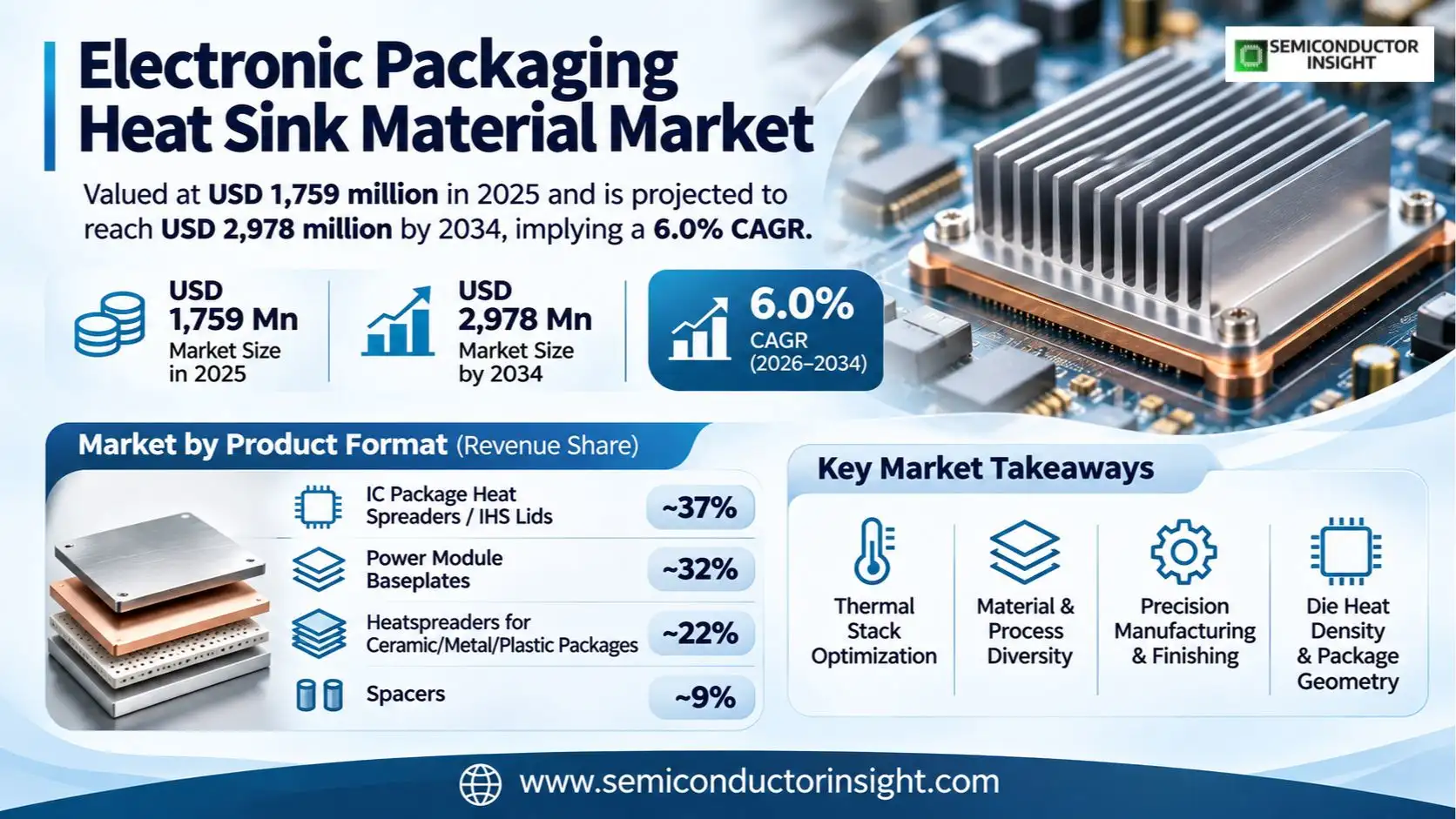
Electronic packaging heat sink material market is valued at USD 1,759 million in 2025 and is projected to reach USD 2,978 million by 2034, implying a 6.0% CAGR. The market covers semi-finished heat-sink spreaders, baseplates, lids and spacers incorporated in electronic packages; excludes standalone server cooling systems, full power devices, fans, and off-package chiller equipment; purchasing decisions combine component functionality, development resources and verified integration performance.

Get the sample PDF with study scope, segmentation and methodology details.

Key Statistics

2025 Market Size
USD 1,759 million
2034 Projected Size
USD 2,978 million
CAGR (2026–2034)
6.0%
Largest Market in 2025
Asia-Pacific (~52%)

Key Takeaways

  • Market trajectory: The market moves from USD 1,759 million in 2025 toward USD 2,978 million by 2034. A 6.0% CAGR connects those anchors across nine annual periods; shipments depend on qualification programs, OEM platform cycles and the reliability of technologies used in engineered heat spreaders, baseplates and package-level thermal spacer materials.
  • Primary product: IC Package Heat Spreaders and IHS Lids lead at an estimated ~37% of 2025 value, with Power Module Baseplates accounting for roughly ~32%. These parts direct heat away from silicon yet face different mechanical and assembly stresses. A processor lid prioritizes broad contact area and coplanarity, while a power baseplate must maintain a sound thermal path through repeated inverter or drive temperature cycles.
  • Application demand: CPU / GPU packages comprise an estimated ~37% of application sales; power modules account for approximately ~30%. The former rely on efficient spreading across large compute dies, while the latter often combine a metal or composite plate with an electrically insulating ceramic substrate. In both environments, the thermal interface can impose more practical resistance than the bulk spreader material alone.
  • Geographic balance: Asia-Pacific accounts for an estimated ~52%, reflecting electronics production, engineering facilities and supplier ecosystems. North America at an estimated ~21% and Europe at an estimated ~21% play important roles in specification, procurement and specialist equipment programs.
  • Engineering bottleneck: A highly conductive spreader is not automatically reliable when it is joined to silicon, ceramic or a plated package surface. Thermal expansion mismatch, porosity and dimensional variation can cause cracking or bond fatigue. Customers pay for demonstrated thermal cycling and controlled flatness as well as conductivity, especially where a package is expected to operate repeatedly at high power.

Electronic Packaging Heat Sink Material Market Overview

Electronic packaging heat sink material market is valued at USD 1,759 million in 2025 and is projected to reach USD 2,978 million by 2034, implying a 6.0% CAGR. The market covers semi-finished heat-sink spreaders, baseplates, lids and spacers incorporated in electronic packages; excludes standalone server cooling systems, full power devices, fans, and off-package chiller equipment; purchasing decisions combine component functionality, development resources and verified integration performance.

Base year: 2025 · Estimated year: 2026 · Forecast period: 2026–2034 · Historical context: 2020–2024 · Values in USD million

For 2026 purchasing, electronic package heat-sink materials transfer concentrated device heat through engineered solid structures. Included parts range from processor lids to composite power-module plates and precision spacers. Looking toward 2034, their value depends on the combination of thermal conduction and dimensional stability under assembly conditions. The same material can perform differently when bonded to silicon, a ceramic insulator or a metal enclosure, so the commercial selection must be specific to the package design.

For 2026 purchasing, manufacturers aim to reduce junction-to-case thermal resistance without introducing strain that shortens device life. An advanced composite may offer better expansion compatibility with a ceramic substrate, while conventional copper may deliver sufficient conductivity for a less mechanically demanding package. Looking toward 2034, engineering approval involves realistic power cycling, surface-finish inspection and control of joining material thickness. Improved device performance is valuable only if those attributes can be reproduced over production lots.

For 2026 purchasing, the revenue object is a package-integrated lid, spreader, baseplate or spacer and the directly associated precision manufacture needed to deliver it. Complete servers, motor inverters and external cold plates are outside this category even though they interact with the internal component. Looking toward 2034, this boundary is particularly important for high-power electronics, where a comprehensive thermal-management system can cost far more than the specialized material embedded at the chip package.

For 2026 purchasing, future demand is connected to concentrated computing loads, electric drives and industrial power systems that call for better heat movement from semiconductor junctions. Adoption will remain selective because customers compare copper, ceramics, refractory composites and diamond-based materials using distinct technical requirements. Looking toward 2034, the long-run purchasing opportunity belongs to suppliers that combine practical fabrication capacity with validated interfaces, consistent metallurgy and application-specific service support.

Segment Analysis: By Type

Four product formats address distinct locations in the semiconductor thermal stack. IC Package Heat Spreaders / IHS Lids account for an estimated ~37%, Power Module Baseplates ~32%, Heatspreaders for Ceramic/Metal/Plastic Packages ~22% and Spacers ~9%. Their process requirements span copper machining, composite infiltration, precision ceramic compatibility and contact-surface finishing. The optimal construction is determined by die heat density and package assembly geometry.

Type Function Market position
IC Package Heat Spreaders / IHS Lids Type share: an estimated ~37% in 2025. For 2026 design programs, A package lid is designed to spread concentrated heat from a processor or other active die over an area that can connect to the next thermal interface. Geometry and surface finish control the effective bondline, while copper thickness influences both conduction and mechanical load. By 2034, the supplier must satisfy the particular package’s flatness tolerance and joining process rather than offering a generic metal plate. For 2026 purchasing, commercial demand is tied to high-power computing and other integrated circuits whose thermal density makes conventional package coverage inadequate. Buyers examine lid dimensional consistency, plating integrity and performance under sustained load. Looking toward 2034, a premium conductivity grade provides little advantage if the attachment interface traps voids or cannot handle package warpage. Manufacturing yields and inspection capability therefore influence the supplier nomination.
Power Module Baseplates Type share: an estimated ~32% in 2025. For 2026 design programs, Automotive inverters and industrial modules use baseplates to conduct heat from power dice through ceramic-insulated structures toward external cooling equipment. Copper delivers effective heat conduction, while AlSiC and other composites can reduce expansion differences with the ceramic stack. By 2034, engineers test solder fatigue and plate flatness after repeated heating, because internal cracks can raise junction temperatures long before total mechanical failure. For 2026 purchasing, a baseplate supplier competes on thermo-mechanical endurance, machined tolerances and compatibility with module assembly operations. Customers may select an expansion-matched composite despite higher unit cost if it protects vulnerable ceramic or solder interfaces. Looking toward 2034, contract terms often specify controlled metallurgy and traceable inspection records. The product revenue covers the package-level part rather than the full inverter, motor drive or cold plate that ultimately removes waste heat.
Heatspreaders for Ceramic/Metal/Plastic Packages Type share: an estimated ~22% in 2025. For 2026 design programs, Specialized spreaders sit within several package types, including RF modules and high-temperature industrial electronics. The design may pair metal with an insulating ceramic substrate or use a selected composite to accommodate thermal expansion. By 2034, performance depends on metal-to-ceramic adhesion, metallization uniformity and resistance to stress under assembly conditions. A suitable product balances electrical requirements with the needed heat path. For 2026 purchasing, these spreaders serve niche designs that cannot adopt a standard processor lid or broad power-module plate. Engineering revenue may include prototyping and customized dimensions before recurring material orders begin. Looking toward 2034, a customer can accept higher prices for stable thermal performance and production traceability. Suppliers must be able to reproduce the same layer construction when package volumes rise or replacement orders arrive years later.
Spacers Type share: an estimated ~9% in 2025. For 2026 design programs, Thermal spacers establish a controlled distance between surfaces in double-sided cooling and other layered semiconductor package structures. Parallelism and surface condition are critical because a small thickness error can change solder distribution or contact pressure across an active die. By 2034, the component must also tolerate the intended joining temperature, mechanical load and subsequent electrical isolation architecture. For 2026 purchasing, spacer purchasing tends to favor precision machining and stable supply of approved alloys or coated components. Although the individual part may be smaller than a baseplate, its dimensions can determine whether the entire module is manufacturable. Looking toward 2034, quality agreements address face-to-face tolerance, burr control and solderability. The commercial benefit is dependable assembly geometry rather than simply adding the maximum possible quantity of conducting metal.

Segment Analysis: By Application

Application demand is concentrated in CPU / GPU packages at an estimated ~37% and Power Module at ~30%, with RF semiconductors representing ~17%, Communication ~11% and Others ~5%. High-performance computing requires heat spreading across dense logic and memory regions, whereas electrical converters must survive large repeated temperature swings. The spreader’s material selection follows the specific package architecture and cannot be reduced to one universal conductivity ranking.

Application Demand characteristics
CPU / GPU Application share: an estimated ~37% in 2025. For 2026 design programs, High-power processors generate dense heat at the silicon surface, requiring lids and spreaders that maintain uniform contact with a thin thermal interface. Mechanical bow and die shape can create localized hot spots even with a high-conductivity metal. By 2034, package vendors qualify coplanarity, attachment chemistry and realistic computing load profiles before approving a production thermal stack.
Power Module Application share: an estimated ~30% in 2025. For 2026 design programs, Vehicle traction inverters, power supplies and industrial drives use baseplates that transfer heat from switched semiconductor junctions to an external cold plate or air-cooled sink. Temperature cycling stresses the ceramic and solder junctions below the baseplate. By 2034, buyers compare copper with composite alternatives using full module endurance results rather than bulk thermal properties alone.
Semiconductor RF Device Application share: an estimated ~17% in 2025. For 2026 design programs, RF power amplifiers can concentrate dissipation in small die regions, while package geometry must preserve high-frequency electrical behavior. Heat spreaders may require compatible ceramics or precisely controlled metals that do not compromise isolation. By 2034, engineering approval examines thermal contact, conductor placement and repeatable assembly yields because inadequate spreading can affect both reliability and signal performance.
Communication Application share: an estimated ~11% in 2025. For 2026 design programs, Network processors and communications modules face continuous service duties that make thermal stability valuable over long operating periods. Small package-spreader imperfections can gradually increase interface resistance under repeated load and temperature exposure. By 2034, vendors support telecom equipment makers by maintaining consistent lid flatness and providing a clear replacement specification across hardware platform revisions.
Others Application share: an estimated ~5% in 2025. For 2026 design programs, Lasers, measurement instruments and specialized high-temperature electronics use thermal parts whose geometry may differ from standard CPU lids or inverter baseplates. Small production quantities create cost pressure for precision machining and custom material qualification. By 2034, suppliers add value by identifying a manufacturable construction that solves the application’s actual thermal path without imposing unnecessary material complexity.

Regional Analysis

Asia-Pacific leads the electronic packaging heat sink material market with an estimated ~52% share, reflecting power semiconductor and integrated-circuit assembly concentration. North America and Europe each contribute an estimated ~21%, supported by specialist composite materials, thermal engineering and high-performance electronics. Demand locations differ from where diamond, ceramic or alloy feedstocks are produced, so procurement analysis must consider both the package fabricator and the final device manufacturing route.

Where are semiconductor heat spreaders, baseplates and thermally engineered package parts most widely purchased?

An effective thermal package material must move heat while maintaining acceptable stress at the silicon, solder, metallization and substrate interfaces. Regions with high output of processors and power modules require repeatable production at scale; other regions emphasize advanced composites or qualification for demanding environments. The market includes engineered lids, spacers and baseplates incorporated into packages rather than entire heatsink assemblies, fan systems or data center cooling installations.

Region Position Growth outlook Demand profile What decides supplier selection
Asia-Pacific An estimated ~52% ~6.5% CAGR electronics fabrication, substrate factories, smartphone assembly and automotive component exports Factory release documentation and verified application engineering
North America An estimated ~21% ~5.8% CAGR platform architecture, integrated-circuit engineering and cross-border manufacturing Qualified supply assurance and verified application engineering
Europe An estimated ~21% ~5.5% CAGR automotive certification, machine safety and industrial development Reliability verification and verified application engineering
South America An estimated ~4% ~5.0% CAGR localized electronics manufacturing and industrial equipment modernization Import and service continuity and verified application engineering
Middle East & Africa An estimated ~2% ~5.0% CAGR infrastructure equipment, telecom deployment and industrial digitalization Long-life vendor support and verified application engineering

Asia-Pacific LARGEST · ~52% SHARE

Which commercial strengths shape Asia-Pacific adoption for electronic packaging heat sink material?

For 2026 purchasing, asia-Pacific holds an estimated ~52% of 2025 demand because many advanced chip packages and power devices are fabricated or assembled in China, Japan and South Korea. Copper spreaders, metallized ceramic surfaces and composite baseplates support different thermal and mechanical requirements. Looking toward 2034, local suppliers benefit from proximity to customers but must still demonstrate surface flatness, solder bond quality and reliable behavior under repeated temperature changes.

Market positionAn estimated ~52% share
Growth outlook~6.5% CAGR
Demand profile2025 electronics programs
Market access gateFactory release documentation
Country Position in region What drives demand
China High-volume power-device packaging For 2026 purchasing, chinese makers of power modules, servers and industrial electronics buy spreaders, baseplates and carefully machined thermal components for densely populated packages. High output volume creates opportunities for scale, but customers face strict limits on material porosity, surface finish and dimensional drift. Looking toward 2034, a baseplate defect can destroy an otherwise valuable semiconductor module, making incoming inspection and matched thermal expansion central to supplier decisions.
Japan Precision alloy and ceramic technology For 2026 purchasing, Japanese thermal-material manufacturers have experience in precision metal processing, refractory-metal combinations and ceramic substrates for demanding electronics. These products can provide reliable heat transfer while controlling dimensional changes under high temperatures. Looking toward 2034, commercial buyers prioritize consistent metallization, controlled material thickness and reproducible interfacial adhesion, particularly when a ceramic part must carry both heat and electrical isolation.
South Korea High-density compute thermal components For 2026 purchasing, South Korean chip and substrate ecosystems create demand for advanced package lids and heat spreaders used near computing processors and memory systems. A rapidly increasing local heat flux must be managed without warping an intricate package substrate. Looking toward 2034, designers assess not only conductivity but also lid geometry, interface uniformity and compatibility with the thermal materials applied in final system assembly.

Market instances

  • Power module baseplate production For 2026 purchasing, automotive and industrial semiconductor modules place copper or composite plates beneath ceramic-insulated power structures. Manufacturers verify that the plate maintains dimensional stability during soldering and thermal cycling. Looking toward 2034, an alloy with excellent bulk conductivity may still prove unsuitable if expansion mismatch causes fatigue in the solder or the ceramic metallization after many operating cycles.
  • Processor heat-spreader qualification For 2026 purchasing, a package lid increases effective heat-transfer area above a high-power die, yet the path also depends on its bonding interface and contact pressure. Asian assembly lines can screen lid coplanarity and plating quality before complete CPU or GPU integration. Looking toward 2034, commercial success requires reliable process yields under actual package dimensions rather than nominal conductivity measurements alone.
  • Ceramic-to-metal interface controls For 2026 purchasing, aluminum nitride and related ceramics can serve insulating and thermal roles inside sophisticated package structures. Their effectiveness depends on metallized layers that bond to adjoining metals without cracks during use. Looking toward 2034, advanced suppliers invest in surface analysis and accelerated cycling to detect weak joining conditions before devices are shipped into vehicles or long-running industrial systems.
In the full report: China, Japan and South Korea support high-output chip and power-module production; local thermal component purchases span machined copper, ceramic-compatible composites and precision spreaders.

North America REGIONAL · ~21% SHARE

Which commercial strengths shape North America adoption for electronic packaging heat sink material?

For 2026 purchasing, north America accounts for an estimated ~21% of thermal packaging material value, supported by advanced processor engineering, power devices, composite-material suppliers and specialist electronics manufacturing. The United States has a large design and materials research base, Canada contributes academic and industrial thermal research, and Mexico participates in vehicle electronics assembly. Looking toward 2034, regional purchasers place particular weight on thermal simulation, supply assurance and the ability to trace baseplate defects back to processing lots.

Market positionAn estimated ~21% share
Growth outlook~5.8% CAGR
Demand profile2025 electronics programs
Market access gateQualified supply assurance
Country Position in region What drives demand
United States Composite spreaders and computing packages For 2026 purchasing, uS thermal component suppliers offer composite solutions and precision metals for power modules and high-performance electronic systems. Material selection must balance conductivity, coefficient of expansion and machinability, especially where a package combines silicon carbide devices with ceramic layers. Looking toward 2034, the strongest commercial claims are supported by demonstrated assembly reliability rather than by heat-transfer performance measured on an isolated coupon.
Canada Applied thermal research and niche supply For 2026 purchasing, Canadian research organizations and specialized manufacturers contribute thermal materials characterization and electronics cooling engineering. The market opportunity is selective where a material or process improves difficult high-power or high-frequency packages. Looking toward 2034, purchasers still need evidence that prototype coatings or novel composites can be fabricated consistently at an appropriate production cost and tied to a stable commercial quality plan.
Mexico Automotive module integration For 2026 purchasing, Mexican vehicle-electronics assembly plants may consume power packages and thermal subassemblies whose baseplates originate elsewhere. Incoming inspection must confirm flatness, plating condition and absence of shipping damage before final module or inverter installation. Looking toward 2034, cross-border suppliers need coordinated revision notices because changing a baseplate alloy or interface finish can affect thermal cycling results and final equipment warranty obligations.

Market instances

  • Aluminum silicon carbide composites For 2026 purchasing, alSiC materials can help tune thermal expansion closer to that of ceramic-insulated power electronics while maintaining a useful heat path. Their processing economics depend on porosity control and repeatable finished dimensions. Looking toward 2034, north American customers may pay a premium where temperature cycling would make a conventional thick metal plate vulnerable to solder or ceramic-interface fatigue.
  • Package thermal simulation For 2026 purchasing, thermal engineers assess the spreader’s geometry and the resistance of adjacent bond layers under realistic electrical loads. A laboratory conductivity number is insufficient when the interface thickness varies across a large processor. Looking toward 2034, suppliers that can provide geometry tolerances, reliable surface finishes and validated material properties are better prepared to participate in demanding electronics design reviews.
  • Materials traceability for long programs For 2026 purchasing, industrial and government-related electronics purchasers may require records of alloy chemistry, composite processing and inspection results extending beyond an initial package test. Such evidence helps diagnose failures when the device has operated for years. Looking toward 2034, maintaining control over subcontracted machining and plating can preserve qualification even where the final power module is assembled outside North America.
In the full report: United States, Canada and Mexico participate in thermal-material innovation and vehicle-electronics production; design reviews emphasize mechanical endurance and credible manufacturing yields.

Europe REGIONAL · ~21% SHARE

Which commercial strengths shape Europe adoption for electronic packaging heat sink material?

For 2026 purchasing, europe represents an estimated ~21% share through automotive power converters, industrial drives, specialist computing and high-reliability electronic systems. German engineering firms impose stringent thermal-cycle requirements, French electronics buyers pursue robust RF and industrial packages, and United Kingdom specialists contribute advanced thermal materials. Looking toward 2034, purchasers often compare lifetime mechanical stability with instantaneous heat-transfer performance, since a spreader that stresses a ceramic joint can reduce device durability.

Market positionAn estimated ~21% share
Growth outlook~5.5% CAGR
Demand profile2025 electronics programs
Market access gateReliability verification
Country Position in region What drives demand
Germany Electric-drive power module materials For 2026 purchasing, German vehicle and industrial drive makers select package baseplates to survive repeated heating and cooling under changing load. Copper, AlSiC and other material systems offer different trade-offs between conductivity and expansion matching. Looking toward 2034, the buying decision must consider the exact soldered and ceramic stack, including the ability to maintain a reliable thermal path during real automotive driving profiles.
France High-reliability RF and industrial packages For 2026 purchasing, French specialist electronics programs may use precision heat spreaders beneath radio-frequency amplifiers or dense industrial modules. Designers value predictable geometry and compatibility with the selected package construction, because small deviations can increase junction temperature or damage bonded surfaces. Looking toward 2034, supplier testing should reflect the intended duty cycle and clarify how mechanical tolerances are held during repeated orders.
United Kingdom Diamond thermal engineering For 2026 purchasing, uK-based advanced materials research and diamond technology capabilities inform premium heat-spreader options for localized high heat flux. Diamond can offer exceptional conductivity, but attachment methods, manufacturable size and cost determine whether the solution reaches commercial packages. Looking toward 2034, buyers need a credible interface design and a production qualification plan instead of assuming that an ultra-high conductivity rating guarantees superior equipment reliability.

Market instances

  • Automotive thermal-cycle testing For 2026 purchasing, european module manufacturers may subject baseplates and bonded substrates to accelerated temperature cycling that exposes microscopic fatigue at material interfaces. These programs help compare thick copper with composite expansion-matched constructions. Looking toward 2034, the key commercial requirement is a durable assembled device, not merely high conductivity in an unconstrained plate before it is joined to the package.
  • RF amplifier heat extraction For 2026 purchasing, rF semiconductor packages can generate concentrated heat over a comparatively small region. Designers consider thermal spreaders and insulating ceramic structures that keep junction temperatures within a safe operating range. Looking toward 2034, electrical isolation, geometry and the thermal interface must be validated together, particularly when high-frequency performance makes it difficult to introduce additional metallic features.
  • Precision manufacturing and inspection For 2026 purchasing, rolling, infiltration, machining and plating operations impose different tolerances on metal and composite spreaders. European suppliers serving long-lived equipment may rely on extensive dimensional and metallographic inspection to demonstrate repeatability. Looking toward 2034, commercial qualification can be delayed if a second production site cannot reproduce the same surface topography, internal porosity and thermal cycling behavior.
In the full report: Germany, France and the United Kingdom serve power converters, RF equipment and advanced material development; joining quality and cycling reliability shape supplier nominations.

South America REGIONAL · ~4% SHARE

Which commercial strengths shape South America adoption for electronic packaging heat sink material?

For 2026 purchasing, South America is estimated to account for ~4% of demand, primarily through power-electronic module purchases, industrial maintenance and selected local electronics assembly. Brazil leads regional vehicle and industrial activity, while Argentina and Chile support equipment modernization in different sectors. Looking toward 2034, the local opportunity is often the qualified replacement package or integrated thermal component rather than domestic production of ultra-high-performance spreader materials.

Market positionAn estimated ~4% share
Growth outlook~5.0% CAGR
Demand profile2025 electronics programs
Market access gateImport and service continuity
Country Position in region What drives demand
Brazil Industrial inverters and automotive electronics For 2026 purchasing, Brazilian industrial and mobility equipment can use packages that contain metal or composite thermal baseplates, especially in motor drives and energy-conversion modules. Local integration teams need assurance that the thermal structure matches the semiconductor and mounting method selected. Looking toward 2034, purchasing often emphasizes reliable import channels, accepted component drawings and availability of replacement assemblies during the service life of capital equipment.
Argentina Power conversion maintenance programs For 2026 purchasing, Argentine industrial facilities purchase power semiconductor modules for machinery, drives and distributed energy equipment. The heat-spreading material is embedded in the component specification rather than purchased as a standalone commodity in many cases. Looking toward 2034, when a module is replaced, engineers must check its thermal interface and mounting pressure to prevent a mechanically compatible substitute from running above its safe junction temperature.
Chile Mining and remote power electronics For 2026 purchasing, Chilean mining operations and infrastructure projects rely on power-electronic equipment that may endure temperature variation and sustained loading. Module heat spreaders and baseplates influence durability but are rarely serviced separately from the complete power component. Looking toward 2034, customers seek dependable spare-part availability, clear handling instructions and evidence that replacements maintain their thermal contact during demanding operation.

Market instances

  • Industrial drive refurbishment For 2026 purchasing, a refurbished inverter may require a new power module whose footprint and baseplate geometry match an established cooling arrangement. Differences in mounting pressure or thermal grease thickness can undermine otherwise adequate component ratings. Looking toward 2034, regional service companies therefore verify the actual contact path from device substrate to external cooling structure before returning equipment to operation.
  • Imported composite component supply For 2026 purchasing, high-performance ceramic-metal and refractory-metal spreaders may have limited local manufacturing availability. Delivery schedules and customs conditions can constrain urgent maintenance or upgrade programs. Looking toward 2034, buyers can reduce risk by retaining approved replacements and documenting whether the necessary surface finish and dimensions are preserved when components pass through multiple distributors.
  • End-equipment thermal audits For 2026 purchasing, when a power unit overheats in service, the diagnosis may involve the internal baseplate, an external heatsink or a failing interface between them. These are separate product boundaries with different suppliers. Looking toward 2034, effective maintenance checks thermal contact and airflow without assigning the complete cooling system’s economic value to the package-level spreader material.
In the full report: Brazil, Argentina and Chile primarily purchase thermal semiconductor packages for industrial systems; specialist baseplates are commonly included within imported power-module assemblies.

Middle East & Africa REGIONAL · ~2% SHARE

Which commercial strengths shape Middle East & Africa adoption for electronic packaging heat sink material?

For 2026 purchasing, middle East & Africa has an estimated ~2% share, reflecting specialized thermal components incorporated into imported communications, industrial and power-conversion electronics. Saudi Arabia and the United Arab Emirates are important systems procurement and distribution locations, while South Africa has industrial maintenance activity. Looking toward 2034, the principal buying concern is reliable packaged-device performance under elevated ambient temperatures, often with limited local access to specialist thermal-material fabrication.

Market positionAn estimated ~2% share
Growth outlook~5.0% CAGR
Demand profile2025 electronics programs
Market access gateLong-life vendor support
Country Position in region What drives demand
Saudi Arabia Power infrastructure module procurement For 2026 purchasing, Saudi industrial and utility equipment often contains power semiconductor packages with carefully engineered thermal structures. Elevated ambient conditions can reduce cooling margins, emphasizing the reliability of internal baseplates and joined interfaces. Looking toward 2034, buyers should verify whether the supplier’s package characterization covers prolonged high-temperature operation instead of assuming that an external chiller can compensate for every internal conduction limitation.
United Arab Emirates Thermal electronics distribution For 2026 purchasing, uAE technology distributors and engineering contractors support telecommunications, building automation and industrial power installations. Some imported modules include premium package lids or composite plates that cannot be substituted independently of the semiconductor design. Looking toward 2034, good distribution practice preserves part numbers, packaging integrity and the ability to obtain failure-analysis support from the original package materials manufacturer.
South Africa Industrial converter servicing For 2026 purchasing, South African maintenance teams working with factory drives and power-conversion equipment may replace semiconductors that incorporate copper or composite thermal baseplates. A physically interchangeable module may still differ in thermal impedance or mounting requirements. Looking toward 2034, service organizations value reliable technical data and a stable replacement supply over unsupported claims that one alloy or ceramic material is universally superior.

Market instances

  • High-ambient enclosure qualification For 2026 purchasing, electronic power packages may operate inside cabinets whose surrounding air temperature is significantly above laboratory conditions. Internal spreaders must move heat without excessive stress while the external cooling arrangement removes it from the enclosure. Looking toward 2034, application qualification checks the combined structure and realistic loading, avoiding the assumption that excellent bulk conductivity eliminates every hot spot.
  • Long-distance equipment support For 2026 purchasing, industrial systems purchased from overseas suppliers may rely on technical support far from their operating site. If a power module’s internal baseplate fails, a customer may need a complete qualified replacement rather than a local material repair. Looking toward 2034, clear drawings, reliable parts identification and responsive warranty channels are important to preventing prolonged outages at remote installations.
  • Cooling upgrade boundaries For 2026 purchasing, a facility upgrading its thermal management can purchase fans, cold plates and air-handling equipment alongside semiconductor modules. Only the package-embedded spreader or baseplate falls within this specialty material market. Looking toward 2034, procurement records should keep those items distinct, because a larger data-center or utility cooling project cannot be interpreted as direct growth in package-level thermal material sales.
In the full report: Saudi Arabia, United Arab Emirates and South Africa consume qualified heat-spreading electronic parts in infrastructure systems, with attention to elevated temperature and service continuity.

Key Electronic Packaging Heat Sink Material Manufacturers and Competitive Landscape

For 2026 purchasing, suppliers serving package-level heat spreading include composite-material developers, precision metal processors, engineered ceramic producers and specialists in diamond technology. CPS Technologies, Element Six, Kyocera, Sumitomo Electric A.L.M.T. and Plansee participate in different thermal material routes. Looking toward 2034, their products should not be treated as interchangeable simply because each can conduct heat; customers evaluate coefficient of thermal expansion, manufacturable geometry, joining surfaces and delivery capability.

For 2026 purchasing, design partnerships are important because the heat spreader and its bond line can only be judged as a combined construction. A materials specialist may help specify a copper alloy, AlSiC grade or metallized ceramic while the package manufacturer controls soldering and final assembly. Looking toward 2034, competitive advantage comes from explaining these interface trade-offs with test results, not from quoting a single maximum conductivity number outside its operating context.

For 2026 purchasing, winning a long-life electronics program often depends on the supplier’s ability to maintain precise finished dimensions and controlled production processes. Customers request thermal cycling records, surface-condition standards and a clear procedure for reviewing material substitutions. Looking toward 2034, current ownership and product availability must also be checked where legacy supplier names appear in technical presentations. A distributor’s listing is insufficient proof that it manufactures the qualified spreader itself.

Tier structure

Tier Companies Basis of competition
Core suppliers CPS Technologies; Element Six; Kyocera; Sumitomo Electric A.L.M.T. The main supplier tier develops solid heat transfer structures and produces the alloys, composites or ceramic parts that are directly incorporated in electronic packages. Buyers typically require repeatable thickness, density, thermal properties and surface condition. The commercial relationship may involve customized part geometry and jointly defined reliability tests before a recurring module manufacturing contract can begin.
Specialist and adjacent suppliers Plansee; AMETEK; Shinko; Denka; Honeywell Advanced Materials; Wieland Specialist companies provide precision manufacturing, coatings, advanced ceramic or diamond technologies that support particular package constructions. Some supply only a constituent material, while others deliver a finished machined baseplate or lid. It is important to distinguish those positions from downstream producers of complete semiconductor devices or full equipment cooling systems when assessing competitive participation.

Key companies profiled

  • CPS Technologies
  • Element Six
  • Kyocera
  • Sumitomo Electric A.L.M.T.
  • Plansee
  • AMETEK
  • Shinko
  • Denka
  • Honeywell Advanced Materials
  • Wieland

Electronic Packaging Heat Sink Material Production Capacity Analysis

For 2026 purchasing, thermal-material manufacturing capacity depends on available composite infiltration equipment, precision machining, ceramic processing, plating and inspection rather than semiconductor wafer starts alone. An alloy producer may have ample bulk stock yet insufficient equipment to finish a specialized lid at required tolerances. Looking toward 2034, the relevant output is the quantity of heat-spreading components able to satisfy customers’ mechanical, thermal and surface specifications following real production qualification.

(‘Fabrication methods and transfer’, ‘For 2026 purchasing, manufacture of a package thermal part begins with raw metal, composite preforms, prepared ceramics or engineered diamond material. Processing can include rolling, powder metallurgy, infiltration, machining and metallization before bonding surfaces are approved. Looking toward 2034, every route has different cost and yield limits. A high-conductivity specimen in a laboratory does not demonstrate that a factory can maintain thickness, surface roughness and internal porosity across repeat orders.’)

(‘Production continuity’, ‘For 2026 purchasing, power electronics and processor customers depend on predictable delivery of parts designed for a specific thermal and mechanical stack. Alternate processing facilities must prove that their materials and surface treatments do not change the qualified module behavior. Looking toward 2034, long-horizon capacity planning therefore includes appropriate inspection machinery, supplier stock controls and engineering assistance for redesigns. Nominal plant size alone cannot describe availability of specialized composite or ceramic components.’)

Electronic Packaging Heat Sink Material Market Dynamics: Drivers, Restraints and Opportunities

For 2026 purchasing, package-level heat sink materials benefit from increased chip power density and rising converter performance requirements, but commercial uptake depends on mechanical reliability and assembly cost. Copper is not displaced universally by composites or ceramics; each material operates within a particular thermal and electrical stack. Looking toward 2034, the adoption outlook therefore reflects compute and electrification demand tempered by tooling, qualification and supplier capability constraints.

MARKET DRIVERS

Drivers Impact Analysis*

Market Drivers Impact Rank CAGR Contribution (%) 2026–2028 2029–2031 2032–2034
Customer miniaturization and integration High +2.88% High High High
Platform capability upgrades Medium-High +1.92% High High High
Industrial and automotive qualification Medium +1.56% Medium High High
Materials and engineering improvements Low-Medium +0.84% Medium Medium Medium
Others (application diversification) Low +0.60% Medium Medium Medium

High-power computing thermal density

For 2026 purchasing, faster processors and larger computing packages put increasing heat flux through the junction-to-lid route. Better spreaders can reduce the temperature difference across a die and improve sustained operating capability. Looking toward 2034, however, the lid must be integrated with a suitable thermal interface, so customer spending follows demonstrated package performance rather than an isolated bulk-material specification.

Vehicle and industrial power conversion

For 2026 purchasing, siC and other switching devices in electric-drive or industrial converter modules create demanding thermal-cycle conditions. Expansion-matched metal matrix composites and carefully machined baseplates can protect ceramic and solder joints during repeated loads. Looking toward 2034, manufacturers able to demonstrate stable junction temperatures across real operating profiles are better placed to win long-life program orders.

Advanced thermal-material engineering

For 2026 purchasing, diamond-based solutions, aluminum nitride ceramics and optimized copper alloys offer different ways to enhance heat movement or control mechanical stresses. Materials innovation becomes commercially significant when processing methods can produce consistent surface quality and practical package dimensions. Looking toward 2034, joining yield and thermal expansion compatibility remain necessary even for highly conductive substances.

Precision manufacturing and inspection

For 2026 purchasing, improved machining, composite infiltration and metallization controls can reduce porosity and create flatter surfaces for power modules and processor packages. Stronger inspection reduces the chance that poor bonding or dimensional drift escapes into a costly finished device. Looking toward 2034, these capabilities can broaden the number of applications where premium thermal components are economically justified.

MARKET RESTRAINTS

Restraints Impact Analysis*

Market Restraints Impact Rank CAGR Contribution (%) 2026–2028 2029–2031 2032–2034
High development and process qualification cost High -0.96% High Medium Medium
Engineering complexity and specialist labor Medium -0.54% Medium Medium Medium
Others (supplier and materials constraints) Low -0.30% Medium Medium Low
*CAGR contribution shows the percentage points each factor adds to or removes from the forecast CAGR for 2026–2034; driver contributions less restraint contributions equal the market CAGR. Period columns rate the strength of each factor in that window.

Qualification and custom tooling costs

For 2026 purchasing, a thermal spreader is often shaped for one package, requiring application-specific drawings, machining tools and endurance studies. New grades must be tested with the actual silicon, solder, metal and ceramic layers before use. Looking toward 2034, the development expense can delay adoption in products with short design lives or limited production volumes. Process partners may also require destructive samples from the actual finished module before accepting a new baseplate material grade for continuing production.

Complex material interfaces and workmanship

For 2026 purchasing, high thermal conductivity is difficult to exploit if a joined surface contains voids, uncontrolled plating or mismatched expansion. Composite preparation and high-temperature ceramic attachment require skilled control of multiple processes. Looking toward 2034, suppliers lacking adequate inspection or engineering support may struggle to establish reliable high-volume production even when a prototype performs well.

Others (specialist feedstock constraints)

For 2026 purchasing, diamond processing, refractory-metal constituents and engineered ceramic powders may face limited sources or expensive fabrication routes. Long lead times complicate customer qualification and safety-stock planning, particularly for small specialized packages. Looking toward 2034, a device manufacturer may continue using a less exotic but thoroughly validated material when replacement risk outweighs the marginal thermal improvement.

MARKET OPPORTUNITIES

Diamond and advanced ceramic applications

For 2026 purchasing, localized heat flux in RF and high-performance computing may justify advanced spreaders if the package interface can use their conductivity effectively. Novel material suppliers can capture specialized applications through credible production results and properly designed joining methods. Looking toward 2034, their addressable revenue is nevertheless limited to package-level materials rather than the full economics of semiconductor cooling installations.

Thermo-mechanically matched baseplates

For 2026 purchasing, power semiconductor manufacturers can reduce joint fatigue by selecting composites with expansion behavior closer to adjacent ceramics. Optimizing infiltration, machining and plating together creates an engineering service opportunity for materials specialists. Looking toward 2034, the commercial advantage appears in validated module endurance rather than simply replacing a thick copper plate with a more expensive alternative.

Custom integrated thermal design

For 2026 purchasing, system designers increasingly ask packaging partners to evaluate spreader shape, bondline thickness and mechanical constraint at the same time. Manufacturers with simulation and test support can participate earlier in processor or converter development. Looking toward 2034, such collaboration improves the odds of a successful high-volume design while preserving a clear boundary between the package component and downstream heat-removal equipment.

Electronic Packaging Heat Sink Material Supply Chain Analysis

For 2026 purchasing, production begins with metal stock, ceramic powders, composite feedstocks and premium thermal materials, followed by shaping and surface preparation for a chosen semiconductor package. Precision component makers then deliver lids, spacers or baseplates to assembly plants, which bond them to device structures and verify thermal cycling performance. Looking toward 2034, a defective internal joint can remain hidden until service, making source traceability and detailed process records commercially significant.

UpstreamCopper and refractory-metal stock, composite powders, ceramic substrates and specialized diamond materials enter package production under chemistry and contamination controls.
Core integrationSpreaders and baseplates are shaped by machining, infiltration, rolling, metallization or deposition before surface preparation and dimensional acceptance tests.
Customer deploymentPackage assemblers bond lids or baseplates to qualified device structures and verify contact resistance, planarity and endurance under the intended electrical power profile.
Lifecycle supportSurface-finish records, material lot traceability and thermal-failure investigations help maintain consistent heat-spreader performance across module replacements and redesigns.

Upstream material control. For 2026 purchasing, copper, molybdenum, tungsten, aluminum silicon carbide and selected diamond products have different supply routes and processing constraints. Before manufacture, providers assess chemistry, density, contamination and the consistency of powder or rolled stock. Looking toward 2034, variations can influence porosity, conductivity and expansion during device operation. Material traceability is especially important where the delivered thermal component is subsequently enclosed inside an expensive, difficult-to-repair semiconductor module.

Shaping and package assembly. For 2026 purchasing, a solid spreader must reach the assembler with specified parallelism, thickness, surface finish and appropriate metallization. The packaging factory then creates a joint whose void level and mechanical strain affect effective heat transfer. Looking toward 2034, quality control combines dimensional inspection with representative thermal and mechanical tests. Rejecting an unsuitable plate before bonding can save the cost of scrapping an integrated power or processor package.

Procurement and logistics. For 2026 purchasing, purchasers order package thermal components against approved drawings that define the material grade as well as geometry and coating. A machining subcontractor cannot alter a critical finish without review simply because the alloy remains nominally unchanged. Looking toward 2034, deliveries may require clean packaging and controlled handling to protect precision surfaces. Multisite manufacturing agreements specify which changes must trigger requalification and who investigates defects when a device fails.

Long-term support. For 2026 purchasing, industrial and automotive modules may use the same internal spreader construction across several equipment generations. If a metal source or plating process is replaced, purchasers need evidence that thermal cycling and electrical isolation remain acceptable. Looking toward 2034, failure analysis may include microsectioning, scanning of material porosity and comparison with original shipment records. Suppliers who maintain these capabilities can protect customers from costly late-stage redesigns.

Recent Developments in the Electronic Packaging Heat Sink Material Market

  • October 2026 THERMALLY CONDUCTIVE DIE-ATTACH
    Henkel introduced ABLESTIK CDF 900 conductive films in October 2026, describing heat transport above 8 W per meter kelvin in a die-attach interface. These joining materials are adjacent to solid package spreaders and illustrate why a good contact layer is critical to effective cooling. A film launch does not establish sales or penetration rates for metal, ceramic or diamond heat-sink package materials. Source
  • October 2026 AUTOMOTIVE CHIP EMBEDDING
    Infineon announced an automotive high-voltage embedded power cell in October 2026, demonstrating the trend toward more integrated power semiconductor structures. Embedding power devices changes the geometry through which heat must pass and can increase the importance of package thermal design. The announcement is a relevant engineering illustration but provides no quantified baseplate shipment total. Source
  • September 2026 ADVANCED SUBSTRATE THERMAL NEEDS
    Samsung Electro-Mechanics discussed advanced substrate structures during September 2026 and noted demands relating to fine-line integration and mechanical stability. Larger high-performance packages require coordinated thermal and structural design, including the spreader and the material below it. An advanced substrate presentation should be treated as nearby technology context, not as a statement of package heat-sink component sales. Source
  • May 2026 SEMICONDUCTOR MATERIALS CONTEXT
    SEMI released broad semiconductor and packaging materials industry figures in May 2026. Its assessment shows the scale of the overall material supply chain but covers classes beyond package heat-spreader metals, composites, lids and spacers. Thermal-material suppliers can use this context when assessing industry activity without assigning that larger revenue figure to the narrowly defined electronic packaging heat sink material category. Source
  • November 2024 ALUMINUM SILICON CARBIDE BASEPLATES
    CPS Technologies presented its AlSiC metal-matrix-composite portfolio in a November 2024 corporate presentation, including baseplates for industrial and transportation electronics. These products illustrate the need to balance thermal conductivity with material expansion and process repeatability. They document an available engineering route rather than supplying an audited market share for every metal and ceramic thermal package component. Source

REPORT SCOPE & SEGMENTATION

Attribute Details
Study Period 2020–2034
Base Year 2025
Estimated Year 2026
Forecast Year 2034
Base Market Value USD 1,759 million
Forecast Market Value USD 2,978 million
Forecast CAGR 6.0%
Revenue Coverage semi-finished heat-sink spreaders, baseplates, lids and spacers incorporated in electronic packages; excludes standalone server cooling systems, full power devices, fans, and off-package chiller equipment
Largest Region Asia-Pacific (~52%)
Currency USD million
Geographic Scope Global
By Type IC Package Heat Spreaders / IHS Lids; Power Module Baseplates; Heatspreaders for Ceramic/Metal/Plastic Packages; Spacers
By Material Metals & Alloys (Cu, Al); Refractory-Metal Composites (Cu-Mo, Cu-W, Cu/Mo/Cu); Aluminium-Based MMCs (AlSiC, Al-Diamond); High-k Insulating Ceramics (AlN, Si3N4, Al2O3); Diamond-Based Ultra-High-k Solutions
By Application CPU / GPU; Power Module; Semiconductor RF Device; Communication; Others
By End User OSATs / IDM Fabricators; Power Module Manufacturers; System Thermal Integrators
By Manufacturing Process Powder Metallurgy & Infiltration; Rolling / Lamination; CVD Deposition (Diamond); Precision Machining & Forging; Surface Plating & Metallization
By Region Five geographic markets assessed with named countries, purchasing conditions and relevant electronic applications.
Asia-PacificChina, Japan, South Korea
North AmericaUnited States, Canada, Mexico
EuropeGermany, France, United Kingdom
South AmericaBrazil, Argentina, Chile
Middle East & AfricaSaudi Arabia, United Arab Emirates, South Africa
Key Companies Profiled CPS Technologies; Element Six; Kyocera; Sumitomo Electric A.L.M.T.; Plansee; AMETEK; Shinko; Denka; Honeywell Advanced Materials; Wieland
Customization Scope Additional breakouts can examine engineered heat spreaders, baseplates and package-level thermal spacer materials, qualified platform revisions, packaging or security subfunctions, application reliability and procurement needs through 2034.

Frequently Asked Questions

What is the electronic packaging heat sink material market forecast?

For 2026 purchasing, the 2025 market size is USD 1,759 million and the 2034 forecast is USD 2,978 million, corresponding to a 6.0% annualized rate. This scope covers solid heat spreaders, lids, baseplates and spacers incorporated into electronic packages. Looking toward 2034, it does not represent the sales of complete processors, power inverters, industrial chillers or external server cooling hardware.

Which thermal materials are included?

For 2026 purchasing, included items are solid package heat spreaders, processor lids, module baseplates and precision thermal spacers made from applicable metals, composites, ceramics or diamond-based materials. These are parts of the semiconductor package’s conduction path. Looking toward 2034, standalone fans, cooling towers, chillers and complete thermal-management installations fall outside the named market, even when sold into the same high-power electronics project.

Which thermal component type leads demand?

For 2026 purchasing, iC Package Heat Spreaders and IHS Lids hold an estimated ~37% of 2025 market value, while Power Module Baseplates account for ~32%. Additional forms include heatspreaders for several package constructions and precision spacers. Looking toward 2034, procurement depends on whether the buyer needs wide-area heat spreading, durable ceramic-interface support or carefully controlled mechanical spacing inside a specific assembly.

Which regions purchase the most package heat spreaders?

For 2026 purchasing, asia-Pacific accounts for an estimated ~52% of 2025 sales, reflecting its major integrated-circuit and power-device assembly networks. North America and Europe each represent approximately ~21%. Looking toward 2034, individual packages can involve raw material processing, spreader finishing and device assembly in separate countries, so the purchasing location is not necessarily the location where every manufacturing step occurs.

What is driving improved heat-spreader demand?

For 2026 purchasing, high-power processors, electric-drive conversion and specialized radio-frequency devices generate heat that must be removed from increasingly confined semiconductor packages. Manufacturers can improve performance through suitable spreader materials, shape control and robust joining interfaces. Looking toward 2034, buyers examine the resulting junction temperature and thermal-cycle endurance because a high conductivity rating is of limited use when the bonded structure cracks or delaminates.

What limits adoption of premium thermal composites?

For 2026 purchasing, custom part tooling, expensive feedstocks and extensive qualification requirements can discourage adoption, particularly in short-lived or small-volume devices. A newly developed composite also must be compatible with the package’s ceramic, solder and metal layers. Looking toward 2034, an unsuitable expansion coefficient or poorly controlled surface can outweigh a benefit in thermal conductivity, making validated package-level tests essential.

What equipment applications use these materials?

For 2026 purchasing, computing processors, automotive power modules, RF amplifiers, communication electronics and specialized industrial instruments all employ heat-spreading parts in different configurations. Their commercial needs differ: computing favors large-area lid contact, while power conversion requires durable baseplates during repeated temperature swings. Looking toward 2034, the selected material and joining process must satisfy each package’s electrical insulation, mechanical and thermal limits.

Which suppliers participate in package thermal materials?

For 2026 purchasing, relevant suppliers include companies such as CPS Technologies, Element Six, Kyocera, Sumitomo Electric A.L.M.T. and Plansee, which provide different composite, ceramic, diamond or precision-metal capabilities. Inclusion on a technical supplier list does not prove that every company manufactures all four component types. Looking toward 2034, customers should confirm current product status and the exact manufacturing role before entering a long-term agreement.

Why must designers evaluate thermal expansion as well as conductivity?

For 2026 purchasing, a material with high heat-transfer capability may expand differently from silicon, solder or insulating ceramic when the device warms and cools. Repeated mismatch can fatigue joints or create cracks, eventually raising electrical junction temperature. Looking toward 2034, engineers therefore evaluate entire package stacks under realistic cycling and inspect interface conditions; a laboratory bulk-conductivity result is only one input to the selection.

What does the forecast imply for buying plans?

For 2026 purchasing, the forecast covers the period from the 2025 base through 2034 and represents growing demand for qualified package-level heat-conduction parts, not universal replacement of conventional copper with advanced materials. Buyers should compare assembly test evidence, cost and supplier continuity for their particular device. Looking toward 2034, broader packaging industry investments and outside cooling-equipment spending remain useful context but are distinct revenue categories.

Research Sources & Evidence Base

View research sources used for this overview
  1. e6.com. Element Six diamond spreader solutions for AI and RF chips, direct engineering context for engineered heat spreaders, baseplates and package-level thermal spacer materials and related supply conditions
  2. e6.com. Element Six diamond conductivity and cooling use, direct engineering context for engineered heat spreaders, baseplates and package-level thermal spacer materials and related supply conditions
  3. global.kyocera.com. Kyocera AlN package substrate high thermal conductivity, direct engineering context for engineered heat spreaders, baseplates and package-level thermal spacer materials and related supply conditions
  4. global.kyocera.com. AlN thermal package design and metallization, direct engineering context for engineered heat spreaders, baseplates and package-level thermal spacer materials and related supply conditions
  5. cpstechnologysolutions.com. CPS AlSiC metal matrix composite thermal baseplate, direct engineering context for engineered heat spreaders, baseplates and package-level thermal spacer materials and related supply conditions
  6. henkel.in. Henkel conductive film heat transfer adjacent interface, adjacent engineering context for engineered heat spreaders, baseplates and package-level thermal spacer materials and related supply conditions
  7. henkel.com. Henkel TIM vs lid engineering interfaces, adjacent engineering context for engineered heat spreaders, baseplates and package-level thermal spacer materials and related supply conditions
  8. samsungsem.co.kr. 2026 high power AI substrate thermal demands, adjacent engineering context for engineered heat spreaders, baseplates and package-level thermal spacer materials and related supply conditions
  9. infineon.com. 2026 automotive inverter embedding thermal paths, adjacent engineering context for engineered heat spreaders, baseplates and package-level thermal spacer materials and related supply conditions
  10. semi.org. SEMI chip packaging materials supplier scope, adjacent engineering context for engineered heat spreaders, baseplates and package-level thermal spacer materials and related supply conditions
  11. shinetsu.co.jp. Thermal conductive epoxy complements solid spreader assembly, adjacent engineering context for engineered heat spreaders, baseplates and package-level thermal spacer materials and related supply conditions
  12. sumibe.co.jp. Power module encapsulation reliability, adjacent engineering context for engineered heat spreaders, baseplates and package-level thermal spacer materials and related supply conditions
  13. india.kyocera.com. Ceramic packages for RF and power devices, direct engineering context for engineered heat spreaders, baseplates and package-level thermal spacer materials and related supply conditions
  14. semi.org. Materials adjacent demand not direct heat sink market, adjacent engineering context for engineered heat spreaders, baseplates and package-level thermal spacer materials and related supply conditions
  15. aseglobal.com. ASE advanced chips heat management design context, adjacent engineering context for engineered heat spreaders, baseplates and package-level thermal spacer materials and related supply conditions
  16. semi.org. SEMI packaging material classification, adjacent engineering context for engineered heat spreaders, baseplates and package-level thermal spacer materials and related supply conditions
  17. cpstechnologysolutions.com. CPS thermal management composite products, direct engineering context for engineered heat spreaders, baseplates and package-level thermal spacer materials and related supply conditions
Electronic Packaging Heat Sink Material Market Size, Share & Industry Analysis, By Type, and Regional Forecast, 2026–2034

Get Sample Report PDF for Exclusive Insights

Report Sample Includes

  • Table of Contents
  • List of Tables & Figures
  • Charts, Research Methodology, and more...

PDF Icon Download Sample Report PDF
SKU: 1ddc965e9e8e
Category:
License Type

Corporate License, Excel License, PDF and Excel Databook License

Download Sample Report

Table of Content

1 Introduction to Research & Analysis Reports
1.1 Electronic Packaging Heat Sink Material Market Definition
1.2 Market Segments
1.2.1 Segment by Type
1.2.2 Segment by Material
1.2.3 Segment by Application
1.3 Global Electronic Packaging Heat Sink Material Market Overview
1.4 Features & Benefits of This Report
1.5 Methodology & Sources of Information
1.5.1 Research Methodology
1.5.2 Research Process
1.5.3 Base Year
1.5.4 Report Assumptions & Caveats
2 Global Electronic Packaging Heat Sink Material Overall Market Size
2.1 Global Electronic Packaging Heat Sink Material Market Size: 2025 VS 2034
2.2 Global Electronic Packaging Heat Sink Material Market Size, Prospects & Forecasts: 2026-2034
2.3 Global Electronic Packaging Heat Sink Material Sales: 2026-2034
3 Company Landscape
3.1 Top Electronic Packaging Heat Sink Material Players in Global Market
3.2 Top Global Electronic Packaging Heat Sink Material Companies Ranked by Revenue
3.3 Global Electronic Packaging Heat Sink Material Revenue by Companies
3.4 Global Electronic Packaging Heat Sink Material Sales by Companies
3.5 Global Electronic Packaging Heat Sink Material Price by Manufacturer (2021-2026)
3.6 Top 3 and Top 5 Electronic Packaging Heat Sink Material Companies in Global Market, by Revenue in 2025
3.7 Global Manufacturers Electronic Packaging Heat Sink Material Product Type
3.8 Tier 1, Tier 2, and Tier 3 Electronic Packaging Heat Sink Material Players in Global Market
3.8.1 List of Global Tier 1 Electronic Packaging Heat Sink Material Companies
3.8.2 List of Global Tier 2 and Tier 3 Electronic Packaging Heat Sink Material Companies
4 Sights by Type
4.1 Overview
4.1.1 Segment by Type – Global Electronic Packaging Heat Sink Material Market Size Markets, 2025 & 2034
4.1.2 IC Package Heat Spreaders
4.1.3 Power Module Baseplate
4.1.4 Heatspreader for Ceramic/Metal/Plastic Package
4.1.5 Spacer
4.2 Segment by Type – Global Electronic Packaging Heat Sink Material Revenue & Forecasts
4.2.1 Segment by Type – Global Electronic Packaging Heat Sink Material Revenue, 2021-2026
4.2.2 Segment by Type – Global Electronic Packaging Heat Sink Material Revenue, 2027-2034
4.2.3 Segment by Type – Global Electronic Packaging Heat Sink Material Revenue Market Share, 2026-2034
4.3 Segment by Type – Global Electronic Packaging Heat Sink Material Sales & Forecasts
4.3.1 Segment by Type – Global Electronic Packaging Heat Sink Material Sales, 2021-2026
4.3.2 Segment by Type – Global Electronic Packaging Heat Sink Material Sales, 2027-2034
4.3.3 Segment by Type – Global Electronic Packaging Heat Sink Material Sales Market Share, 2026-2034
4.4 Segment by Type – Global Electronic Packaging Heat Sink Material Price (Manufacturers Selling Prices), 2026-2034
5 Sights by Material
5.1 Overview
5.1.1 Segment by Material – Global Electronic Packaging Heat Sink Material Market Size Markets, 2025 & 2034
5.1.2 Copper Heat Spreader
5.1.3 AlSiC Heat Spreader
5.1.4 CuMo Heat Spreader
5.1.5 CuW Heat Spreader
5.1.6 Diamond Heat Spreaders
5.1.7 CPC (Cu-MoCu-Cu)
5.1.8 Others
5.2 Segment by Material – Global Electronic Packaging Heat Sink Material Revenue & Forecasts
5.2.1 Segment by Material – Global Electronic Packaging Heat Sink Material Revenue, 2021-2026
5.2.2 Segment by Material – Global Electronic Packaging Heat Sink Material Revenue, 2027-2034
5.2.3 Segment by Material – Global Electronic Packaging Heat Sink Material Revenue Market Share, 2026-2034
5.3 Segment by Material – Global Electronic Packaging Heat Sink Material Sales & Forecasts
5.3.1 Segment by Material – Global Electronic Packaging Heat Sink Material Sales, 2021-2026
5.3.2 Segment by Material – Global Electronic Packaging Heat Sink Material Sales, 2027-2034
5.3.3 Segment by Material – Global Electronic Packaging Heat Sink Material Sales Market Share, 2026-2034
5.4 Segment by Material – Global Electronic Packaging Heat Sink Material Price (Manufacturers Selling Prices), 2026-2034
6 Sights by Application
6.1 Overview
6.1.1 Segment by Application – Global Electronic Packaging Heat Sink Material Market Size, 2025 & 2034
6.1.2 CPU/GPU
6.1.3 Power Module
6.1.4 Semiconductor RF Device
6.1.5 Communication
6.1.6 Others
6.2 Segment by Application – Global Electronic Packaging Heat Sink Material Revenue & Forecasts
6.2.1 Segment by Application – Global Electronic Packaging Heat Sink Material Revenue, 2021-2026
6.2.2 Segment by Application – Global Electronic Packaging Heat Sink Material Revenue, 2027-2034
6.2.3 Segment by Application – Global Electronic Packaging Heat Sink Material Revenue Market Share, 2026-2034
6.3 Segment by Application – Global Electronic Packaging Heat Sink Material Sales & Forecasts
6.3.1 Segment by Application – Global Electronic Packaging Heat Sink Material Sales, 2021-2026
6.3.2 Segment by Application – Global Electronic Packaging Heat Sink Material Sales, 2027-2034
6.3.3 Segment by Application – Global Electronic Packaging Heat Sink Material Sales Market Share, 2026-2034
6.4 Segment by Application – Global Electronic Packaging Heat Sink Material Price (Manufacturers Selling Prices), 2026-2034
7 Sights Region
7.1 By Region – Global Electronic Packaging Heat Sink Material Market Size, 2025 & 2034
7.2 By Region – Global Electronic Packaging Heat Sink Material Revenue & Forecasts
7.2.1 By Region – Global Electronic Packaging Heat Sink Material Revenue, 2021-2026
7.2.2 By Region – Global Electronic Packaging Heat Sink Material Revenue, 2027-2034
7.2.3 By Region – Global Electronic Packaging Heat Sink Material Revenue Market Share, 2026-2034
7.3 By Region – Global Electronic Packaging Heat Sink Material Sales & Forecasts
7.3.1 By Region – Global Electronic Packaging Heat Sink Material Sales, 2021-2026
7.3.2 By Region – Global Electronic Packaging Heat Sink Material Sales, 2027-2034
7.3.3 By Region – Global Electronic Packaging Heat Sink Material Sales Market Share, 2026-2034
7.4 North America
7.4.1 By Country – North America Electronic Packaging Heat Sink Material Revenue, 2026-2034
7.4.2 By Country – North America Electronic Packaging Heat Sink Material Sales, 2026-2034
7.4.3 United States Electronic Packaging Heat Sink Material Market Size, 2026-2034
7.4.4 Canada Electronic Packaging Heat Sink Material Market Size, 2026-2034
7.4.5 Mexico Electronic Packaging Heat Sink Material Market Size, 2026-2034
7.5 Europe
7.5.1 By Country – Europe Electronic Packaging Heat Sink Material Revenue, 2026-2034
7.5.2 By Country – Europe Electronic Packaging Heat Sink Material Sales, 2026-2034
7.5.3 Germany Electronic Packaging Heat Sink Material Market Size, 2026-2034
7.5.4 France Electronic Packaging Heat Sink Material Market Size, 2026-2034
7.5.5 U.K. Electronic Packaging Heat Sink Material Market Size, 2026-2034
7.5.6 Italy Electronic Packaging Heat Sink Material Market Size, 2026-2034
7.5.7 Russia Electronic Packaging Heat Sink Material Market Size, 2026-2034
7.5.8 Nordic Countries Electronic Packaging Heat Sink Material Market Size, 2026-2034
7.5.9 Benelux Electronic Packaging Heat Sink Material Market Size, 2026-2034
7.6 Asia
7.6.1 By Region – Asia Electronic Packaging Heat Sink Material Revenue, 2026-2034
7.6.2 By Region – Asia Electronic Packaging Heat Sink Material Sales, 2026-2034
7.6.3 China Electronic Packaging Heat Sink Material Market Size, 2026-2034
7.6.4 Japan Electronic Packaging Heat Sink Material Market Size, 2026-2034
7.6.5 South Korea Electronic Packaging Heat Sink Material Market Size, 2026-2034
7.6.6 Southeast Asia Electronic Packaging Heat Sink Material Market Size, 2026-2034
7.6.7 India Electronic Packaging Heat Sink Material Market Size, 2026-2034
7.7 South America
7.7.1 By Country – South America Electronic Packaging Heat Sink Material Revenue, 2026-2034
7.7.2 By Country – South America Electronic Packaging Heat Sink Material Sales, 2026-2034
7.7.3 Brazil Electronic Packaging Heat Sink Material Market Size, 2026-2034
7.7.4 Argentina Electronic Packaging Heat Sink Material Market Size, 2026-2034
7.8 Middle East & Africa
7.8.1 By Country – Middle East & Africa Electronic Packaging Heat Sink Material Revenue, 2026-2034
7.8.2 By Country – Middle East & Africa Electronic Packaging Heat Sink Material Sales, 2026-2034
7.8.3 Turkey Electronic Packaging Heat Sink Material Market Size, 2026-2034
7.8.4 Israel Electronic Packaging Heat Sink Material Market Size, 2026-2034
7.8.5 Saudi Arabia Electronic Packaging Heat Sink Material Market Size, 2026-2034
7.8.6 UAE Electronic Packaging Heat Sink Material Market Size, 2026-2034
8 Manufacturers & Brands Profiles
8.1 Shinko
8.1.1 Shinko Company Summary
8.1.2 Shinko Business Overview
8.1.3 Shinko Electronic Packaging Heat Sink Material Major Product Offerings
8.1.4 Shinko Electronic Packaging Heat Sink Material Sales and Revenue in Global (2021-2026)
8.1.5 Shinko Key News & Latest Developments
8.2 Honeywell Advanced Materials
8.2.1 Honeywell Advanced Materials Company Summary
8.2.2 Honeywell Advanced Materials Business Overview
8.2.3 Honeywell Advanced Materials Electronic Packaging Heat Sink Material Major Product Offerings
8.2.4 Honeywell Advanced Materials Electronic Packaging Heat Sink Material Sales and Revenue in Global (2021-2026)
8.2.5 Honeywell Advanced Materials Key News & Latest Developments
8.3 Jentech Precision Industrial
8.3.1 Jentech Precision Industrial Company Summary
8.3.2 Jentech Precision Industrial Business Overview
8.3.3 Jentech Precision Industrial Electronic Packaging Heat Sink Material Major Product Offerings
8.3.4 Jentech Precision Industrial Electronic Packaging Heat Sink Material Sales and Revenue in Global (2021-2026)
8.3.5 Jentech Precision Industrial Key News & Latest Developments
8.4 Denka
8.4.1 Denka Company Summary
8.4.2 Denka Business Overview
8.4.3 Denka Electronic Packaging Heat Sink Material Major Product Offerings
8.4.4 Denka Electronic Packaging Heat Sink Material Sales and Revenue in Global (2021-2026)
8.4.5 Denka Key News & Latest Developments
8.5 Sumitomo Electric (A.L.M.T. Corp.)
8.5.1 Sumitomo Electric (A.L.M.T. Corp.) Company Summary
8.5.2 Sumitomo Electric (A.L.M.T. Corp.) Business Overview
8.5.3 Sumitomo Electric (A.L.M.T. Corp.) Electronic Packaging Heat Sink Material Major Product Offerings
8.5.4 Sumitomo Electric (A.L.M.T. Corp.) Electronic Packaging Heat Sink Material Sales and Revenue in Global (2021-2026)
8.5.5 Sumitomo Electric (A.L.M.T. Corp.) Key News & Latest Developments
8.6 Plansee
8.6.1 Plansee Company Summary
8.6.2 Plansee Business Overview
8.6.3 Plansee Electronic Packaging Heat Sink Material Major Product Offerings
8.6.4 Plansee Electronic Packaging Heat Sink Material Sales and Revenue in Global (2021-2026)
8.6.5 Plansee Key News & Latest Developments
8.7 TAIWA CO., Ltd.
8.7.1 TAIWA CO., Ltd. Company Summary
8.7.2 TAIWA CO., Ltd. Business Overview
8.7.3 TAIWA CO., Ltd. Electronic Packaging Heat Sink Material Major Product Offerings
8.7.4 TAIWA CO., Ltd. Electronic Packaging Heat Sink Material Sales and Revenue in Global (2021-2026)
8.7.5 TAIWA CO., Ltd. Key News & Latest Developments
8.8 Dana Incorporated
8.8.1 Dana Incorporated Company Summary
8.8.2 Dana Incorporated Business Overview
8.8.3 Dana Incorporated Electronic Packaging Heat Sink Material Major Product Offerings
8.8.4 Dana Incorporated Electronic Packaging Heat Sink Material Sales and Revenue in Global (2021-2026)
8.8.5 Dana Incorporated Key News & Latest Developments
8.9 Kawaso Texcel
8.9.1 Kawaso Texcel Company Summary
8.9.2 Kawaso Texcel Business Overview
8.9.3 Kawaso Texcel Electronic Packaging Heat Sink Material Major Product Offerings
8.9.4 Kawaso Texcel Electronic Packaging Heat Sink Material Sales and Revenue in Global (2021-2026)
8.9.5 Kawaso Texcel Key News & Latest Developments
8.10 Wieland Microcool
8.10.1 Wieland Microcool Company Summary
8.10.2 Wieland Microcool Business Overview
8.10.3 Wieland Microcool Electronic Packaging Heat Sink Material Major Product Offerings
8.10.4 Wieland Microcool Electronic Packaging Heat Sink Material Sales and Revenue in Global (2021-2026)
8.10.5 Wieland Microcool Key News & Latest Developments
8.11 CPS Technologies
8.11.1 CPS Technologies Company Summary
8.11.2 CPS Technologies Business Overview
8.11.3 CPS Technologies Electronic Packaging Heat Sink Material Major Product Offerings
8.11.4 CPS Technologies Electronic Packaging Heat Sink Material Sales and Revenue in Global (2021-2026)
8.11.5 CPS Technologies Key News & Latest Developments
8.12 Element Six
8.12.1 Element Six Company Summary
8.12.2 Element Six Business Overview
8.12.3 Element Six Electronic Packaging Heat Sink Material Major Product Offerings
8.12.4 Element Six Electronic Packaging Heat Sink Material Sales and Revenue in Global (2021-2026)
8.12.5 Element Six Key News & Latest Developments
8.13 AMETEK
8.13.1 AMETEK Company Summary
8.13.2 AMETEK Business Overview
8.13.3 AMETEK Electronic Packaging Heat Sink Material Major Product Offerings
8.13.4 AMETEK Electronic Packaging Heat Sink Material Sales and Revenue in Global (2021-2026)
8.13.5 AMETEK Key News & Latest Developments
8.14 Huangshan Googe
8.14.1 Huangshan Googe Company Summary
8.14.2 Huangshan Googe Business Overview
8.14.3 Huangshan Googe Electronic Packaging Heat Sink Material Major Product Offerings
8.14.4 Huangshan Googe Electronic Packaging Heat Sink Material Sales and Revenue in Global (2021-2026)
8.14.5 Huangshan Googe Key News & Latest Developments
8.15 Jiangyin Saiying electron
8.15.1 Jiangyin Saiying electron Company Summary
8.15.2 Jiangyin Saiying electron Business Overview
8.15.3 Jiangyin Saiying electron Electronic Packaging Heat Sink Material Major Product Offerings
8.15.4 Jiangyin Saiying electron Electronic Packaging Heat Sink Material Sales and Revenue in Global (2021-2026)
8.15.5 Jiangyin Saiying electron Key News & Latest Developments
8.16 Suzhou Haoli Electronic Technology
8.16.1 Suzhou Haoli Electronic Technology Company Summary
8.16.2 Suzhou Haoli Electronic Technology Business Overview
8.16.3 Suzhou Haoli Electronic Technology Electronic Packaging Heat Sink Material Major Product Offerings
8.16.4 Suzhou Haoli Electronic Technology Electronic Packaging Heat Sink Material Sales and Revenue in Global (2021-2026)
8.16.5 Suzhou Haoli Electronic Technology Key News & Latest Developments
8.17 Kunshan Gootage Thermal Technology
8.17.1 Kunshan Gootage Thermal Technology Company Summary
8.17.2 Kunshan Gootage Thermal Technology Business Overview
8.17.3 Kunshan Gootage Thermal Technology Electronic Packaging Heat Sink Material Major Product Offerings
8.17.4 Kunshan Gootage Thermal Technology Electronic Packaging Heat Sink Material Sales and Revenue in Global (2021-2026)
8.17.5 Kunshan Gootage Thermal Technology Key News & Latest Developments
8.18 SITRI Material Technologies
8.18.1 SITRI Material Technologies Company Summary
8.18.2 SITRI Material Technologies Business Overview
8.18.3 SITRI Material Technologies Electronic Packaging Heat Sink Material Major Product Offerings
8.18.4 SITRI Material Technologies Electronic Packaging Heat Sink Material Sales and Revenue in Global (2021-2026)
8.18.5 SITRI Material Technologies Key News & Latest Developments
8.19 Hunan Harvest Technology Development
8.19.1 Hunan Harvest Technology Development Company Summary
8.19.2 Hunan Harvest Technology Development Business Overview
8.19.3 Hunan Harvest Technology Development Electronic Packaging Heat Sink Material Major Product Offerings
8.19.4 Hunan Harvest Technology Development Electronic Packaging Heat Sink Material Sales and Revenue in Global (2021-2026)
8.19.5 Hunan Harvest Technology Development Key News & Latest Developments
8.20 Malico Inc
8.20.1 Malico Inc Company Summary
8.20.2 Malico Inc Business Overview
8.20.3 Malico Inc Electronic Packaging Heat Sink Material Major Product Offerings
8.20.4 Malico Inc Electronic Packaging Heat Sink Material Sales and Revenue in Global (2021-2026)
8.20.5 Malico Inc Key News & Latest Developments
8.21 Amulaire Thermal Technology
8.21.1 Amulaire Thermal Technology Company Summary
8.21.2 Amulaire Thermal Technology Business Overview
8.21.3 Amulaire Thermal Technology Electronic Packaging Heat Sink Material Major Product Offerings
8.21.4 Amulaire Thermal Technology Electronic Packaging Heat Sink Material Sales and Revenue in Global (2021-2026)
8.21.5 Amulaire Thermal Technology Key News & Latest Developments
8.22 I-Chiun
8.22.1 I-Chiun Company Summary
8.22.2 I-Chiun Business Overview
8.22.3 I-Chiun Electronic Packaging Heat Sink Material Major Product Offerings
8.22.4 I-Chiun Electronic Packaging Heat Sink Material Sales and Revenue in Global (2021-2026)
8.22.5 I-Chiun Key News & Latest Developments
8.23 Favor Precision Technology
8.23.1 Favor Precision Technology Company Summary
8.23.2 Favor Precision Technology Business Overview
8.23.3 Favor Precision Technology Electronic Packaging Heat Sink Material Major Product Offerings
8.23.4 Favor Precision Technology Electronic Packaging Heat Sink Material Sales and Revenue in Global (2021-2026)
8.23.5 Favor Precision Technology Key News & Latest Developments
8.24 Niching Industrial Corporation
8.24.1 Niching Industrial Corporation Company Summary
8.24.2 Niching Industrial Corporation Business Overview
8.24.3 Niching Industrial Corporation Electronic Packaging Heat Sink Material Major Product Offerings
8.24.4 Niching Industrial Corporation Electronic Packaging Heat Sink Material Sales and Revenue in Global (2021-2026)
8.24.5 Niching Industrial Corporation Key News & Latest Developments
8.25 Fastrong Technologies Corp.
8.25.1 Fastrong Technologies Corp. Company Summary
8.25.2 Fastrong Technologies Corp. Business Overview
8.25.3 Fastrong Technologies Corp. Electronic Packaging Heat Sink Material Major Product Offerings
8.25.4 Fastrong Technologies Corp. Electronic Packaging Heat Sink Material Sales and Revenue in Global (2021-2026)
8.25.5 Fastrong Technologies Corp. Key News & Latest Developments
8.26 ECE (Excel Cell Electronic)
8.26.1 ECE (Excel Cell Electronic) Company Summary
8.26.2 ECE (Excel Cell Electronic) Business Overview
8.26.3 ECE (Excel Cell Electronic) Electronic Packaging Heat Sink Material Major Product Offerings
8.26.4 ECE (Excel Cell Electronic) Electronic Packaging Heat Sink Material Sales and Revenue in Global (2021-2026)
8.26.5 ECE (Excel Cell Electronic) Key News & Latest Developments
8.27 Shandong Ruisi Precision Industry
8.27.1 Shandong Ruisi Precision Industry Company Summary
8.27.2 Shandong Ruisi Precision Industry Business Overview
8.27.3 Shandong Ruisi Precision Industry Electronic Packaging Heat Sink Material Major Product Offerings
8.27.4 Shandong Ruisi Precision Industry Electronic Packaging Heat Sink Material Sales and Revenue in Global (2021-2026)
8.27.5 Shandong Ruisi Precision Industry Key News & Latest Developments
8.28 HongRiDa Electronics (HRD)
8.28.1 HongRiDa Electronics (HRD) Company Summary
8.28.2 HongRiDa Electronics (HRD) Business Overview
8.28.3 HongRiDa Electronics (HRD) Electronic Packaging Heat Sink Material Major Product Offerings
8.28.4 HongRiDa Electronics (HRD) Electronic Packaging Heat Sink Material Sales and Revenue in Global (2021-2026)
8.28.5 HongRiDa Electronics (HRD) Key News & Latest Developments
8.29 TBT Co., Ltd
8.29.1 TBT Co., Ltd Company Summary
8.29.2 TBT Co., Ltd Business Overview
8.29.3 TBT Co., Ltd Electronic Packaging Heat Sink Material Major Product Offerings
8.29.4 TBT Co., Ltd Electronic Packaging Heat Sink Material Sales and Revenue in Global (2021-2026)
8.29.5 TBT Co., Ltd Key News & Latest Developments
9 Global Electronic Packaging Heat Sink Material Production Capacity, Analysis
9.1 Global Electronic Packaging Heat Sink Material Production Capacity, 2026-2034
9.2 Electronic Packaging Heat Sink Material Production Capacity of Key Manufacturers in Global Market
9.3 Global Electronic Packaging Heat Sink Material Production by Region
10 Key Market Trends, Opportunity, Drivers and Restraints
10.1 Market Opportunities & Trends
10.2 Market Drivers
10.3 Market Restraints
11 Electronic Packaging Heat Sink Material Supply Chain Analysis
11.1 Electronic Packaging Heat Sink Material Industry Value Chain
11.2 Electronic Packaging Heat Sink Material Upstream Market
11.3 Electronic Packaging Heat Sink Material Downstream and Clients
11.4 Marketing Channels Analysis
11.4.1 Marketing Channels
11.4.2 Electronic Packaging Heat Sink Material Distributors and Sales Agents in Global
12 Conclusion
13 Appendix
13.1 Note
13.2 Examples of Clients
13.3 DisclaimerList of Tables
Table 1. Key Players of Electronic Packaging Heat Sink Material in Global Market
Table 2. Top Electronic Packaging Heat Sink Material Players in Global Market, Ranking by Revenue (2025)
Table 3. Global Electronic Packaging Heat Sink Material Revenue by Companies, (US$, Mn), 2021-2026
Table 4. Global Electronic Packaging Heat Sink Material Revenue Share by Companies, 2021-2026
Table 5. Global Electronic Packaging Heat Sink Material Sales by Companies, (K Units), 2021-2026
Table 6. Global Electronic Packaging Heat Sink Material Sales Share by Companies, 2021-2026
Table 7. Key Manufacturers Electronic Packaging Heat Sink Material Price (2021-2026) & (US$/Unit)
Table 8. Global Manufacturers Electronic Packaging Heat Sink Material Product Type
Table 9. List of Global Tier 1 Electronic Packaging Heat Sink Material Companies, Revenue (US$, Mn) in 2025 and Market Share
Table 10. List of Global Tier 2 and Tier 3 Electronic Packaging Heat Sink Material Companies, Revenue (US$, Mn) in 2025 and Market Share
Table 11. Segment by Type – Global Electronic Packaging Heat Sink Material Revenue, (US$, Mn), 2025 & 2034
Table 12. Segment by Type – Global Electronic Packaging Heat Sink Material Revenue (US$, Mn), 2021-2026
Table 13. Segment by Type – Global Electronic Packaging Heat Sink Material Revenue (US$, Mn), 2027-2034
Table 14. Segment by Type – Global Electronic Packaging Heat Sink Material Sales (K Units), 2021-2026
Table 15. Segment by Type – Global Electronic Packaging Heat Sink Material Sales (K Units), 2027-2034
Table 16. Segment by Material – Global Electronic Packaging Heat Sink Material Revenue, (US$, Mn), 2025 & 2034
Table 17. Segment by Material – Global Electronic Packaging Heat Sink Material Revenue (US$, Mn), 2021-2026
Table 18. Segment by Material – Global Electronic Packaging Heat Sink Material Revenue (US$, Mn), 2027-2034
Table 19. Segment by Material – Global Electronic Packaging Heat Sink Material Sales (K Units), 2021-2026
Table 20. Segment by Material – Global Electronic Packaging Heat Sink Material Sales (K Units), 2027-2034
Table 21. Segment by Application – Global Electronic Packaging Heat Sink Material Revenue, (US$, Mn), 2025 & 2034
Table 22. Segment by Application – Global Electronic Packaging Heat Sink Material Revenue, (US$, Mn), 2021-2026
Table 23. Segment by Application – Global Electronic Packaging Heat Sink Material Revenue, (US$, Mn), 2027-2034
Table 24. Segment by Application – Global Electronic Packaging Heat Sink Material Sales, (K Units), 2021-2026
Table 25. Segment by Application – Global Electronic Packaging Heat Sink Material Sales, (K Units), 2027-2034
Table 26. By Region – Global Electronic Packaging Heat Sink Material Revenue, (US$, Mn), 2025 & 2034
Table 27. By Region – Global Electronic Packaging Heat Sink Material Revenue, (US$, Mn), 2021-2026
Table 28. By Region – Global Electronic Packaging Heat Sink Material Revenue, (US$, Mn), 2027-2034
Table 29. By Region – Global Electronic Packaging Heat Sink Material Sales, (K Units), 2021-2026
Table 30. By Region – Global Electronic Packaging Heat Sink Material Sales, (K Units), 2027-2034
Table 31. By Country – North America Electronic Packaging Heat Sink Material Revenue, (US$, Mn), 2021-2026
Table 32. By Country – North America Electronic Packaging Heat Sink Material Revenue, (US$, Mn), 2027-2034
Table 33. By Country – North America Electronic Packaging Heat Sink Material Sales, (K Units), 2021-2026
Table 34. By Country – North America Electronic Packaging Heat Sink Material Sales, (K Units), 2027-2034
Table 35. By Country – Europe Electronic Packaging Heat Sink Material Revenue, (US$, Mn), 2021-2026
Table 36. By Country – Europe Electronic Packaging Heat Sink Material Revenue, (US$, Mn), 2027-2034
Table 37. By Country – Europe Electronic Packaging Heat Sink Material Sales, (K Units), 2021-2026
Table 38. By Country – Europe Electronic Packaging Heat Sink Material Sales, (K Units), 2027-2034
Table 39. By Region – Asia Electronic Packaging Heat Sink Material Revenue, (US$, Mn), 2021-2026
Table 40. By Region – Asia Electronic Packaging Heat Sink Material Revenue, (US$, Mn), 2027-2034
Table 41. By Region – Asia Electronic Packaging Heat Sink Material Sales, (K Units), 2021-2026
Table 42. By Region – Asia Electronic Packaging Heat Sink Material Sales, (K Units), 2027-2034
Table 43. By Country – South America Electronic Packaging Heat Sink Material Revenue, (US$, Mn), 2021-2026
Table 44. By Country – South America Electronic Packaging Heat Sink Material Revenue, (US$, Mn), 2027-2034
Table 45. By Country – South America Electronic Packaging Heat Sink Material Sales, (K Units), 2021-2026
Table 46. By Country – South America Electronic Packaging Heat Sink Material Sales, (K Units), 2027-2034
Table 47. By Country – Middle East & Africa Electronic Packaging Heat Sink Material Revenue, (US$, Mn), 2021-2026
Table 48. By Country – Middle East & Africa Electronic Packaging Heat Sink Material Revenue, (US$, Mn), 2027-2034
Table 49. By Country – Middle East & Africa Electronic Packaging Heat Sink Material Sales, (K Units), 2021-2026
Table 50. By Country – Middle East & Africa Electronic Packaging Heat Sink Material Sales, (K Units), 2027-2034
Table 51. Shinko Company Summary
Table 52. Shinko Electronic Packaging Heat Sink Material Product Offerings
Table 53. Shinko Electronic Packaging Heat Sink Material Sales (K Units), Revenue (US$, Mn) and Average Price (US$/Unit) & (2021-2026)
Table 54. Shinko Key News & Latest Developments
Table 55. Honeywell Advanced Materials Company Summary
Table 56. Honeywell Advanced Materials Electronic Packaging Heat Sink Material Product Offerings
Table 57. Honeywell Advanced Materials Electronic Packaging Heat Sink Material Sales (K Units), Revenue (US$, Mn) and Average Price (US$/Unit) & (2021-2026)
Table 58. Honeywell Advanced Materials Key News & Latest Developments
Table 59. Jentech Precision Industrial Company Summary
Table 60. Jentech Precision Industrial Electronic Packaging Heat Sink Material Product Offerings
Table 61. Jentech Precision Industrial Electronic Packaging Heat Sink Material Sales (K Units), Revenue (US$, Mn) and Average Price (US$/Unit) & (2021-2026)
Table 62. Jentech Precision Industrial Key News & Latest Developments
Table 63. Denka Company Summary
Table 64. Denka Electronic Packaging Heat Sink Material Product Offerings
Table 65. Denka Electronic Packaging Heat Sink Material Sales (K Units), Revenue (US$, Mn) and Average Price (US$/Unit) & (2021-2026)
Table 66. Denka Key News & Latest Developments
Table 67. Sumitomo Electric (A.L.M.T. Corp.) Company Summary
Table 68. Sumitomo Electric (A.L.M.T. Corp.) Electronic Packaging Heat Sink Material Product Offerings
Table 69. Sumitomo Electric (A.L.M.T. Corp.) Electronic Packaging Heat Sink Material Sales (K Units), Revenue (US$, Mn) and Average Price (US$/Unit) & (2021-2026)
Table 70. Sumitomo Electric (A.L.M.T. Corp.) Key News & Latest Developments
Table 71. Plansee Company Summary
Table 72. Plansee Electronic Packaging Heat Sink Material Product Offerings
Table 73. Plansee Electronic Packaging Heat Sink Material Sales (K Units), Revenue (US$, Mn) and Average Price (US$/Unit) & (2021-2026)
Table 74. Plansee Key News & Latest Developments
Table 75. TAIWA CO., Ltd. Company Summary
Table 76. TAIWA CO., Ltd. Electronic Packaging Heat Sink Material Product Offerings
Table 77. TAIWA CO., Ltd. Electronic Packaging Heat Sink Material Sales (K Units), Revenue (US$, Mn) and Average Price (US$/Unit) & (2021-2026)
Table 78. TAIWA CO., Ltd. Key News & Latest Developments
Table 79. Dana Incorporated Company Summary
Table 80. Dana Incorporated Electronic Packaging Heat Sink Material Product Offerings
Table 81. Dana Incorporated Electronic Packaging Heat Sink Material Sales (K Units), Revenue (US$, Mn) and Average Price (US$/Unit) & (2021-2026)
Table 82. Dana Incorporated Key News & Latest Developments
Table 83. Kawaso Texcel Company Summary
Table 84. Kawaso Texcel Electronic Packaging Heat Sink Material Product Offerings
Table 85. Kawaso Texcel Electronic Packaging Heat Sink Material Sales (K Units), Revenue (US$, Mn) and Average Price (US$/Unit) & (2021-2026)
Table 86. Kawaso Texcel Key News & Latest Developments
Table 87. Wieland Microcool Company Summary
Table 88. Wieland Microcool Electronic Packaging Heat Sink Material Product Offerings
Table 89. Wieland Microcool Electronic Packaging Heat Sink Material Sales (K Units), Revenue (US$, Mn) and Average Price (US$/Unit) & (2021-2026)
Table 90. Wieland Microcool Key News & Latest Developments
Table 91. CPS Technologies Company Summary
Table 92. CPS Technologies Electronic Packaging Heat Sink Material Product Offerings
Table 93. CPS Technologies Electronic Packaging Heat Sink Material Sales (K Units), Revenue (US$, Mn) and Average Price (US$/Unit) & (2021-2026)
Table 94. CPS Technologies Key News & Latest Developments
Table 95. Element Six Company Summary
Table 96. Element Six Electronic Packaging Heat Sink Material Product Offerings
Table 97. Element Six Electronic Packaging Heat Sink Material Sales (K Units), Revenue (US$, Mn) and Average Price (US$/Unit) & (2021-2026)
Table 98. Element Six Key News & Latest Developments
Table 99. AMETEK Company Summary
Table 100. AMETEK Electronic Packaging Heat Sink Material Product Offerings
Table 101. AMETEK Electronic Packaging Heat Sink Material Sales (K Units), Revenue (US$, Mn) and Average Price (US$/Unit) & (2021-2026)
Table 102. AMETEK Key News & Latest Developments
Table 103. Huangshan Googe Company Summary
Table 104. Huangshan Googe Electronic Packaging Heat Sink Material Product Offerings
Table 105. Huangshan Googe Electronic Packaging Heat Sink Material Sales (K Units), Revenue (US$, Mn) and Average Price (US$/Unit) & (2021-2026)
Table 106. Huangshan Googe Key News & Latest Developments
Table 107. Jiangyin Saiying electron Company Summary
Table 108. Jiangyin Saiying electron Electronic Packaging Heat Sink Material Product Offerings
Table 109. Jiangyin Saiying electron Electronic Packaging Heat Sink Material Sales (K Units), Revenue (US$, Mn) and Average Price (US$/Unit) & (2021-2026)
Table 110. Jiangyin Saiying electron Key News & Latest Developments
Table 111. Suzhou Haoli Electronic Technology Company Summary
Table 112. Suzhou Haoli Electronic Technology Electronic Packaging Heat Sink Material Product Offerings
Table 113. Suzhou Haoli Electronic Technology Electronic Packaging Heat Sink Material Sales (K Units), Revenue (US$, Mn) and Average Price (US$/Unit) & (2021-2026)
Table 114. Suzhou Haoli Electronic Technology Key News & Latest Developments
Table 115. Kunshan Gootage Thermal Technology Company Summary
Table 116. Kunshan Gootage Thermal Technology Electronic Packaging Heat Sink Material Product Offerings
Table 117. Kunshan Gootage Thermal Technology Electronic Packaging Heat Sink Material Sales (K Units), Revenue (US$, Mn) and Average Price (US$/Unit) & (2021-2026)
Table 118. Kunshan Gootage Thermal Technology Key News & Latest Developments
Table 119. SITRI Material Technologies Company Summary
Table 120. SITRI Material Technologies Electronic Packaging Heat Sink Material Product Offerings
Table 121. SITRI Material Technologies Electronic Packaging Heat Sink Material Sales (K Units), Revenue (US$, Mn) and Average Price (US$/Unit) & (2021-2026)
Table 122. SITRI Material Technologies Key News & Latest Developments
Table 123. Hunan Harvest Technology Development Company Summary
Table 124. Hunan Harvest Technology Development Electronic Packaging Heat Sink Material Product Offerings
Table 125. Hunan Harvest Technology Development Electronic Packaging Heat Sink Material Sales (K Units), Revenue (US$, Mn) and Average Price (US$/Unit) & (2021-2026)
Table 126. Hunan Harvest Technology Development Key News & Latest Developments
Table 127. Malico Inc Company Summary
Table 128. Malico Inc Electronic Packaging Heat Sink Material Product Offerings
Table 129. Malico Inc Electronic Packaging Heat Sink Material Sales (K Units), Revenue (US$, Mn) and Average Price (US$/Unit) & (2021-2026)
Table 130. Malico Inc Key News & Latest Developments
Table 131. Amulaire Thermal Technology Company Summary
Table 132. Amulaire Thermal Technology Electronic Packaging Heat Sink Material Product Offerings
Table 133. Amulaire Thermal Technology Electronic Packaging Heat Sink Material Sales (K Units), Revenue (US$, Mn) and Average Price (US$/Unit) & (2021-2026)
Table 134. Amulaire Thermal Technology Key News & Latest Developments
Table 135. I-Chiun Company Summary
Table 136. I-Chiun Electronic Packaging Heat Sink Material Product Offerings
Table 137. I-Chiun Electronic Packaging Heat Sink Material Sales (K Units), Revenue (US$, Mn) and Average Price (US$/Unit) & (2021-2026)
Table 138. I-Chiun Key News & Latest Developments
Table 139. Favor Precision Technology Company Summary
Table 140. Favor Precision Technology Electronic Packaging Heat Sink Material Product Offerings
Table 141. Favor Precision Technology Electronic Packaging Heat Sink Material Sales (K Units), Revenue (US$, Mn) and Average Price (US$/Unit) & (2021-2026)
Table 142. Favor Precision Technology Key News & Latest Developments
Table 143. Niching Industrial Corporation Company Summary
Table 144. Niching Industrial Corporation Electronic Packaging Heat Sink Material Product Offerings
Table 145. Niching Industrial Corporation Electronic Packaging Heat Sink Material Sales (K Units), Revenue (US$, Mn) and Average Price (US$/Unit) & (2021-2026)
Table 146. Niching Industrial Corporation Key News & Latest Developments
Table 147. Fastrong Technologies Corp. Company Summary
Table 148. Fastrong Technologies Corp. Electronic Packaging Heat Sink Material Product Offerings
Table 149. Fastrong Technologies Corp. Electronic Packaging Heat Sink Material Sales (K Units), Revenue (US$, Mn) and Average Price (US$/Unit) & (2021-2026)
Table 150. Fastrong Technologies Corp. Key News & Latest Developments
Table 151. ECE (Excel Cell Electronic) Company Summary
Table 152. ECE (Excel Cell Electronic) Electronic Packaging Heat Sink Material Product Offerings
Table 153. ECE (Excel Cell Electronic) Electronic Packaging Heat Sink Material Sales (K Units), Revenue (US$, Mn) and Average Price (US$/Unit) & (2021-2026)
Table 154. ECE (Excel Cell Electronic) Key News & Latest Developments
Table 155. Shandong Ruisi Precision Industry Company Summary
Table 156. Shandong Ruisi Precision Industry Electronic Packaging Heat Sink Material Product Offerings
Table 157. Shandong Ruisi Precision Industry Electronic Packaging Heat Sink Material Sales (K Units), Revenue (US$, Mn) and Average Price (US$/Unit) & (2021-2026)
Table 158. Shandong Ruisi Precision Industry Key News & Latest Developments
Table 159. HongRiDa Electronics (HRD) Company Summary
Table 160. HongRiDa Electronics (HRD) Electronic Packaging Heat Sink Material Product Offerings
Table 161. HongRiDa Electronics (HRD) Electronic Packaging Heat Sink Material Sales (K Units), Revenue (US$, Mn) and Average Price (US$/Unit) & (2021-2026)
Table 162. HongRiDa Electronics (HRD) Key News & Latest Developments
Table 163. TBT Co., Ltd Company Summary
Table 164. TBT Co., Ltd Electronic Packaging Heat Sink Material Product Offerings
Table 165. TBT Co., Ltd Electronic Packaging Heat Sink Material Sales (K Units), Revenue (US$, Mn) and Average Price (US$/Unit) & (2021-2026)
Table 166. TBT Co., Ltd Key News & Latest Developments
Table 167. Electronic Packaging Heat Sink Material Capacity of Key Manufacturers in Global Market, 2024-2026 (K Units)
Table 168. Global Electronic Packaging Heat Sink Material Capacity Market Share of Key Manufacturers, 2024-2026
Table 169. Global Electronic Packaging Heat Sink Material Production by Region, 2021-2026 (K Units)
Table 170. Global Electronic Packaging Heat Sink Material Production by Region, 2027-2034 (K Units)
Table 171. Electronic Packaging Heat Sink Material Market Opportunities & Trends in Global Market
Table 172. Electronic Packaging Heat Sink Material Market Drivers in Global Market
Table 173. Electronic Packaging Heat Sink Material Market Restraints in Global Market
Table 174. Electronic Packaging Heat Sink Material Raw Materials
Table 175. Electronic Packaging Heat Sink Material Raw Materials Suppliers in Global Market
Table 176. Typical Electronic Packaging Heat Sink Material Downstream
Table 177. Electronic Packaging Heat Sink Material Downstream Clients in Global Market
Table 178. Electronic Packaging Heat Sink Material Distributors and Sales Agents in Global Market

List of Figures
Figure 1. Electronic Packaging Heat Sink Material Product Picture
Figure 2. Electronic Packaging Heat Sink Material Segment by Type in 2025
Figure 3. Electronic Packaging Heat Sink Material Segment by Material in 2025
Figure 4. Electronic Packaging Heat Sink Material Segment by Application in 2025
Figure 5. Global Electronic Packaging Heat Sink Material Market Overview: 2025
Figure 6. Key Caveats
Figure 7. Global Electronic Packaging Heat Sink Material Market Size: 2025 VS 2034 (US$, Mn)
Figure 8. Global Electronic Packaging Heat Sink Material Revenue: 2026-2034 (US$, Mn)
Figure 9. Electronic Packaging Heat Sink Material Sales in Global Market: 2026-2034 (K Units)
Figure 10. The Top 3 and 5 Players Market Share by Electronic Packaging Heat Sink Material Revenue in 2025
Figure 11. Segment by Type – Global Electronic Packaging Heat Sink Material Revenue, (US$, Mn), 2025 & 2034
Figure 12. Segment by Type – Global Electronic Packaging Heat Sink Material Revenue Market Share, 2026-2034
Figure 13. Segment by Type – Global Electronic Packaging Heat Sink Material Sales Market Share, 2026-2034
Figure 14. Segment by Type – Global Electronic Packaging Heat Sink Material Price (US$/Unit), 2026-2034
Figure 15. Segment by Material – Global Electronic Packaging Heat Sink Material Revenue, (US$, Mn), 2025 & 2034
Figure 16. Segment by Material – Global Electronic Packaging Heat Sink Material Revenue Market Share, 2026-2034
Figure 17. Segment by Material – Global Electronic Packaging Heat Sink Material Sales Market Share, 2026-2034
Figure 18. Segment by Material – Global Electronic Packaging Heat Sink Material Price (US$/Unit), 2026-2034
Figure 19. Segment by Application – Global Electronic Packaging Heat Sink Material Revenue, (US$, Mn), 2025 & 2034
Figure 20. Segment by Application – Global Electronic Packaging Heat Sink Material Revenue Market Share, 2026-2034
Figure 21. Segment by Application – Global Electronic Packaging Heat Sink Material Sales Market Share, 2026-2034
Figure 22. Segment by Application -Global Electronic Packaging Heat Sink Material Price (US$/Unit), 2026-2034
Figure 23. By Region – Global Electronic Packaging Heat Sink Material Revenue, (US$, Mn), 2025 & 2034
Figure 24. By Region – Global Electronic Packaging Heat Sink Material Revenue Market Share, 2021 VS 2025 VS 2034
Figure 25. By Region – Global Electronic Packaging Heat Sink Material Revenue Market Share, 2026-2034
Figure 26. By Region – Global Electronic Packaging Heat Sink Material Sales Market Share, 2026-2034
Figure 27. By Country – North America Electronic Packaging Heat Sink Material Revenue Market Share, 2026-2034
Figure 28. By Country – North America Electronic Packaging Heat Sink Material Sales Market Share, 2026-2034
Figure 29. United States Electronic Packaging Heat Sink Material Revenue, (US$, Mn), 2026-2034
Figure 30. Canada Electronic Packaging Heat Sink Material Revenue, (US$, Mn), 2026-2034
Figure 31. Mexico Electronic Packaging Heat Sink Material Revenue, (US$, Mn), 2026-2034
Figure 32. By Country – Europe Electronic Packaging Heat Sink Material Revenue Market Share, 2026-2034
Figure 33. By Country – Europe Electronic Packaging Heat Sink Material Sales Market Share, 2026-2034
Figure 34. Germany Electronic Packaging Heat Sink Material Revenue, (US$, Mn), 2026-2034
Figure 35. France Electronic Packaging Heat Sink Material Revenue, (US$, Mn), 2026-2034
Figure 36. U.K. Electronic Packaging Heat Sink Material Revenue, (US$, Mn), 2026-2034
Figure 37. Italy Electronic Packaging Heat Sink Material Revenue, (US$, Mn), 2026-2034
Figure 38. Russia Electronic Packaging Heat Sink Material Revenue, (US$, Mn), 2026-2034
Figure 39. Nordic Countries Electronic Packaging Heat Sink Material Revenue, (US$, Mn), 2026-2034
Figure 40. Benelux Electronic Packaging Heat Sink Material Revenue, (US$, Mn), 2026-2034
Figure 41. By Region – Asia Electronic Packaging Heat Sink Material Revenue Market Share, 2026-2034
Figure 42. By Region – Asia Electronic Packaging Heat Sink Material Sales Market Share, 2026-2034
Figure 43. China Electronic Packaging Heat Sink Material Revenue, (US$, Mn), 2026-2034
Figure 44. Japan Electronic Packaging Heat Sink Material Revenue, (US$, Mn), 2026-2034
Figure 45. South Korea Electronic Packaging Heat Sink Material Revenue, (US$, Mn), 2026-2034
Figure 46. Southeast Asia Electronic Packaging Heat Sink Material Revenue, (US$, Mn), 2026-2034
Figure 47. India Electronic Packaging Heat Sink Material Revenue, (US$, Mn), 2026-2034
Figure 48. By Country – South America Electronic Packaging Heat Sink Material Revenue Market Share, 2026-2034
Figure 49. By Country – South America Electronic Packaging Heat Sink Material Sales, Market Share, 2026-2034
Figure 50. Brazil Electronic Packaging Heat Sink Material Revenue, (US$, Mn), 2026-2034
Figure 51. Argentina Electronic Packaging Heat Sink Material Revenue, (US$, Mn), 2026-2034
Figure 52. By Country – Middle East & Africa Electronic Packaging Heat Sink Material Revenue, Market Share, 2026-2034
Figure 53. By Country – Middle East & Africa Electronic Packaging Heat Sink Material Sales, Market Share, 2026-2034
Figure 54. Turkey Electronic Packaging Heat Sink Material Revenue, (US$, Mn), 2026-2034
Figure 55. Israel Electronic Packaging Heat Sink Material Revenue, (US$, Mn), 2026-2034
Figure 56. Saudi Arabia Electronic Packaging Heat Sink Material Revenue, (US$, Mn), 2026-2034
Figure 57. UAE Electronic Packaging Heat Sink Material Revenue, (US$, Mn), 2026-2034
Figure 58. Global Electronic Packaging Heat Sink Material Production Capacity (K Units), 2026-2034
Figure 59. The Percentage of Production Electronic Packaging Heat Sink Material by Region, 2025 VS 2034
Figure 60. Electronic Packaging Heat Sink Material Industry Value Chain
Figure 61. Marketing Channels