Graphene Thermal Pad Market Insights
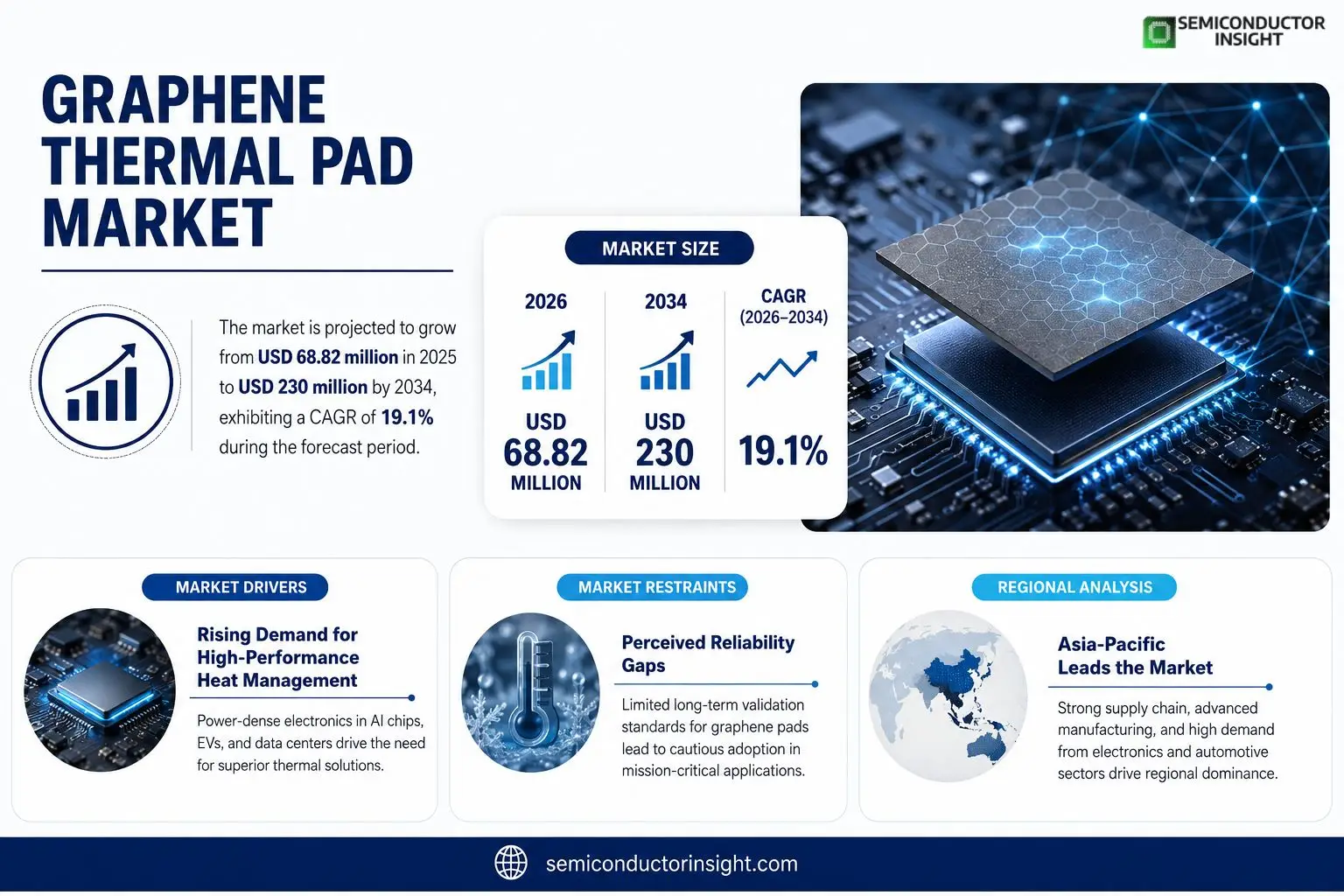
Graphene Thermal Pad market size was valued at USD 68.82 million in 2025. The market is projected to grow from USD 68.82 million in 2025 to USD 230 million by 2034, exhibiting a CAGR of 19.1% during the forecast period.
Graphene Thermal Pads are high‑efficiency heat‑dissipation components that employ graphene as the core material. Leveraging graphene’s ultra‑high thermal conductivity and flexibility, they are placed between heat‑generating chips and heat‑sink structures, reducing thermal resistance and maintaining stable device operation.The market expands because AI processors, high‑performance computing, 5G infrastructure and automotive electronics demand superior cooling solutions. Leading manufacturers such as Thermal Grizzly, ORICO Technologies, Shenzhen Hongfucheng New Materials and Changzhou Fuxi Technology dominate supply chains, while innovations in laser‑induced graphene and composite formulations drive further adoption.
MARKET DRIVERS
Rising Demand for High‑Performance Heat Management
Manufacturers of power‑dense electronics are increasingly constrained by temperature limits that threaten reliability. Graphene Thermal Pad technology, with its superior in‑plane conductivity, offers a practical route to dissipate heat without the bulk of traditional ceramic‑based solutions. This shift is reflected in the growing adoption of graphene‑infused pads across data‑center servers, electric‑vehicle power modules, and aerospace avionics, where every degree saved translates into longer component life and higher performance margins.
Advances in Scalable Production Processes
Recent breakthroughs in liquid‑phase exfoliation and roll‑to‑roll deposition have lowered the cost per square meter of graphene‑based thermal interface materials. Companies that once relied on small‑batch laboratory synthesis now ship kilogram‑scale batches, enabling OEMs to source pads at price points comparable to conventional silicone gels. The resulting economies of scale are prompting design engineers to replace legacy materials with graphene pads, especially in applications where weight and thickness are premium concerns.
➤ “The transition from metal‑based heatsinks to ultra‑thin graphene pads is reshaping thermal architecture across multiple sectors.”
Beyond cost, the environmental profile of graphene pads—requiring fewer hazardous curing agents and offering longer service life—aligns with stricter sustainability mandates in Europe and North America. As compliance frameworks tighten, procurement teams are incentivized to qualify suppliers that can demonstrate lower carbon footprints, further reinforcing market momentum for graphene‑enabled solutions.
MARKET CHALLENGES
Integration Complexity in Legacy Designs
Although graphene pads deliver superior thermal performance, retrofitting existing equipment often demands redesign of mounting hardware. The ultra‑thin form factor may cause uneven pressure distribution if not paired with compatible clamping mechanisms, leading to localized hotspots. Engineers must therefore allocate additional validation cycles, which can erode the perceived time‑to‑market advantage.
Other Challenges
Supply‑Chain Volatility
he raw graphite feedstock market experiences periodic price swings driven by mining output and geopolitical factors. While scalable production mitigates some risk, sudden disruptions can affect lead times and push up interim pricing, making budgeting more difficult for large‑scale adopters.Regulatory scrutiny of nanomaterial handling adds another layer of compliance work. Certain jurisdictions require detailed safety data sheets and worker‑exposure assessments for graphene powders, compelling manufacturers to invest in training and documentation that were previously unnecessary for conventional thermal pads.
MARKET RESTRAINTS
Perceived Reliability Gaps
End‑users remain cautious about long‑term reliability of graphene‑based pads, especially under cyclic thermal loading typical of automotive power electronics. The industry lacks a universally accepted set of accelerated aging standards for these materials, prompting some OEMs to continue specifying proven ceramic or silicone alternatives until third‑party validation studies become widespread.
MARKET OPPORTUNITIES
Emerging Segments Requiring Ultra‑Thin Thermal Interfaces
Smart‑wearable devices and flexible displays are orchestrating a new wave of demand for thermal solutions that can conform to curved surfaces without adding bulk. Graphene Thermal Pad technology, with its combination of flexibility and high conductivity, is uniquely positioned to satisfy these niche requirements. Early‑stage collaborations between material suppliers and wearable manufacturers suggest a revenue stream that could double within the next five years if integration hurdles are addressed.
Graphene Thermal Pad Market Trends
Rising Demand for High‑Performance Thermal Management
In 2025 the Graphene Thermal Pad Market generated US$68.8 million, while annual output reached roughly 3.0 million units at an average price of $25 per pad. The combination of ultra‑high thermal conductivity and the inherent flexibility of graphene has made these pads the preferred choice for designers seeking to lower thermal resistance in densely packed electronic assemblies. As AI‑accelerated processors, 5G base stations, and electric‑vehicle power modules push power densities beyond traditional limits, system integrators are turning to graphene‑based solutions to preserve reliability and extend product lifetimes. This shift is reflected in the observed production increase and the forecast that revenue will approach US$230 million by 2034, indicating a strong alignment between material capability and emerging cooling challenges.
Other Trends
Manufacturing Innovation and Process Refinement
Manufacturers are refining the compounding stage that blends graphene sheets with polymer matrices such as silicone gel. Ultrasonic agitation creates a controlled mesoscopic architecture that preserves graphene’s conductive pathways while granting the pad sufficient compressibility for intimate contact with component surfaces. Recent pilot lines have introduced laser‑induced graphene techniques, which pattern porous graphene directly onto polyimide substrates, enabling on‑demand customization of pad dimensions and thicknesses without the need for post‑process polishing. These advances reduce interface thermal resistance and lower unit‑costs, allowing smaller OEMs to adopt the technology without prohibitive upfront investment. The convergence of scalable processing and material engineering positions the sector to meet the escalating volume requirements of both consumer and industrial segments.
Application‑Driven Momentum
Beyond traditional consumer electronics, automotive electronics and high‑performance computing are accelerating adoption rates. Thermal pads embedded in power‑train control units and battery‑management systems benefit from graphene’s ability to conduct heat while tolerating mechanical vibrations. In data‑center environments, the pads serve as low‑profile interlayers that facilitate heat extraction from dense server blades, directly influencing uptime and energy efficiency metrics. The expanding portfolio of use‑cases creates a feedback loop: as manufacturers demonstrate reliability in one sector, design engineers in adjacent fields replicate the solution, broadening the addressable market and reinforcing the growth trajectory of Graphene Thermal Pad Market.
COMPETITIVE LANDSCAPEKey Industry Players
Competitive Overview of the Graphene Thermal Pad Market
The market is dominated by a handful of manufacturers that have cultivated extensive distribution networks across North America, Europe, and East Asia. Thermal Grizzly, with its broad portfolio of high‑performance pads, leverages established relationships in the gaming and workstation segments, allowing it to command a sizable share of volume sales. ORICO Technologies mirrors this approach in the consumer electronics arena, differentiating through aggressive pricing and rapid product refresh cycles. Both firms benefit from vertically integrated supply chains that secure access to premium graphene feedstock, thereby sustaining margins while scaling production to meet the accelerating demand from AI‑centric hardware.Beyond the two leaders, a cadre of specialized players is carving out niches by focusing on application‑specific innovations. Panasonic and Laird Performance Materials are investing heavily in multilayer graphene constructs that target automotive electronics and 5G infrastructure, where thermal stability under vibration is critical. Meanwhile, emerging Chinese manufacturers such as Shenzhen Hongfucheng New Materials and Changzhou Fuxi Technology are gaining traction through customized pad geometries and lower‑cost composite formulations, appealing to regional OEMs seeking cost‑effective cooling solutions.
List of Key Graphene Thermal Pad Companies Profiled
- Thermal Grizzly
- ORICO Technologies
- Panasonic
- Laird Performance Materials
- Wurth Elektronik
- Vicor
- T- Technology
- Leader Tech
- Danish Graphene
- Ryan Technology Co., Ltd.
- Smart High Tech
- Toyo Tanso
- Shenzhen Hongfucheng New Materials
- Changzhou Fuxi Technology
- Carbonene
Segment Analysis:
| Segment Category | Sub-Segments | Key Insights |
| By Type |
|
Leading Segment focuses on multilayer graphene constructions that balance ultra‑high thermal conductivity with mechanical flexibility.
|
| By Application |
|
Leading Segment is the high‑performance computing and AI chip domain where heat flux density is extreme.
|
| By End User |
|
Leading Segment in data‑center servers emphasizes continuous operation with minimal thermal throttling.
|
| By Material Innovation |
|
Leading Segment focuses on hybrid composites that enhance thermal pathways while reducing material cost.
|
| By Manufacturing Process |
|
Leading Segment leverages laser‑induced graphene to produce customized pad geometries directly on flexible substrates.
|
Regional Analysis: Graphene Thermal Pad Market
Asia-Pacific
Close collaboration between graphene producers and thermal‑pad manufacturers shortens lead times, allowing customers to replace legacy silicone solutions with graphene‑enhanced alternatives within a single product cycle.
Joint labs in Shenzhen and Seoul focus on layering techniques that boost in‑plane conductivity while preserving flexibility, a combination prized by high‑density computing platforms.
Harmonised safety standards across ASEAN and East Asia streamline certification, reducing time‑to‑market for new pad formulations aimed at automotive power modules.
Tier‑1 device manufacturers in the region prioritize thermal performance as a differentiator, prompting early integration of graphene pads into flagship product lines.
North America
The North American segment leverages its strong IP ecosystem and venture‑capital support to nurture startups that commercialise niche graphene‑based thermal solutions. While the market size trails Asia‑Pacific, the emphasis on premium consumer electronics and data‑center reliability drives a willingness to pay for superior heat‑management performance. Suppliers often bundle engineering services with the material, positioning the Graphene Thermal Pad Market as a strategic component rather than a commodity. This approach fosters closer relationships with semiconductor firms that demand thermal reliability at the edge of miniaturisation.
Europe
European manufacturers adopt a cautious yet innovative stance, marrying rigorous environmental standards with a growing appetite for green‑technology applications. The region’s focus on sustainability translates into demand for pads that combine high conductivity with recyclable or low‑toxicity compositions. Collaborative projects funded by the EU encourage cross‑border testing, ensuring that graphene solutions meet both performance and regulatory criteria across multiple jurisdictions.
South America
In South America, emerging electronics assemblers view graphene thermal pads as a pathway to differentiate locally produced devices from imported alternatives. Market participants stress cost‑effectiveness, favouring supply agreements that balance performance gains with price sensitivity. As local universities expand materials‑science programmes, a pipeline of talent is beginning to feed modest scale‑up initiatives, hinting at incremental market maturation.
Middle East & Africa
The Middle East & Africa region experiences nascent adoption, largely driven by telecom infrastructure projects that require robust thermal management for edge‑computing nodes. Investments in renewable‑energy systems, such as solar inverters, also create niche demand for reliable heat‑dissipation components. Although the overall market remains small, strategic partnerships with Asian manufacturers enable regional players to pilot graphene pads without large upfront capital commitments.
Report Scope
This market research report provides a comprehensive analysis of the Graphene Thermal Pad Market , covering the forecast period 2026–2034. It offers detailed insights into market dynamics, technological advancements, competitive landscape, and key trends shaping the industry.
Key focus areas of the report include:
-
Market Overview: The report begins with an overview outlining its current market scenario, key growth indicators, and industry transformation drivers. It discusses macroeconomic factors, demand–supply balance, regulatory landscape, and the strategic role of semiconductors in powering advancements across industries such as automotive, telecommunications, consumer electronics, and industrial automation.
- Market Size & Forecast: Historical data and future projections for revenue, unit shipments, and market value across major regions and segments.
- Segmentation Analysis: Detailed breakdown by product type, technology, application, and end-user industry to identify high-growth segments and investment opportunities.
- Regional Insights: Insights into market performance across North America, Europe, Asia-Pacific, Latin America, and the Middle East & Africa, including country-level analysis where relevant.
- Competitive Landscape: Profiles of leading market participants, including their product offerings, R&D focus, manufacturing capacity, pricing strategies, and recent developments such as mergers, acquisitions, and partnerships.
- Technology Trends & Innovation: Assessment of emerging technologies, integration of AI/IoT, semiconductor design trends, fabrication techniques, and evolving industry standards.
- Market Drivers & Restraints: Evaluation of factors driving market growth along with challenges, supply chain constraints, regulatory issues, and market-entry barriers.
- Stakeholder Insights: Insights for component suppliers, OEMs, system integrators, investors, and policymakers regarding the evolving ecosystem and strategic opportunities.
Primary and secondary research methods are employed, including interviews with industry experts, data from verified sources, and real-time market intelligence to ensure the accuracy and reliability of the insights presented.
FREQUENTLY ASKED QUESTIONS:
What is the current market size of Graphene Thermal Pad Market?
-> Graphene Thermal Pad Market was valued at USD 68.82 million in 2025 and is expected to reach USD 230 million by 2034, growing at a CAGR of 19.1% over the forecast period.
Which key companies operate in Graphene Thermal Pad Market?
-> Key players include Thermal Grizzly, ORICO Technologies, Shenzhen Hongfucheng New Materials, Changzhou Fuxi Technology, Panasonic, Ohmite, Laird Performance Materials, Wurth Elektronik, Vicor, Danish Graphene, among others.
What are the key growth drivers?
-> Key growth drivers include the rapid expansion of artificial‑intelligence chips, high‑performance computing devices, 5G communications infrastructure, and the growing demand for advanced cooling solutions in automotive electronics.
Which region dominates the market?
-> Europe and North America together hold the highest market concentration, with Europe traditionally leading in production capacity and adoption.
What are the emerging trends?
-> Emerging trends include development of multifunctional composites (e.g., carbon‑nanotube or boron‑nitride reinforced pads), integration of temperature‑sensing capabilities for intelligent thermal management, and the pursuit of recyclable, eco‑friendly graphene materials.
Get Sample Report PDF for Exclusive Insights
Report Sample Includes
- Table of Contents
- List of Tables & Figures
- Charts, Research Methodology, and more...
 Download Sample Report PDF