Dual Channel Reinforced Digital Isolators Market Insights
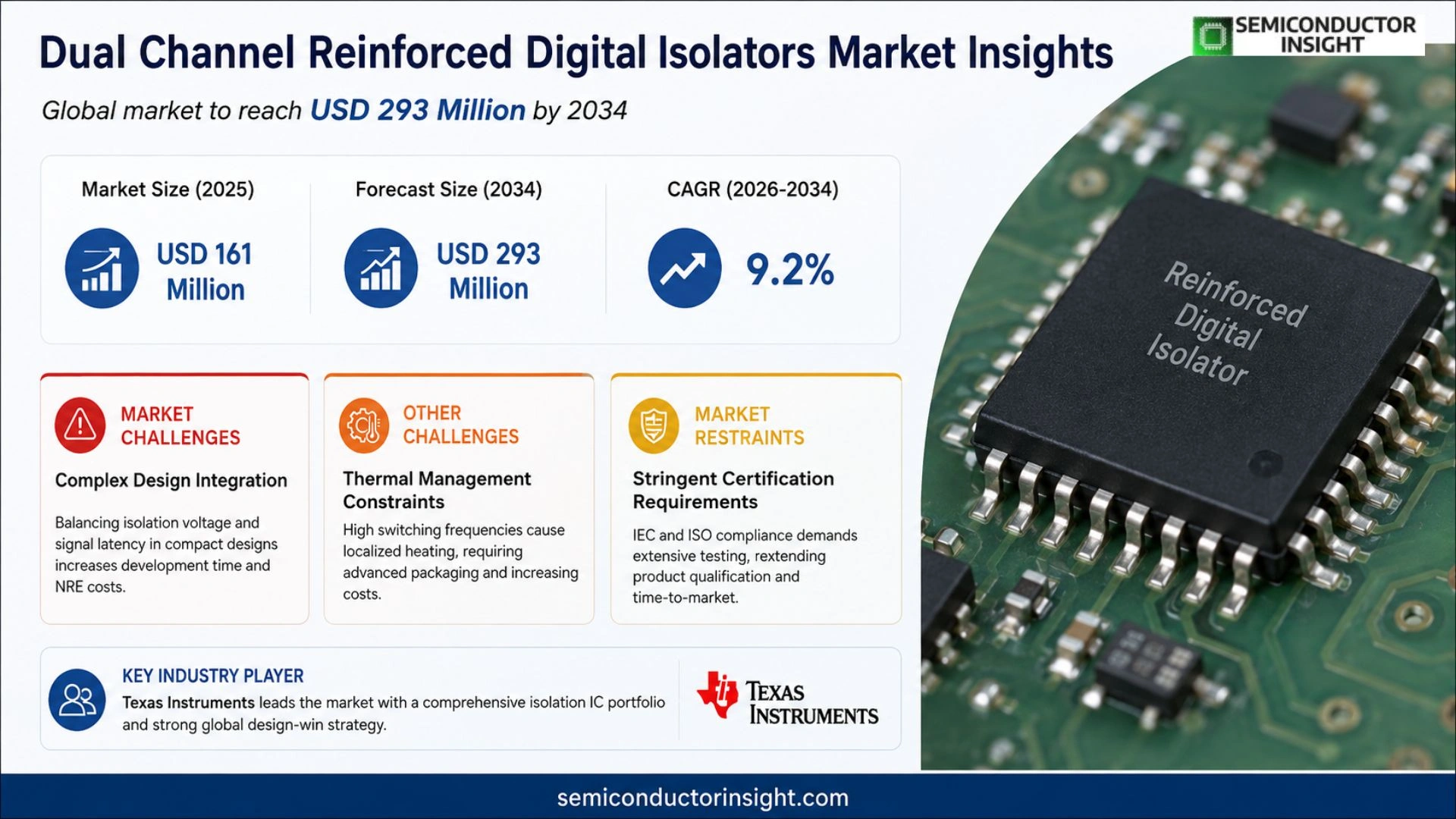
Global Dual Channel Reinforced Digital Isolators market was valued at USD 161 million in 2025 and is projected to reach USD 293 million by 2034, exhibiting a CAGR of 9.2% during the forecast period.
Dual Channel Reinforced Digital Isolators are semiconductor devices that provide reinforced electrical isolation while enabling the safe transmission of two independent digital signals across an isolation barrier. They employ capacitive or magnetic coupling technologies to block high voltages and common‑mode transients, ensuring signal integrity, functional safety, and protection of low‑voltage control circuits.
The market is gaining momentum as industrial automation, power electronics, electric vehicles, data‑center power systems and medical equipment increasingly require high‑reliability isolation solutions; production reached approximately 144.49 million units in 2025 at an average price of USD 1.22 per unit, while typical gross profit margins range from 20 % to 40 %.
MARKET DRIVERS
Rising Demand in Automotive Electronics
The shift toward electrified powertrains has created a pressing need for isolation solutions that can handle higher voltage differentials without adding bulk. Dual Channel Reinforced Digital Isolators Market participants are capitalising on this momentum by offering devices that meet stringent automotive safety standards while supporting fast data rates required for ADAS and infotainment systems.
Adoption of Industry‑4.0 Architecture
Manufacturers investing in smart factories are integrating digital isolators to protect sensors and actuators that operate at disparate voltage levels. The ability of reinforced channels to sustain EMI‑harsh environments reduces downtime, which translates into measurable cost savings for large‑scale producers.
➤ “Enhanced channel redundancy is becoming a decisive factor for OEMs seeking to future‑proof their designs,” notes a senior engineering director at a leading semiconductor firm.
Beyond automotive and manufacturing, the telecommunications sector is embracing these isolators to safeguard high‑speed transceivers. The cumulative effect of cross‑industry uptake fuels a sustained upward trajectory for Dual Channel Reinforced Digital Isolators Market.
MARKET CHALLENGES
Complex Design Integration
Design engineers often grapple with the trade‑off between isolation voltage and signal latency. Embedding dual‑channel architectures within compact PCBs demands meticulous layout discipline, which can elongate development cycles and inflate NRE costs.
Other Challenges
Thermal Management Constraints
Operating at higher switching frequencies generates localized heating. Without effective thermal pathways, performance degrades, prompting manufacturers to invest in advanced packaging,an expense that may deter price‑sensitive adopters.
MARKET RESTRAINTS
Stringent Certification Requirements
Regulatory bodies such as IEC and ISO enforce rigorous testing for isolation integrity. Achieving compliance often involves multiple qualification rounds, stretching time‑to‑market for new product launches.
Supply‑chain volatility for silicon wafers and specialized substrate materials adds another layer of uncertainty. When lead times extend, OEMs may postpone projects or revert to legacy solutions that are already stocked.
Finally, the steep learning curve associated with reinforced channel topologies discourages smaller design houses from adopting the technology, limiting overall market penetration.
MARKET OPPORTUNITIES
Expansion into Renewable Energy Systems
Solar inverters and wind‑turbine converters operate at elevated voltages and demand reliable isolation. Dual Channel Reinforced Digital Isolators Market players can tailor products for these segments, leveraging the inherent robustness of reinforced channels to meet the harsh outdoor conditions.
The rise of electric‑grid micro‑stations presents a niche where compact, high‑performance isolators are essential for bidirectional power flow. Early entrants that co‑develop with system integrators stand to capture a sizeable share of this emerging niche.
Moreover, collaborations with chipset manufacturers to embed digital isolators directly within power‑management ICs could unlock a new wave of integration, reducing BOM costs and simplifying system architecture for end customers.
Dual Channel Reinforced Digital Isolators Market Trends
Escalating Demand for High‑Reliability Isolation in Industrial Automation
Dual Channel Reinforced Digital Isolators Market is riding a wave of adoption across factories that are modernizing control systems. In 2025, sales volumes hit roughly 144.5 million units, while unit pricing averaged about US$1.22, delivering a gross margin bracket of 20 %–40 %. This price‑performance balance satisfies engineers who must protect dual signal paths against spikes and common‑mode noise. The surge stems from tighter safety certifications and a shift toward modular power architectures where a single isolator can replace multiple discrete components. Consequently, equipment manufacturers are redesigning motor‑drive and inverter boards to embed these devices, cutting board‑space and improving overall system reliability.
Other Trends
Wider Adoption of Wide‑Bandgap Semiconductor Platforms
Silicon‑carbide (SiC) and gallium‑nitride (GaN) converters are expanding the voltage envelope of power electronics, and Dual Channel Reinforced Digital Isolators Market is responding by tailoring its coupling topologies. Capacitive and magnetic variants now accommodate higher dv/dt rates, which are typical in fast‑switching SiC drives. The ability to sustain reinforced isolation under those conditions reduces the need for auxiliary protection circuits, translating into lower Bill‑of‑Materials costs for EV inverters and data‑center power modules. Suppliers that align product roadmaps with wide‑bandgap trends are seeing order growth that outpaces the broader market, positioning themselves as preferred partners for OEMs pursuing efficiency gains.
Regional Shift Toward Asia‑Pacific Manufacturing
Asia‑Pacific accounts for the bulk of production capacity,approximately 150 million units in 2025,driven by dense electronics fabs and cost‑effective supply chains. The region’s emphasis on high‑volume automotive and renewable‑energy projects amplifies demand for dual‑channel isolation solutions that meet strict IEC standards. Meanwhile, North America and Europe retain a foothold in safety‑critical sectors such as medical imaging, where margin expectations hover near the upper end of the 20 %–40 % range. The divergence creates a competitive landscape where players must balance scale efficiencies in the East with premium positioning in the West, influencing pricing strategies and R&D investment decisions.
COMPETITIVE LANDSCAPE
Key Industry Players
Dual Channel Reinforced Digital Isolators – Competitive Overview
Texas Instruments dominates the dual‑channel reinforced digital isolator segment, leveraging its extensive portfolio of isolation ICs and a global design‑win strategy that ties customers to its broader analog and mixed‑signal family. The company’s ability to integrate high‑speed data‑rate options with reinforced voltage‑stand‑off has translated into a commanding share of the 2025 production run, while its aggressive pricing on 1.2‑V units pressures marginal players to specialize or form alliances. Recent firmware‑compatible releases demonstrate how TI is translating safety‑standard compliance into a differentiator that resonates with automotive OEMs and data‑center OEMs alike, reshaping the supply chain toward a few high‑volume sources.
Beyond TI, a cadre of midsized and niche firms sustains competitive tension. NXP Semiconductors and Infineon Technologies each command strong footholds in automotive power‑train modules, where their magnetic‑coupling isolators meet the rigorous IEC 60747‑5‑2 criteria. Analog Devices and STMicroelectronics diversify the market with capacitive‑coupling solutions that prioritize low‑power consumption for renewable‑energy inverters. ON Semiconductor, Silicon Labs, and Microchip Technology focus on industrial automation, offering custom data‑rate families that address the growing need for noise‑immune communication links. Smaller but agile players such as Rohm Semiconductor, Toshiba Electronic Devices, Maxim Integrated (now part of ADI), Melexis, and Renesas Electronics target specific verticals,medical equipment, EV chargers, and motor‑drive interfaces,thereby preserving a fragmented yet innovative landscape.
List of Key Dual Channel Reinforced Digital Isolators Companies Profiled
- Texas Instruments
- NXP Semiconductors
- Infineon Technologies
- Analog Devices
- STMicroelectronics
- ON Semiconductor
- Silicon Labs
- Microchip Technology
- Rohm Semiconductor
- Toshiba Electronic Devices
- Melexis
- Renesas Electronics
Segment Analysis:
| Segment Category | Sub-Segments | Key Insights |
| By Type |
|
Capacitive Coupling
This technology remains the workhorse of the market, balancing cost efficiency with dependable isolation strength. |
| By Application |
|
Industrial Automation
The sector drives continuous innovation, prompting manufacturers to embed stronger isolation grades and broader temperature tolerances. |
| By End User |
|
OEMs
These considerations shape product roadmaps, encouraging the development of variants with higher pressure‑resistance grades and extended temperature ranges. |
| By Coupling Mechanism |
|
Magnetic Based Isolation
Manufacturers are increasingly leveraging magnetic coupling to differentiate products targeting high‑speed data links in renewable‑energy converters. |
| By Data Rate Capability |
|
25‑150 Mbps+
These high‑performance segments influence roadmap decisions, encouraging partners to co‑develop firmware and layout guidance that maximizes throughput while maintaining safety compliance. |
Regional Analysis: Dual Channel Reinforced Digital Isolators Market
North America
Federal safety directives for autonomous vehicles have tightened isolation requirements, compelling manufacturers to certify dual‑channel designs that meet higher voltage‑withstand criteria. The resulting regulatory pressure nudges design teams toward reinforced digital isolators that can demonstrate compliance without extensive redesign, accelerating market uptake across automotive and industrial sectors.
Recent reshoring initiatives have shortened the distance between silicon fabs and end‑users, improving lead‑time visibility for isolator components. This proximity enables manufacturers to hold tighter inventory buffers while still delivering rapid design iterations, a competitive advantage that underpins steady demand growth in the region.
Automotive power‑train modules and high‑speed data‑acquisition systems are the primary adopters, each seeking the reliability offered by reinforced isolation. Meanwhile, the renewable‑energy sector is beginning to explore these components for inverter protection, widening the addressable base.
Leading manufacturers are pursuing portfolio consolidation, acquiring niche firms that specialize in high‑frequency shielding technologies. These moves are designed to broaden product breadth, allowing suppliers to present complete isolation solutions that integrate seamlessly into complex system architectures.
Europe
European automotive manufacturers are integrating dual‑channel reinforced isolators into next‑generation electric vehicle platforms, motivated by stringent electromagnetic‑compatibility standards. The region’s strong emphasis on sustainability drives system designers to favor components that reduce heat dissipation, thereby improving overall energy efficiency. Meanwhile, Germany and France host a dense network of engineering consultancies that act as catalysts for rapid technology transfer, ensuring that new isolator designs reach production lines with minimal friction. Business leaders are also capitalizing on the EU’s incentives for advanced manufacturing, which subsidize tooling upgrades necessary for high‑precision isolator fabrication.
Asia‑Pacific
In Asia‑Pacific, the market is shaped by a blend of high‑volume consumer electronics production and burgeoning electric‑vehicle factories. Manufacturers in Japan and South Korea prioritize reinforced digital isolators for their ability to maintain signal integrity in compact, high‑density modules. Concurrently, China’s aggressive push toward localized semiconductor capabilities has led to a surge in joint‑venture projects focused on isolator miniaturization, creating a fertile environment for collaborative innovation. The region’s cost‑sensitive landscape forces suppliers to balance premium performance with competitive pricing, prompting a wave of incremental product improvements.
South America
South American adopters are largely concentrated in the industrial automation segment, where reinforced isolators are viewed as essential for protecting legacy equipment during modernization efforts. Countries such as Brazil are witnessing increased investment in smart‑factory initiatives, and the need for robust isolation solutions is becoming a prerequisite for integrating IoT sensors into hazardous environments. Although market size remains modest, early‑stage partnerships between local integrators and global silicon vendors are laying the groundwork for expanded adoption across energy and manufacturing verticals.
Middle East & Africa
The Middle East & Africa region is experiencing a slow but steady rise in demand for dual‑channel reinforced isolators, driven primarily by large‑scale solar‑farm projects that require reliable power conversion hardware. In the Gulf Cooperation Council, distributors are emphasizing the durability of reinforced isolators to meet the harsh temperature swings characteristic of desert operations. African markets, still in early adoption phases, are leveraging international financing programs that promote technology transfer, allowing local OEMs to incorporate advanced isolation components into emerging telecommunications infrastructure.
Report Scope
This market research report provides a comprehensive analysis of the Dual Channel Reinforced Digital Isolators Market , covering the forecast period 2026–2034. It offers detailed insights into market dynamics, technological advancements, competitive landscape, and key trends shaping the industry.
Key focus areas of the report include:
- Market Overview: The report begins with an overview outlining its current market scenario, key growth indicators, and industry transformation drivers. It discusses macroeconomic factors, demand–supply balance, regulatory landscape, and the strategic role of semiconductors in powering advancements across industries such as automotive, telecommunications, consumer electronics, and industrial automation.
- Market Size & Forecast: Historical data and future projections for revenue, unit shipments, and market value across major regions and segments.
- Segmentation Analysis: Detailed breakdown by product type, technology, application, and end-user industry to identify high-growth segments and investment opportunities.
- Regional Insights: Insights into market performance across North America, Europe, Asia-Pacific, Latin America, and the Middle East & Africa, including country-level analysis where relevant.
- Competitive Landscape: Profiles of leading market participants, including their product offerings, R&D focus, manufacturing capacity, pricing strategies, and recent developments such as mergers, acquisitions, and partnerships.
- Technology Trends & Innovation: Assessment of emerging technologies, integration of AI/IoT, semiconductor design trends, fabrication techniques, and evolving industry standards.
- Market Drivers & Restraints: Evaluation of factors driving market growth along with challenges, supply chain constraints, regulatory issues, and market-entry barriers.
- Stakeholder Insights: Insights for component suppliers, OEMs, system integrators, investors, and policymakers regarding the evolving ecosystem and strategic opportunities.
Primary and secondary research methods are employed, including interviews with industry experts, data from verified sources, and real-time market intelligence to ensure the accuracy and reliability of the insights presented.
FREQUENTLY ASKED QUESTIONS:
What is the current market size of Dual Channel Reinforced Digital Isolators Market?
-> Dual Channel Reinforced Digital Isolators market is projected to reach USD 293 million by 2034, exhibiting a CAGR of 9.2% during the forecast period.
Which key companies operate in Dual Channel Reinforced Digital Isolators Market?
-> Key players include Texas Instruments, ON Semiconductor, Analog Devices, Infineon Technologies, and STMicroelectronics, among others.
What are the key growth drivers?
-> Key growth drivers include rising demand for high‑reliability electrical isolation in industrial automation, power electronics, automotive and data‑center applications, stricter safety standards, and increasing adoption of wide‑bandgap semiconductors (SiC/GaN).
Which region dominates the market?
-> Asia‑Pacific leads the market, driven by strong electronics manufacturing activity, while North America and Europe remain important regions for safety‑critical applications.
What are the emerging trends?
-> Emerging trends include integration of dual‑channel isolators in electric‑vehicle inverters, expanding use in renewable‑energy power supplies, and development of higher data‑rate isolators for AI‑enabled edge devices.
Get Sample Report PDF for Exclusive Insights
Report Sample Includes
- Table of Contents
- List of Tables & Figures
- Charts, Research Methodology, and more...