Camera Auto Focus Driver IC Market Insights
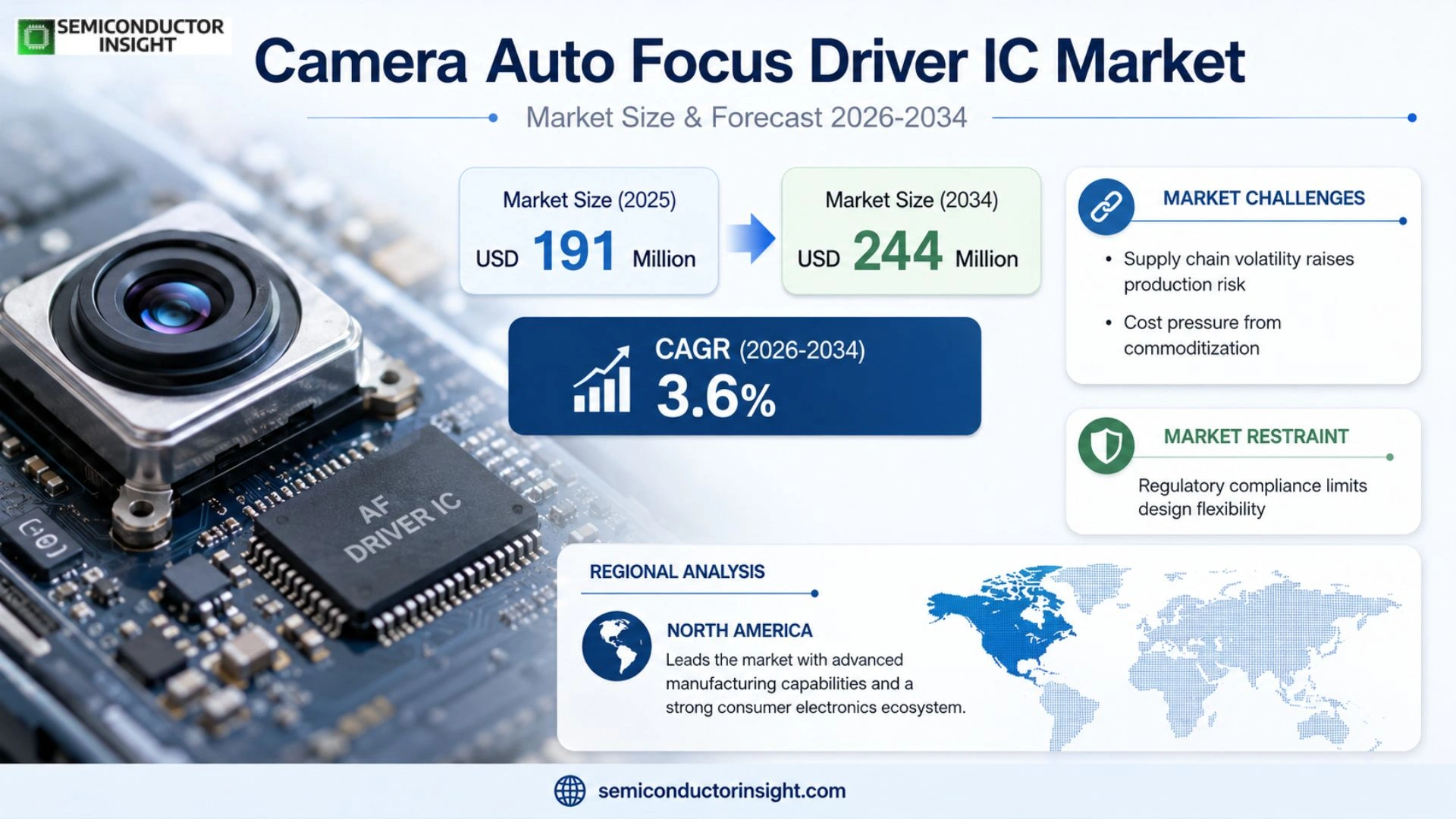
Global Camera Auto Focus Driver IC market size was valued at USD 191 million in 2025. It is expected to rise to USD 244 million by 2034, delivering a CAGR of 3.6 % over the forecast horizon.
Camera auto focus driver ICs are dedicated drive and control chips installed within camera or lens modules. Their primary function is to operate VCMs, SMA actuators or lens motors so that lens elements move, hold position, home, brake and compensate under strict limits for space, power consumption, noise and reliability. This enables fast focusing, low ringing, minimal error and stable imaging across photography, video recording, continuous autofocus, optical zoom and hand‑shake mitigation scenarios.
The expansion of this niche stems from several converging forces: smartphones continue demanding higher‑speed autofocus combined with optical image stabilization; per‑iscope and telephoto modules increase mechanical complexity; emerging applications such as drones, AR headsets and security cameras broaden the addressable base beyond mobile devices; and regional semiconductor policies,particularly in the United States, Japan, South Korea and China,support design‑for‑manufacturing initiatives that lower cost and improve time‑to‑market for advanced driver solutions.
MARKET DRIVERS
Smart‑phone camera demand fuels IC adoption
The surge in flagship smartphones equipped with multi‑lens arrays has created a steady requirement for high‑precision focus mechanisms. Camera Auto Focus Driver ICs translate sensor data into rapid lens displacement, enabling manufacturers to meet consumer expectations for crisp imagery across diverse lighting conditions.
Automotive ADAS integration expands market
Advanced driver‑assistance systems (ADAS) increasingly rely on compact imaging modules for lane‑keeping and pedestrian detection. The need for robust, temperature‑tolerant focus driver ICs in automotive cameras adds a substantial volume stream that complements the consumer electronics segment.
➤ “Designs that combine low power consumption with nanometer‑scale actuation are becoming the baseline for next‑gen imaging solutions.”
The convergence of 5G‑enabled devices, edge‑AI processing, and higher pixel counts forces OEMs to source ICs capable of sub‑micron positioning while preserving battery life. Suppliers that align product roadmaps with these technical pressures are positioned to capture the bulk of upcoming orders in Camera Auto Focus Driver IC Market.
MARKET CHALLENGES
Supply chain volatility raises production risk
Semiconductor fabs worldwide face fluctuations in wafer availability, especially for specialty processes used in focus driver ICs. Limited capacity can delay volume shipments, forcing camera manufacturers to re‑evaluate inventory policies and potentially increase unit costs.
Other Challenges
Cost pressure from commoditization
As component standardization proceeds, price sensitivity intensifies across mid‑tier smartphone tiers. Vendors must balance margin preservation with the need to offer competitive pricing, often by leveraging larger wafer volumes or adopting newer node efficiencies.
MARKET RESTRAINTS
Regulatory compliance limits design flexibility
Stringent electromagnetic interference (EMI) and automotive safety standards constrain the allowable architecture of focus driver ICs. Engineers must allocate additional design resources to meet certification requirements, which can extend development cycles and deter smaller players from entering Camera Auto Focus Driver IC Market.
MARKET OPPORTUNITIES
Emerging AR/VR headsets require ultra‑fast autofocus
Augmented and virtual reality platforms depend on real‑time scene adaptation, demanding focus driver ICs that operate at kilohertz‑level response rates. Companies that can deliver such performance in a compact, power‑efficient package stand to secure contracts with hardware manufacturers seeking immersive experiences.
In parallel, the rollout of 8‑megapixel and higher sensors in surveillance cameras opens a niche for driver ICs optimized for low‑light performance and long‑duration reliability. Targeting this segment with ruggedized products can diversify revenue streams and offset the cyclical nature of the consumer market.
Camera Auto Focus Driver IC Market Trends
Shift Toward Integrated Closed‑Loop Control
The prevailing direction of Camera Auto Focus Driver IC Market is a migration from isolated DAC‑I2C drivers to platform‑centric solutions that embed constant‑current regulation, soft‑landing algorithms, and on‑chip EEPROM for parameter storage. Recent silicon releases incorporate Hall‑sensor feedback and PID loops, turning a simple actuator supply into a genuine motion controller. Vendors that embed 32‑bit RISC cores or DSP engines can host firmware that adapts in real time to temperature drift and lens‑specific dynamics, delivering faster focus lock and reduced ringing without sacrificing power budget. This architectural consolidation shortens module‑tuning cycles for OEMs, improves yield on high‑resolution smartphone cameras, and creates a new revenue tier where software licensing and tuning services complement the silicon price.
Other Trends
Regional Competitive Landscape
Globally, the supply side remains multipolar. U.S. firms span entry‑level drivers and advanced system‑on‑chip offerings, leveraging mature analog expertise and extensive design‑win programs with major smartphone brands. Japanese suppliers retain a strong foothold in lens‑module integration, using long‑standing relationships with camera‑module assemblers to push incremental performance gains. Korean companies provide a breadth of catalog parts that cover both AF and OIS functions, positioning themselves as a one‑stop source for tier‑1 tier‑2 customers. Chinese and Taiwanese players have accelerated development of closed‑loop ASICs, benefitting from national semiconductor incentives that lower fab costs and speed time‑to‑market. The United Kingdom’s niche entrants focus on SMA‑based architectures targeting premium imaging rigs. The confluence of policy support, localized design houses, and diversified product portfolios makes supply resilience a decisive factor for buyers seeking long‑term partnership.
Emerging Opportunities in Machine‑Vision Applications
Beyond the traditional smartphone arena, Camera Auto Focus Driver IC Market is gaining traction in security, AR, and drone vision systems where autofocus precision directly influences operational reliability. In surveillance lenses, coordinated zoom‑focus‑iris control reduced mechanical latency, allowing higher frame‑rate analytics. AR headsets demand sub‑millisecond focus adjustments to maintain visual fidelity during rapid head movements, prompting IC designers to embed ultra‑low‑power sleep modes and fast‑wake sequencers. These applications elevate the average contribution of each driver IC to the host device’s bill of materials, shifting commercial focus from unit volume to functional value. Companies that can bundle firmware libraries, calibration kits, and reference designs with their silicon are better positioned to capture design‑win opportunities across these expanding verticals.
COMPETITIVE LANDSCAPE
Key Industry Players
Camera Auto Focus Driver IC Market – Competitive Overview
The segment is anchored by a handful of firms that supply both catalog‑type drivers and fully integrated control platforms. Texas Instruments (TI) and ON Semiconductor (onsemi) command the largest share of volume shipments, leveraging extensive analog‑digital IP libraries and deep relationships with smartphone OEMs. Their products span the classic DAC‑plus‑I²C VCM drivers to newer constant‑current architectures that still prioritize footprint and cost. On the higher‑performance side, ROHM (ROHM) and Analog Devices (ADI) differentiate through closed‑loop PID controllers, Hall‑sensor feedback and integrated DSP cores, enabling fast focus acquisition with minimal ringing. This dual‑track structure creates a competitive lattice where price‑sensitive OEMs gravitate toward the legacy drivers, while premium camera modules,especially those integrating AF with OIS or multi‑actuator zoom,look to the system‑level solutions.
Beyond the dominant tier, a diverse set of regional specialists enriches the landscape. Japanese players such as Renesas Electronics and Nuvoton Technology provide tightly coupled ASICs optimized for the compact modules favored by domestic smartphone makers. South Korean contributors, notably Samsung Electronics and Himax, exploit advanced packaging to deliver sub‑millimeter footprints for periscope lenses. Taiwanese and mainland Chinese firms,including ZINITIX, Dongwoon Anatech, Giantec Semiconductor, Halo Microelectronics Group, Cambridge Mechatronics and Eutech Microelectronics,focus on niche actuation technologies (SMA, micro‑gear) and cost‑effective closed‑loop designs for security cameras, drones and AR vision systems. Their rapid iteration cycles and close proximity to device assemblers give them leverage in emerging machine‑vision applications, where customized firmware and tuning tools are becoming decisive purchase criteria.
List of Key Camera Auto Focus Driver IC Companies Profiled
- Texas Instruments
- ON Semiconductor
- ROHM
- Analog Devices
- Renesas Electronics
- Nuvoton Technology Corporation
- Samsung Electronics
- Himax Technologies
- ZINITIX
- Dongwoon Anatech Co., Ltd.
- Giantec Semiconductor Corporation
- Halo Microelectronics Group Co., Ltd.
- Cambridge Mechatronics Ltd.
- Eutech Microelectronics Inc.
- Jadard Technology Inc.
Segment Analysis:
| Segment Category | Sub-Segments | Key Insights |
| By Type |
|
Closed Loop Drivers are emerging as the preferred choice because they combine precise position feedback with adaptive algorithms.
|
| By Application |
|
Smartphone and Tablet remain the dominant application due to relentless demand for faster focus and integrated OIS.
|
| By End User |
|
Smartphone OEMs drive specification depth and integration complexity.
|
| By Functionality |
|
Focus + OIS is gaining traction as devices consolidate motion control.
|
| By Integration Level |
|
Full Solution Platforms are becoming the premium offering for high‑performance optics.
|
Regional Analysis: Camera Auto Focus Driver IC Market
North America
Smartphone manufacturers drive the bulk of demand, seeking driver ICs that deliver sub‑millisecond focus lock for high‑resolution sensors. Simultaneously, automotive camera modules require robust, temperature‑tolerant components to support advanced driver‑assist systems, prompting a modest but growing allocation of capacity toward automotive‑grade parts.
Recent geopolitical shifts have motivated key players to diversify wafer fab locations across the United States and Canada. Near‑shoring initiatives, combined with flexible fab‑as‑a‑service models, mitigate exposure to overseas disruptions while preserving throughput for high‑volume orders.
A handful of entrenched firms command the majority of market share through deep patent portfolios and long‑standing OEM relationships. Emerging challengers focus on niche applications such as medical imaging, leveraging bespoke design cycles to carve out specialized market slices.
Integration of AI‑assisted autofocus algorithms is prompting a shift toward driver ICs that support on‑chip processing, allowing faster subject tracking. Early adopters are exploring heterogeneous integration to combine sensor, driver, and image‑signal processing in a single package.
Europe
European manufacturers benefit from a strong legacy in precision optics and a dense network of camera lens suppliers. The region’s emphasis on sustainability has spurred interest in low‑power driver ICs that meet stringent energy‑efficiency standards, especially in professional video equipment. Automotive markets in Germany and France are accelerating the adoption of driver‑assist cameras, creating a niche for rugged, temperature‑stable components. While the overall demand volume trails North America, Europe’s fragmented supplier base fosters niche innovation, with several mid‑size firms pursuing differentiated ASIC designs for specialized imaging applications.
Asia‑Pacific
Asia‑Pacific represents a vibrant growth corridor driven by rapid smartphone penetration and rising consumer willingness to adopt premium camera features. Manufacturing hubs in Taiwan, South Korea, and China provide a cost‑effective production backbone, enabling aggressive price competition. Emerging smart‑city projects are incorporating surveillance cameras that rely on precise autofocus, further expanding the addressable market. However, the region’s reliance on export‑oriented supply chains introduces timing risks, prompting some OEMs to explore regional fab investments to secure capacity for next‑generation driver ICs.
South America
In South America, market activity is anchored by expanding smartphone uptake in Brazil and Mexico, where manufacturers are beginning to differentiate devices through superior camera performance. Automotive adoption is slower, yet local initiatives to modernize public‑transport fleets with advanced driver‑assist systems are generating early demand for reliable autofocus driver ICs. Infrastructure constraints and import tariffs influence pricing dynamics, encouraging regional assemblers to partner with multinational IC suppliers to achieve cost‑effective sourcing.
Middle East & Africa
The Middle East & Africa region exhibits modest but strategically significant demand, largely tied to high‑end luxury vehicle introductions that feature sophisticated camera arrays. In the consumer space, rising smartphone ownership in affluent Gulf markets fuels interest in premium imaging capabilities, prompting local distributors to stock advanced driver ICs. Limited indigenous semiconductor fabrication pushes the region to depend on imported modules, reinforcing the importance of robust logistics and after‑sales support from global vendors.
Report Scope
This market research report provides a comprehensive analysis of the Camera Auto Focus Driver IC Market , covering the forecast period 2026–2034. It offers detailed insights into market dynamics, technological advancements, competitive landscape, and key trends shaping the industry.
Key focus areas of the report include:
- Market Overview: The report begins with an overview outlining its current market scenario, key growth indicators, and industry transformation drivers. It discusses macroeconomic factors, demand–supply balance, regulatory landscape, and the strategic role of semiconductors in powering advancements across industries such as automotive, telecommunications, consumer electronics, and industrial automation.
- Market Size & Forecast: Historical data and future projections for revenue, unit shipments, and market value across major regions and segments.
- Segmentation Analysis: Detailed breakdown by product type, technology, application, and end-user industry to identify high-growth segments and investment opportunities.
- Regional Insights: Insights into market performance across North America, Europe, Asia-Pacific, Latin America, and the Middle East & Africa, including country-level analysis where relevant.
- Competitive Landscape: Profiles of leading market participants, including their product offerings, R&D focus, manufacturing capacity, pricing strategies, and recent developments such as mergers, acquisitions, and partnerships.
- Technology Trends & Innovation: Assessment of emerging technologies, integration of AI/IoT, semiconductor design trends, fabrication techniques, and evolving industry standards.
- Market Drivers & Restraints: Evaluation of factors driving market growth along with challenges, supply chain constraints, regulatory issues, and market-entry barriers.
- Stakeholder Insights: Insights for component suppliers, OEMs, system integrators, investors, and policymakers regarding the evolving ecosystem and strategic opportunities.
Primary and secondary research methods are employed, including interviews with industry experts, data from verified sources, and real-time market intelligence to ensure the accuracy and reliability of the insights presented.
FREQUENTLY ASKED QUESTIONS:
What is the current market size of Camera Auto Focus Driver IC Market?
-> Camera Auto Focus Driver IC market is expected to rise to USD 244 million by 2034, delivering a CAGR of 3.6 % over the forecast horizon.
Which key companies operate in Camera Auto Focus Driver IC Market?
-> Key players include Dongwoon Anatech Co., Ltd., ZINITIX Co., Ltd., Texas Instruments Incorporated, onsemi, Nuvoton Technology Corporation, ROHM Co., Ltd., Giantec Semiconductor Corporation, Jadard Technology Inc., Analog Devices, Inc., Cambridge Mechatronics Ltd., Renesas Electronics Corporation, Halo Microelectronics Group Co., Ltd., and Eutech Microelectronics Inc..
What are the key growth drivers?
-> Key growth drivers include rising demand for high‑performance smartphone cameras, integration of autofocus (AF) with optical image stabilization (OIS), expansion of periscope and telephoto modules, multicamera coordination, need for lower power consumption and smaller package sizes, and broader adoption in digital cameras, security, AR/VR and drone vision systems.
Which region dominates the market?
-> Asia dominates the market, driven by the concentration of smartphone shipments, camera module manufacturing hubs, and extensive OEM and supply‑chain ecosystems in China, Japan, South Korea, and other Asian economies.
What are the emerging trends?
-> Emerging trends include closed‑loop AF with Hall feedback and PID algorithms, system‑class driver ICs featuring 32‑bit RISC/DSP cores, AI‑enabled tuning and calibration tools, multi‑actuator and zoom‑focus‑iris integrated solutions, and deeper integration of AF with OIS for advanced imaging applications.

Get Sample Report PDF for Exclusive Insights
Report Sample Includes
- Table of Contents
- List of Tables & Figures
- Charts, Research Methodology, and more...
 Download Sample Report PDF