
Bus Line Transceiver Market Insights
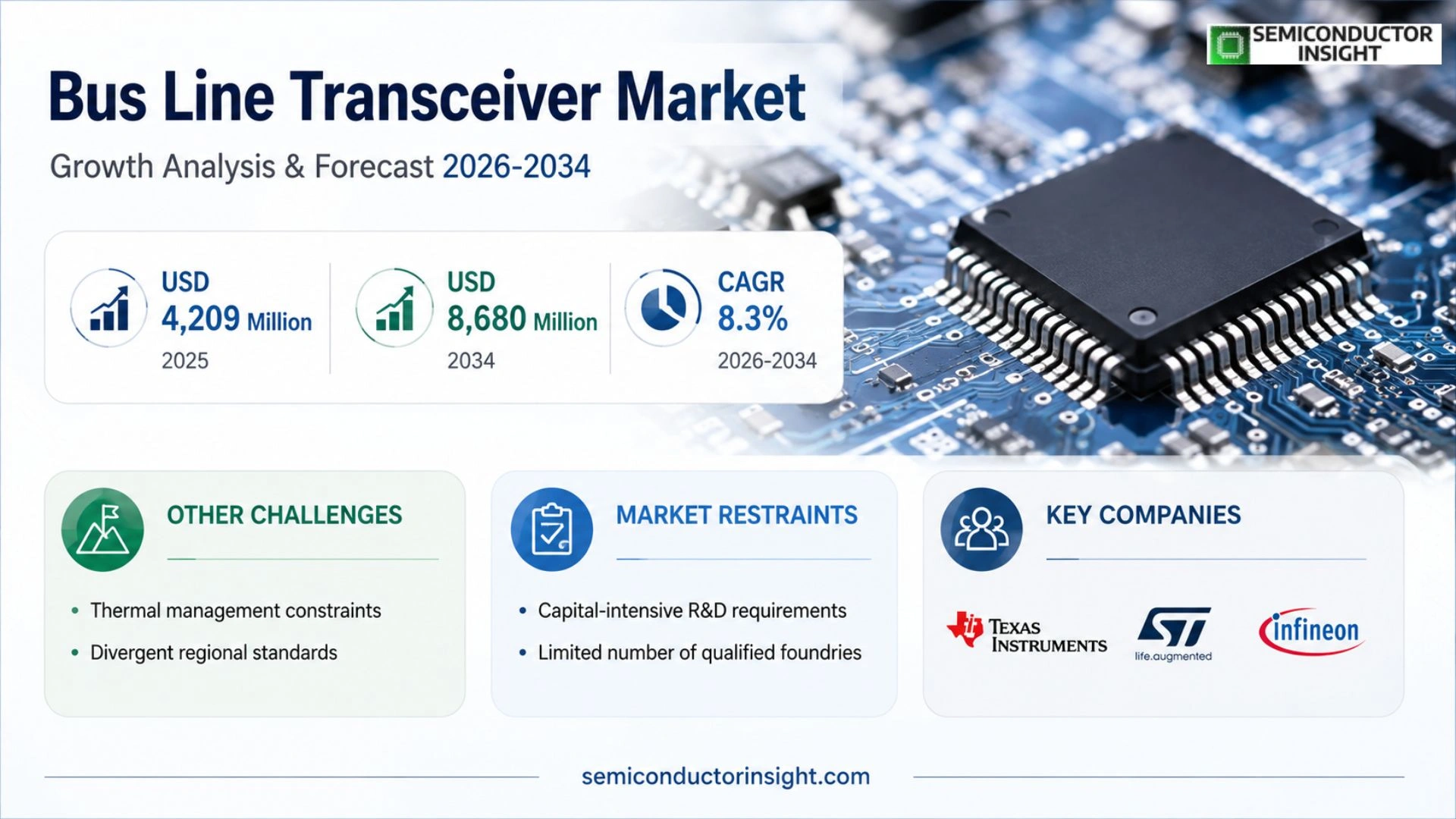
Bus Line Transceiver market was valued at USD 4,209 million in 2025 and is expected to climb to USD 8,680 million by 2034, indicating an implied CAGR of approximately 8.3% over the forecast horizon.
A Bus Line Transceiver is a physical‑layer interface chip positioned between a microcontroller or SoC and an external bus such as CAN, LIN, RS‑485 or backplane lines. It integrates driver and receiver functions, performs level conversion, bidirectional data transfer, and incorporates protection features like over‑voltage, short‑circuit and ESD safeguards.
The market expansion is fueled by the surge in automotive electronic content,especially in new‑energy vehicles,and the rising demand for robust communication links in industrial automation and energy‑storage systems. Stricter EMC and functional‑safety standards are prompting OEMs to replace low‑end devices with higher‑performance transceivers, while regional manufacturers are gaining ground on generic RS‑485/LIN solutions.
MARKET DRIVERS
Automotive Electrification and Safety Requirements
The shift toward electric powertrains has forced vehicle manufacturers to re‑engineer communication backbones. Bus Line Transceiver components now carry higher voltage levels while maintaining signal integrity, a combination that is essential for meeting stringent crash‑safety standards and for supporting fast charging protocols.
Industrial Automation and High‑Speed Data Exchange
Factories adopting Industry 4.0 architectures rely on deterministic networks to synchronize robotic cells. Modern transceivers, with embedded error‑correction and low‑latency interfaces, enable the precise timing required for motion control loops, thereby justifying higher capital outlays.
➤ “Reliability gains of up to 30 % are being reported in test benches where next‑generation transceivers replace legacy modules.”
These technical imperatives are prompting OEMs to partner with specialist silicon firms, creating a feedback loop that fuels further innovation across Bus Line Transceiver market.
MARKET CHALLENGES
Design Complexity and Qualification Overheads
Engineering a transceiver that simultaneously satisfies automotive EMC limits, temperature extremes, and high‑speed data rates demands multi‑disciplinary expertise. The qualification process, often spanning 12‑18 months, compresses product launch windows and inflates development budgets.
Other Challenges
Thermal Management Constraints
As power densities climb, dissipating heat without compromising board space becomes a critical hurdle, prompting designers to adopt advanced packaging technologies.
Furthermore, divergent regional standards force manufacturers to maintain multiple design variants, eroding economies of scale.
MARKET RESTRAINTS
Capital‑Intensive R&D Requirements
The need for continuous silicon refresh cycles drives up research expenditures, particularly for firms lacking deep pockets. Smaller players often resort to licensing agreements, which can dilute profit margins.
Additionally, the limited number of qualified foundries capable of delivering automotive‑grade processes creates a bottleneck that hampers supply‑side agility.
MARKET OPPORTUNITIES
Autonomous Systems and Edge Connectivity
Self‑driving platforms demand fault‑tolerant, high‑bandwidth links between sensors, compute units, and actuation modules. Transceiver architectures that integrate time‑sensitive networking (TSN) are positioned to capture a growing slice of this nascent market.
Parallel to automotive trends, the aerospace sector is retrofitting legacy aircraft with digital bus infrastructures to support predictive maintenance. The stringent reliability criteria in aviation open a premium niche for ruggedized transceiver families.
Finally, the proliferation of IoT gateways in smart‑city deployments presents a peripheral but measurable avenue, where low‑cost, scalable transceivers can embed themselves in municipal sensor grids.
Bus Line Transceiver Market Trends
Automotive Architecture Evolution Boosts Unit Demand
The transition toward domain‑centric electronic architectures in passenger vehicles has expanded the number of communication nodes per platform. A conventional gasoline model now carries roughly 20 CAN/LIN transceivers, while a mid‑range electric vehicle may require up to 50. This escalation stems from higher voltage power‑train control, advanced driver‑assistance modules, and over‑the‑air update capabilities, all of which rely on reliable physical‑layer interfaces. As each node incorporates a dedicated transceiver, total unit shipments climbed to 5.9 billion in 2025, sustaining a pricing band of US $0.75‑0.85. The resulting margin profile,hovering between 28 % and 40 %,reflects the premium placed on integrated protection features that meet tightening EMC and safety specifications.
Other Trends
Supply‑Chain Pressures on Component Margins
Periodic shortages of advanced wafer capacity and packaging lines introduce volatility into cost structures. Fluctuations in copper and precious‑metal prices further compress gross margins, especially for manufacturers relying on high‑volume, low‑margin product families. Companies that have diversified their foundry base or adopted in‑house testing see a steadier cost curve, enabling them to retain pricing power while still delivering the high‑integrity devices demanded by automotive OEMs and industrial system integrators.
Industrial Automation and Energy‑Infrastructure Demand
Parallel to automotive trends, the rollout of smart factories and grid‑edge storage solutions fuels demand for robust RS‑485 and CAN FD transceivers. A typical PLC station now integrates three to six field‑bus interfaces, and photovoltaic inverters often embed four to ten units to manage monitoring, protection, and communication with energy‑management platforms. The push for higher data‑rate capabilities,up to 50 Mbit/s in emerging bus‑hybrid schemes,encourages OEMs to favor highly integrated, low‑power parts that reduce board real‑estate and simplify system design. This shift reshapes the competitive landscape: global IDMs retain leadership in high‑reliability segments, while regional players gain traction in cost‑sensitive, mid‑range offerings, creating a tiered market that balances performance with price elasticity.
COMPETITIVE LANDSCAPE
Key Industry Players
Competitive Overview of Bus Line Transceiver market
The market is led by a handful of international integrated device manufacturers whose breadth of process technology and global production capacity give them a decisive edge in high‑reliability automotive and industrial transceivers. Texas Instruments, STMicroelectronics, Infineon Technologies and Renesas Electronics each command double‑digit shares in the CAN/F‑D, LIN and RS‑485 segments, leveraging mature 65 nm and below wafers to deliver parts that meet stringent functional‑safety and EMC standards. Their product portfolios are tightly integrated with major ECU and PLC suppliers, which reinforces recurring revenue streams and creates high barriers for new entrants.
Beyond the tier‑one giants, a second layer of specialists supplies niche or cost‑sensitive solutions. Companies such as ON Semiconductor, NXP Semiconductors and Nexperia focus on mid‑range CAN and LIN devices that balance performance with competitive pricing. Smaller firms,including Vector Informatik, Exar, SG Micro, Analog Devices, Diodes Incorporated, Teledyne Technologies, and Adafruit Industries,target particular applications such as diagnostic tools, isolated RS‑485 front‑ends, or development kits for rapid prototyping. Their agility allows quick adaptation to emerging standards in electric‑vehicle networking and industrial IoT, which keeps them relevant despite limited scale.
List of Key Bus Line Transceiver Companies Profiled
- Texas Instruments
- STMicroelectronics
- Infineon Technologies
- Renesas Electronics
- ON Semiconductor
- NXP Semiconductors
- Nexperia
- Analog Devices
- Diodes Incorporated
- Vector Informatik
- Exar
- SG Micro
- Teledyne Technologies
- Adafruit Industries
- Microchip Technology
Segment Analysis:
| Segment Category | Sub-Segments | Key Insights |
| By Type |
|
CAN/LIN Transceivers dominate the market due to their entrenched role in automotive networking and legacy industrial platforms.
|
| By Application |
|
Automotive Electronics remains the leading application segment, driven by increasing ECU count and the shift toward domain‑oriented architectures.
|
| By End User |
|
Vehicle ECUs are the primary end‑user, reflecting the exponential growth of electronic functions inside modern cars.
|
| By Voltage Level |
|
5 V Devices have become the preferred voltage class for mixed‑signal automotive and industrial platforms.
|
| By Protection Feature |
|
ESD Protection is a decisive differentiator as devices encounter increasingly harsh electromagnetic environments.
|
Regional Analysis: Bus Line Transceiver Market
North America
Leading car makers are standardizing high‑speed transceivers across power‑train modules, creating a uniform platform that reduces integration risk. This shift is motivated by the need to support over‑the‑air updates and sensor fusion, which demand consistent bandwidth across the vehicle network. OEMs also value the reduced wiring complexity that modern transceivers provide, translating into lighter assemblies and lower fuel consumption.
Beyond automotive, manufacturers of factory automation equipment are embedding bus line transceivers to synchronize robotic cells. The move is driven by tighter cycle times and the desire for deterministic communication. Suppliers that can guarantee low jitter gain preferred‑supplier status, influencing procurement decisions across multiple industrial sectors.
Federal safety directives now reference specific fault‑tolerance levels for in‑vehicle networks, pushing manufacturers toward transceivers with built‑in redundancy. Compliance testing labs are aligning their criteria with these standards, meaning that early adopters secure certification pathways ahead of competitors.
The region’s diversified silicon fab base offers a buffer against global shortages. Companies that maintain dual‑sourcing strategies can sustain production schedules even when a single plant faces disruption, preserving market share and customer confidence.
Europe
European manufacturers are capitalizing on the Union’s stringent emissions agenda, which forces tighter integration of communication modules within electric drivetrains. Companies in Germany and France are collaborating with local chipset firms to embed transceivers that support both CAN‑FD and automotive Ethernet, allowing a smoother transition between legacy and future networks. The regulatory emphasis on functional safety, paired with a highly skilled engineering workforce, creates an environment where product refinement cycles are short and customer feedback loops are tight. As a result, European players are shaping global specifications for bus line transceivers, influencing standards bodies and driving cross‑border component harmonization.
Asia‑Pacific
In Asia‑Pacific, rapid growth of low‑cost vehicle production drives demand for affordable yet reliable transceiver solutions. Chinese and Indian OEMs prioritize volume manufacturing, prompting suppliers to streamline designs for economies of scale without sacrificing essential safety features. Simultaneously, the region’s burgeoning electric‑vehicle market is nudging manufacturers toward higher‑bandwidth interfaces that can handle extensive battery‑management communications. The confluence of cost pressures and technology upgrades forces a delicate balance, encouraging innovation in integration techniques that keep component footprints minimal while preserving performance.
South America
South American markets are experiencing a modest upgrade of fleet management systems, where bus line transceivers enable real‑time telemetry for public transportation networks. Governments are investing in smart city initiatives that require reliable data exchange between vehicles and central control hubs. Although the overall market size remains smaller than in the north, the emphasis on connectivity for passenger safety and operational efficiency creates a niche that attracts specialized suppliers seeking to establish early footholds.
Middle East & Africa
The Middle East & Africa region is witnessing a gradual shift from diesel‑centric fleets to hybrid and electric platforms, especially in affluent Gulf states. This transition fuels interest in transceiver technologies that can withstand high-temperature environments while delivering consistent data integrity. Meanwhile, emerging economies in Africa are piloting telematics solutions for logistics, using bus line transceivers to enhance route optimization and cargo monitoring. These divergent drivers,climate resilience in the Gulf and cost‑effective connectivity in Africa,prompt vendors to tailor product families to distinct operating conditions, thereby expanding the overall footprint of Bus Line Transceiver market.
Report Scope
This market research report provides a comprehensive analysis of the Bus Line Transceiver Market , covering the forecast period 2026–2034. It offers detailed insights into market dynamics, technological advancements, competitive landscape, and key trends shaping the industry.
Key focus areas of the report include:
- Market Overview: The report begins with an overview outlining its current market scenario, key growth indicators, and industry transformation drivers. It discusses macroeconomic factors, demand–supply balance, regulatory landscape, and the strategic role of semiconductors in powering advancements across industries such as automotive, telecommunications, consumer electronics, and industrial automation.
- Market Size & Forecast: Historical data and future projections for revenue, unit shipments, and market value across major regions and segments.
- Segmentation Analysis: Detailed breakdown by product type, technology, application, and end-user industry to identify high-growth segments and investment opportunities.
- Regional Insights: Insights into market performance across North America, Europe, Asia-Pacific, Latin America, and the Middle East & Africa, including country-level analysis where relevant.
- Competitive Landscape: Profiles of leading market participants, including their product offerings, R&D focus, manufacturing capacity, pricing strategies, and recent developments such as mergers, acquisitions, and partnerships.
- Technology Trends & Innovation: Assessment of emerging technologies, integration of AI/IoT, semiconductor design trends, fabrication techniques, and evolving industry standards.
- Market Drivers & Restraints: Evaluation of factors driving market growth along with challenges, supply chain constraints, regulatory issues, and market-entry barriers.
- Stakeholder Insights: Insights for component suppliers, OEMs, system integrators, investors, and policymakers regarding the evolving ecosystem and strategic opportunities.
Primary and secondary research methods are employed, including interviews with industry experts, data from verified sources, and real-time market intelligence to ensure the accuracy and reliability of the insights presented.
FREQUENTLY ASKED QUESTIONS:
What is the current market size of Bus Line Transceiver Market?
-> Bus Line Transceiver market is expected to climb to USD 8,680 million by 2034, indicating an implied CAGR of approximately 8.3% over the forecast horizon.
Which key companies operate in Bus Line Transceiver Market?
-> Key players include Texas Instruments, Onsemi, STMicroelectronics, Microchip Technology, Renesas Electronics, Infineon, NXP Semiconductors, Toshiba, Vector Informatik, and Analog Devices.
What are the key growth drivers?
-> Key growth drivers include rising penetration of automotive electronics and new‑energy vehicles, expanding industrial automation and digitalized energy infrastructure, and increasing demand for high‑performance, high‑reliability transceivers meeting stricter EMC and functional‑safety standards.
Which region dominates the market?
-> Asia-Pacific holds the largest market share, driven by strong automotive and industrial demand, while Europe shows significant growth potential.
What are the emerging trends?
-> Emerging trends include integration of bus transceivers with Ethernet and IoT functionalities, development of isolated and high‑EMC versions, and a shift toward highly integrated, low‑power designs for electric and autonomous vehicle applications.

Get Sample Report PDF for Exclusive Insights
Report Sample Includes
- Table of Contents
- List of Tables & Figures
- Charts, Research Methodology, and more...
 Download Sample Report PDF






