Automotive MEMS Component Foundry Service Market Insights
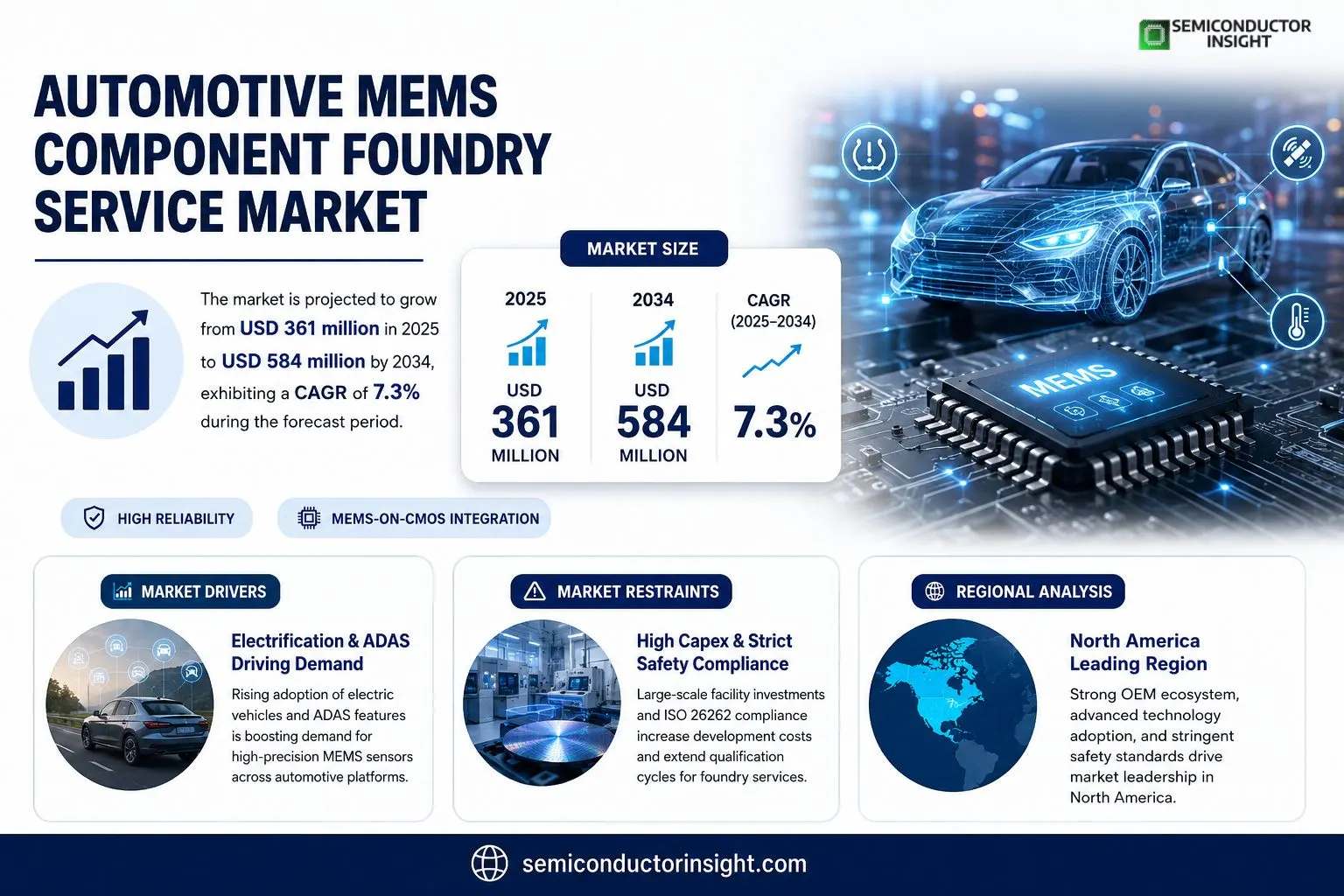
Automotive MEMS Component Foundry Service market size was valued at USD 361 million in 2025 and is projected to reach USD 584 million by 2034, exhibiting a CAGR of 7.3% during the forecast period.
Automotive MEMS component foundry services refer to one‑stop services such as design, manufacturing, packaging and testing of MEMS (micro‑electromechanical systems) components provided to automobile manufacturers or related suppliers. This model covers the entire process from product design through mass production, aiming to meet automotive demand for high‑performance, high‑precision sensors that deliver miniaturization, low power consumption and high reliability.The market is experiencing growth because accelerated demand for autonomous‑driving sensors, stricter safety regulations such as TPMS and ESP, and cost‑saving integration of MEMS‑on‑CMOS encourage OEMs toward large‑scale contract manufacturing. Recent collaborationssuch as TSMC’s partnership with automotive OEMs on advanced MEMS processes announced in early 2024illustrate how leading foundries are expanding capacity to satisfy rising sensor counts per vehicle.
MARKET DRIVERS
Electrification of Vehicle Platforms
The shift toward electric and hybrid powertrains has forced OEMs to integrate more sophisticated sensor suites. Automotive MEMS Component Foundry Service Market providers are benefitting because MEMS sensors offer the size, reliability, and speed required for battery‑management and motor‑control functions. Manufacturers that can deliver high‑volume, low‑cost wafers are gaining a competitive edge as original equipment makers tighten bill‑of‑materials targets.
Advanced Driver‑Assistance Systems (ADAS) Adoption
ADAS features such as automatic emergency braking, lane‑keeping, and adaptive cruise control rely heavily on micro‑electromechanical sensors for acceleration, pressure, and proximity detection. The acceleration of ADAS roll‑out across mid‑range models enlarges the addressable base for MEMS foundries, prompting them to upscale production lines and embed more robust testing protocols.
➤ Foundry partners that embed co‑design capabilities into their service contracts see faster design closures and lower iteration costs, directly influencing OEM time‑to‑market.
Strategic alliances between semiconductor manufacturers and automotive suppliers are also reshaping the supply chain. By pooling R&D resources, these collaborations lower entry barriers for niche MEMS designs, reinforcing the growth momentum of Automotive MEMS Component Foundry Service Market.
MARKET CHALLENGES
Stringent Functional Safety Requirements
ISO 26262 compliance imposes rigorous validation steps that extend development cycles. Foundry services must invest in specialized test equipment and traceability frameworks, which can erode margin when serving low‑volume automotive customers.
Other Challenges
Supply‑Chain Visibility
The fragmented nature of raw‑material sourcing for silicon wafers introduces lead‑time volatility. OEMs demand greater transparency, pressuring foundries to adopt digital twins and real‑time monitoring platforms.
MARKET RESTRAINTS
Capital‑Intensive Facility Upgrades
Transitioning from legacy 200 mm lines to 300 mm platforms, which are favored for higher throughput, requires multi‑hundred‑million‑dollar investments. Smaller foundries often lack the financial bandwidth to make this leap, limiting their ability to capture emerging automotive contracts.
MARKET OPPORTUNITIES
In‑Vehicle Connectivity and Edge Computing
As vehicles become data‑rich environments, the demand for on‑board edge processors equipped with MEMS‑based timing and inertial modules is rising. Foundry services that can co‑fabricate MEMS with CMOS logic on a single die will unlock new revenue streams, positioning themselves at the forefront of next‑generation automotive electronics.
Automotive MEMS Component Foundry Service Market Trends
Higher Sensor Integration in Autonomous Vehicles
The shift toward higher levels of vehicle autonomy is forcing automakers to embed a vastly larger array of micro‑sensors within each chassis. Where a typical L3‑equipped car carried a handful of MEMS devices, L4 prototypes now require dozens of pressure, temperature and motion units to deliver the granularity needed for real‑time environment mapping. This escalation translates into a pronounced need for contract manufacturers that can deliver end‑to‑end design, wafer fabrication, packaging and test under automotive‑grade reliability constraints. Foundry partners that combine clean‑room capacity with rigorous qualification processes are therefore becoming indispensable to OEM supply chains. In this environment, Automotive MEMS Component Foundry Service Market is reshaping its value proposition from pure volume production to a collaborative engineering platform that shortens time‑to‑market while safeguarding safety‑critical performance.
Other Trends
Regulatory Momentum Accelerates Reliability Standards
Stringent safety legislation across North America, Europe and China is compelling original equipment manufacturers to adopt MEMS‑based monitoring solutions as a baseline requirement rather than an optional upgrade. Regulations such as mandatory Tire Pressure Monitoring Systems and Electronic Stability Control mandate sensor precision that can only be guaranteed through a qualified foundry pipeline. In China, the “New Four Modernizations” agenda explicitly calls for a domestically sourced, high‑reliability MEMS supply chain, prompting local OEMs to shift demand toward contract fabs that can certify compliance with both national and international standards. This regulatory momentum is prompting foundries to invest in advanced test and burn‑in capabilities, thereby creating a competitive moat around manufacturers that can consistently meet audit thresholds while maintaining cost discipline.
Cost‑Effective MEMS‑CMOS Co‑Design Expands
Automotive MEMS Component Foundry Service Market is embracing this convergence of MEMS and CMOS processes, delivering a new class of sensors that consume markedly less power while preserving the mechanical robustness required for automotive deployment. By integrating sensing elements directly on top of digital logic, manufacturers can eliminate separate packaging steps, shorten assembly lines and lower bill‑of‑materials for mid‑range vehicle platforms, not just premium lines. Foundry services that have mastered MEMS‑on‑CMOS co‑design are therefore able to offer OEMs a pricing advantage that makes high‑precision perception units viable in volume models, not just premium lines. This cost‑efficiency pressure is prompting traditional pure‑play MEMS fabs to expand their design‑for‑manufacturability toolkits, while IDM‑style players are leveraging internal silicon expertise to capture larger share of the value chain. The net effect is a broader, more price‑competitive ecosystem that accelerates adoption of advanced driver‑assist functions. Overall, the trajectory reshapes supplier relationships across the industry.
COMPETITIVE LANDSCAPE
Key Industry Players
Competitive dynamics and market concentration in the Automotive MEMS Component Foundry Service sector
The market is anchored by a handful of large‑scale semiconductor foundries that have expanded into MEMS‑on‑CMOS capabilities. TSMC, leveraging its 5‑nm logic platform, has introduced a dedicated MEMS line that couples low‑power circuitry with micromechanical structures, allowing automotive OEMs to source high‑volume pressure and temperature sensors from a single fab. This integration reduces hand‑off risk and aligns with the automotive push toward consolidated supplier bases. Parallel to TSMC, Silex Microsystems has built a reputation for pure‑play MEMS fabrication, offering customizable wafer‑level processes that cater to niche safety‑monitoring applications such as TPMS and ESP. Their gross margin of roughly 40 % reflects pricing power derived from deep technical expertise and a relatively thin competitive field. The concentration around these two entities creates a tiered ecosystem: Tier‑1 foundries dominate mass‑production contracts, while specialized pure‑play firms capture design‑heavy, low‑volume projects.Beyond the dominant tier, a diverse set of players occupies strategic niches across geography and technology focus. Europe’s X‑Fab provides a hybrid IDM‑foundry model that emphasizes advanced silicon‑on‑glass MEMS for inertial measurement units, positioning itself as a preferred partner for premium autonomous‑driving sensor suites. Japan’s Sony and Taiwan’s VIS operate vertically integrated production lines targeting high‑precision accelerometers and gyroscopes used in electronic stability programs. Meanwhile, emerging outfits such as Atomica Corp. and Asia Pacific Microsystems, Inc. are capitalising on regional electrification policies by offering cost‑optimised temperature‑sensor platforms for electric‑vehicle battery management. The proliferation of these firms intensifies competition on innovation speed, prompting alliances and IP‑licensing deals that reshape the supply chain. For OEMs, the spread of capable foundries translates into bargaining leverage and the ability to diversify risk across multiple technology providers.
List of Key Automotive MEMS Component Foundry Service Companies Profiled
- Silex Microsystems
- TSMC
- X‑Fab
- Sony
- VIS (Vanguard International Semiconductor)
- Atomica Corp.
- Asia Pacific Microsystems, Inc.
- Philips Engineering Solutions
- UMC
- Teledyne Technologies
- STMicroelectronics
- Analog Devices
- Infineon Technologies
- Broadcom Inc.
Segment Analysis:
| Segment Category | Sub-Segments | Key Insights |
| By Type |
|
Pure Play Model is emerging as the dominant service framework because it allows automotive OEMs to off‑load the full design‑to‑production chain while focusing on vehicle integration. • Enables rapid iteration of MEMS designs without heavy capital investment. • Provides flexibility to adopt emerging sensor architectures such as MEMS‑on‑CMOS. • Facilitates scale‑up for high‑volume safety‑critical components, strengthening supplier‑OEM collaboration. |
| By Application |
|
Pressure Sensor services are central to the expansion of tire‑pressure monitoring systems and battery‑thermal management in electric vehicles. • High reliability requirements drive OEMs to partner with foundries that guarantee long‑term sensor performance. • Integrated packaging solutions reduce system complexity and improve vehicle safety compliance. • Continuous technology iteration, such as MEMS‑on‑CMOS, lowers power consumption and supports broader deployment across vehicle platforms. |
| By End User |
|
OEMs increasingly view foundry services as strategic partners to accelerate autonomous‑driving sensor suites. • Preference for one‑stop solutions shortens time‑to‑market for new vehicle generations. • OEMs demand rigorous validation processes that align with safety standards such as ISO 26262. • Collaborative development models enable co‑innovation on sensor miniaturization and low‑power operation. |
| By Technology |
|
Advanced MEMS are gaining traction as they deliver higher sensitivity and integration density required for next‑generation driver‑assistance functions. • Seamless integration with CMOS logic supports smarter on‑chip processing. • Enables consolidation of multiple sensing modalities within a single die, reducing overall vehicle wiring. • Drives competitive differentiation for foundries that can offer low‑cost, high‑volume production of these sophisticated devices. |
| By Functional Category |
|
Safety Monitoring remains the core driver for MEMS foundry engagements because regulatory mandates require ultra‑reliable sensors for airbags, ESP and TPMS. • High‑integrity testing protocols are essential to meet automotive safety certifications. • Foundries that embed redundancy and self‑test capabilities directly into the MEMS architecture gain a strategic advantage. • Continuous improvement in packaging resilience supports harsh automotive environments, reinforcing supplier loyalty. |
Regional Analysis: Automotive MEMS Component Foundry Service Market
North America
Leading OEMs frequently forge joint development agreements with foundries, allowing simultaneous progress on device architecture and process optimization. These alliances reduce time‑to‑market for advanced driver‑assist sensors and embed foundry expertise within the automotive value chain.
Recent disruptions have motivated manufacturers to diversify their supplier base across multiple North American facilities. This geographic spread mitigates risk and ensures continuity for safety‑critical MEMS components.
The region shows early uptake of wafer‑scale integration techniques that combine multiple sensing modalities on a single die, a trend that encourages foundries to invest in multi‑process tooling.
Stringent safety regulations compel manufacturers to source MEMS devices verified through rigorous qualification programs, boosting demand for foundry services that can meet documented performance thresholds.
Europe
European automotive manufacturers lean heavily on the region’s strong engineering heritage, seeking foundry partners capable of delivering ultra‑stable pressure and temperature sensors for electric power‑train control. National initiatives that fund collaborative research between universities and foundries have spawned niche process nodes tailored for high‑volume, low‑cost production. The fragmented market, with several mid‑size suppliers, encourages OEMs to negotiate competitive terms while preserving flexibility for future platform shifts. Furthermore, tighter emissions standards across the EU compel a migration toward more precise air‑flow and exhaust monitoring solutions, a requirement that MEMS foundries are rapidly addressing through refined silicon‑on‑glass technologies.
Asia‑Pacific
The Asia‑Pacific corridor, anchored by China, Japan, and South Korea, is distinguished by a blend of scale and rapid technology transfer. Automakers in this region prioritize volume‑driven cost structures, prompting foundries to adopt high‑throughput batch processes for inertial MEMS used in stability control. Simultaneously, emerging markets within Southeast Asia are experimenting with low‑cost acoustic sensors for driver‑alert systems, creating a tiered demand pattern. Government incentives that subsidize advanced micro‑fabrication facilities have lowered entry barriers, spurring new entrants eager to capture a share of the expanding automotive sensor portfolio.
South America
In South America, market activity centers on Brazil’s growing passenger‑vehicle sector, where local manufacturers are beginning to integrate MEMS‑based fuel‑efficiency monitors. The limited number of domestic foundry assets has led firms to outsource to nearby North American facilities, fostering cross‑border collaborations. While overall volume remains modest, the region’s focus on cost‑effective solutions drives foundries to offer standardized MEMS platforms that can be quickly adapted to diverse vehicle models.
Middle East & Africa
The Middle East & Africa region presents a niche but increasingly sophisticated demand landscape, particularly within the United Arab Emirates and South Africa where luxury and off‑road vehicle segments dominate. Clients in these markets value high‑precision inclination sensors for advanced stability systems, prompting foundries to provide customized calibration services. Though the scale is smaller than other regions, the willingness to invest in premium MEMS components underscores an emerging market that could attract specialized foundry offerings focused on reliability under extreme temperature fluctuations.
Report Scope
This market research report provides a comprehensive analysis of the Automotive MEMS Component Foundry Service Market , covering the forecast period 2026–2034. It offers detailed insights into market dynamics, technological advancements, competitive landscape, and key trends shaping the industry.
Key focus areas of the report include:
- Market Overview: The report begins with an overview outlining its current market scenario, key growth indicators, and industry transformation drivers. It discusses macroeconomic factors, demand–supply balance, regulatory landscape, and the strategic role of semiconductors in powering advancements across industries such as automotive, telecommunications, consumer electronics, and industrial automation.
- Market Size & Forecast: Historical data and future projections for revenue, unit shipments, and market value across major regions and segments.
- Segmentation Analysis: Detailed breakdown by product type, technology, application, and end-user industry to identify high-growth segments and investment opportunities.
- Regional Insights: Insights into market performance across North America, Europe, Asia-Pacific, Latin America, and the Middle East & Africa, including country-level analysis where relevant.
- Competitive Landscape: Profiles of leading market participants, including their product offerings, R&D focus, manufacturing capacity, pricing strategies, and recent developments such as mergers, acquisitions, and partnerships.
- Technology Trends & Innovation: Assessment of emerging technologies, integration of AI/IoT, semiconductor design trends, fabrication techniques, and evolving industry standards.
- Market Drivers & Restraints: Evaluation of factors driving market growth along with challenges, supply chain constraints, regulatory issues, and market-entry barriers.
- Stakeholder Insights: Insights for component suppliers, OEMs, system integrators, investors, and policymakers regarding the evolving ecosystem and strategic opportunities.
Primary and secondary research methods are employed, including interviews with industry experts, data from verified sources, and real-time market intelligence to ensure the accuracy and reliability of the insights presented.
FREQUENTLY ASKED QUESTIONS:
What is the current market size of Automotive MEMS Component Foundry Service Market?
-> Automotive MEMS Component Foundry Service Market was valued at USD 361 million in 2025 and is expected to reach USD 584 million by 2034.
Which key companies operate in Automotive MEMS Component Foundry Service Market?
-> Key players include Axalta Coating Systems, AkzoNobel, BASF SE, PPG, Sherwin-Williams, and 3M, among others.
What are the key growth drivers?
-> Key growth drivers include railway infrastructure investments, urbanization, and demand for durable coatings.
Which region dominates the market?
-> Asia-Pacific is the fastest-growing region, while Europe remains a dominant market.
What are the emerging trends?
-> Emerging trends include bio-based coatings, smart coatings, and sustainable rail solutions.
Get Sample Report PDF for Exclusive Insights
Report Sample Includes
- Table of Contents
- List of Tables & Figures
- Charts, Research Methodology, and more...
 Download Sample Report PDF