MEMS Microphone Foundry Service Market Insights
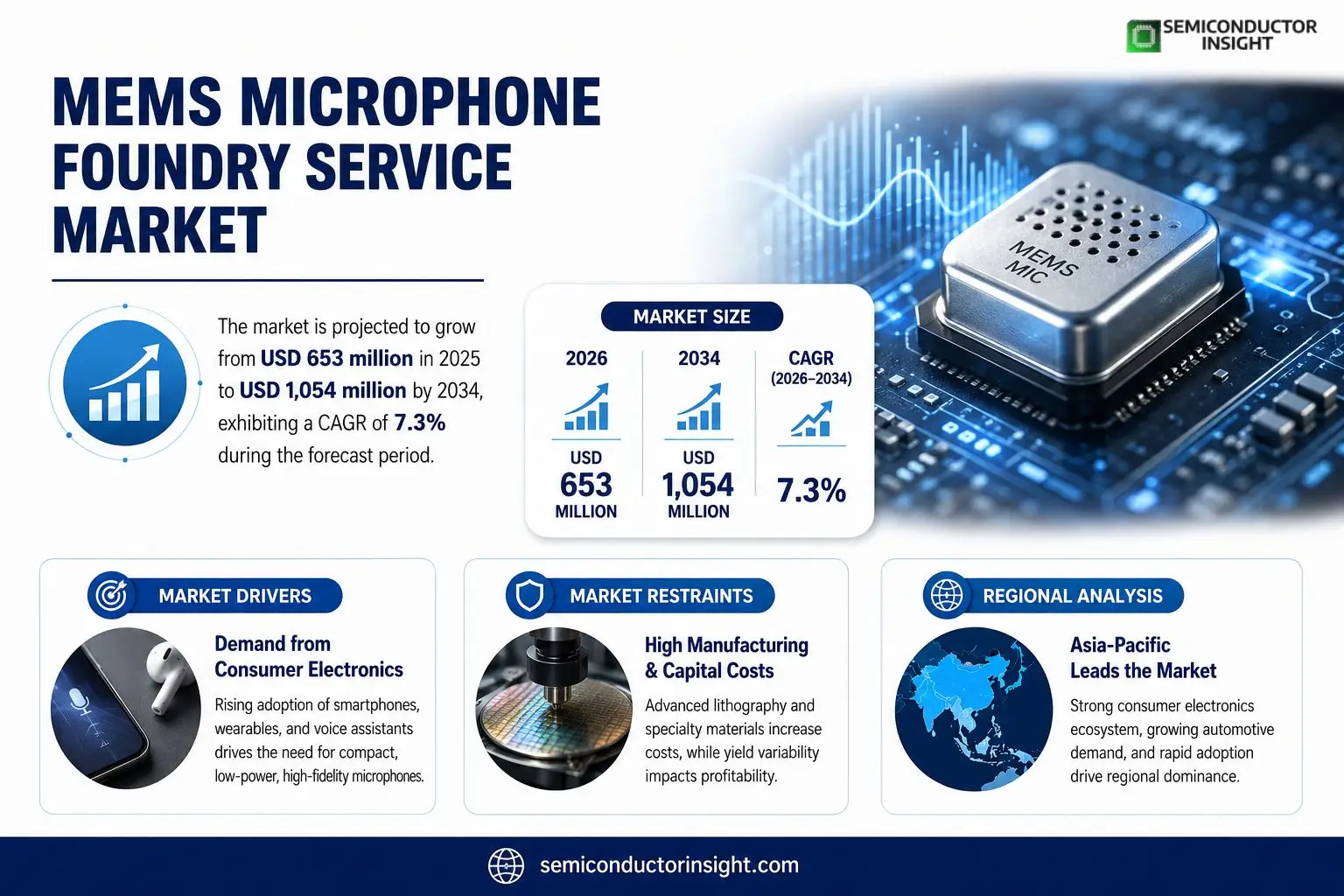
MEMS Microphone Foundry Service market size was valued at USD 653 million in 2025. The market is projected to grow from USD 653 million in 2025 to USD 1,054 million by 2034, exhibiting a CAGR of 7.3% during the forecast period.
MEMS microphone foundry service refers to a one‑stop foundry offering design, manufacturing, packaging and testing exclusively for MEMS microphone manufacturers. It delivers high‑performance, high‑quality solutions that combine micromechanical structuressuch as diaphragms and backplateswith integrated circuit technology, achieving millimetre‐scale miniaturisation, microwatt‐level power consumption, and signal‐to‐noise ratios often exceeding 75 dB.The market is expanding because consumer electronics demand for low‐power, high‐fidelity microphonesdriven by smartphones and true wireless earbudsand automotive intelligence requirements for multiple microphones per vehicle are rising sharply. Technological iteration such as MEMS‐on‐CMOS integration reduces cost and power draw, allowing foundries to serve both premium and mid‐range segments efficiently. Policy incentives for IoT and smart manufacturing further support growth, while gross profit margins of 40–60% make the business attractive for established semiconductor foundries.
MARKET DRIVERS
Demand from Consumer Electronics
Smart‑phone manufacturers are redesigning flagship devices to include voice‑activated assistants, which forces a shift toward smaller, lower‑power acoustic sensors. MEMS Microphone Foundry Service Market providers that can guarantee sub‑micron pitch tolerances are seeing a surge in orders because OEMs need to meet both form‑factor and battery‑life targets. The trend reflects a broader industry move away from bulk acoustic ceramic solutions.
Automotive Voice‑Control Expansion
New vehicle platforms now embed wake‑word detection in infotainment consoles and interior cabin monitoring. The rise of over‑the‑air updates means manufacturers prefer foundry partners that can iterate designs within four‑week cycles, ensuring that updated acoustic algorithms can be supported without a full redesign. MEMS Microphone Foundry Service Market participants offering rapid prototyping are therefore becoming integral to automotive supply chains.
➤ “Design‑for‑manufacturability is no longer a luxury; it is the baseline expectation for any MEMS acoustic device entering high‑volume production.”
Beyond device performance, regulatory pressure on noise emissions in public spaces is prompting city planners to adopt smart‑mic arrays for real‑time monitoring. Foundries that can integrate acoustic sensors with IoT connectivity are positioned to capture a slice of municipal‑infrastructure spending, adding a non‑consumer dimension to the growth equation.
MARKET CHALLENGES
Manufacturing Yield Variability
Although MEMS processes have matured, achieving consistent yields across 200‑mm and 300‑mm wafers remains a hurdle. Small deviations in etch depth can translate into acoustic sensitivity drift, forcing OEMs to allocate extra testing resources. Companies that cannot demonstrate >95 % first‑pass yield risk losing contracts to competitors with tighter process control.
Other Challenges
Intellectual‑Property Hurdles
Foundry clients often bring proprietary acoustic models that must be protected under strict NDAs. Negotiating licensing terms while maintaining a shared development roadmap can delay project kick‑off, especially when multiple tier‑1 automakers vie for the same technology.
MARKET RESTRAINTS
Capital Intensity of Advanced Lithography
Upgrading to deep‑UV and extreme‑UV lithography tools demands multi‑hundred‑million‑dollar investments. Smaller foundries often lack the financial bandwidth to make such upgrades, limiting their ability to serve high‑performance segments that require finer feature sizes.
Supply‑Chain Fragility for Specialty Materials
The rare‑gas consumables used in micro‑cavity formation are sourced from a narrow set of suppliers. Disruptionswhether geopolitical or pandemic‑relatedcan create bottlenecks that inflate lead times, causing OEMs to hedge with multiple vendors and diluting market concentration.
Standardization Gaps
Unlike semiconductor logic, the acoustic MEMS domain lacks a unified test‑and‑qualify framework. Divergent specification sheets force customers to undertake extensive validation, increasing total cost of ownership and slowing adoption rates.
MARKET OPPORTUNITIES
Integration of AI‑Enhanced Signal Processing
Foundries that bundle on‑chip DSP cores tuned for noise‑cancellation and beam‑forming can command premium pricing. As AI models become more compute‑efficient, the marginal cost of adding a dedicated inference block drops, creating a clear value proposition for voice‑controlled wearables.
Emergence of Edge‑Compute Platforms
Edge devices in industrial IoT are beginning to require localized acoustic monitoring for safety compliance. MEMS Microphone Foundry Service Market players that can certify their sensors for harsh temperature and vibration environments will unlock a pipeline of contracts from equipment manufacturers.
Strategic Partnerships with Audio‑Chip Designers
Co‑development agreements that align sensor layout with analog front‑end architectures reduce board‑space and power consumption. Such collaborations not only accelerate time‑to‑market but also embed the foundry deeper into the design ecosystem, yielding recurring revenue streams.
MEMS Microphone Foundry Service Market Trends
Shift Toward Integrated MEMS‑on‑CMOS Processes
The convergence of micromechanical structures with CMOS circuitry is redefining cost structures across MEMS Microphone Foundry Service Market. By embedding the diaphragm and backplate directly onto a CMOS wafer, manufacturers achieve a reduction in interconnect complexity that translates into lower power drawoften below a few microwatts per deviceand tighter control of signal‑to‑noise performance. This technical migration also compresses the bill‑of‑materials, allowing foundries to offer price points attractive to mid‑range consumer OEMs without sacrificing the acoustic fidelity required by premium segments. The result is a broader adoption curve where previously niche, high‑end microphones become viable for mass‑market smartphones, earbuds, and entry‑level automotive infotainment units.
Other Trends
Automotive Voice and Sensing Expansion
Advancements in vehicle autonomy, especially the transition from level 3 to level 4 driver assistance, are inflating the microphone count per car from a handful to several dozen units. This surge stems from the need for interior voice commands, cabin noise cancellation, and external acoustic perception for safety systems. Foundry service providers are therefore investing in automotive‑grade certification pipelines and ruggedized packaging to meet the higher reliability standards demanded by car manufacturers. The ripple effect is a reshaping of supply chains, where automotive OEMs increasingly source entire microphone portfolios from a limited set of qualified foundries, consolidating demand and creating a steady revenue stream distinct from the more seasonal consumer electronics market.
Margin Pressure and Consolidation
Gross profit margins in the foundry segment typically hover between 40 % and 60 %, but competitive pricing pressures and the push for larger wafer volumes are compressing the upper end of that range. To preserve profitability, leading players are pursuing strategic acquisitions of niche design houses that bring proprietary acoustic models or advanced test capabilities in‑house. This consolidation trend not only stabilizes margin outlooks but also equips larger foundries with a diversified technology portfoliospanning bulk micromachining, CMOS, and integrated signal‑processing circuitsenabling them to serve both high‑volume consumer lines and specialized industrial applications. For clients, the move signals greater supply security and the potential for bundled service contracts that combine design, fabrication, and testing under a single umbrella.
COMPETITIVE LANDSCAPE
Key Industry Players
MEMS Microphone Foundry Service – Competitive Overview
The market is anchored by a handful of pure‑play foundries that combine MEMS fabrication with advanced CMOS integration. Silex Microsystems commands the top tier, leveraging its legacy in wafer‑level acoustic structures and a network of design‑for‑manufacturing services. Its ability to deliver end‑to‑end solutionsfrom silicon‑on‑glass diaphragms to final acoustic testingtranslates into gross margins that comfortably sit above the industry median. The company’s recent rollout of a 28 nm MEMS‑on‑CMOS platform has attracted leading smartphone OEMs seeking higher signal‑to‑noise ratios while keeping power consumption under a microwatt. This strategic positioning has solidified Silex’s share of the 2025 revenue pool, forcing other vendors to either specialize in niche form factors or invest heavily in process consolidation to remain viable.Beyond the dominant player, the competitive set is fragmented across several specialized and geographically diverse firms. Teledyne Technologies and Sony operate hybrid IDM models, pairing in‑house design expertise with contract manufacturing capacity to serve automotive‑grade microphone programs. TSMC’s entry through its advanced packaging unit offers high‑volume, cost‑effective routes for mid‑range consumer devices, compelling smaller foundries to differentiate on acoustic performance rather than price. X‑Fab, Atomica Corp., and VIS focus on bulk‑micromachining and custom packaging for industrial IoT sensors, while Asia Pacific Microsystems, Inc. and Philips Engineering Solutions concentrate on compliant automotive safety monitoring modules. UMC, Bosch, Knowles, Infineon, STMicroelectronics, and Analog Devices round out the ecosystem, each exploiting a blend of legacy semiconductor assets and targeted R&D investments to capture specific segments such as voice‑activation in wearables or environmental‑noise‑cancellation in smart home hubs.
List of Key MEMS Microphone Foundry Service Companies Profiled
- Silex Microsystems
- Teledyne Technologies
- TSMC
- Sony Semiconductor Solutions
- X‑Fab
- Atomica Corp.
- VIS
- Asia Pacific Microsystems, Inc.
- Philips Engineering Solutions
- UMC
- Bosch
- Knowles Corporation
- Infineon Technologies
- STMicroelectronics
- Analog Devices
Segment Analysis:
| Segment Category | Sub-Segments | Key Insights |
| By Type |
|
Pure Play Model
|
| By Application |
|
Consumer Electronics
|
| By End User |
|
Smartphones & Wearables
|
| By Technology |
|
CMOS Integrated Process
|
| By Function |
|
Environmental Noise Reduction
|
Regional Analysis: MEMS Microphone Foundry Service Market
North America
The region hosts a network of design houses that specialize in MEMS acoustic modeling, enabling rapid iteration of diaphragm geometries and back‑plate configurations. Close proximity to major OEM engineering teams shortens feedback loops, allowing foundries to incorporate customer‑driven refinements within weeks rather than months.
An entrenched semiconductor supply chain delivers high‑purity silicon wafers, precision lithography equipment, and reliable packaging services on a just‑in‑time basis. This logistical depth reduces lead times for prototype runs and supports volume scaling without bottlenecks, a distinct advantage over regions with fragmented sourcing options.
Foundries in North America cultivate partnership models that blend confidential design services with joint development roadmaps. By embedding technical liaisons within OEM product teams, they capture early market signals and adjust process parameters proactively, creating a feedback‑driven ecosystem that enhances product differentiation.
State‑level incentives for advanced manufacturing and targeted grants for acoustic research encourage capital investment in next‑generation process nodes. These policy tools lower the effective cost of deploying new wafer sizes and foster collaboration between academia and industry, reinforcing the region’s leadership in MEMS microphone innovation.
Europe
Europe’s MEMS microphone foundry landscape is anchored by a heritage of precision engineering and a strong automotive acoustic market. Companies in Germany, France and the United Kingdom leverage decades of micro‑machining expertise to produce devices that meet stringent vibration and temperature specifications required for car infotainment and advanced driver‑assistance systems. Sustainability regulations push manufacturers toward low‑power acoustic solutions, prompting foundries to experiment with novel thin‑film materials that reduce energy draw. Collaborative clusters that bring together universities, equipment suppliers and OEMs foster a steady pipeline of design innovations, while cross‑border research programs fund the exploration of next‑generation acoustic sensing for smart‑city applications.
Asia‑Pacific
Asia‑Pacific delivers the largest volume of consumer electronics that incorporate MEMS microphones, creating a vibrant demand environment for foundry services. Nations such as China, South Korea and Taiwan have invested heavily in semiconductor fabs, allowing them to offer competitive pricing while maintaining quality standards. Local OEMs prioritize rapid product cycles, which pressures foundries to adopt flexible mask‑set strategies and modular packaging approaches. At the same time, rising awareness of voice‑enabled interfaces in mobile devices and emerging wearable categories fuels a push for smaller, higher‑sensitivity diaphragms. The region’s blend of cost efficiency and accelerating innovation cycles positions it as a key destination for both bulk production and early‑stage acoustic prototyping.
South America
South America’s adoption of MEMS microphone technology is still emerging, yet it is gaining relevance within automotive infotainment upgrades and localized IoT deployments. Brazil and Mexico host a handful of engineering firms that outsource acoustic component manufacturing to nearby foundries, valuing shorter transit times over pure cost considerations. The market’s modest scale encourages foundries to offer bespoke design‑for‑manufacture services, ensuring that niche performance requirementssuch as enhanced noise‑cancellation for densely populated urban environmentsare addressed. Although local wafer production remains limited, the region’s growing emphasis on smart‑city initiatives is prompting strategic partnerships aimed at establishing a more resilient supply channel.
Middle East & Africa
The Middle East and Africa represent a nascent yet strategically important segment for MEMS microphone foundry services, driven largely by expanding telecommunications infrastructure and defense communication projects. Nations such as the United Arab Emirates and South Africa are investing in local technology incubators that attract foundry operators seeking footholds in the region. Customers value the ability to source acoustic components that meet rigorous security and temperature‑stability criteria, prompting foundries to adapt packaging processes for harsh environments. While current volume is limited, the appetite for integrated voice‑controlled solutions in smart‑building and automotive sectors signals a gradual build‑out of demand that could encourage dedicated capacity allocations in the near term.
Report Scope
This market research report provides a comprehensive analysis of the MEMS Microphone Foundry Service Market , covering the forecast period 2026–2034. It offers detailed insights into market dynamics, technological advancements, competitive landscape, and key trends shaping the industry.
Key focus areas of the report include:
- Market Overview: The report begins with an overview outlining its current market scenario, key growth indicators, and industry transformation drivers. It discusses macroeconomic factors, demand–supply balance, regulatory landscape, and the strategic role of semiconductors in powering advancements across industries such as automotive, telecommunications, consumer electronics, and industrial automation.
- Market Size & Forecast: Historical data and future projections for revenue, unit shipments, and market value across major regions and segments.
- Segmentation Analysis: Detailed breakdown by product type, technology, application, and end-user industry to identify high-growth segments and investment opportunities.
- Regional Insights: Insights into market performance across North America, Europe, Asia-Pacific, Latin America, and the Middle East & Africa, including country-level analysis where relevant.
- Competitive Landscape: Profiles of leading market participants, including their product offerings, R&D focus, manufacturing capacity, pricing strategies, and recent developments such as mergers, acquisitions, and partnerships.
- Technology Trends & Innovation: Assessment of emerging technologies, integration of AI/IoT, semiconductor design trends, fabrication techniques, and evolving industry standards.
- Market Drivers & Restraints: Evaluation of factors driving market growth along with challenges, supply chain constraints, regulatory issues, and market-entry barriers.
- Stakeholder Insights: Insights for component suppliers, OEMs, system integrators, investors, and policymakers regarding the evolving ecosystem and strategic opportunities.
Primary and secondary research methods are employed, including interviews with industry experts, data from verified sources, and real-time market intelligence to ensure the accuracy and reliability of the insights presented.
FREQUENTLY ASKED QUESTIONS:
What is the current market size of MEMS Microphone Foundry Service Market?
-> MEMS Microphone Foundry Service Market was valued at USD 653 million in 2025 and is expected to reach USD 1054 million by 2034 with a CAGR of 7.3%.
Which key companies operate in MEMS Microphone Foundry Service Market?
-> Key players include Silex Microsystems, Teledyne Technologies, TSMC, Sony, X-Fab, Atomica Corp., VIS, Asia Pacific Microsystems, Inc., Philips Engineering Solutions, UMC, Bosch.
What are the key growth drivers?
-> Key growth drivers include explosive demand from consumer electronics and automotive intelligence, technological iteration and cost optimization (e.g., MEMS‑on‑CMOS), and policy support for IoT and smart manufacturing.
Which region dominates the market?
-> Asia‑Pacific leads the market due to strong consumer‑electronics and automotive adoption, while North America and Europe also hold significant shares.
What are the emerging trends?
-> Emerging trends include integration of MEMS with CMOS processes, growth of smart‑home and IoT applications, and increasing focus on automotive‑grade safety monitoring.
Get Sample Report PDF for Exclusive Insights
Report Sample Includes
- Table of Contents
- List of Tables & Figures
- Charts, Research Methodology, and more...
 Download Sample Report PDF