
Market Insights
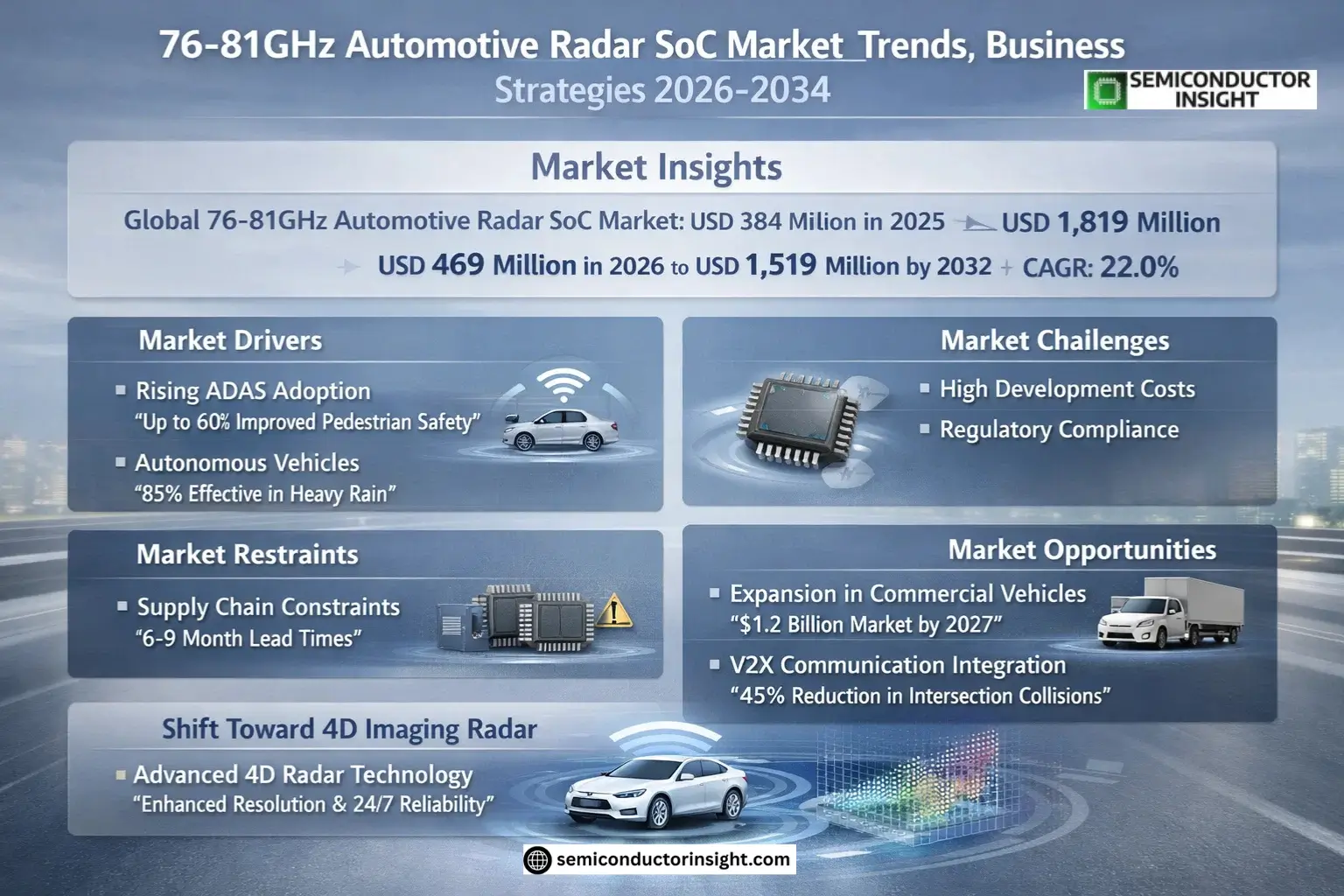
Global 76-81GHz Automotive Radar SoC Market size was valued at USD 384 million in 2025. The market is projected to grow from USD 469 million in 2026 to USD 1,519 million by 2032, exhibiting a CAGR of 22.0% during the forecast period.
76–81GHz Automotive Radar SoC is a highly integrated millimeter-wave system-on-chip that operates in the 76–81GHz band and combines RF front-end circuits, digital signal processing, and microcontroller functions on a single CMOS die. This enables compact architecture, low power consumption, and stable signal performance required for high-resolution angle radar and forward radar in advanced automotive sensing applications.
The market growth is driven by increasing demand for autonomous driving technologies and advanced driver-assistance systems (ADAS), which rely on high-precision radar sensors for object detection and collision avoidance. While traditional millimeter-wave radars face limitations in resolution, the shift toward 4D imaging radar solutions using these SoCs addresses critical gaps in perception accuracy. Key industry players such as Texas Instruments, Infineon Technologies, and Arbe Robotics are accelerating innovation to meet evolving automotive safety standards.
MARKET DRIVERS
Growing Demand for Advanced Driver Assistance Systems (ADAS)
76-81GHz Automotive Radar SoC Market is experiencing significant growth due to increasing adoption of ADAS features in modern vehicles. Regulations mandating safety technologies and consumer preference for collision avoidance systems are propelling demand. Radar SoCs in this frequency range enable high-resolution object detection, improving pedestrian safety by up to 60% compared to lower frequency solutions.
Automotive Industry Shift Toward Autonomous Vehicles
Automakers are accelerating development of autonomous driving technologies, with 76-81GHz radar SoCs becoming essential for Level 3+ autonomy. The higher frequency range provides superior performance in adverse weather conditions, with 76-81GHz radar maintaining 85% effectiveness in heavy rain compared to 24GHz alternatives. This reliability is crucial for autonomous vehicle deployment.
Recent industry forecasts predict over 35 million 76-81GHz Automotive Radar SoCs will be shipped annually by 2026, reflecting a CAGR of 22% from current levels.
MARKET CHALLENGES
High Development Costs and Complexity
Designing 76-81GHz Automotive Radar SoCs requires specialized semiconductor expertise and expensive test equipment. The millimeter-wave technology demands precise antenna integration and advanced packaging solutions, increasing time-to-market by an average of 18-24 months compared to conventional ICs.
Other Challenges
Regulatory Compliance Hurdles
Meeting diverse global automotive safety standards (EU, US, China) adds complexity to 76-81GHz Radar SoC development. Frequency regulations vary by region, requiring costly redesigns for different markets.
Thermal Management Issues
High-frequency operation generates significant heat in compact SoC packages, requiring innovative cooling solutions that maintain reliability while meeting automotive-grade temperature ranges (-40°C to +125°C).
MARKET RESTRAINTS
Semiconductor Supply Chain Constraints
76-81GHz Automotive Radar SoC Market faces production bottlenecks due to limited availability of high-quality gallium arsenide and silicon germanium substrates. Current capacity can only meet approximately 60% of projected demand, creating extended lead times of 6-9 months for automotive OEMs.
MARKET OPPORTUNITIES
Emerging Applications in Commercial Vehicles
76-81GHz Automotive Radar SoC Market is expanding beyond passenger cars into heavy trucks and fleet vehicles. New safety regulations for commercial transport are creating a USD 1.2 billion addressable market opportunity by 2027, with radar-based blind spot detection systems showing particular growth potential.
Integration with V2X Communication Systems
Combining 76-81GHz radar data with vehicle-to-everything (V2X) networks enables predictive safety features. Trials show this fusion reduces intersection collisions by up to 45%, opening new revenue streams for SoC manufacturers developing these hybrid systems.
76?81GHz Automotive Radar SoC Market Trends
Shift Toward 4D Imaging Radar Technology
76-81GHz Automotive Radar SoC Market is experiencing a technological shift toward 4D imaging radar solutions. Traditional millimeter-wave radars lack height parameter detection and high-density point cloud imaging capabilities, making them insufficient for advanced automotive sensing requirements. 4D radar SoCs address these limitations while offering cost advantages over lidar systems, particularly in 24/7 operational reliability across varying weather conditions.
Other Trends
CMOS Process Node Advancements
Leading manufacturers are transitioning from 40nm to 28nm process nodes for 76?81GHz Automotive Radar SoCs, achieving 30% power reduction and improved RF performance. This enables more compact designs with higher integration of RF front-end circuits and digital signal processing while meeting stringent automotive grade requirements.
Increasing Safety Standard Compliance
The market shows rising demand for ISO 26262 ASIL-B and ASIL-C compliant 76?81GHz Radar SoCs as automakers implement more stringent functional safety requirements. This drives architectural innovations in fault detection, redundancy mechanisms, and mixed-signal verification processes throughout the SoC development cycle.
Regional Production Capacity Expansion
Asia-Pacific semiconductor foundries are increasing 76?81GHz Radar SoC production capacity, with current utilization rates around 60%. This expansion addresses growing demand from Chinese automakers and global Tier 1 suppliers while reducing lead times for corner radar and front radar applications.
Integration With V2X Communication Systems
Emerging trends show closer coupling between 76?81GHz Radar SoCs and vehicle-to-everything (V2X) communication modules. This integration enhances object classification accuracy by combining radar detections with infrastructure data, though it presents challenges in electromagnetic interference management and real-time processing requirements.
COMPETITIVE LANDSCAPE
Key Industry Players
76–81GHz Automotive Radar SoC Market Dominated by Semiconductor Giants and Radar Specialists
76-81GHz Automotive Radar SoC Market is primarily led by Texas Instruments and Infineon Technologies, which together control over 60% of global market share. These companies leverage their advanced CMOS process technologies (40nm and 28nm nodes) and robust RF design capabilities to deliver high-performance automotive radar solutions. The market features vertical integration with major Tier 1 suppliers like Bosch and Continental developing proprietary solutions while partnering with semiconductor vendors for bulk production.
Emerging players such as Arbe Robotics and Calterah Semiconductor are gaining traction with innovative 4D imaging radar solutions. Chinese manufacturers including Muniu Tech and WHST are expanding aggressively in the domestic market with cost-competitive offerings. The competitive landscape is characterized by intense R&D focus on ASIL-C compliance, improved angular resolution, and higher levels of integration to support autonomous driving applications.
List of Key 76–81GHz Automotive Radar SoC Companies Profiled
- Texas Instruments
- Infineon Technologies
- Arbe Robotics
- Smartmicro
- Muniu Tech
- WHST
- HUAWEI
- Calterah Semiconductor
- NXP Semiconductors
- Continental AG
- Robert Bosch GmbH
- Denso Corporation
- Valeo
- ZF Friedrichshafen
- Nidec Elesys
Segment Analysis:
| Segment Category | Sub-Segments | Key Insights |
| By Type |
|
4Tx/4Rx emerges as the dominant configuration due to:
|
| By Application |
|
Front Radar maintains leadership with compelling advantages:
|
| By End User |
|
Tier 1 Suppliers dominate the ecosystem with significant advantages:
|
| By Process Node |
|
28nm process node is gaining traction due to:
|
| By Safety Grade |
|
ASIL-B currently represents the mainstream safety requirement:
|
Regional Analysis: 76-81GHz Automotive Radar SoC Market
Asia-Pacific
Chinese automakers are standardizing 76-81GHz radar SoCs across entry-level EVs, driving down costs through vertical integration and high-volume production. Domestic semiconductor firms now offer cost-competitive alternatives to imported radar chips.
Japanese automotive radar SoC development prioritizes ultra-high resolution for luxury vehicles, with proprietary algorithms enhancing performance in adverse weather conditions. Tight integration with camera systems creates sophisticated sensor fusion platforms.
Korean manufacturers lead in 76-81GHz radar SoCs with integrated processing, reducing system complexity. Strategic partnerships between chipmakers and automakers accelerate development cycles for next-generation radar-based autonomous features.
Asia’s semiconductor ecosystem provides proximity between radar SoC designers, foundries, and automotive OEMs enabling rapid iteration. Specialized packaging solutions address heat dissipation challenges in compact radar modules.
North America
The North American 76-81GHz Automotive Radar SoC market benefits from stringent safety regulations and consumer demand for advanced ADAS. U.S. automakers prioritize long-range radar capabilities for highway driving, while Canadian winters drive development of weather-resistant radar processing algorithms. Silicon Valley startups are innovating with AI-accelerated radar SoCs that enable new use cases like predictive collision avoidance. The region sees increasing adoption of 76-81GHz solutions in commercial vehicles, particularly for trailer monitoring and blind spot detection systems.
Europe
European automakers are at the forefront of integrating 76-81GHz radar SoCs with other sensors for holistic safety systems. German manufacturers lead in developing radar SoCs compliant with stringent EU safety standards, particularly for vulnerable road user protection. Scandinavian countries drive innovation in icy condition performance. The region’s focus on reducing false alarms has led to sophisticated signal processing implementations in radar SoC designs, balancing sensitivity and reliability.
Middle East & Africa
Adoption of 76-81GHz Automotive Radar SoCs in this region focuses on high-temperature operation and dust resistance. Luxury vehicle penetration drives premium radar solutions, while local manufacturers develop cost-optimized versions for commercial fleets. Middle Eastern countries increasingly mandate ADAS features in new vehicles, creating new opportunities for radar SoC suppliers to develop region-specific firmware accommodating desert driving conditions.
South America
The South American market shows growing interest in 76-81GHz radar SoCs, particularly for urban safety applications in congested cities. Brazilian automakers are partnering with global semiconductor firms to develop economical radar solutions suited for regional vehicle platforms. The challenging topography of Andean countries accelerates adoption of robust radar systems with enhanced elevation detection capabilities.
Report Scope
This market research report provides a comprehensive analysis of the 76–81GHz Automotive Radar SoC Market, covering the forecast period 2025–2032. It offers detailed insights into market dynamics, technological advancements, competitive landscape, and key trends shaping the industry.
Key focus areas of the report include:
- Market Overview: The report begins with an overview outlining its current market scenario, key growth indicators, and industry transformation drivers. It discusses macroeconomic factors, demand–supply balance, regulatory landscape, and the strategic role of semiconductors in powering advancements across industries such as automotive, telecommunications, consumer electronics, and industrial automation.
- Market Size & Forecast: Historical data and future projections for revenue, unit shipments, and market value across major regions and segments.
- Segmentation Analysis: Detailed breakdown by product type, technology, application, and end-user industry to identify high-growth segments and investment opportunities.
- Regional Insights: Insights into market performance across North America, Europe, Asia-Pacific, Latin America, and the Middle East & Africa, including country-level analysis where relevant.
- Competitive Landscape: Profiles of leading market participants, including their product offerings, R&D focus, manufacturing capacity, pricing strategies, and recent developments such as mergers, acquisitions, and partnerships.
- Technology Trends & Innovation: Assessment of emerging technologies, integration of AI/IoT, semiconductor design trends, fabrication techniques, and evolving industry standards.
- Market Drivers & Restraints: Evaluation of factors driving market growth along with challenges, supply chain constraints, regulatory issues, and market-entry barriers.
- Stakeholder Insights: Insights for component suppliers, OEMs, system integrators, investors, and policymakers regarding the evolving ecosystem and strategic opportunities.
Primary and secondary research methods are employed, including interviews with industry experts, data from verified sources, and real-time market intelligence to ensure the accuracy and reliability of the insights presented.
FREQUENTLY ASKED QUESTIONS:
What is the current market size of 76–81GHz Automotive Radar SoC Market?
-> 76-81GHz Automotive Radar SoC Market size was valued at USD 384 million in 2025. The market is projected to grow from USD 469 million in 2026 to USD 1,519 million by 2032, exhibiting a CAGR of 22.0% during the forecast period.
Which key companies operate in 76–81GHz Automotive Radar SoC Market?
-> Key players include Texas Instruments, Infineon Technologies, Arbe Robotics, Smartmicro, Muniu Tech, WHST, HUAWEI, and Calterah Semiconductor, among others.
What are the key growth drivers?
-> Key growth drivers include advancements in automotive sensing technology, demand for high-resolution radar systems, and the transition towards autonomous vehicles.
Which region dominates the market?
-> Asia is a dominant market, with strong growth in China, Japan, and South Korea, while Europe and North America also hold significant shares.
What are the emerging trends?
-> Emerging trends include 4D imaging radar development, improved signal processing capabilities, and integration of AI in radar systems.
Get Sample Report PDF for Exclusive Insights
Report Sample Includes
- Table of Contents
- List of Tables & Figures
- Charts, Research Methodology, and more...
 Download Sample Report PDF




