6G ultra-massive MIMO with holographic beamforming at sub-THz Market Insights
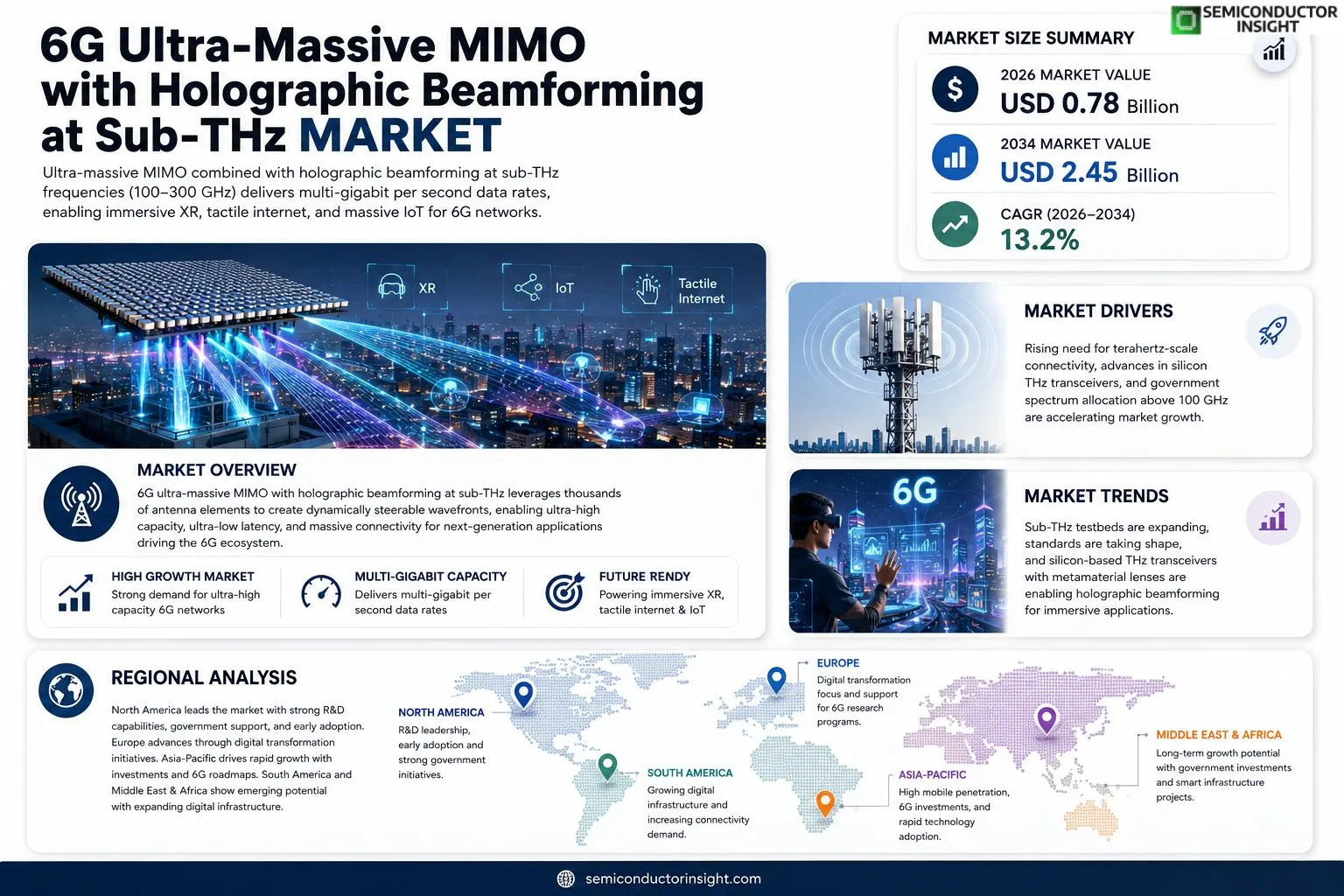
6G ultra-massive MIMO with holographic beamforming at sub-THz market size was valued at USD 0.68 billion in 2025. The market is projected to grow from USD 0.78 billion in 2026 to USD 2.45 billion by 2034, exhibiting a CAGR of 13.2% during the forecast period.
Ultra‑massive MIMO combined with holographic beamforming leverages thousands of antenna elements operating in the sub‑terahertz spectrum (100 GHz–300 GHz) to create dynamically steerable wavefronts that can deliver multi‑gigabit per second data rates over short distances. This technology enables spatial multiplexing beyond conventional phased‑array limits, supporting immersive XR, tactile internet, and massive IoT scenarios envisioned for 6G networks.The market is experiencing rapid growth because telecom operators are investing heavily in next‑generation testbeds and governments are allocating spectrum above 100 GHz for commercial use. Furthermore, advances in silicon‑based THz transceivers and low‑loss metamaterial lenses are reducing cost barriers. Key players such as Nokia Bell Labs, Ericsson Research, Samsung Electronics, and Huawei Technologies have announced pilot deployments or collaborations in early 2024 to validate holographic beamforming prototypes at sub‑THz frequencies.
MARKET DRIVERS
Emerging Demand for Terahertz-Scale Connectivity
The rollout of 6G ultra-massive MIMO with holographic beamforming at sub-THz Market is being propelled by the need for data rates exceeding 1 Tbps in metropolitan areas. Enterprises are targeting immersive AR/VR experiences and real‑time digital twins, which require ultra‑low latency and massive bandwidth.
Advancements in Integrated Circuit Technology
Recent breakthroughs in silicon‑based THz transceivers and low‑loss antenna arrays have reduced power consumption, making large‑scale deployments economically viable. Analysts note that the convergence of CMOS processes with photonic integration accelerates commercial readiness.
➤ “By 2030, sub‑THz beamforming solutions are expected to support over 20 % of global mobile traffic, unlocking new services across healthcare, manufacturing, and smart cities.”
These technical enablers, coupled with aggressive national 6G roadmaps, create a fertile environment for early adopters to capture market share and establish ecosystem leadership.
MARKET CHALLENGES
Technical Complexity and Standardization
Designing ultra‑massive MIMO arrays that operate reliably at sub‑THz frequencies involves intricate thermal management and signal integrity challenges. The lack of unified standards hampers cross‑vendor interoperability, slowing large‑scale rollout.
Other Challenges
Regulatory Hurdles
Spectrum allocation for sub‑THz bands remains fragmented across regions, requiring coordinated policy efforts. Delays in licensing can increase time‑to‑market for critical infrastructure projects.Furthermore, the scarcity of skilled engineers specialized in holographic beamforming adds to recruitment costs and project timelines.
MARKET RESTRAINTS
High Capital Expenditure
Deploying dense sub‑THz antenna panels requires substantial upfront investment in site acquisition, civil works, and backhaul upgrades. Organizations must justify ROI against uncertain early‑adopter demand.Cost of advanced materials, such as low‑loss dielectrics and high‑precision fabrication, further elevates CAPEX, especially for small‑cell deployments in urban cores.Financial risk is amplified by the fast‑evolving technology landscape, where legacy infrastructure may become obsolete within a few years.
MARKET OPPORTUNITIES
Industrial IoT and Smart City Deployments
Manufacturing plants are eyeing sub‑THz holographic beamforming to enable real‑time robotics coordination and ultra‑reliable low‑latency control loops. This creates a lucrative niche for early 6G solution providers.Smart city initiatives, including high‑definition traffic monitoring and pervasive AR navigation, demand the bandwidth and precision that only ultra‑massive MIMO can deliver, opening partnership opportunities with municipal authorities.In addition, the defense sector’s interest in secure, high‑capacity links for autonomous platforms presents a parallel growth avenue, where performance requirements align closely with the capabilities of the 6G ultra‑massive MIMO with holographic beamforming at sub-THz Market.
6G ultra-massive MIMO with holographic beamforming at sub-THz Market Trends
Accelerated Roll‑out of Sub‑THz Testbeds and Standards
The global market recorded a valuation of USD 0.68 billion in 2025 and is expected to expand to USD 2.45 billion by 2034, reflecting a compound annual growth of roughly 13 percent. This surge is driven by telecom operators establishing dedicated sub‑THz testbeds to validate ultra‑massive MIMO arrays with holographic beamforming. Regulatory bodies in Europe, North America and Asia‑Pacific have already allocated spectrum blocks above 100 GHz, enabling early commercial trials. The convergence of silicon‑based THz transceivers and low‑loss metamaterial lenses has lowered the bill of materials, allowing pilot deployments from Nokia Bell Labs, Ericsson Research, Samsung Electronics and Huawei Technologies to progress from laboratory prototypes to field‑ready solutions by early 2024.
Other Trends
Integration with Immersive XR and Tactile Internet Services
Ultra‑massive MIMO combined with holographic beamforming creates dynamically steerable wavefronts that support multi‑gigabit per second links over short distances. These links are essential for immersive extended reality (XR) experiences and tactile‑internet applications that demand sub‑millisecond latency and reliable spatial multiplexing. Operators are therefore aligning network rollout plans with the rollout of high‑resolution XR platforms, leveraging the ability of thousands of antenna elements to multiplex independent data streams beyond the limits of conventional phased arrays. Early trials have demonstrated seamless 8K video streaming and haptic feedback transmission at 200 GHz, confirming the technology’s suitability for the next‑generation digital ecosystem.
Emerging Ecosystem of Standards and Collaborative R&D
Industry consortia such as 3GPP and the IEEE 802.15 working group are finalising specifications for sub‑THz channel models, beam‑training protocols and waveform designs tailored to holographic beamforming. Collaborative research programs between academia and major vendors are focusing on power‑efficient silicon‑on‑insulator (SOI) THz transceivers, which are projected to achieve over 30 percent improvement in energy efficiency compared with earlier prototypes. These standard‑setting activities are expected to accelerate commercial adoption, as equipment manufacturers can align product roadmaps with globally harmonised specifications, reducing time‑to‑market for 6G ultra‑massive MIMO deployments.
COMPETITIVE LANDSCAPE
Key Industry Players
6G Ultra‑Massive MIMO with Holographic Beamforming: Competitive Overview
6G ultra‑massive MIMO market is currently anchored by a handful of global telecom and semiconductor leaders that are scaling holographic beamforming prototypes into sub‑THz testbeds. Nokia Bell Labs and Ericsson Research dominate early‑stage deployments, leveraging extensive R&D assets to validate thousand‑element antenna arrays across the 100‑300 GHz band. Samsung Electronics and Huawei Technologies complement this core by integrating silicon‑based THz transceivers into mobile‑backhaul solutions, positioning themselves as primary suppliers for operator‑driven pilots scheduled for 2024‑2025. This concentration reflects a classic winner‑takes‑most dynamic, where the leading quartet secures the majority of spectrum‑allocation collaborations and government‑funded innovation programs, setting the performance baseline for the broader ecosystem.Beyond the dominant quartet, a diverse set of niche innovators contributes critical subsystems and application‑specific expertise. Qualcomm and Intel advance low‑power THz front‑ends, while AMD (formerly Xilinx) supplies reconfigurable beam‑forming ASICs. Regional players such as NTT DoCoMo, SK Telecom, and ZTE drive carrier‑centric trials in Asia‑Pacific, whereas European firms Fujitsu and Rohde & Schwarz focus on high‑precision metrology and test equipment. Emerging contributors including MediaTek, Keysight Technologies, Texas Instruments, and Broadcom round out the supply chain, delivering RF ICs, calibration tools, and high‑speed interconnects that enable the full‑stack rollout of ultra‑massive MIMO solutions.
List of Key 6G Ultra‑Massive MIMO with Holographic Beamforming Companies Profiled
- Nokia Bell Labs
- Ericsson Research
- Samsung Electronics
- Huawei Technologies
- Qualcomm
- Intel Corporation
- AMD (Xilinx)
- NTT DoCoMo
- SK Telecom
- ZTE Corporation
- Fujitsu Ltd.
- Rohde & Schwarz
- MediaTek Inc.
- Keysight Technologies
- Texas Instruments
- Broadcom Inc.
Segment Analysis:
| Segment Category | Sub-Segments | Key Insights |
| By Type |
|
Ultra‑massive MIMO drives the core of holographic beamforming at sub‑THz frequencies.
|
| By Application |
|
Immersive XR stands out as the primary application where ultra‑massive MIMO adds tangible value.
|
| By End User |
|
Telecom Operators are the leading end‑user driving adoption.
|
| By Deployment Scenario |
|
Urban Micro‑cells emerge as the dominant deployment scenario.
|
| By Technology Enabler |
|
Silicon THz Transceivers act as the cornerstone enabler.
|
Regional Analysis: North America
North America
Government funding and strategic initiatives aimed at fostering technological advancement are significantly boosting the development and deployment of 6G technologies in North America. These programs facilitate research collaborations, infrastructure development, and spectrum allocation, creating a supportive ecosystem for market expansion.
The growing demand from enterprises across various industries for high-bandwidth, low-latency connectivity is a major catalyst for the 6G market in North America. Sectors like manufacturing, healthcare, and logistics are increasingly leveraging advanced wireless technologies to enhance operational efficiency, improve productivity, and enable new applications.
North America boasts a strong foundation in research and development, with leading universities and research institutions actively engaged in exploring the potential of 6G technologies, including ultra-massive MIMO and holographic beamforming at sub-THz frequencies. These efforts are driving innovation and paving the way for the commercialization of advanced 6G solutions.
The availability of suitable spectrum bands is crucial for the successful deployment of 6G networks. Regulatory bodies in North America are actively working on allocating and managing spectrum resources to accommodate the evolving needs of 6G technologies, facilitating network expansion and service delivery.
Europe
Europe presents a significant market opportunity for 6G ultra-massive MIMO with holographic beamforming at sub-THz. The region’s commitment to digital transformation, coupled with robust technological capabilities and a focus on innovation, positions it favorably for early adoption. Key drivers include the demand for enhanced connectivity in smart cities, industrial automation, and advanced healthcare applications. The European Union’s initiatives to foster 6G research and development, along with investments in 5G infrastructure, are laying the groundwork for the future of wireless communications.
Asia-Pacific
Asia-Pacific is anticipated to witness rapid growth in 6G ultra-massive MIMO with holographic beamforming at sub-THz Market. The region’s burgeoning digital economy, high mobile penetration rates, and increasing adoption of emerging technologies are creating a strong demand for advanced wireless solutions. Governments across Asia-Pacific are actively investing in 6G research, infrastructure development, and spectrum allocation to drive technological advancement and economic growth.
South America
South America is expected to experience a gradual but steady adoption of 6G ultra-massive MIMO with holographic beamforming at sub-THz. The increasing focus on digitalization across various sectors, including telecommunications, agriculture, and mining, is driving the demand for enhanced connectivity and high-bandwidth applications. Government initiatives aimed at improving digital infrastructure and expanding broadband access are creating a favorable environment for 6G market growth.
Middle East & Africa
The Middle East & Africa region presents a promising long-term growth opportunity for 6G ultra-massive MIMO with holographic beamforming at sub-THz Market. The region’s rapid economic development, increasing urbanization, and growing adoption of mobile technologies are fueling the demand for advanced wireless solutions. Investments in digital infrastructure, coupled with government initiatives to promote innovation and technological advancement, are expected to drive the adoption of 6G technologies in the coming years.
Report Scope
This market research report provides a comprehensive analysis of the 6G ultra-massive MIMO with holographic beamforming at sub-THz Market , covering the forecast period 2026–2034. It offers detailed insights into market dynamics, technological advancements, competitive landscape, and key trends shaping the industry.
Key focus areas of the report include:
- Market Overview: The report begins with an overview outlining its current market scenario, key growth indicators, and industry transformation drivers. It discusses macroeconomic factors, demand–supply balance, regulatory landscape, and the strategic role of semiconductors in powering advancements across industries such as automotive, telecommunications, consumer electronics, and industrial automation.
- Market Size & Forecast: Historical data and future projections for revenue, unit shipments, and market value across major regions and segments.
- Segmentation Analysis: Detailed breakdown by product type, technology, application, and end-user industry to identify high-growth segments and investment opportunities.
- Regional Insights: Insights into market performance across North America, Europe, Asia-Pacific, Latin America, and the Middle East & Africa, including country-level analysis where relevant.
- Competitive Landscape: Profiles of leading market participants, including their product offerings, R&D focus, manufacturing capacity, pricing strategies, and recent developments such as mergers, acquisitions, and partnerships.
- Technology Trends & Innovation: Assessment of emerging technologies, integration of AI/IoT, semiconductor design trends, fabrication techniques, and evolving industry standards.
- Market Drivers & Restraints: Evaluation of factors driving market growth along with challenges, supply chain constraints, regulatory issues, and market-entry barriers.
- Stakeholder Insights: Insights for component suppliers, OEMs, system integrators, investors, and policymakers regarding the evolving ecosystem and strategic opportunities.
Primary and secondary research methods are employed, including interviews with industry experts, data from verified sources, and real-time market intelligence to ensure the accuracy and reliability of the insights presented.
FREQUENTLY ASKED QUESTIONS:
What is the current market size of 6G ultra-massive MIMO with holographic beamforming at sub-THz Market?
-> 6G ultra-massive MIMO with holographic beamforming at sub-THz Market was valued at USD 0.68 billion in 2025 and is expected to reach USD 2.45 billion by 2034.
Which key companies operate in 6G ultra-massive MIMO with holographic beamforming at sub-THz Market?
-> Key players include Nokia Bell Labs, Ericsson Research, Samsung Electronics, and Huawei Technologies, among others.
What are the key growth drivers?
-> Key growth drivers include heavy investments by telecom operators in next‑generation testbeds, government allocation of spectrum above 100 GHz, advances in silicon‑based THz transceivers, and low‑loss metamaterial lenses.
Which region dominates the market?
-> The reference does not specify a dominant region.
What are the emerging trends?
-> Emerging trends include advances in silicon‑based THz transceivers, low‑loss metamaterial lenses, and prototype deployments of holographic beamforming at sub‑THz frequencies.
Get Sample Report PDF for Exclusive Insights
Report Sample Includes
- Table of Contents
- List of Tables & Figures
- Charts, Research Methodology, and more...
 Download Sample Report PDF