
6G Baseband Processing Market Insights
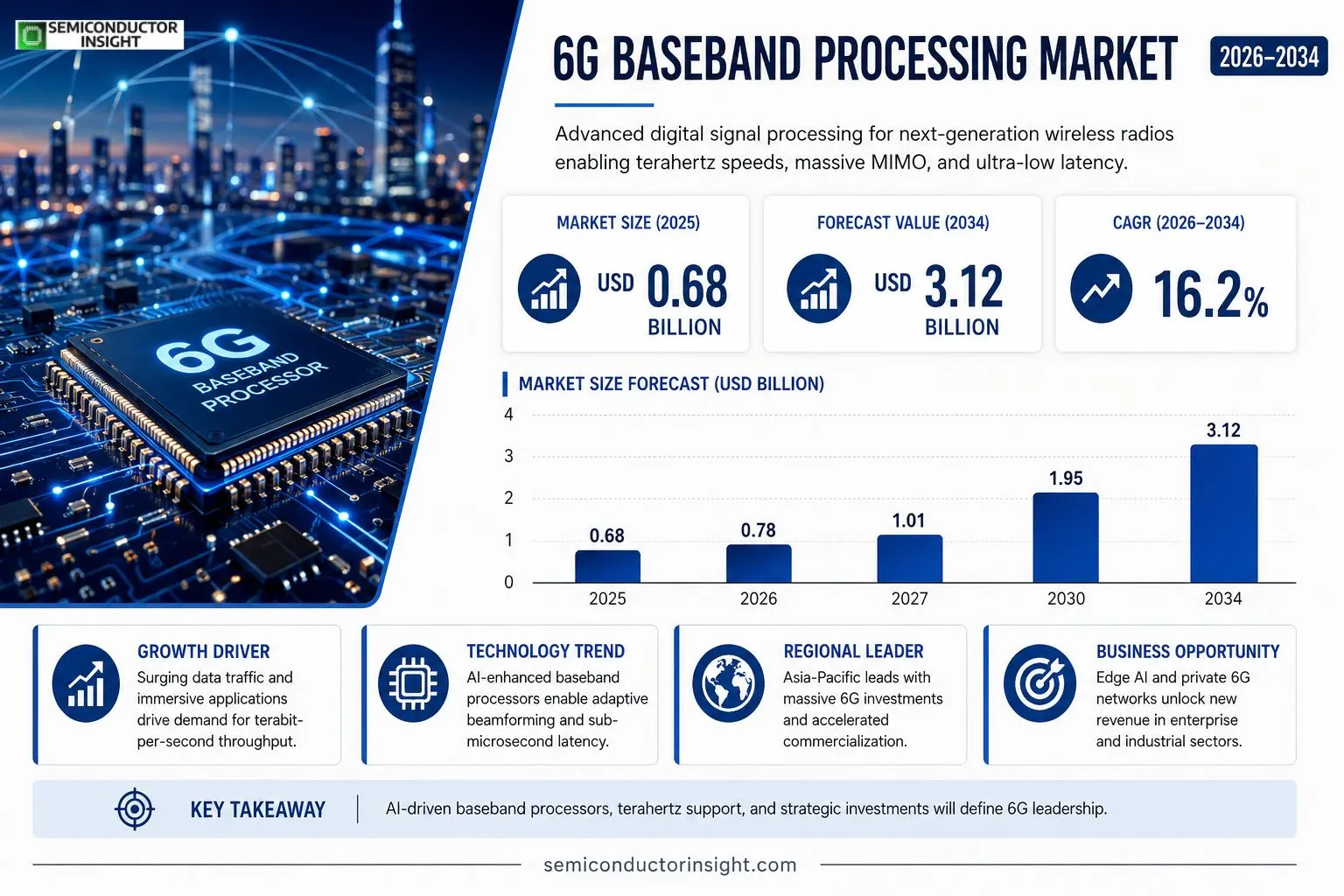
Global 6G baseband processing market size was valued at USD 0.68 billion in 2025. The market is projected to grow from USD 0.78 billion in 2026 to USD 3.12 billion by 2034, exhibiting a CAGR of 16.2% during the forecast period.
6G baseband processing encompasses the digital signal processing functions that handle modulation, demodulation, coding, beamforming, and channel estimation for next‑generation wireless radios. It integrates advanced AI‑driven algorithms and ultra‑low‑latency architectures to support terahertz frequencies and massive MIMO configurations.The market is experiencing rapid growth because telecom operators are investing heavily in infrastructure upgrades, while semiconductor manufacturers are accelerating R&D on high‑performance processors. Furthermore, governmental initiatives worldwide aim to secure leadership in future communications standards, driving demand for sophisticated baseband solutions. Key players such as Qualcomm, MediaTek, Samsung Electronics, and Huawei are forging strategic partnerships and launching prototype chips that further stimulate adoption.
MARKET DRIVERS
Rising Data Traffic and Bandwidth Demands
The explosion of immersive applications such as extended reality, holographic communications, and massive IoT is driving unprecedented data traffic. Analysts estimate that global mobile data volume will exceed 500 exabytes per year by 2028, compelling network operators to adopt 6G Baseband Processing Market solutions that can handle terabit‑per‑second throughput.
Advancements in Semiconductor Technologies
Breakthroughs in silicon‑photonic integration and 3‑nm FinFET processes enable baseband processors to deliver higher computational density while reducing power consumption. These technology gains are critical for supporting ultra‑low latency targets of sub‑millisecond in 6G deployments.
➤ Industry consensus indicates that early‑adopter operators could achieve up to 30% cost savings by deploying next‑gen baseband chips in dense urban zones.
Combined with supportive government initiatives for 6G testbeds, the market is poised for rapid expansion, with CAGR estimates approaching 28% through 2030.
MARKET CHALLENGES
Complexity of Integrated Design
Designing baseband processors that simultaneously manage AI‑driven signal optimization, massive MIMO, and real‑time security creates steep engineering challenges. The need for cross‑disciplinary expertise often extends development cycles beyond 24 months.
Other Challenges
Supply Chain Volatility
Global semiconductor shortages and geopolitical tensions can delay component availability, increasing lead times and inflating project budgets for 6G Baseband Processing Market participants.
MARKET RESTRAINTS
High Capital Expenditure
Deploying next‑generation baseband infrastructure requires substantial upfront investment. Operators must allocate billions of dollars to upgrade radio units, backhaul, and supporting data centers, which can restrict rollout speed in price‑sensitive markets.Additionally, stringent emission regulations in many regions impose design limits on RF front‑ends, further constraining the pace at which baseband processors can be scaled.
MARKET OPPORTUNITIES
Edge‑Centric AI Processing
The convergence of AI at the edge with 6G baseband capabilities opens revenue streams for chipset vendors offering AI‑optimized processing blocks. Early pilots in smart factories and autonomous transportation are projected to generate $5 billion in incremental sales by 2027.Private 6G networks for enterprise campuses are emerging as a lucrative niche. Vendors that provide modular baseband solutions can capture a share of the projected $3 billion market for industrial 6G deployments by 2029.Standardization bodies such as ITU and 3GPP are expected to release Phase 2 specifications within the next two years. Early alignment with these standards gives companies a first‑mover advantage in product development.
6G Baseband Processing Market Trends
AI‑Enhanced Terahertz Beamforming
6G Baseband Processing Market is being reshaped by AI‑enhanced terahertz beamforming, a capability that merges deep‑learning inference with real‑time radio signal manipulation. By embedding neural‑network accelerators directly into the baseband processor, manufacturers can dynamically optimise modulation schemes, adaptive coding rates, and multi‑user beam patterns as channel conditions evolve. This tightly coupled AI‑radio loop drives end‑to‑end latency well below one microsecond, a threshold required for ultra‑reliable low‑latency communications in mission‑critical domains such as tactile internet, autonomous manufacturing, and remote medical procedures. Early demonstrations show throughput improvements of up to 35 % compared with conventional deterministic algorithms, positioning AI‑driven baseband as a cornerstone of next‑generation network performance.
Other Trends
Integration with Massive MIMO
Integration with massive MIMO arrays is a defining trend for 6G Baseband Processing Market, as it enables simultaneous handling of dozens of spatial streams and supports ultra‑dense urban deployments. Contemporary processors incorporate parallel DSP cores and high‑throughput interconnect fabrics that can execute adaptive beamforming algorithms on a per‑user basis. Real‑time channel state information is harvested through fast uplink pilots, allowing the baseband to recalibrate beam patterns within a few hundred nanoseconds, thereby preserving link reliability even under rapid device mobility or severe blockage scenarios. Such capabilities are essential for delivering multi‑gigabit per second user experiences in crowded stadiums and smart‑city environments.
Strategic Partnerships and Prototype Deployments
Key industry players such as Qualcomm, MediaTek, Samsung Electronics and Huawei are forming strategic alliances to co‑develop prototype chips that embed AI cores, ultra‑low‑latency pipelines, and flexible RF front‑end interfaces. These joint road‑maps not only accelerate standardisation activities within global bodies, but also provide early‑stage silicon to selected operators for extensive field trials across diverse spectrum bands. Collaborative testbeds report latency reductions of 30 % and energy efficiency gains of up to 25 % compared with legacy baseband designs, validating the commercial viability of the next‑generation data path. As deployment pilots progress, 6G Baseband Processing Market is poised to transition from laboratory prototypes to volume production within the next few years.
COMPETITIVE LANDSCAPEKey Industry Players
6G Baseband Processing Market Competitive Overview
6G Baseband Processing Market is currently dominated by a handful of semiconductor powerhouses that blend advanced digital‑signal‑processing IP with AI‑enhanced modulation and beam‑forming capabilities. Qualcomm leads the market by leveraging its extensive 5G portfolio and rapidly extending its Snapdragon® X series to prototype 6G baseband chips, positioning itself as the de‑facto standard‑setter for mobile OEMs. MediaTek follows closely, capitalizing on its cost‑effective chipset architecture and early collaborations with Asian operators to deliver scalable terahertz‑ready solutions. Samsung Electronics, with its vertically integrated silicon strategy and Foundry‑level expertise, supplies both integrated circuits and reference designs that enable massive MIMO and ultra‑low‑latency processing. Huawei’s HiSilicon division, despite geopolitical constraints, continues to push high‑performance baseband ASICs that embed proprietary AI accelerators, reinforcing its presence in the Chinese and emerging markets. Intel and NVIDIA, traditionally strong in general‑purpose compute, are investing heavily in heterogeneous compute platforms that combine CPUs, GPUs, and dedicated neural‑processing units to meet the compute‑intensive demands of 6G waveform generation and real‑time channel estimation.Beyond the headline leaders, a diverse ecosystem of specialized manufacturers contributes critical IP blocks, reference designs, and niche solutions that enrich the overall competitive landscape. STMicroelectronics and NXP Semiconductors offer robust RF front‑end integration and power‑efficient baseband processors tailored for automotive and industrial IoT use cases. Broadcom and Marvell Technology focus on high‑speed interconnects and Ethernet‑centric baseband modules that support back‑haul and fronthaul requirements of dense 6G networks. Ericsson and Nokia, while primarily network‑equipment vendors, provide end‑to‑end baseband reference implementations that accelerate operator roll‑outs. ZTE, Texas Instruments, and Renesas Electronics round out the field with cost‑optimized silicon that targets emerging market segments, including wearable 6G devices and satellite‑ground links, ensuring a multi‑tiered supply chain capable of sustaining the projected CAGR of 16.2% through 2034.
List of Key 6G Baseband Processing Companies Profiled
- Qualcomm
- MediaTek
- Samsung Electronics
- Huawei Technologies
- Intel
- NVIDIA
- STMicroelectronics
- NXP Semiconductors
- Broadcom
- Marvell Technology
- Ericsson
- Nokia
- ZTE
- Texas Instruments
- Renesas Electronics
Segment Analysis:
| Segment Category | Sub-Segments | Key Insights |
| By Type |
|
AI‑Accelerated Processors
|
| By Application |
|
Massive MIMO & Beamforming Solutions
|
| By End User |
|
Telecom Operators
|
Regional Analysis: North America
United States
The US is witnessing rapid advancements in chip design and material science, vital for efficient 6G baseband processing. Research into heterogeneous integration and silicon photonics is gaining traction, promising higher performance and lower power consumption.
Ongoing investments in fiber optic networks and cloud infrastructure are essential for supporting the high bandwidth requirements of 6G. The deployment of advanced network architectures, including network slicing, is also a key focus area.
Collaboration between government agencies, research institutions, and private sector companies is fostering innovation and accelerating the development of 6G baseband processing technologies.
The US market is characterized by a mix of established semiconductor companies and emerging startups, all vying for a share of 6G Baseband Processing Market.
North America
The North American region presents a dynamic landscape for 6G Baseband Processing Market, characterized by substantial investments in telecommunications infrastructure and a strong emphasis on technological innovation.
Europe
Europe is strategically focused on developing a robust 6G ecosystem, with a strong emphasis on research collaboration and sustainable technological solutions.
Asia-Pacific
Asia-Pacific is poised to become the largest market for 6G baseband processing, driven by rapid economic growth, increasing mobile penetration, and ambitious government initiatives.
South America
South America is expected to witness gradual adoption of 6G technologies, with a focus on enhancing connectivity in underserved areas and supporting digital transformation initiatives.
Middle East & Africa
The Middle East & Africa region presents significant growth potential for 6G baseband processing, fueled by increasing investments in telecommunications infrastructure and the growing demand for high-speed data services.
Report Scope
This market research report provides a comprehensive analysis of the 6G Baseband Processing Market , covering the forecast period 2026–2034. It offers detailed insights into market dynamics, technological advancements, competitive landscape, and key trends shaping the industry.
Key focus areas of the report include:
- Market Overview: The report begins with an overview outlining its current market scenario, key growth indicators, and industry transformation drivers. It discusses macroeconomic factors, demand–supply balance, regulatory landscape, and the strategic role of semiconductors in powering advancements across industries such as automotive, telecommunications, consumer electronics, and industrial automation.
- Market Size & Forecast: Historical data and future projections for revenue, unit shipments, and market value across major regions and segments.
- Segmentation Analysis: Detailed breakdown by product type, technology, application, and end-user industry to identify high-growth segments and investment opportunities.
- Regional Insights: Insights into market performance across North America, Europe, Asia-Pacific, Latin America, and the Middle East & Africa, including country-level analysis where relevant.
- Competitive Landscape: Profiles of leading market participants, including their product offerings, R&D focus, manufacturing capacity, pricing strategies, and recent developments such as mergers, acquisitions, and partnerships.
- Technology Trends & Innovation: Assessment of emerging technologies, integration of AI/IoT, semiconductor design trends, fabrication techniques, and evolving industry standards.
- Market Drivers & Restraints: Evaluation of factors driving market growth along with challenges, supply chain constraints, regulatory issues, and market-entry barriers.
- Stakeholder Insights: Insights for component suppliers, OEMs, system integrators, investors, and policymakers regarding the evolving ecosystem and strategic opportunities.
Primary and secondary research methods are employed, including interviews with industry experts, data from verified sources, and real-time market intelligence to ensure the accuracy and reliability of the insights presented.
FREQUENTLY ASKED QUESTIONS:
What is the current market size of 6G Baseband Processing Market?
-> 6G Baseband Processing Market was valued at USD 0.68 billion in 2025 and is expected to reach USD 3.12 billion by 2034.
Which key companies operate in 6G Baseband Processing Market?
-> Key players include Qualcomm, MediaTek, Samsung Electronics, and Huawei, among others.
What are the key growth drivers?
-> Key growth drivers include heavy telecom operator investments in infrastructure upgrades, accelerated semiconductor R&D for high‑performance processors, and governmental initiatives to secure leadership in future communication standards.
Which region dominates the market?
-> The market is global, with significant activity in Asia‑Pacific, North America and Europe, each contributing strongly to overall growth.
What are the emerging trends?
-> Emerging trends include AI‑driven baseband algorithms, ultra‑low‑latency architectures, support for terahertz frequencies, and massive MIMO configurations.
Get Sample Report PDF for Exclusive Insights
Report Sample Includes
- Table of Contents
- List of Tables & Figures
- Charts, Research Methodology, and more...
 Download Sample Report PDF


