5G mmWave Chipset Market Insights
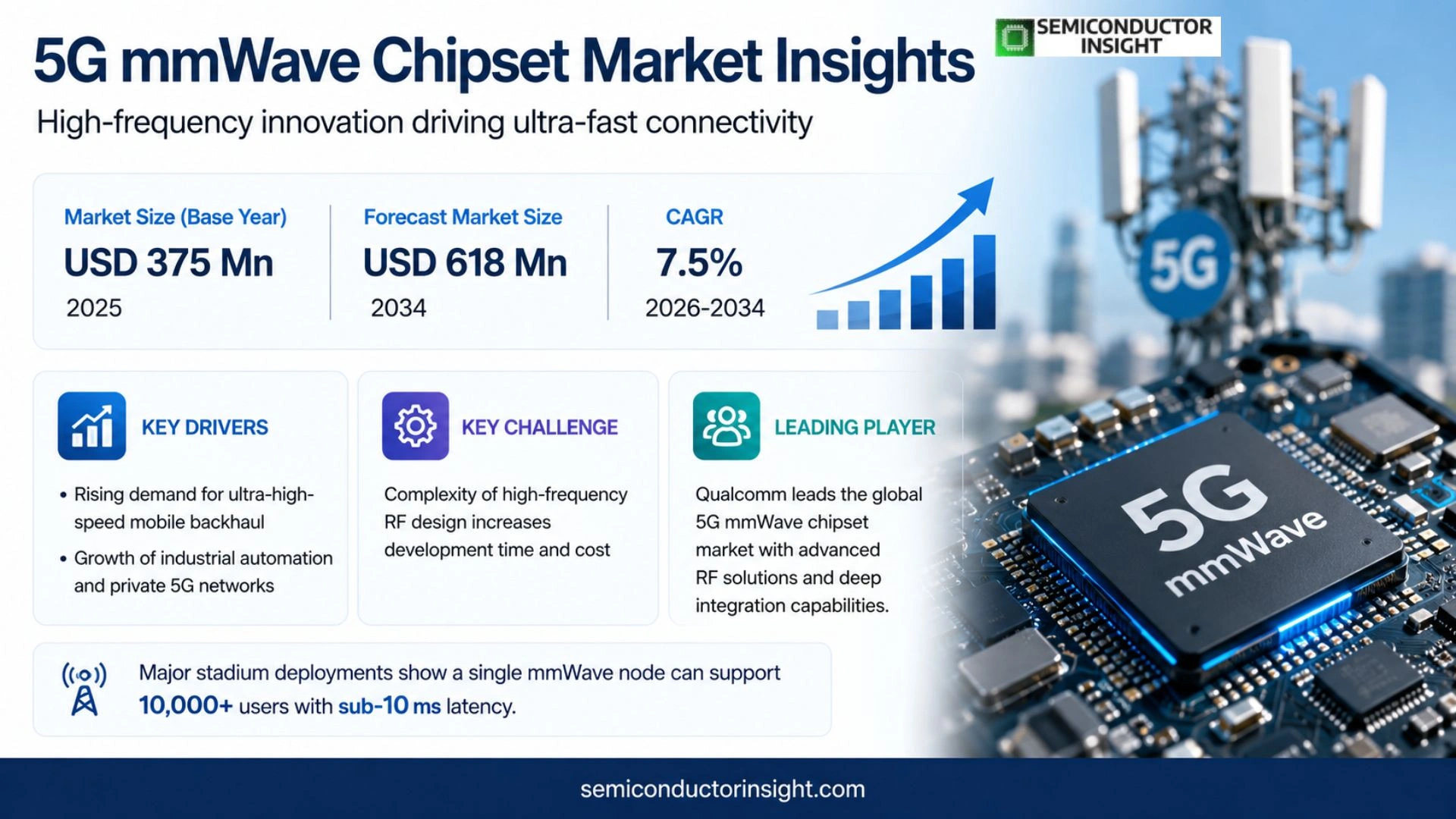
5G mmWave Chipset market was valued at USD 375 million in 2025 and will reach USD 618 million by 2034, showing a CAGR of 7.5% over the forecast period.
5G mmWave chipset refers to the core integrated‑circuit set that enables communication on the millimeter‑wave band (approximately 24 GHz to 100 GHz). It is typically embedded in smartphones and other terminal equipment and comprises a millimeter‑wave RF transceiver, antenna tuner, beam‑forming controller and associated baseband processing units. These components together generate, modulate, transmit, receive, demodulate and precisely steer high‑frequency beams, forming the hardware foundation for ultra‑high bandwidth and ultra‑low latency services promised by fifth‑generation networks.
MARKET DRIVERS
Growing Need for Ultra‑High‑Speed Mobile Backhaul
The surge in data‑intensive applications such as augmented reality, cloud gaming and real‑time video analytics forces operators to replace legacy microwave links with wider‑band solutions. 5G mmWave Chipset Market players that can deliver aggregate throughputs beyond 5 Gbps are witnessing accelerated adoption in dense urban corridors, where conventional sub‑6 GHz bands are saturated.
Industrial Automation and Private Networks
Manufacturers are building private 5G cells to connect robots, sensors and autonomous guided vehicles. The promise of sub‑meter latency combined with deterministic bandwidth pushes equipment makers to embed mmWave chipsets directly into edge gateways, creating a parallel revenue stream beyond consumer devices.
➤ Deployments in major stadiums have demonstrated that a single mmWave node can support over 10,000 concurrent users while maintaining sub‑10 ms round‑trip latency.
These deployments illustrate a shifting value proposition: operators and enterprises now evaluate chipsets on the basis of spectral efficiency and integration flexibility, rather than merely cost per radio. Vendors that align product roadmaps with these performance criteria are positioning themselves at the forefront of the market trajectory.
MARKET CHALLENGES
Complexity of High‑Frequency RF Design
Designing for frequencies above 24 GHz demands meticulous layout, advanced packaging and rigorous thermal management. Small variations in antenna placement can translate into pronounced signal loss, raising engineering bills and lengthening time‑to‑market for new chipset families.
Other Challenges
Supply‑Chain Constraints
The scarcity of gallium nitride (GaN) substrates and high‑precision lithography tools creates bottlenecks that ripple through the entire production line. Companies that lack diversified supplier bases risk missing quarterly revenue targets when component lead times extend beyond forecast windows.
MARKET RESTRAINTS
Regulatory and Spectrum Allocation Issues
National regulators continue to parcel out mmWave bands in piecemeal fashion, often reserving portions for defense or satellite services. This fragmented allocation forces handset makers to support multiple band masks, inflating bill‑of‑materials and complicating certification procedures.
In regions where spectrum auctions command premiums exceeding $300 million, operators may defer large‑scale rollout until a clear business case emerges, thereby damping immediate demand for new chipset designs.
Further, health‑concern narratives surrounding high‑frequency emissions, although not substantiated by scientific consensus, generate public‑policy pressure that can delay deployments and increase compliance costs for vendors.
MARKET OPPORTUNITIES
Emergence of AI‑Optimized Beamforming
Integrating machine‑learning algorithms directly into mmWave chipsets enables dynamic beam steering that adapts to user movement and environmental obstructions. Early trials report up to a 35% increase in link reliability, opening avenues for premium services such as remote surgery and tactile internet.
Expansion into Automotive Radar and V2X
Automakers are standardizing 77 GHz radar modules that share architecture with mmWave communication chipsets. By offering dual‑function silicon that can toggle between sensing and data transmission, chipset vendors can capture a share of the projected $12 billion automotive radar market within the next five years.
Finally, the push toward open‑source hardware platforms invites smaller system integrators to experiment with customizable mmWave solutions. This democratization reduces entry barriers and is likely to spawn niche applications in smart agriculture, drone swarms and public safety networks.
5G mmWave Chipset Market Trends
Integration‑Driven Cost Compression
5G mmWave Chipset market is increasingly defined by the push toward higher levels of functional integration. By embedding RF front‑end, beamforming control, and baseband processing into a single module, manufacturers are shaving both bill‑of‑materials and board‑level footprint. This shift is not merely engineering‑centric; it translates into lower handset pricing, which in turn broadens consumer adoption beyond flagship devices. Moreover, tighter integration facilitates more accurate beam steering, a prerequisite for maintaining link reliability at the high frequencies that mmWave employs. Suppliers that can deliver compact, power‑efficient solutions are therefore gaining a decisive advantage in negotiations with OEMs seeking to differentiate their next‑generation products.
Other Trends
Manufacturing Process Innovation
The semiconductor fabrication route for mmWave components is evolving from traditional silicon to compound semiconductors such as gallium arsenide and gallium nitride. These materials support the electron velocities required for the 24‑100 GHz spectrum, reducing signal loss and enhancing thermal performance. Advanced wafer‑scale techniques,thin‑film deposition, high‑resolution photolithography, and precision etching,now enable transistor geometries that were infeasible a few years ago. Coupled with fan‑out and antenna‑in‑package solutions, this process chain delivers higher signal integrity while meeting the stringent size constraints of mobile terminals. The industry’s willingness to invest in these sophisticated steps signals confidence that the ensuing performance gains will outweigh the added capital intensity.
Broadening Application Horizons
While early deployments focused on premium smartphones and fixed wireless access, 5G mmWave Chipset market is witnessing a marked migration toward diversified use‑cases. High‑bandwidth, low‑latency requirements of extended‑reality headsets, autonomous vehicle sensor suites, and mission‑critical industrial IoT are prompting OEMs to embed mmWave capabilities directly into edge devices. This diversification reduces reliance on a single product category and spreads risk across multiple sectors. Simultaneously, chipset designers are adding multi‑band support and carrier‑aggregation features to accommodate the heterogeneous spectrum allocations found worldwide. The convergence of communications and sensing functions within a single silicon platform is emerging as a strategic priority, positioning mmWave chipsets as foundational components of the broader connected ecosystem.
COMPETITIVE LANDSCAPE
Key Industry Players
5G mmWave Chipset Market: Competitive Overview
Qualcomm remains the dominant force in the global 5G mmWave chipset arena, leveraging its extensive RF‑front‑end portfolio and deep integration capabilities across handset and infrastructure segments. The company’s ability to combine millimeter‑wave transceivers, beam‑forming controllers, and baseband processing in a single silicon solution has secured a sizable share of the $618 million forecast market for 2034. Qualcomm’s strategy of iterating on advanced SiGe and GaN processes reduces unit cost while preserving the high‑frequency performance required for carrier‑grade deployments. This technical edge translates into stronger bargaining power with OEMs, better margin resilience, and a platform that can be repurposed for emerging use‑cases such as extended reality and autonomous mobility. As network operators expand spectrum holdings, Qualcomm’s broad band‑support roadmap positions it to capture incremental demand from both premium smartphones and fixed‑wireless access equipment.
Beyond the market leader, a constellation of firms competes on specialization and regional strength. Samsung and Huawei each operate sophisticated in‑house fabs that enable customized GaN‑based front‑ends, allowing them to address high‑volume Asian markets and government‑backed 5G rollouts. MediaTek’s cost‑effective system‑on‑chip approach appeals to mid‑range device makers, while European player Nokia focuses on network‑side chipsets that integrate tightly with its radio access solutions. Smaller but technically agile companies such as Qorvo, Analog Devices, NXP Semiconductors, Marvell, Renesas, MACOM, MixComm, Sivers Semiconductor, Movandi and Anokiwave contribute niche innovations,from ultra‑compact antenna packaging to low‑power beamforming ASICs,that keep the ecosystem vibrant and prevent concentration from stifling new entrants.
List of Key 5G mmWave Chipset Companies Profiled
- Qualcomm
- Samsung
- Huawei
- MediaTek
- Qorvo
- Analog Devices
- NXP Semiconductors
- Marvell
- Renesas
- MACOM
- MixComm
- Sivers Semiconductor
- Movandi
- Anokiwave
Segment Analysis:
| Segment Category | Sub-Segments | Key Insights |
| By Type |
|
Integrated RF Transceiver
|
| By Application |
|
Smartphones
|
| By End User |
|
Consumer Electronics
|
Regional Analysis: 5G mmWave Chipset Market
North America
The FCC’s recent spectrum harmonization aligns mmWave allocations across carriers, removing legacy barriers that once fragmented device rollouts. By granting conditional approvals for experimental deployments, regulators accelerate proof‑of‑concept cycles, allowing chipset firms to test integration in live networks without protracted waiting periods.
Regional fabs in Arizona and Texas have consolidated advanced lithography lines, delivering higher wafer yields for high‑frequency components. Proximity to design hubs shortens feedback loops, enabling rapid design‑for‑manufacturing adjustments that keep lead times competitive against offshore alternatives.
Enterprise‑grade private‑network operators and the automotive industry dominate demand, each seeking low‑latency links for edge‑compute and vehicle‑to‑infrastructure communication. Their procurement cycles drive chip specifications toward higher integration and power efficiency.
Venture capital has gravitated toward startups that combine AI‑optimized beamforming with mmWave front‑ends. Simultaneously, large cap semiconductor players allocate capital to expand silicon‑on‑glass processes, signaling confidence in sustained market expansion.
Europe
European nations are leveraging the continent’s strong standards‑setting bodies to create a cohesive approach to mmWave rollout. The EU’s digital agenda encourages cross‑border spectrum sharing, which eases the path for chipset vendors to certify designs across multiple markets simultaneously. Major automotive clusters in Germany and France are integrating mmWave solutions into next‑gen driver assistance platforms, prompting OEMs to demand chips that balance high data rates with stringent thermal envelopes. Telecom operators, constrained by denser legacy infrastructure, are focusing on hotspot installations in metros, shaping a niche for highly integrated, low‑profile chipsets. The overall effect is a market where differentiation hinges on meeting rigorous safety certifications while maintaining cost discipline.
Asia‑Pacific
The Asia‑Pacific region is distinguished by its scale of consumer adoption and aggressive network densification strategies. Countries such as South Korea and Japan have already launched extensive mmWave‑based mobile broadband services, compelling chipset manufacturers to prioritize mass‑production capabilities. Simultaneously, China’s policy incentives for domestic semiconductor self‑sufficiency stimulate rapid scaling of fab capacity, though quality parity with established players remains a focus. The confluence of massive device shipments and governmental backing creates a pressure cooker environment where speed to volume outweighs marginal performance gains, driving firms to streamline design cycles and adopt modular architectures.
South America
South America presents a heterogeneous landscape where urban centers like São Paulo and Buenos Aires are piloting mmWave trials to support high‑density events and smart‑city initiatives. Regulatory bodies are gradually opening higher frequency bands, yet the rollout pace is moderated by infrastructure financing constraints. Chipset suppliers therefore target a hybrid offering that combines robust outdoor performance with cost‑effective integration to appeal to emerging carriers seeking to differentiate in competitive markets. The region’s trajectory suggests a gradual shift from experimental deployments to modest commercial services within the next few years.
Middle East & Africa
In the Middle East & Africa, wealth‑driven telecom projects in nations such as the United Arab Emirates and Saudi Arabia have spurred early interest in mmWave applications for stadiums, airports, and luxury resorts. These deployments prioritize ultra‑high‑throughput experiences, prompting chipset designers to emphasize power‑efficient beamforming that can operate in extreme climatic conditions. Conversely, many African markets remain focused on foundational 4G expansion, limiting immediate demand. However, strategic partnerships between global chipset firms and regional system integrators are laying the groundwork for a future upside as infrastructure investments accelerate across the continent.
Report Scope
This market research report provides a comprehensive analysis of the 5G mmWave Chipset Market , covering the forecast period 2026–2034. It offers detailed insights into market dynamics, technological advancements, competitive landscape, and key trends shaping the industry.
Key focus areas of the report include:
- Market Overview: The report begins with an overview outlining its current market scenario, key growth indicators, and industry transformation drivers. It discusses macroeconomic factors, demand–supply balance, regulatory landscape, and the strategic role of semiconductors in powering advancements across industries such as automotive, telecommunications, consumer electronics, and industrial automation.
- Market Size & Forecast: Historical data and future projections for revenue, unit shipments, and market value across major regions and segments.
- Segmentation Analysis: Detailed breakdown by product type, technology, application, and end-user industry to identify high-growth segments and investment opportunities.
- Regional Insights: Insights into market performance across North America, Europe, Asia-Pacific, Latin America, and the Middle East & Africa, including country-level analysis where relevant.
- Competitive Landscape: Profiles of leading market participants, including their product offerings, R&D focus, manufacturing capacity, pricing strategies, and recent developments such as mergers, acquisitions, and partnerships.
- Technology Trends & Innovation: Assessment of emerging technologies, integration of AI/IoT, semiconductor design trends, fabrication techniques, and evolving industry standards.
- Market Drivers & Restraints: Evaluation of factors driving market growth along with challenges, supply chain constraints, regulatory issues, and market-entry barriers.
- Stakeholder Insights: Insights for component suppliers, OEMs, system integrators, investors, and policymakers regarding the evolving ecosystem and strategic opportunities.
Primary and secondary research methods are employed, including interviews with industry experts, data from verified sources, and real-time market intelligence to ensure the accuracy and reliability of the insights presented.
FREQUENTLY ASKED QUESTIONS:
What is the current market size of 5G mmWave Chipset Market?
-> 5G mmWave Chipset market was valued at USD 375 million in 2025 and will reach USD 618 million by 2034, showing a CAGR of 7.5% over the forecast period.
Which key companies operate in 5G mmWave Chipset Market?
-> Key players include Qualcomm (USA), MediaTek (Taiwan), Huawei (China), Samsung (South Korea), Nokia (Finland), Qorvo (USA), Analog Devices (USA), NXP Semiconductors (Netherlands), Marvell (USA), Renesas (Japan), among others.
What are the key growth drivers?
-> Key growth drivers include massive 5G network roll‑out, increasing demand for high‑bandwidth mobile devices, proliferation of IoT, augmented/virtual reality, autonomous vehicle connectivity, and the need for energy‑efficient, multi‑band chip solutions.
Which region dominates the market?
-> Asia‑Pacific is the fastest‑growing region, while Europe remains a dominant market.
What are the emerging trends?
-> Emerging trends include advanced system‑in‑package (SiP) integration, multi‑band and carrier‑aggregation capabilities, AI‑enhanced beamforming, use of GaN/ GaAs substrates, and convergence of communications with sensing technologies.

Get Sample Report PDF for Exclusive Insights
Report Sample Includes
- Table of Contents
- List of Tables & Figures
- Charts, Research Methodology, and more...