5G LAN-type service for industrial private network Market Insights
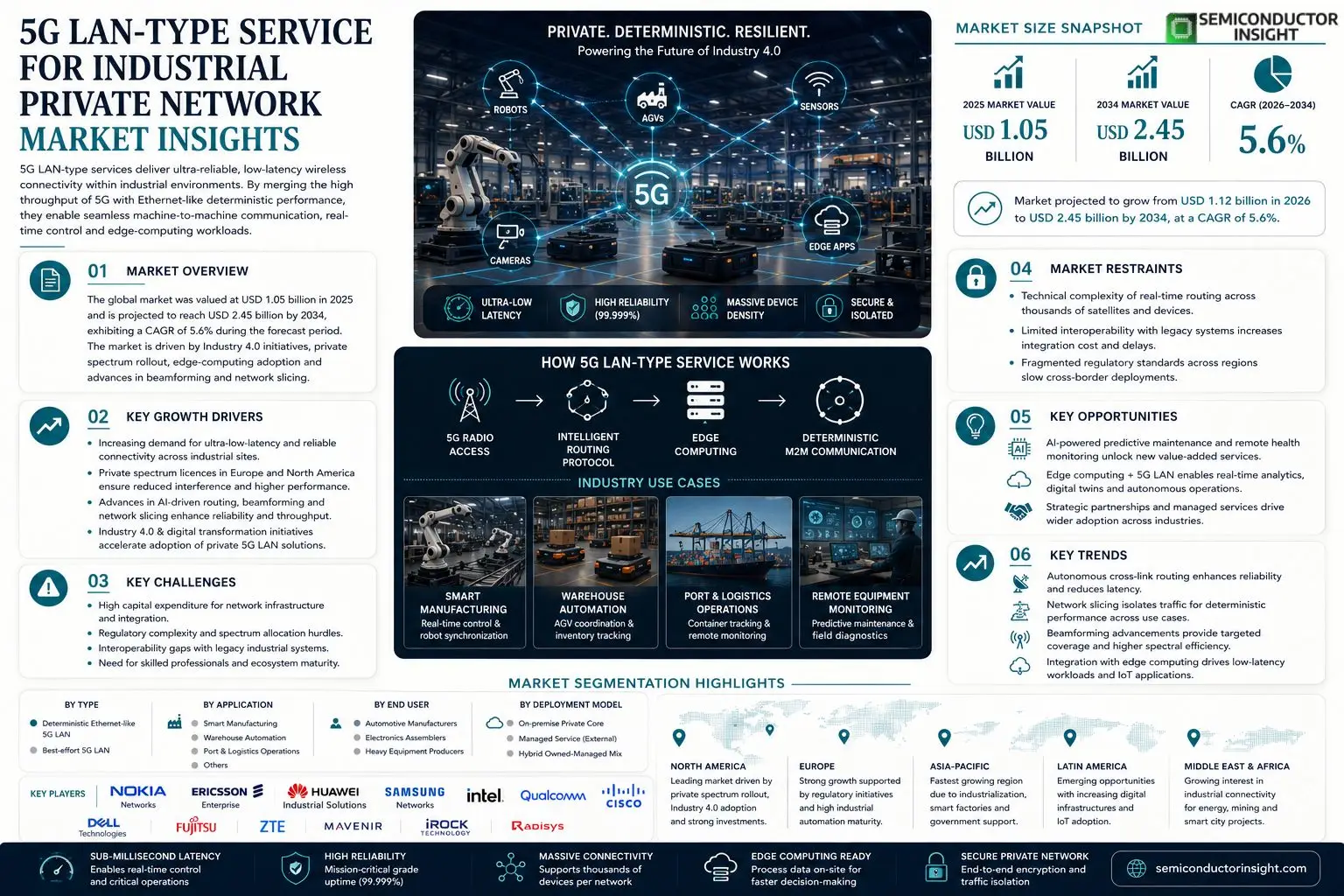
Global 5G LAN-type service for industrial private network market size was valued at USD 1.05 billion in 2025. The market is projected to grow from USD 1.12 billion in 2026 to USD 2.45 billion by 2034, exhibiting a CAGR of 9.0% during the forecast period.
5G LAN‑type services deliver ultra‑reliable low‑latency wireless connectivity within confined industrial environments such as factories, warehouses and ports. By merging the high throughput of 5G with Ethernet‑like deterministic performance, they enable seamless machine‑to‑machine communication, real‑time control loops and edge‑computing workloads.The market is accelerating because manufacturers are embracing Industry 4.0 initiatives that demand sub‑millisecond latency and massive device density. Furthermore, the rollout of private spectrum licences in Europe and North America reduces interference risk, while advances in beamforming and network slicing simplify deployment. Leading vendors—including Nokia Networks, Ericsson Enterprise, Huawei Industrial Solutions and Samsung Networks—are expanding their portfolios with turnkey kits and managed services, further fueling adoption.
MARKET DRIVERS
Rapid Adoption of Private 5G Networks
5G LAN-type service for industrial private network Market is gaining momentum as manufacturers seek dedicated spectrum to achieve ultra‑reliable low‑latency communication. Enterprises can sidestep public‑network congestion, ensuring deterministic performance for robotics, autonomous guided vehicles, and real‑time analytics.
Enhanced Operational Efficiency
Edge‑computing integration with private 5G LAN enables on‑site data processing, reducing downtime and lowering operational costs by up to 20 % in benchmark studies. The ability to localize traffic also improves security and compliance for critical infrastructure.
➤ “Enterprises that deploy private 5G LAN report faster time‑to‑market for new production lines, driven by seamless machine‑to‑machine connectivity.”
Overall, the convergence of Industry 4.0 initiatives and the need for reliable connectivity serves as a strong catalyst for market expansion.
MARKET CHALLENGES
High Capital Expenditure for Network Build‑Out
Deploying a dedicated 5G LAN requires substantial upfront investment in spectrum licensing, base‑station hardware, and integration services. Smaller manufacturers often lack the financial bandwidth, slowing adoption rates in certain regions.
Other Challenges
Regulatory Complexity
Navigating national spectrum allocations and compliance standards adds layers of administrative effort, which can delay project timelines and increase costs.Moreover, the need for skilled personnel to design, install, and maintain private 5G infrastructure remains a talent bottleneck across the industry.
MARKET RESTRAINTS
Limited Interoperability with Legacy Systems
Many legacy production assets rely on older communication protocols that are not natively compatible with 5G LAN. Retrofitting these devices incurs additional cost and engineering effort, dampening the speed of rollout.In addition, the fragmented ecosystem of vendors and lack of standardized interfaces can hinder seamless integration, creating uncertainty for prospective adopters.These technical constraints act as a restraint, especially for organizations that operate mixed‑technology environments.
MARKET OPPORTUNITIES
Growth of Edge‑Enabled Automation
The rising demand for real‑time analytics and AI‑driven automation opens a sizable opportunity for 5G LAN-type service for industrial private network Market. Providers that bundle edge compute platforms with private 5G can differentiate themselves and capture premium contracts.Furthermore, emerging use‑cases in predictive maintenance, digital twins, and remote robotics are projected to drive new deployments across automotive, electronics, and heavy‑equipment sectors.Strategic partnerships between telecom operators, equipment manufacturers, and system integrators are expected to accelerate market penetration and unlock untapped revenue streams.
5G LAN-type service for industrial private network Market Trends
Increasing Adoption Driven by Industry 4.0
5G LAN-type service for industrial private network Market was valued at USD 1.05 billion in 2025. Analysts project the market to expand to USD 2.45 billion by 2034, reflecting a compound annual growth of roughly 9 percent. This trajectory is anchored in manufacturers’ shift toward Industry 4.0 strategies that require sub‑millisecond latency, deterministic throughput and dense device connectivity. By combining the high bandwidth of 5G with Ethernet‑like reliability, LAN‑type services enable real‑time control loops, synchronized robotics and edge‑computing workloads across factories, warehouses and port terminals. The convergence of these capabilities reduces downtime and improves production efficiency, prompting large‑scale pilots that are quickly moving into commercial roll‑outs. Enterprises observe reduced installation time and lower maintenance overhead compared with traditional wired solutions. The flexibility of wireless cells enables rapid reconfiguration of production lines without extensive civil works.
Other Trends
Spectrum Allocation and Regulatory Support
Private spectrum licences granted in Europe and North America are a critical catalyst for market expansion. Dedicated bands minimise interference from public networks and allow operators to deliver guaranteed quality of service for mission‑critical applications. Regulators are also streamlining approval processes for indoor deployments, which shortens time‑to‑market for turnkey solutions. As a result, more enterprises are confident to invest in private 5G LAN infrastructures, knowing that the regulatory environment sustains reliable performance. Harmonised spectrum frameworks across the EU further simplify cross‑border deployments for multinational manufacturers.
Advances in Beamforming and Network Slicing
Recent improvements in beamforming algorithms and network‑slicing techniques simplify the design of industrial private networks. Precise beam steering concentrates radio energy where machines operate, extending coverage while preserving energy efficiency. Network slicing, on the other hand, isolates traffic streams for control, monitoring and infotainment, ensuring that latency‑sensitive packets are prioritised without compromising overall capacity. AI‑driven analytics are increasingly used to dynamically allocate slices based on real‑time demand, improving overall network efficiency. Leading vendors such as Nokia, Ericsson, Huawei and Samsung are integrating these functions into modular kits, enabling faster deployment and managed‑service models that appeal to mid‑size manufacturers seeking rapid digital transformation.
COMPETITIVE LANDSCAPE
Key Industry Players
5G LAN‑type Service for Industrial Private Networks – Competitive Landscape Overview
The market is dominated by a handful of global telecommunications giants that have already commercialised end‑to‑end private‑network kits. Nokia Networks, Ericsson Enterprise, Huawei Industrial Solutions and Samsung Networks each offer integrated radio units, edge‑cloud platforms and managed‑service contracts that address the ultra‑reliable low‑latency requirements of factory floors and ports. Their extensive R&D resources and early access to private‑spectrum licences allow them to deliver deterministic 5G LAN performance that rivals traditional Ethernet, positioning them as the primary choice for Tier‑1 manufacturers pursuing Industry 4.0 transformations.Beyond the core four, several niche and technology‑focused players are expanding the ecosystem. Intel supplies edge‑compute processors that accelerate real‑time analytics, while Qualcomm provides radio‑chipsets optimized for dense device deployments. Cisco Systems and Dell Technologies contribute networking‑fabric expertise and integrated management software. Fujitsu and ZTE bring region‑specific deployment experience in Asia‑Pacific, and Mavenir offers software‑defined radio solutions that enable rapid scaling of private 5G LAN services. These companies collectively enhance competition, foster innovation, and broaden the choice set for mid‑size factories and logistics hubs.
List of Key 5G LAN‑type Service for Industrial Private Network Companies Profiled
- Nokia Networks
- Ericsson Enterprise
- Huawei Industrial Solutions
- Samsung Networks
- Intel
- Qualcomm
- Cisco Systems
- Dell Technologies
- Fujitsu Ltd.
- ZTE Corporation
- Mavenir
- iRock Technology
- Radisys
- Qualcomm Technologies
Segment Analysis:
| Segment Category | Sub-Segments | Key Insights |
| By Type |
|
Deterministic Ethernet‑like 5G LAN drives the core value proposition for industrial private networks, delivering sub‑millisecond latency and strict jitter control.
|
| By Application |
|
Smart Manufacturing stands out as the primary driver, where ultra‑reliable connectivity fuels continuous production optimization.
|
| By End User |
|
Automotive manufacturers leverage the deterministic 5G LAN to synchronize robotic cells and enable real‑time quality monitoring across assembly lines.
|
| By Deployment Model |
|
Managed service with external provider is gaining traction as enterprises prefer to offload operational complexity while retaining strict performance guarantees.
|
| By Connectivity Requirement |
|
Ultra‑reliable low‑latency (URLLC) is the cornerstone for mission‑critical industrial use cases, where any communication delay can disrupt production stability.
|
Regional Analysis: North America
United States
The manufacturing industry is at the forefront of adopting 5G LAN-type services, leveraging them for enhanced automation, predictive maintenance, and improved supply chain management. The need for low-latency, reliable connectivity is critical for real-time control and monitoring of industrial processes.
The healthcare sector is exploring the potential of 5G LAN-type networks for applications such as remote patient monitoring, connected medical devices, and enhanced data transmission. Ensuring secure and reliable communication is paramount in this sensitive industry.
The ongoing upgrades to telecommunications infrastructure are directly supporting the deployment of 5G LAN-type services. Expansion of fiber networks and the implementation of advanced network technologies are enabling wider accessibility and improved performance.
Government programs and initiatives focused on fostering industrial innovation and digital transformation are playing a crucial role in accelerating the adoption of 5G LAN-type solutions across various industries.
Europe
Europe presents a significant opportunity for 5G LAN-type services in industrial settings. With a strong focus on Industry 4.0 and digital sovereignty, European nations are actively investing in advanced connectivity solutions. The relatively high level of technological sophistication and a well-established industrial base contribute to a favorable market environment. Emphasis on data privacy regulations like GDPR also drives the need for secure private 5G networks. Focus on energy efficiency and sustainable industrial practices is another key trend influencing the demand for optimized network solutions. Several countries are piloting and implementing 5G LAN-type networks in sectors like automotive, pharmaceuticals, and energy.
Asia-Pacific
The Asia-Pacific region is poised for substantial growth in the 5G LAN-type service market. Rapid industrialization, particularly in countries like China and India, is driving demand for advanced networking infrastructure. The burgeoning manufacturing sector and increasing adoption of IoT devices are key factors. Government support for technological advancements and infrastructure development further fuels market expansion. The region also presents challenges related to fragmented regulatory landscapes and infrastructure disparities, but the overall growth potential remains considerable. The focus on smart factories and connected supply chains is translating into strong demand for private 5G networks.
South America
South America is witnessing a gradual but steady increase in the adoption of 5G LAN-type services. The expansion of industrial sectors, particularly in mining, agriculture, and manufacturing, is driving demand for improved connectivity. The region faces challenges related to infrastructure development and economic stability, but the long-term outlook remains positive. Increasing investment in digital transformation initiatives is creating opportunities for private 5G network deployments to enhance operational efficiency and productivity.
Middle East & Africa
The Middle East and Africa region represents an emerging market for 5G LAN-type services. Significant investments in infrastructure development and industrial expansion are fueling demand for advanced connectivity solutions. The growing adoption of automation and IoT in sectors like oil & gas, logistics, and manufacturing is driving market growth. Government initiatives aimed at diversifying economies and promoting technological advancement are creating a favorable environment for private 5G network deployments.
Report Scope
This market research report provides a comprehensive analysis of the 5G LAN-type service for industrial private network Market , covering the forecast period 2026–2034. It offers detailed insights into market dynamics, technological advancements, competitive landscape, and key trends shaping the industry.
Key focus areas of the report include:
- Market Overview: The report begins with an overview outlining its current market scenario, key growth indicators, and industry transformation drivers. It discusses macroeconomic factors, demand–supply balance, regulatory landscape, and the strategic role of semiconductors in powering advancements across industries such as automotive, telecommunications, consumer electronics, and industrial automation.
- Market Size & Forecast: Historical data and future projections for revenue, unit shipments, and market value across major regions and segments.
- Segmentation Analysis: Detailed breakdown by product type, technology, application, and end-user industry to identify high-growth segments and investment opportunities.
- Regional Insights: Insights into market performance across North America, Europe, Asia-Pacific, Latin America, and the Middle East & Africa, including country-level analysis where relevant.
- Competitive Landscape: Profiles of leading market participants, including their product offerings, R&D focus, manufacturing capacity, pricing strategies, and recent developments such as mergers, acquisitions, and partnerships.
- Technology Trends & Innovation: Assessment of emerging technologies, integration of AI/IoT, semiconductor design trends, fabrication techniques, and evolving industry standards.
- Market Drivers & Restraints: Evaluation of factors driving market growth along with challenges, supply chain constraints, regulatory issues, and market-entry barriers.
- Stakeholder Insights: Insights for component suppliers, OEMs, system integrators, investors, and policymakers regarding the evolving ecosystem and strategic opportunities.
Primary and secondary research methods are employed, including interviews with industry experts, data from verified sources, and real-time market intelligence to ensure the accuracy and reliability of the insights presented.
FREQUENTLY ASKED QUESTIONS:
What is the current market size of 5G LAN-type service for industrial private network Market?
-> 5G LAN-type service for industrial private network Market was valued at USD 1.05 billion in 2025 and is expected to reach USD 2.45 billion by 2034.
Which key companies operate in 5G LAN-type service for industrial private network Market?
-> Key players include Nokia Networks, Ericsson Enterprise, Huawei Industrial Solutions and Samsung Networks, among others.
What are the key growth drivers?
-> Key growth drivers include Industry 4.0 adoption demanding sub‑millisecond latency, massive device density, rollout of private spectrum licences in Europe and North America, and advances in beamforming and network slicing.
Which region dominates the market?
-> Europe and North America are leading regions, driven by private spectrum licence deployments and strong Industry 4.0 initiatives.
What are the emerging trends?
-> Emerging trends include beamforming, network slicing, and deeper integration with edge‑computing workloads.
Get Sample Report PDF for Exclusive Insights
Report Sample Includes
- Table of Contents
- List of Tables & Figures
- Charts, Research Methodology, and more...
 Download Sample Report PDF