4D Imaging Radar-on-chip (RoC) Market Insights
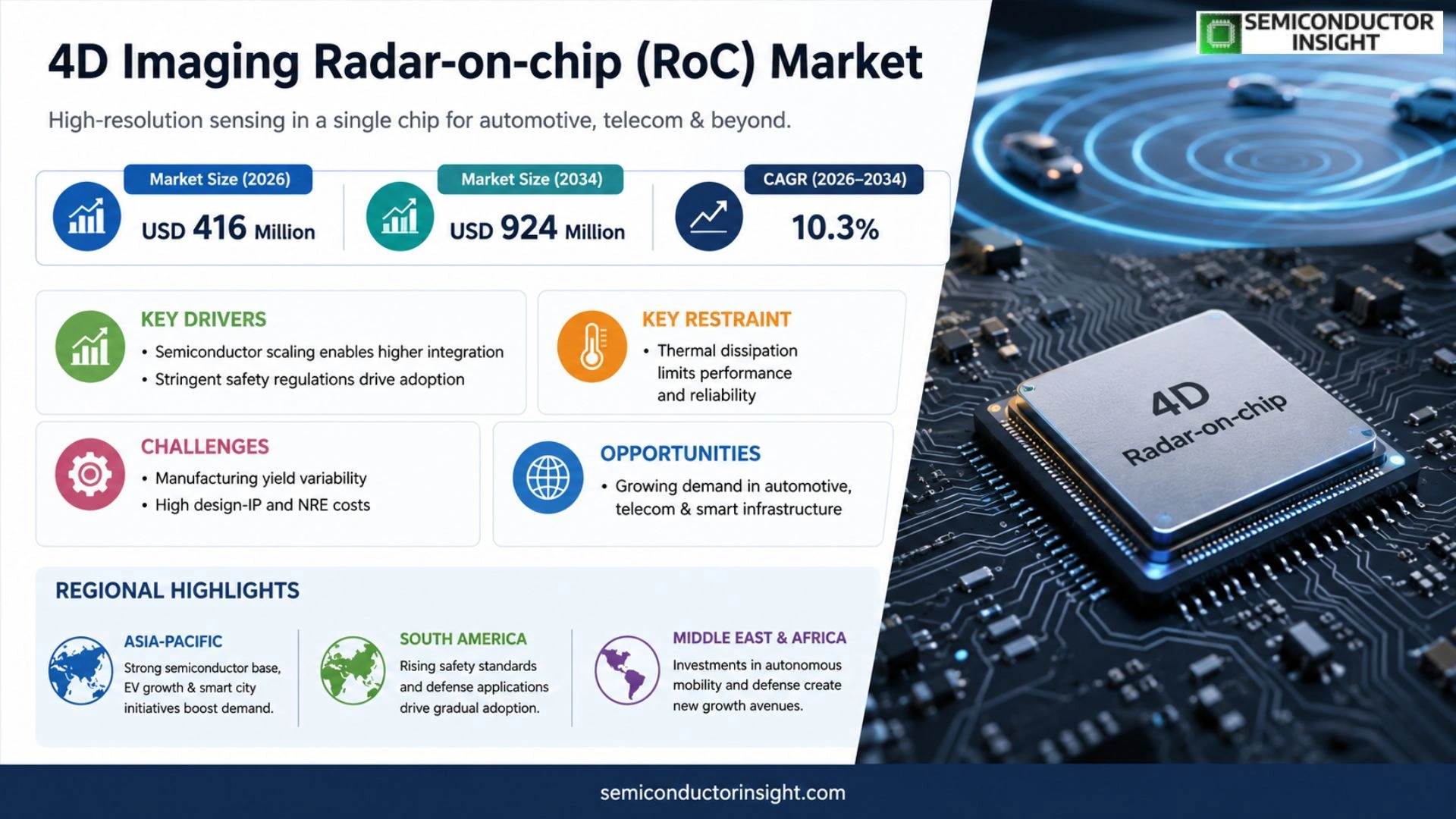
Global 4D Imaging Radar-on-chip (RoC) market was valued at USD 493 million in 2025 and is expected to reach USD 924 million by 2034, reflecting a CAGR of 10.3 % over the forecast horizon.
4D imaging radar chips integrate full‑range sensing functions onto a single silicon die, delivering compact form factor, low power draw and high‑speed data processing. The devices measure distance, velocity, azimuth and elevation angles, enabling advanced driver‑assistance systems and autonomous driving capabilities.
The expansion is fueled by rising adoption of ADAS across passenger vehicles, growing interest in autonomous shuttles and intelligent transportation infrastructure, as well as steady progress in semiconductor manufacturing that lowers cost per unit. Leading suppliers such as NXP, Uhnder, Arbe Robotics, Vayyar and Calterah are scaling production while enhancing calibration and software integration services.
MARKET DRIVERS
Semiconductor Scaling Fuels Integration
The transition from discrete radar modules to monolithic silicon solutions has accelerated as process nodes shrink below 10 nm. This scaling reduces parasitic losses, enables higher aperture densities, and consequently improves angular resolution of 4D Imaging Radar-on-chip (RoC) market. OEMs now recognize that a single‑chip architecture can deliver automotive‑grade performance while occupying a fraction of the board area previously required.
Regulatory Pressure for Higher Resolution
Mandates for advanced driver‑assistance systems (ADAS) demand millimeter‑wave sensors that can differentiate pedestrians from static objects at greater distances. As safety standards tighten, manufacturers are compelled to adopt 4D RoC solutions that provide precise range, velocity, and angle data within a unified package. This regulatory impetus is converting what was once a niche technology into a mainstream component of vehicle safety architectures.
➤ Combined, process‑node advances and stricter safety guidelines create a compelling value proposition for chip‑level radar, driving rapid adoption across premium‑ and mass‑market vehicles.
Beyond automotive, the telecom sector’s push for high‑resolution sensing in dense urban environments adds another layer of demand. Operators are evaluating 4D RoC chips to augment network‑level situational awareness, a move that broadens the addressable market and reinforces the upward trajectory of 4D Imaging Radar-on-chip (RoC) market.
MARKET CHALLENGES
Manufacturing Yield Variability
Even as node sizes shrink, the intricate antenna arrays and low‑noise amplifiers embedded on a single die remain sensitive to minute process deviations. Yield losses translate into higher unit costs, making it difficult for smaller suppliers to achieve economies of scale. Consequently, many automotive OEMs remain cautious, preferring proven legacy parts until yield stability is demonstrated at volume.
Other Challenges
Design‑IP Cost Burden
Licensing advanced signal‑processing algorithms and high‑frequency RF front‑ends adds a substantial non‑recurring engineering (NRE) expense. Companies that cannot amortize these costs across multiple programs may find the total cost of ownership prohibitive, limiting the pace of broader market penetration.
MARKET RESTRAINTS
Thermal Dissipation Limits
Integrating high‑power transmitters and sensitive receivers onto a compact die generates localized heat that, if unmanaged, degrades signal integrity and long‑term reliability. Current packaging technologies can mitigate but not entirely eliminate this issue, prompting designers to trade off performance for thermal safety,an inherent restraint on the full exploitation of 4D imaging capabilities.
MARKET OPPORTUNITIES
AI‑Enhanced Perception Platforms
Embedding lightweight neural‑network inference engines alongside the radar front‑end opens pathways to on‑chip object classification and predictive tracking. Such integration reduces latency and off‑board bandwidth requirements, positioning 4D RoC chips as foundational elements of next‑generation autonomous‑driving stacks. Early adopters stand to capture premium pricing, while the broader ecosystem benefits from a scalable, software‑driven value chain.
4D Imaging Radar-on-chip (RoC) Market Trends
Higher Integration of 4D RoC Drives ADAS Adoption
4D Imaging Radar-on-chip (RoC) market recorded a valuation of $493 million in 2025 and is on track to approach $924 million by 2034. A decisive factor behind this trajectory is the migration of the complete radar sensor suite onto a single silicon die, which slashes board‑level complexity and reduces overall vehicle weight. Automakers are now able to embed full‑range distance, velocity, azimuth and elevation detection directly into ADAS modules without the traditional multi‑chip architecture. This simplification shortens development cycles, lowers BOM costs, and improves reliability,attributes that resonate strongly with tier‑one suppliers seeking to meet accelerated timelines for Level‑3 and Level‑4 autonomy. As a result, purchasing decisions are shifting from discrete radar stacks to integrated RoC solutions, creating a clear upside for chip designers that can deliver sub‑20 mW power envelopes while maintaining high‑resolution imaging.
Other Trends
Supply‑Chain Consolidation Around Core Wafer Fabrication
Fragmented upstream sources for radar‑grade semiconductor materials have begun to coalesce around a handful of foundries capable of 16 nm and 22 nm processes. The consolidation is driven by the need for tighter control over yield and uniformity, which directly affect the calibration accuracy of 4D RoC devices. Companies that have secured dedicated wafer slots report gross margins in the 30‑50 % range, reflecting the premium pricing of high‑performance chips priced near $21 per unit. Meanwhile, capacity expansion to roughly 32 million units annually eases the previous bottleneck between design approval and volume production, enabling OEMs to plan long‑term supply contracts with greater confidence.
Diversifying Application Portfolio Fuels New Revenue Streams
Beyond passenger‑car ADAS, 4D Imaging Radar-on-chip (RoC) market is witnessing a gradual shift toward commercial trucks, autonomous shuttles, and intelligent transportation infrastructure. The ability of the chip to resolve pitch angles makes it attractive for low‑profile mounting on heavy‑duty vehicles, where traditional lidar faces clearance challenges. Simultaneously, integration with traffic‑management systems opens avenues for city‑wide safety networks that rely on consistent, high‑frequency radar updates. This broadening of end‑use cases reduces dependence on any single automotive segment and encourages manufacturers to diversify their product roadmaps, ultimately strengthening the overall resilience of the market.
COMPETITIVE LANDSCAPE
Key Industry Players
Competitive Overview of 4D Imaging Radar‑on‑Chip Market
The market is currently anchored by a handful of large silicon vendors whose foundry capacity and ASIC design expertise enable them to ship tens of millions of units annually. NXP leads the segment with a portfolio that couples 24 GHz front‑end arrays to advanced digital back‑ends, delivering sub‑10 cm resolution for high‑level ADAS. Its dominant position is reinforced by strategic OEM partnerships that lock in volume commitments for next‑generation autonomous sedans. Parallel to NXP, Infineon and Texas Instruments operate sizable fabs that emphasize power‑efficient 77 GHz designs, targeting commercial trucks where long‑range detection is critical. The concentration of manufacturing talent and the ability to absorb the 30‑50 % gross margin swings reported in 2025 make these incumbents difficult to displace.
Beyond the tier‑one silicon houses, a vibrant cohort of specialist firms is reshaping niche applications. Arbe Robotics and Vayyar have carved out market share by leveraging ultra‑compact 16 nm processes that enable multi‑modal sensor fusion inside compact vehicle‑to‑vehicle modules. Uhnder’s digital‑beam‑forming architecture, protected by multiple patents, offers a cost‑effective path for mass‑market ADAS in emerging economies. Smaller players such as Calterah, Sony Semiconductor Solutions, and Magna International focus on high‑frequency 79 GHz chips for drone and military platforms, where short‑distance accuracy and rugged packaging are prized. The diversity of these firms, combined with a steady pipeline of ASIC‑level innovations, creates a competitive fabric where differentiation rests on architecture choices, ecosystem integration, and regional supply‑chain resilience.
List of Key 4D Imaging Radar‑on‑Chip Companies Profiled
- NXP Semiconductors
- Uhnder
- Arbe Robotics
- Vayyar Imaging
- Calterah
- Infineon Technologies
- Texas Instruments
- Sony Semiconductor Solutions
- Samsung Electro‑Mechanics
- STMicroelectronics
- Qualcomm
- Renesas Electronics
Segment Analysis:
| Segment Category | Sub-Segments | Key Insights |
| By Type |
|
Advanced Node RoC
|
| By Application |
|
Automotive & Mobility
|
| By End User |
|
OEM & Tier‑1 Ecosystem
|
| By Frequency Band |
|
Band‑Specific Positioning
|
| By Detection Range |
|
Range‑Optimized Architectures
|
Regional Analysis: 4D Imaging Radar-on-chip (RoC) Market
North America
Tier‑one vehicle manufacturers are integrating 4D imaging radar chips to meet upcoming safety regulations that require object classification at longer ranges. The technology enables simultaneous detection of distance, velocity, and angular position, allowing automated emergency braking systems to react earlier and more precisely, which in turn differentiates premium models in a crowded market.
U.S. defense agencies prioritize compact, high‑resolution radar for unmanned aerial platforms, prompting joint ventures between chip makers and aerospace firms. The ability to generate three‑dimensional situational pictures from a single silicon die reduces payload weight, a decisive factor for stealth and endurance missions.
Wearable and smart‑home manufacturers are experimenting with miniature radar arrays that can sense gestures and presence without cameras. The low‑power consumption of modern RoC designs aligns with the battery constraints of portable devices, opening a niche yet rapidly evolving segment.
Leading fabs have earmarked new process lines optimized for high‑frequency operation, acknowledging the market’s appetite for chips that combine dense antenna integration with advanced digital back‑ends. These investments lower entry barriers for smaller players seeking to scale production.
Europe
European automakers are translating strict Euro NCAP guidelines into early adoption of 4D imaging radar chips, aiming to differentiate premium sedans through enhanced driver‑assist suites. Simultaneously, the region’s collaborative research clusters,particularly in Germany and France,merge radar design expertise with emerging AI frameworks, fostering a breed of sensors capable of nuanced classification in dense urban settings. Defense ministries across the continent fund demonstrators that integrate radar‑on‑chip modules into reconnaissance drones, emphasizing stealthy signature reduction. The regulatory climate, paired with a strong IP ecosystem, encourages both multinational vendors and boutique innovators to co‑develop solutions that cater to local market nuances while retaining export potential.
Asia‑Pacific
In Asia‑Pacific, rapid vehicle electrification and the rise of smart city initiatives amplify demand for high‑resolution radar chips. Nations such as Japan and South Korea leverage their world‑class semiconductor foundries to produce RoC devices at scale, often coupling them with home‑grown AI accelerators for autonomous driving pilots. Emerging economies like India view radar‑on‑chip technology as a gateway to advanced driver‑assist implementations without reliance on expensive foreign hardware, prompting public‑private partnerships that subsidize pilot projects. Additionally, defense sectors in the region experiment with airborne radar arrays that benefit from the low‑power footprint of modern chips, aligning with broader strategic goals of indigenous capability development.
South America
South American manufacturers, while modest in volume, are exploring 4D imaging radar to meet growing expectations for safety in newer vehicle models destined for urban markets such as Brazil and Argentina. Regional design houses capitalize on partnerships with North American suppliers to embed radar modules into cost‑effective platforms, thereby offering differentiated features to price‑sensitive consumers. Defense agencies, confronting complex terrain, evaluate lightweight radar‑on‑chip solutions for border‑patrol UAVs, valuing the balance between range and payload efficiency. The market’s evolution is further shaped by governmental incentives that encourage local assembly of advanced sensors, nurturing a nascent supplier base.
Middle East & Africa
The Middle East & Africa region exhibits a nuanced trajectory, with affluent Gulf states investing heavily in autonomous vehicle testbeds that demand reliable 4D imaging radar performance under extreme heat and sand conditions. Local research institutes collaborate with global chip designers to tailor packaging solutions that mitigate temperature‑induced drift, a critical factor for sensor fidelity. In North Africa, emerging defense contracts call for compact radar modules to equip surveillance drones operating over vast desert expanses. While overall market size remains modest, strategic pilot programs and government‑backed funding schemes are laying the groundwork for broader technology adoption across transportation and security sectors.
Report Scope
This market research report provides a comprehensive analysis of the 4D Imaging Radar-on-chip (RoC) Market , covering the forecast period 2026–2034. It offers detailed insights into market dynamics, technological advancements, competitive landscape, and key trends shaping the industry.
Key focus areas of the report include:
- Market Overview: The report begins with an overview outlining its current market scenario, key growth indicators, and industry transformation drivers. It discusses macroeconomic factors, demand–supply balance, regulatory landscape, and the strategic role of semiconductors in powering advancements across industries such as automotive, telecommunications, consumer electronics, and industrial automation.
- Market Size & Forecast: Historical data and future projections for revenue, unit shipments, and market value across major regions and segments.
- Segmentation Analysis: Detailed breakdown by product type, technology, application, and end-user industry to identify high-growth segments and investment opportunities.
- Regional Insights: Insights into market performance across North America, Europe, Asia-Pacific, Latin America, and the Middle East & Africa, including country-level analysis where relevant.
- Competitive Landscape: Profiles of leading market participants, including their product offerings, R&D focus, manufacturing capacity, pricing strategies, and recent developments such as mergers, acquisitions, and partnerships.
- Technology Trends & Innovation: Assessment of emerging technologies, integration of AI/IoT, semiconductor design trends, fabrication techniques, and evolving industry standards.
- Market Drivers & Restraints: Evaluation of factors driving market growth along with challenges, supply chain constraints, regulatory issues, and market-entry barriers.
- Stakeholder Insights: Insights for component suppliers, OEMs, system integrators, investors, and policymakers regarding the evolving ecosystem and strategic opportunities.
Primary and secondary research methods are employed, including interviews with industry experts, data from verified sources, and real-time market intelligence to ensure the accuracy and reliability of the insights presented.
FREQUENTLY ASKED QUESTIONS:
What is the current market size of 4D Imaging Radar-on-chip (RoC) Market?
-> 4D Imaging Radar-on-chip (RoC) market is expected to reach USD 924 million by 2034, reflecting a CAGR of 10.3 %
Which key companies operate in 4D Imaging Radar-on-chip (RoC) Market?
-> Key players include NXP, Uhnder, Arbe, Vayyar, and Calterah, among others.
What are the key growth drivers?
-> Key growth drivers include rising adoption of advanced driver assistance systems (ADAS), accelerating development of autonomous vehicles, demand for compact low‑power radar chips, and stricter safety regulations in automotive sectors.
Which region dominates the market?
-> Asia‑Pacific leads the market, driven by strong automotive production, extensive R&D investments, and early integration of 4D radar solutions, while Europe and North America remain important secondary markets.
What are the emerging trends?
-> Emerging trends include integration of AI‑based signal processing, use of higher frequency bands such as 77 GHz and 79 GHz, multi‑function sensor convergence, and increased focus on wafer‑level packaging to enhance performance and reduce cost.
Get Sample Report PDF for Exclusive Insights
Report Sample Includes
- Table of Contents
- List of Tables & Figures
- Charts, Research Methodology, and more...
 Download Sample Report PDF