3D Time-of-flight Image Sensors Market, Global Business Strategies 2025-2032

3D Time-of-flight Image Sensors Market size was valued at USD 1574 million in 2024 to USD 6020 million by 2032, exhibiting a CAGR of 21.7% during the forecast period

PDF Icon Download Sample Report PDF
  • Quick Dispatch

    All Orders

  • Secure Payment

    100% Secure Payment

Price range: $1,500.00 through $4,250.00

Clear

MARKET INSIGHTS

Global 3D Time-of-flight Image Sensors Market size was valued at USD 1574 million in 2024 to USD 6020 million by 2032, exhibiting a CAGR of 21.7% during the forecast period.

3D Time-of-flight (ToF) image sensors are advanced components that measure depth by calculating the time it takes for light to travel to an object and back. These devices integrate ToF sensing with an analog-to-digital converter (ADC) and a programmable timing generator (TG). The built-in TG controls the reset, modulation, readout, and digitization sequence, offering flexibility to optimize for various depth-sensing performance metrics.

The Market is experiencing rapid growth due to several factors, including increasing adoption in consumer electronics for facial recognition and augmented reality applications, rising demand in industrial automation for robotics and machine vision systems, and growing integration into the automotive sector for driver monitoring and gesture control. Additionally, advancements in sensor resolution and power efficiency are contributing to Market expansion. Initiatives by key players are also expected to fuel Market growth. For instance, leading manufacturers are continuously developing new sensors with enhanced range and accuracy for next-generation devices. Texas Instruments, STMicroelectronics, PMD Technologies, Infineon, and PrimeSense (Apple) are some of the key players that operate in the Market with a wide range of portfolios.
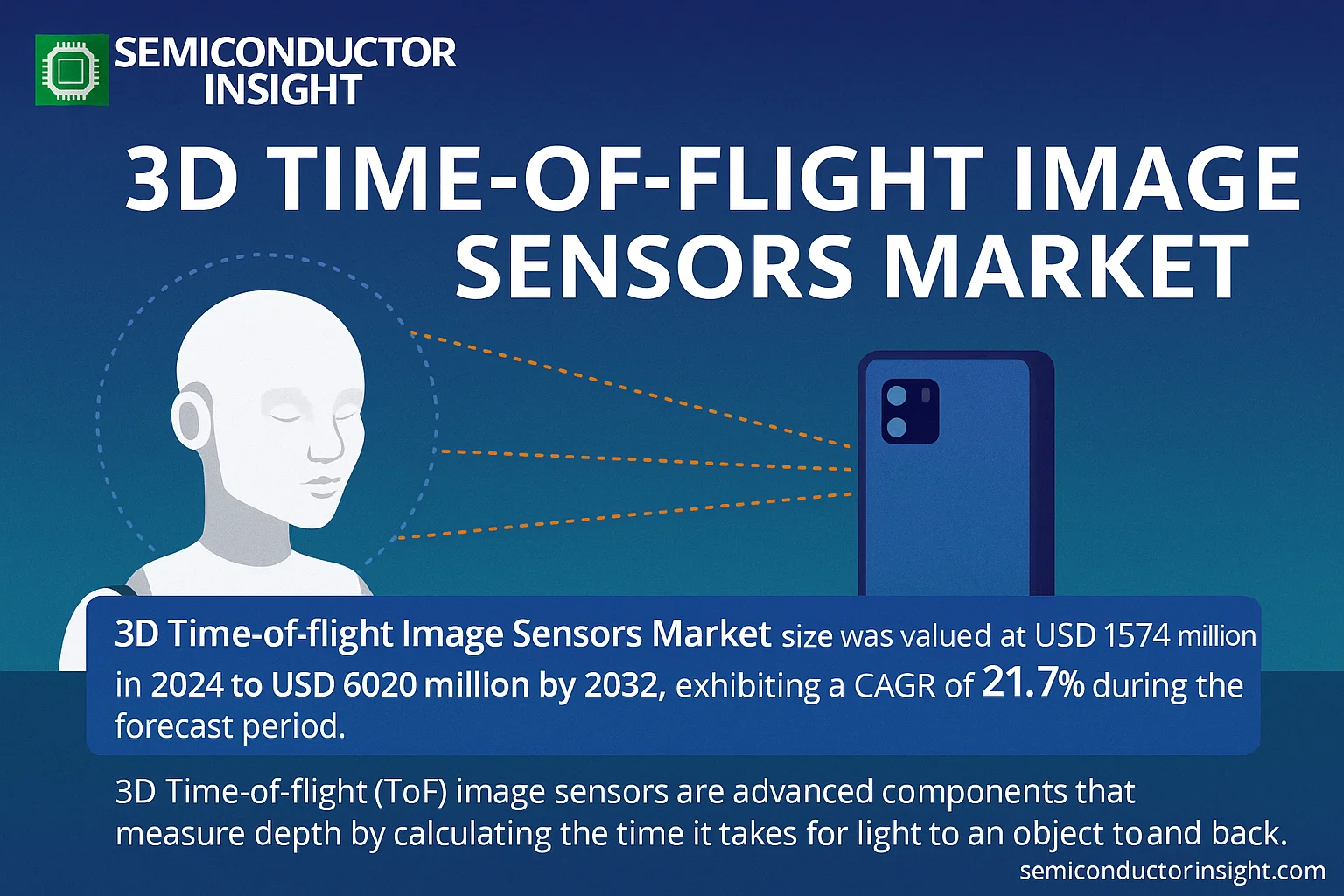
3D Time-of-flight Image Sensors Market Size-semiconductorinsight

MARKET DRIVERS

Proliferation in Consumer Electronics and Smartphones

The integration of 3D Time-of-Flight (ToF) image sensors into consumer electronics, particularly for facial recognition, augmented reality (AR) applications, and improved photography capabilities, is a major Market driver. The demand for enhanced user authentication and immersive gaming experiences continues to propel adoption. Shipments of 3D sensing modules for smartphones are projected to grow annually, driven by flagship and increasingly mid-range devices.

Advancements in Industrial Automation and Robotics

Industrial automation represents a significant growth area, where 3D ToF sensors are utilized for object recognition, bin picking, and robotic navigation. Their ability to provide real-time depth mapping improves operational efficiency and safety in logistics and manufacturing environments. The Market for industrial robots, which increasingly rely on 3D vision, is expected to see substantial growth, directly boosting demand for these sensors.

The automotive sector is emerging as a critical driver, with 3D ToF sensors being adopted for in-cabin monitoring, gesture control, and advanced driver-assistance systems (ADAS).

This expansion is supported by stringent safety regulations and the push towards autonomous driving, where accurate depth perception is paramount for functions like occupancy detection and driver alertness monitoring.

MARKET CHALLENGES

High System Cost and Integration Complexity

The relatively high cost of 3D ToF systems compared to traditional 2D sensors can be a barrier to mass adoption, especially in price-sensitive Market segments. Integrating the sensor with supporting software and processing units adds complexity and cost for original equipment manufacturers (OEMs).

Other Challenges

Performance Limitations in Outdoor Environments
ToF sensors can face challenges with accuracy in bright sunlight due to interference, limiting their reliability for certain outdoor applications like automotive exterior sensing.

Competition from Alternative Technologies
Structured light and stereo vision technologies offer competing depth-sensing solutions. Each technology has distinct trade-offs in terms of accuracy, range, and cost, creating a competitive landscape that challenges ToF sensor proliferation in some applications.

MARKET RESTRAINTS

Limited Resolution and Accuracy Constraints

While improving, the spatial resolution of 3D ToF sensors generally remains lower than that of high-end competing technologies, which can restrict their use in applications requiring fine detail. Multi-path interference, where light reflects off multiple surfaces before returning to the sensor, can also degrade depth measurement accuracy in complex scenes.

Supply Chain and Manufacturing Hurdles

The specialized nature of ToF sensor manufacturing relies on a complex global supply chain for components like VCSELs (Vertical-Cavity Surface-Emitting Lasers) and specialized CMOS imagers. Disruptions or shortages in this supply chain can constrain Market growth and lead to increased lead times and costs.

Data Processing and Power Consumption

The computational requirements for processing the raw data from ToF sensors to generate accurate depth maps can be significant. This results in higher power consumption, which is a critical restraint for battery-powered mobile devices and can impact system design and thermal management.

MARKET OPPORTUNITIES

Expansion into Healthcare and Medical Imaging

The healthcare sector presents significant opportunities for 3D ToF sensors in applications such as patient monitoring, surgical navigation, and medical imaging. Their non-contact nature and ability to operate in low light make them suitable for sensitive medical environments, driving new R&D and pilot programs.

Growth in Smart Home and Security Systems

The demand for smarter home security systems with features like people counting, gesture-based controls, and presence detection is creating a robust Market. 3D ToF sensors offer advantages over traditional PIR sensors by providing detailed spatial information, enabling more intelligent and responsive smart home devices.

Advancements in AR/VR and Metaverse Applications

The development of the metaverse and more sophisticated augmented and virtual reality platforms relies heavily on accurate 3D mapping of real-world environments and user interactions. This emerging ecosystem is a powerful long-term growth vector for high-performance, low-latency ToF sensor technology.

3D Time-of-flight Image Sensors Market Trends
Strong Market Expansion Driven by Proliferation in Consumer Electronics

Global 3D Time-of-flight (ToF) Image Sensors Market is demonstrating remarkable growth, projected to surge from a valuation of USD 1,574 million in 2024 to USD 6,020 million by 2032, representing a compound annual growth rate (CAGR) of 21.7%. This robust expansion is primarily fueled by the increasing integration of 3D sensing capabilities into consumer electronics. Applications such as facial recognition for device security, augmented reality (AR) experiences, and enhanced photography features are becoming standard in smartphones and tablets, creating substantial and sustained demand. The programmable timing generator within these sensors offers the flexibility required to optimize depth-sensing performance for these diverse consumer applications.

Other Trends

Market Consolidation and Regional Dominance

The competitive landscape is characterized by a high degree of concentration, with the top five manufacturersincluding Texas Instruments, STMicroelectronics, and Infineon collectively holding approximately 70% of the global Market share. Geographically, Europe is the largest Market, accounting for about 40% of the total, while Japan and North America together represent over 45% of the Market. This regional concentration reflects the advanced technological infrastructure and strong presence of leading automotive and industrial automation sectors in these areas, which are key consumers of ToF sensor technology.

Segmental Growth: QVGA Sensors Lead, Robotics and Drones Accelerate

In terms of product types, QVGA ToF Image Sensors dominate the Market, holding a share of about 50%. Their higher resolution makes them suitable for applications requiring detailed depth mapping. Regarding application segments, Consumer Electronics is the largest, but the Robotics and Drone sector is emerging as a high-growth area. ToF sensors are critical for enabling obstacle avoidance, navigation, and object manipulation in autonomous systems, driving significant adoption in industrial and commercial robotics.

Increasing Integration Across Diverse Industries

Beyond the primary segments, the application of 3D ToF image sensors is broadening into Machine Vision and Industrial Automation for precise measurement and quality control, the Automobile sector for in-cabin monitoring and gesture control, and the Entertainment industry for immersive gaming and interactive displays. This diversification indicates a trend towards the technology becoming a fundamental component for enabling machine perception and human-machine interaction across a wide spectrum of next-generation technologies, underpinning the Market’s long-term growth trajectory.

COMPETITIVE LANDSCAPE

Key Industry Players

A Market Dominated by Semiconductor Powerhouses and Specialized Innovators

Global 3D Time-of-flight (ToF) Image Sensors Market is characterized by a consolidated competitive environment where the top five manufacturers collectively command approximately 70% of the Market share. Texas Instruments and STMicroelectronics stand as the unequivocal leaders, leveraging their extensive semiconductor expertise, robust manufacturing capabilities, and established relationships across the consumer electronics and automotive sectors. Their significant Market control is reinforced by continuous innovation in sensor resolution, power efficiency, and integration capabilities, which are critical for applications like smartphone facial recognition, automotive driver monitoring, and industrial automation. The acquisition of PrimeSense by Apple has further solidified the position of major players, integrating advanced 3D sensing technology directly into a vast ecosystem of devices.

Beyond the dominant players, a tier of specialized companies holds significant influence in specific niches. PMD Technologies, a pioneer in ToF technology, maintains a strong position through its advanced intellectual property and custom sensor solutions. Companies like Infineon, often in partnership with PMD, supply key components for major 3D camera systems. Other significant players, including Melexis, ifm Electronic, and Espros Photonics, have carved out strong positions in industrial and automotive Markets by offering robust, high-performance sensors tailored for machine vision, robotics, and safety applications. These companies compete on factors such as precision, reliability, and the ability to operate in challenging environmental conditions, catering to B2B segments less saturated by the consumer electronics giants.

List of Key 3D Time-of-flight Image Sensors Companies Profiled

Segment Analysis:

Segment Category Sub-Segments Key Insights
By Type
  • QVGA ToF Image Sensor
  • Half-QVGA ToF Image Sensor
  • Others
QVGA ToF Image Sensor is the dominant product category, largely due to its superior resolution and depth-sensing accuracy which make it highly suitable for complex applications in consumer electronics and automotive systems. The Market preference leans towards QVGA sensors as they offer a compelling balance of performance and power consumption, meeting the rigorous demands of modern devices for enhanced user interaction and environmental understanding. The ‘Others’ category includes specialized sensors that cater to niche applications requiring unique form factors or extreme performance parameters.
By Application
  • Consumer Electronics
  • Robotics and Drone
  • Machine Vision and Industrial Automation
  • Entertainment
  • Automobile
  • Others
Consumer Electronics stands as the leading application segment, driven by the widespread integration of ToF sensors in smartphones for facial recognition, augmented reality features, and camera autofocus enhancements. This segment’s growth is propelled by continuous innovation and high consumer demand for smarter, more interactive devices. The Automotive sector is also emerging as a high-growth area, leveraging ToF technology for in-cabin monitoring, gesture control, and advanced driver-assistance systems, highlighting the sensor’s versatility beyond traditional electronics.
By End User
  • OEMs (Original Equipment Manufacturers)
  • System Integrators
  • Research and Academic Institutions
OEMs (Original Equipment Manufacturers) represent the most significant end-user segment, as they are the primary integrators of ToF sensors into final products such as smartphones, laptops, and vehicles. Their dominance is attributed to large-scale production capabilities and direct relationships with sensor suppliers, enabling efficient incorporation of advanced sensing technology into mass-Market goods. System Integrators play a crucial role in creating tailored solutions for industrial and specialized applications, while Research and Academic Institutions drive foundational innovation and early-stage development of new ToF applications.
By Technology Integration
  • Direct Time-of-Flight (dToF)
  • Indirect Time-of-Flight (iToF)
  • Hybrid Systems
Indirect Time-of-Flight (iToF) is the prevailing technology integration method, favored for its balance of cost-effectiveness and performance in medium-range applications commonly found in consumer electronics. This method’s ability to provide robust depth data under various lighting conditions makes it highly adaptable. Direct Time-of-Flight (dToF) is gaining traction for applications requiring higher accuracy and longer range, such as LiDAR in autonomous vehicles. Hybrid Systems are emerging to combine the strengths of both technologies, offering superior flexibility for next-generation applications that demand multi-functional sensing capabilities.
By Resolution Requirement
  • High Resolution
  • Medium Resolution
  • Low Resolution
Medium Resolution requirements currently lead the Market, as typified by QVGA sensors, which offer an optimal trade-off between detail capture and processing efficiency for a wide array of applications from gaming to industrial automation. This resolution level provides sufficient data density for accurate depth perception without overwhelming system resources. High Resolution sensors are critical for applications demanding fine detail, such as precision manufacturing inspection, while Low Resolution sensors are deployed in cost-sensitive or power-constrained applications where basic presence detection or gesture recognition is sufficient, illustrating the Market’s segmentation based on performance needs and economic considerations.

Regional Analysis: 3D Time-of-flight Image Sensors Market

Asia-Pacific

The Asia-Pacific region is the undisputed leader in the 3D Time-of-flight (ToF) image sensors Market, driven by an unparalleled concentration of manufacturing and innovation. This dominance is fueled by the massive consumer electronics sector, where flagship smartphones from leading brands in China, South Korea, and Japan extensively integrate ToF sensors for facial recognition, augmented reality applications, and advanced photography features. Beyond consumer tech, the region’s strong industrial automation base, particularly in China, Japan, and South Korea, is a significant adopter of ToF sensors for robotics, gesture control in manufacturing, and logistics automation, where precise depth sensing is critical for efficiency and safety. The presence of major sensor manufacturers and technology giants who are heavily investing in R&D creates a vibrant ecosystem that continuously pushes the boundaries of ToF technology, ensuring the region remains at the forefront of both supply and demand. This robust integration across multiple high-growth industries, combined with significant government support for advanced technologies, solidifies Asia-Pacific’s leading position for the foreseeable future.

Consumer Electronics Hub
Asia-Pacific’s leadership is heavily anchored in its dominant smartphone industry. Manufacturers are aggressively incorporating ToF sensors to enable sophisticated features like improved portrait-mode bokeh effects, accurate AR filters for social media, and secure 3D facial authentication, creating massive, sustained demand. The region’s ability to produce these components at scale and integrate them cost-effectively gives it a distinct competitive advantage.
Industrial and Automotive Adoption
There is rapidly growing adoption in industrial automation and emerging automotive applications. ToF sensors are used for obstacle detection in autonomous guided vehicles within smart factories, inventory management, and quality control. In the automotive sector, developments in-cabin monitoring for driver alertness and gesture-controlled infotainment systems are gaining significant traction among regional automakers and suppliers.
Strong Manufacturing & Supply Chain
The region boasts a deeply integrated and mature supply chain for semiconductor and sensor production. Leading companies have established advanced fabrication facilities and packaging technologies specifically for ToF sensors. This vertical integration reduces time-to-Market and costs, allowing for rapid innovation and deployment across various applications, from gaming consoles to smart home devices.
Government and R&D Focus
Supportive government initiatives promoting Industry 4.0, artificial intelligence, and next-generation electronics provide a significant tailwind. Substantial investments in research institutions and corporate R&D centers across the region are focused on enhancing ToF sensor resolution, power efficiency, and miniaturization, ensuring the technology continues to evolve and find new use cases.

North America
North America is a key innovation-driven Market for 3D ToF image sensors, characterized by strong demand from the enterprise and technology sectors. The region’s strength lies in its advanced R&D capabilities, with major technology companies and startups developing cutting-edge applications for augmented and virtual reality systems, where precise depth mapping is essential. There is significant adoption in the automotive industry for advanced driver-assistance systems (ADAS) and developing autonomous vehicle technologies. Furthermore, North America sees growing use of ToF sensors in logistics for package dimensioning, in healthcare for patient monitoring and surgical assistance, and in security systems for enhanced surveillance. The presence of leading cloud service providers and a focus on developing AI-powered solutions that leverage 3D data also contribute to a robust and sophisticated demand landscape.

Europe
Europe maintains a strong position in the 3D ToF sensor Market, driven by its robust automotive industrial base and high standards for industrial safety and quality. Automotive OEMs and tier-one suppliers in Germany, France, and Italy are integrating ToF sensors for in-cabin monitoring applications, such as detecting child presence or driver drowsiness, to meet stringent safety regulations. The region also exhibits significant demand from industrial automation, particularly in manufacturing and robotics, where ToF sensors are used for precise object detection and manipulation. There is growing interest in smart home applications and consumer electronics, though adoption is more measured compared to Asia-Pacific. Europe’s focus on data privacy and security also influences the development and deployment of ToF-based solutions, ensuring they comply with regulatory frameworks.

South America
The South American Market for 3D ToF image sensors is currently in a developing stage, with growth primarily driven by the gradual adoption of advanced technologies in specific sectors. The consumer electronics Market, particularly in countries like Brazil, is seeing increased integration of ToF sensors in mid-to-high-end smartphones. Industrial applications are emerging slowly, with some use in security and surveillance systems and initial explorations in agricultural technology for monitoring and automation. The Market growth is tempered by economic volatility and slower technological infrastructure development compared to other regions. However, as global technology trends permeate the region and costs decrease, a gradual increase in adoption across various applications is expected over the coming years.

Middle East & Africa
The Middle East & Africa region represents an emerging Market with niche but growing applications for 3D ToF sensors. The most prominent demand comes from the security and surveillance sector, especially in the Gulf Cooperation Council (GCC) countries, where ToF technology is used for perimeter monitoring and crowd analysis in smart city projects. There is also increasing interest in the consumer electronics space as premium devices become more accessible. In Africa, adoption is very limited but shows potential for growth in specific applications like agricultural monitoring and select industrial uses, although this is contingent on broader economic development and infrastructural improvements. The Market is characterized by a focus on high-value applications rather than mass-Market adoption at this stage.

Report Scope

This Market research report provides a comprehensive analysis of the 3D Time-of-flight Image Sensors Market, covering the forecast period 2025–2032. It offers detailed insights into Market dynamics, technological advancements, competitive landscape, and key trends shaping the industry.

Key focus areas of the report include:

  • Market Overview: The report begins with an overview outlining its current Market scenario, key growth indicators, and industry transformation drivers. It discusses macroeconomic factors, demand–supply balance, regulatory landscape, and the strategic role of semiconductors in powering advancements across industries such as automotive, telecommunications, consumer electronics, and industrial automation.
  • Market Size & Forecast: Historical data and future projections for revenue, unit shipments, and Market value across major regions and segments.
  • Segmentation Analysis: Detailed breakdown by product type, technology, application, and end-user industry to identify high-growth segments and investment opportunities.
  • Regional Insights: Insights into Market performance across North America, Europe, Asia-Pacific, Latin America, and the Middle East & Africa, including country-level analysis where relevant.
  • Competitive Landscape: Profiles of leading Market participants, including their product offerings, R&D focus, manufacturing capacity, pricing strategies, and recent developments such as mergers, acquisitions, and partnerships.
  • Technology Trends & Innovation: Assessment of emerging technologies, integration of AI/IoT, semiconductor design trends, fabrication techniques, and evolving industry standards.
  • Market Drivers & Restraints: Evaluation of factors driving Market growth along with challenges, supply chain constraints, regulatory issues, and Market-entry barriers.
  • Stakeholder Insights: Insights for component suppliers, OEMs, system integrators, investors, and policymakers regarding the evolving ecosystem and strategic opportunities.

Primary and secondary research methods are employed, including interviews with industry experts, data from verified sources, and real-time Market intelligence to ensure the accuracy and reliability of the insights presented.

FREQUENTLY ASKED QUESTIONS:

What is the current Market size of 3D Time-of-flight Image Sensors Market?

-> 3D Time-of-flight Image Sensors Market size was valued at USD 1574 million in 2024 to USD 6020 million by 2032, exhibiting a CAGR of 21.7% during the forecast period.

Which key companies operate in 3D Time-of-flight Image Sensors Market?

-> Key players include Texas Instruments, STMicroelectronics, PMD Technologies, Infineon, and PrimeSense (Apple), among others. Global top five manufacturers hold a share of about 70%.

What are the key growth drivers?

-> Key growth drivers include increasing adoption in consumer electronics, advancements in robotics and automation, and the integration of ToF sensors in automotive applications.

Which region dominates the Market?

-> Europe is the largest Market, with a share of about 40%, followed by Japan and North America.

What are the emerging trends?

-> Emerging trends include the programmability of timing generators for optimized depth-sensing, the dominance of QVGA ToF image sensors, and expanding applications in machine vision and industrial automation.

3D Time-of-flight Image Sensors Market, Global Business Strategies 2025-2032

Get Sample Report PDF for Exclusive Insights

Report Sample Includes

  • Table of Contents
  • List of Tables & Figures
  • Charts, Research Methodology, and more...

PDF Icon Download Sample Report PDF
SKU: 5d55d3233e5b
Category:

Download Sample Report

Table of Content

1 Introduction to Research & Analysis Reports
1.1 3D Time-of-flight Image Sensors Market Definition
1.2 Market Segments
1.2.1 Segment by Type
1.2.2 Segment by Application
1.3 Global 3D Time-of-flight Image Sensors Market Overview
1.4 Features & Benefits of This Report
1.5 Methodology & Sources of Information
1.5.1 Research Methodology
1.5.2 Research Process
1.5.3 Base Year
1.5.4 Report Assumptions & Caveats
2 Global 3D Time-of-flight Image Sensors Overall Market Size
2.1 Global 3D Time-of-flight Image Sensors Market Size: 2024 VS 2032
2.2 Global 3D Time-of-flight Image Sensors Market Size, Prospects & Forecasts: 2020-2032
2.3 Global 3D Time-of-flight Image Sensors Sales: 2020-2032
3 Company Landscape
3.1 Top 3D Time-of-flight Image Sensors Players in Global Market
3.2 Top Global 3D Time-of-flight Image Sensors Companies Ranked by Revenue
3.3 Global 3D Time-of-flight Image Sensors Revenue by Companies
3.4 Global 3D Time-of-flight Image Sensors Sales by Companies
3.5 Global 3D Time-of-flight Image Sensors Price by Manufacturer (2020-2025)
3.6 Top 3 and Top 5 3D Time-of-flight Image Sensors Companies in Global Market, by Revenue in 2024
3.7 Global Manufacturers 3D Time-of-flight Image Sensors Product Type
3.8 Tier 1, Tier 2, and Tier 3 3D Time-of-flight Image Sensors Players in Global Market
3.8.1 List of Global Tier 1 3D Time-of-flight Image Sensors Companies
3.8.2 List of Global Tier 2 and Tier 3 3D Time-of-flight Image Sensors Companies
4 Sights by Product
4.1 Overview
4.1.1 Segment by Type – Global 3D Time-of-flight Image Sensors Market Size Markets, 2024 & 2032
4.1.2 Half-QVGA ToF Image Sensor
4.1.3 QVGA ToF Image Sensor
4.1.4 Others
4.2 Segment by Type – Global 3D Time-of-flight Image Sensors Revenue & Forecasts
4.2.1 Segment by Type – Global 3D Time-of-flight Image Sensors Revenue, 2020-2025
4.2.2 Segment by Type – Global 3D Time-of-flight Image Sensors Revenue, 2026-2032
4.2.3 Segment by Type – Global 3D Time-of-flight Image Sensors Revenue Market Share, 2020-2032
4.3 Segment by Type – Global 3D Time-of-flight Image Sensors Sales & Forecasts
4.3.1 Segment by Type – Global 3D Time-of-flight Image Sensors Sales, 2020-2025
4.3.2 Segment by Type – Global 3D Time-of-flight Image Sensors Sales, 2026-2032
4.3.3 Segment by Type – Global 3D Time-of-flight Image Sensors Sales Market Share, 2020-2032
4.4 Segment by Type – Global 3D Time-of-flight Image Sensors Price (Manufacturers Selling Prices), 2020-2032
5 Sights by Application
5.1 Overview
5.1.1 Segment by Application – Global 3D Time-of-flight Image Sensors Market Size, 2024 & 2032
5.1.2 Consumer Electronics
5.1.3 Robotics and Drone
5.1.4 Machine Vision and Industrial Automation
5.1.5 Entertainment
5.1.6 Automobile
5.1.7 Others
5.2 Segment by Application – Global 3D Time-of-flight Image Sensors Revenue & Forecasts
5.2.1 Segment by Application – Global 3D Time-of-flight Image Sensors Revenue, 2020-2025
5.2.2 Segment by Application – Global 3D Time-of-flight Image Sensors Revenue, 2026-2032
5.2.3 Segment by Application – Global 3D Time-of-flight Image Sensors Revenue Market Share, 2020-2032
5.3 Segment by Application – Global 3D Time-of-flight Image Sensors Sales & Forecasts
5.3.1 Segment by Application – Global 3D Time-of-flight Image Sensors Sales, 2020-2025
5.3.2 Segment by Application – Global 3D Time-of-flight Image Sensors Sales, 2026-2032
5.3.3 Segment by Application – Global 3D Time-of-flight Image Sensors Sales Market Share, 2020-2032
5.4 Segment by Application – Global 3D Time-of-flight Image Sensors Price (Manufacturers Selling Prices), 2020-2032
6 Sights by Region
6.1 By Region – Global 3D Time-of-flight Image Sensors Market Size, 2024 & 2032
6.2 By Region – Global 3D Time-of-flight Image Sensors Revenue & Forecasts
6.2.1 By Region – Global 3D Time-of-flight Image Sensors Revenue, 2020-2025
6.2.2 By Region – Global 3D Time-of-flight Image Sensors Revenue, 2026-2032
6.2.3 By Region – Global 3D Time-of-flight Image Sensors Revenue Market Share, 2020-2032
6.3 By Region – Global 3D Time-of-flight Image Sensors Sales & Forecasts
6.3.1 By Region – Global 3D Time-of-flight Image Sensors Sales, 2020-2025
6.3.2 By Region – Global 3D Time-of-flight Image Sensors Sales, 2026-2032
6.3.3 By Region – Global 3D Time-of-flight Image Sensors Sales Market Share, 2020-2032
6.4 North America
6.4.1 By Country – North America 3D Time-of-flight Image Sensors Revenue, 2020-2032
6.4.2 By Country – North America 3D Time-of-flight Image Sensors Sales, 2020-2032
6.4.3 United States 3D Time-of-flight Image Sensors Market Size, 2020-2032
6.4.4 Canada 3D Time-of-flight Image Sensors Market Size, 2020-2032
6.4.5 Mexico 3D Time-of-flight Image Sensors Market Size, 2020-2032
6.5 Europe
6.5.1 By Country – Europe 3D Time-of-flight Image Sensors Revenue, 2020-2032
6.5.2 By Country – Europe 3D Time-of-flight Image Sensors Sales, 2020-2032
6.5.3 Germany 3D Time-of-flight Image Sensors Market Size, 2020-2032
6.5.4 France 3D Time-of-flight Image Sensors Market Size, 2020-2032
6.5.5 U.K. 3D Time-of-flight Image Sensors Market Size, 2020-2032
6.5.6 Italy 3D Time-of-flight Image Sensors Market Size, 2020-2032
6.5.7 Russia 3D Time-of-flight Image Sensors Market Size, 2020-2032
6.5.8 Nordic Countries 3D Time-of-flight Image Sensors Market Size, 2020-2032
6.5.9 Benelux 3D Time-of-flight Image Sensors Market Size, 2020-2032
6.6 Asia
6.6.1 By Region – Asia 3D Time-of-flight Image Sensors Revenue, 2020-2032
6.6.2 By Region – Asia 3D Time-of-flight Image Sensors Sales, 2020-2032
6.6.3 China 3D Time-of-flight Image Sensors Market Size, 2020-2032
6.6.4 Japan 3D Time-of-flight Image Sensors Market Size, 2020-2032
6.6.5 South Korea 3D Time-of-flight Image Sensors Market Size, 2020-2032
6.6.6 Southeast Asia 3D Time-of-flight Image Sensors Market Size, 2020-2032
6.6.7 India 3D Time-of-flight Image Sensors Market Size, 2020-2032
6.7 South America
6.7.1 By Country – South America 3D Time-of-flight Image Sensors Revenue, 2020-2032
6.7.2 By Country – South America 3D Time-of-flight Image Sensors Sales, 2020-2032
6.7.3 Brazil 3D Time-of-flight Image Sensors Market Size, 2020-2032
6.7.4 Argentina 3D Time-of-flight Image Sensors Market Size, 2020-2032
6.8 Middle East & Africa
6.8.1 By Country – Middle East & Africa 3D Time-of-flight Image Sensors Revenue, 2020-2032
6.8.2 By Country – Middle East & Africa 3D Time-of-flight Image Sensors Sales, 2020-2032
6.8.3 Turkey 3D Time-of-flight Image Sensors Market Size, 2020-2032
6.8.4 Israel 3D Time-of-flight Image Sensors Market Size, 2020-2032
6.8.5 Saudi Arabia 3D Time-of-flight Image Sensors Market Size, 2020-2032
6.8.6 UAE 3D Time-of-flight Image Sensors Market Size, 2020-2032
7 Manufacturers & Brands Profiles
7.1 Texas Instruments
7.1.1 Texas Instruments Company Summary
7.1.2 Texas Instruments Business Overview
7.1.3 Texas Instruments 3D Time-of-flight Image Sensors Major Product Offerings
7.1.4 Texas Instruments 3D Time-of-flight Image Sensors Sales and Revenue in Global (2020-2025)
7.1.5 Texas Instruments Key News & Latest Developments
7.2 STMicroelectronics
7.2.1 STMicroelectronics Company Summary
7.2.2 STMicroelectronics Business Overview
7.2.3 STMicroelectronics 3D Time-of-flight Image Sensors Major Product Offerings
7.2.4 STMicroelectronics 3D Time-of-flight Image Sensors Sales and Revenue in Global (2020-2025)
7.2.5 STMicroelectronics Key News & Latest Developments
7.3 PMD Technologies
7.3.1 PMD Technologies Company Summary
7.3.2 PMD Technologies Business Overview
7.3.3 PMD Technologies 3D Time-of-flight Image Sensors Major Product Offerings
7.3.4 PMD Technologies 3D Time-of-flight Image Sensors Sales and Revenue in Global (2020-2025)
7.3.5 PMD Technologies Key News & Latest Developments
7.4 Infineon
7.4.1 Infineon Company Summary
7.4.2 Infineon Business Overview
7.4.3 Infineon 3D Time-of-flight Image Sensors Major Product Offerings
7.4.4 Infineon 3D Time-of-flight Image Sensors Sales and Revenue in Global (2020-2025)
7.4.5 Infineon Key News & Latest Developments
7.5 PrimeSense (Apple)
7.5.1 PrimeSense (Apple) Company Summary
7.5.2 PrimeSense (Apple) Business Overview
7.5.3 PrimeSense (Apple) 3D Time-of-flight Image Sensors Major Product Offerings
7.5.4 PrimeSense (Apple) 3D Time-of-flight Image Sensors Sales and Revenue in Global (2020-2025)
7.5.5 PrimeSense (Apple) Key News & Latest Developments
7.6 MESA (Heptagon)
7.6.1 MESA (Heptagon) Company Summary
7.6.2 MESA (Heptagon) Business Overview
7.6.3 MESA (Heptagon) 3D Time-of-flight Image Sensors Major Product Offerings
7.6.4 MESA (Heptagon) 3D Time-of-flight Image Sensors Sales and Revenue in Global (2020-2025)
7.6.5 MESA (Heptagon) Key News & Latest Developments
7.7 Melexis
7.7.1 Melexis Company Summary
7.7.2 Melexis Business Overview
7.7.3 Melexis 3D Time-of-flight Image Sensors Major Product Offerings
7.7.4 Melexis 3D Time-of-flight Image Sensors Sales and Revenue in Global (2020-2025)
7.7.5 Melexis Key News & Latest Developments
7.8 ifm Electronic
7.8.1 ifm Electronic Company Summary
7.8.2 ifm Electronic Business Overview
7.8.3 ifm Electronic 3D Time-of-flight Image Sensors Major Product Offerings
7.8.4 ifm Electronic 3D Time-of-flight Image Sensors Sales and Revenue in Global (2020-2025)
7.8.5 ifm Electronic Key News & Latest Developments
7.9 Canesta (Microsoft)
7.9.1 Canesta (Microsoft) Company Summary
7.9.2 Canesta (Microsoft) Business Overview
7.9.3 Canesta (Microsoft) 3D Time-of-flight Image Sensors Major Product Offerings
7.9.4 Canesta (Microsoft) 3D Time-of-flight Image Sensors Sales and Revenue in Global (2020-2025)
7.9.5 Canesta (Microsoft) Key News & Latest Developments
7.10 Espros Photonics
7.10.1 Espros Photonics Company Summary
7.10.2 Espros Photonics Business Overview
7.10.3 Espros Photonics 3D Time-of-flight Image Sensors Major Product Offerings
7.10.4 Espros Photonics 3D Time-of-flight Image Sensors Sales and Revenue in Global (2020-2025)
7.10.5 Espros Photonics Key News & Latest Developments
7.11 TriDiCam
7.11.1 TriDiCam Company Summary
7.11.2 TriDiCam Business Overview
7.11.3 TriDiCam 3D Time-of-flight Image Sensors Major Product Offerings
7.11.4 TriDiCam 3D Time-of-flight Image Sensors Sales and Revenue in Global (2020-2025)
7.11.5 TriDiCam Key News & Latest Developments
8 Global 3D Time-of-flight Image Sensors Production Capacity, Analysis
8.1 Global 3D Time-of-flight Image Sensors Production Capacity, 2020-2032
8.2 3D Time-of-flight Image Sensors Production Capacity of Key Manufacturers in Global Market
8.3 Global 3D Time-of-flight Image Sensors Production by Region
9 Key Market Trends, Opportunity, Drivers and Restraints
9.1 Market Opportunities & Trends
9.2 Market Drivers
9.3 Market Restraints
10 3D Time-of-flight Image Sensors Supply Chain Analysis
10.1 3D Time-of-flight Image Sensors Industry Value Chain
10.2 3D Time-of-flight Image Sensors Upstream Market
10.3 3D Time-of-flight Image Sensors Downstream and Clients
10.4 Marketing Channels Analysis
10.4.1 Marketing Channels
10.4.2 3D Time-of-flight Image Sensors Distributors and Sales Agents in Global
11 Conclusion
12 Appendix
12.1 Note
12.2 Examples of Clients
12.3 DisclaimerList of Tables
Table 1. Key Players of 3D Time-of-flight Image Sensors in Global Market
Table 2. Top 3D Time-of-flight Image Sensors Players in Global Market, Ranking by Revenue (2024)
Table 3. Global 3D Time-of-flight Image Sensors Revenue by Companies, (US$, Mn), 2020-2025
Table 4. Global 3D Time-of-flight Image Sensors Revenue Share by Companies, 2020-2025
Table 5. Global 3D Time-of-flight Image Sensors Sales by Companies, (K Units), 2020-2025
Table 6. Global 3D Time-of-flight Image Sensors Sales Share by Companies, 2020-2025
Table 7. Key Manufacturers 3D Time-of-flight Image Sensors Price (2020-2025) & (USD/Unit)
Table 8. Global Manufacturers 3D Time-of-flight Image Sensors Product Type
Table 9. List of Global Tier 1 3D Time-of-flight Image Sensors Companies, Revenue (US$, Mn) in 2024 and Market Share
Table 10. List of Global Tier 2 and Tier 3 3D Time-of-flight Image Sensors Companies, Revenue (US$, Mn) in 2024 and Market Share
Table 11. Segment by Type – Global 3D Time-of-flight Image Sensors Revenue, (US$, Mn), 2024 & 2032
Table 12. Segment by Type – Global 3D Time-of-flight Image Sensors Revenue (US$, Mn), 2020-2025
Table 13. Segment by Type – Global 3D Time-of-flight Image Sensors Revenue (US$, Mn), 2026-2032
Table 14. Segment by Type – Global 3D Time-of-flight Image Sensors Sales (K Units), 2020-2025
Table 15. Segment by Type – Global 3D Time-of-flight Image Sensors Sales (K Units), 2026-2032
Table 16. Segment by Application – Global 3D Time-of-flight Image Sensors Revenue, (US$, Mn), 2024 & 2032
Table 17. Segment by Application – Global 3D Time-of-flight Image Sensors Revenue, (US$, Mn), 2020-2025
Table 18. Segment by Application – Global 3D Time-of-flight Image Sensors Revenue, (US$, Mn), 2026-2032
Table 19. Segment by Application – Global 3D Time-of-flight Image Sensors Sales, (K Units), 2020-2025
Table 20. Segment by Application – Global 3D Time-of-flight Image Sensors Sales, (K Units), 2026-2032
Table 21. By Region – Global 3D Time-of-flight Image Sensors Revenue, (US$, Mn), 2025-2032
Table 22. By Region – Global 3D Time-of-flight Image Sensors Revenue, (US$, Mn), 2020-2025
Table 23. By Region – Global 3D Time-of-flight Image Sensors Revenue, (US$, Mn), 2026-2032
Table 24. By Region – Global 3D Time-of-flight Image Sensors Sales, (K Units), 2020-2025
Table 25. By Region – Global 3D Time-of-flight Image Sensors Sales, (K Units), 2026-2032
Table 26. By Country – North America 3D Time-of-flight Image Sensors Revenue, (US$, Mn), 2020-2025
Table 27. By Country – North America 3D Time-of-flight Image Sensors Revenue, (US$, Mn), 2026-2032
Table 28. By Country – North America 3D Time-of-flight Image Sensors Sales, (K Units), 2020-2025
Table 29. By Country – North America 3D Time-of-flight Image Sensors Sales, (K Units), 2026-2032
Table 30. By Country – Europe 3D Time-of-flight Image Sensors Revenue, (US$, Mn), 2020-2025
Table 31. By Country – Europe 3D Time-of-flight Image Sensors Revenue, (US$, Mn), 2026-2032
Table 32. By Country – Europe 3D Time-of-flight Image Sensors Sales, (K Units), 2020-2025
Table 33. By Country – Europe 3D Time-of-flight Image Sensors Sales, (K Units), 2026-2032
Table 34. By Region – Asia 3D Time-of-flight Image Sensors Revenue, (US$, Mn), 2020-2025
Table 35. By Region – Asia 3D Time-of-flight Image Sensors Revenue, (US$, Mn), 2026-2032
Table 36. By Region – Asia 3D Time-of-flight Image Sensors Sales, (K Units), 2020-2025
Table 37. By Region – Asia 3D Time-of-flight Image Sensors Sales, (K Units), 2026-2032
Table 38. By Country – South America 3D Time-of-flight Image Sensors Revenue, (US$, Mn), 2020-2025
Table 39. By Country – South America 3D Time-of-flight Image Sensors Revenue, (US$, Mn), 2026-2032
Table 40. By Country – South America 3D Time-of-flight Image Sensors Sales, (K Units), 2020-2025
Table 41. By Country – South America 3D Time-of-flight Image Sensors Sales, (K Units), 2026-2032
Table 42. By Country – Middle East & Africa 3D Time-of-flight Image Sensors Revenue, (US$, Mn), 2020-2025
Table 43. By Country – Middle East & Africa 3D Time-of-flight Image Sensors Revenue, (US$, Mn), 2026-2032
Table 44. By Country – Middle East & Africa 3D Time-of-flight Image Sensors Sales, (K Units), 2020-2025
Table 45. By Country – Middle East & Africa 3D Time-of-flight Image Sensors Sales, (K Units), 2026-2032
Table 46. Texas Instruments Company Summary
Table 47. Texas Instruments 3D Time-of-flight Image Sensors Product Offerings
Table 48. Texas Instruments 3D Time-of-flight Image Sensors Sales (K Units), Revenue (US$, Mn) and Average Price (USD/Unit) & (2020-2025)
Table 49. Texas Instruments Key News & Latest Developments
Table 50. STMicroelectronics Company Summary
Table 51. STMicroelectronics 3D Time-of-flight Image Sensors Product Offerings
Table 52. STMicroelectronics 3D Time-of-flight Image Sensors Sales (K Units), Revenue (US$, Mn) and Average Price (USD/Unit) & (2020-2025)
Table 53. STMicroelectronics Key News & Latest Developments
Table 54. PMD Technologies Company Summary
Table 55. PMD Technologies 3D Time-of-flight Image Sensors Product Offerings
Table 56. PMD Technologies 3D Time-of-flight Image Sensors Sales (K Units), Revenue (US$, Mn) and Average Price (USD/Unit) & (2020-2025)
Table 57. PMD Technologies Key News & Latest Developments
Table 58. Infineon Company Summary
Table 59. Infineon 3D Time-of-flight Image Sensors Product Offerings
Table 60. Infineon 3D Time-of-flight Image Sensors Sales (K Units), Revenue (US$, Mn) and Average Price (USD/Unit) & (2020-2025)
Table 61. Infineon Key News & Latest Developments
Table 62. PrimeSense (Apple) Company Summary
Table 63. PrimeSense (Apple) 3D Time-of-flight Image Sensors Product Offerings
Table 64. PrimeSense (Apple) 3D Time-of-flight Image Sensors Sales (K Units), Revenue (US$, Mn) and Average Price (USD/Unit) & (2020-2025)
Table 65. PrimeSense (Apple) Key News & Latest Developments
Table 66. MESA (Heptagon) Company Summary
Table 67. MESA (Heptagon) 3D Time-of-flight Image Sensors Product Offerings
Table 68. MESA (Heptagon) 3D Time-of-flight Image Sensors Sales (K Units), Revenue (US$, Mn) and Average Price (USD/Unit) & (2020-2025)
Table 69. MESA (Heptagon) Key News & Latest Developments
Table 70. Melexis Company Summary
Table 71. Melexis 3D Time-of-flight Image Sensors Product Offerings
Table 72. Melexis 3D Time-of-flight Image Sensors Sales (K Units), Revenue (US$, Mn) and Average Price (USD/Unit) & (2020-2025)
Table 73. Melexis Key News & Latest Developments
Table 74. ifm Electronic Company Summary
Table 75. ifm Electronic 3D Time-of-flight Image Sensors Product Offerings
Table 76. ifm Electronic 3D Time-of-flight Image Sensors Sales (K Units), Revenue (US$, Mn) and Average Price (USD/Unit) & (2020-2025)
Table 77. ifm Electronic Key News & Latest Developments
Table 78. Canesta (Microsoft) Company Summary
Table 79. Canesta (Microsoft) 3D Time-of-flight Image Sensors Product Offerings
Table 80. Canesta (Microsoft) 3D Time-of-flight Image Sensors Sales (K Units), Revenue (US$, Mn) and Average Price (USD/Unit) & (2020-2025)
Table 81. Canesta (Microsoft) Key News & Latest Developments
Table 82. Espros Photonics Company Summary
Table 83. Espros Photonics 3D Time-of-flight Image Sensors Product Offerings
Table 84. Espros Photonics 3D Time-of-flight Image Sensors Sales (K Units), Revenue (US$, Mn) and Average Price (USD/Unit) & (2020-2025)
Table 85. Espros Photonics Key News & Latest Developments
Table 86. TriDiCam Company Summary
Table 87. TriDiCam 3D Time-of-flight Image Sensors Product Offerings
Table 88. TriDiCam 3D Time-of-flight Image Sensors Sales (K Units), Revenue (US$, Mn) and Average Price (USD/Unit) & (2020-2025)
Table 89. TriDiCam Key News & Latest Developments
Table 90. 3D Time-of-flight Image Sensors Capacity of Key Manufacturers in Global Market, 2023-2025 (K Units)
Table 91. Global 3D Time-of-flight Image Sensors Capacity Market Share of Key Manufacturers, 2023-2025
Table 92. Global 3D Time-of-flight Image Sensors Production by Region, 2020-2025 (K Units)
Table 93. Global 3D Time-of-flight Image Sensors Production by Region, 2026-2032 (K Units)
Table 94. 3D Time-of-flight Image Sensors Market Opportunities & Trends in Global Market
Table 95. 3D Time-of-flight Image Sensors Market Drivers in Global Market
Table 96. 3D Time-of-flight Image Sensors Market Restraints in Global Market
Table 97. 3D Time-of-flight Image Sensors Raw Materials
Table 98. 3D Time-of-flight Image Sensors Raw Materials Suppliers in Global Market
Table 99. Typical 3D Time-of-flight Image Sensors Downstream
Table 100. 3D Time-of-flight Image Sensors Downstream Clients in Global Market
Table 101. 3D Time-of-flight Image Sensors Distributors and Sales Agents in Global Market

List of Figures
Figure 1. 3D Time-of-flight Image Sensors Product Picture
Figure 2. 3D Time-of-flight Image Sensors Segment by Type in 2024
Figure 3. 3D Time-of-flight Image Sensors Segment by Application in 2024
Figure 4. Global 3D Time-of-flight Image Sensors Market Overview: 2024
Figure 5. Key Caveats
Figure 6. Global 3D Time-of-flight Image Sensors Market Size: 2024 VS 2032 (US$, Mn)
Figure 7. Global 3D Time-of-flight Image Sensors Revenue: 2020-2032 (US$, Mn)
Figure 8. 3D Time-of-flight Image Sensors Sales in Global Market: 2020-2032 (K Units)
Figure 9. The Top 3 and 5 Players Market Share by 3D Time-of-flight Image Sensors Revenue in 2024
Figure 10. Segment by Type – Global 3D Time-of-flight Image Sensors Revenue, (US$, Mn), 2024 & 2032
Figure 11. Segment by Type – Global 3D Time-of-flight Image Sensors Revenue Market Share, 2020-2032
Figure 12. Segment by Type – Global 3D Time-of-flight Image Sensors Sales Market Share, 2020-2032
Figure 13. Segment by Type – Global 3D Time-of-flight Image Sensors Price (USD/Unit), 2020-2032
Figure 14. Segment by Application – Global 3D Time-of-flight Image Sensors Revenue, (US$, Mn), 2024 & 2032
Figure 15. Segment by Application – Global 3D Time-of-flight Image Sensors Revenue Market Share, 2020-2032
Figure 16. Segment by Application – Global 3D Time-of-flight Image Sensors Sales Market Share, 2020-2032
Figure 17. Segment by Application -Global 3D Time-of-flight Image Sensors Price (USD/Unit), 2020-2032
Figure 18. By Region – Global 3D Time-of-flight Image Sensors Revenue, (US$, Mn), 2025 & 2032
Figure 19. By Region – Global 3D Time-of-flight Image Sensors Revenue Market Share, 2020 VS 2024 VS 2032
Figure 20. By Region – Global 3D Time-of-flight Image Sensors Revenue Market Share, 2020-2032
Figure 21. By Region – Global 3D Time-of-flight Image Sensors Sales Market Share, 2020-2032
Figure 22. By Country – North America 3D Time-of-flight Image Sensors Revenue Market Share, 2020-2032
Figure 23. By Country – North America 3D Time-of-flight Image Sensors Sales Market Share, 2020-2032
Figure 24. United States 3D Time-of-flight Image Sensors Revenue, (US$, Mn), 2020-2032
Figure 25. Canada 3D Time-of-flight Image Sensors Revenue, (US$, Mn), 2020-2032
Figure 26. Mexico 3D Time-of-flight Image Sensors Revenue, (US$, Mn), 2020-2032
Figure 27. By Country – Europe 3D Time-of-flight Image Sensors Revenue Market Share, 2020-2032
Figure 28. By Country – Europe 3D Time-of-flight Image Sensors Sales Market Share, 2020-2032
Figure 29. Germany 3D Time-of-flight Image Sensors Revenue, (US$, Mn), 2020-2032
Figure 30. France 3D Time-of-flight Image Sensors Revenue, (US$, Mn), 2020-2032
Figure 31. U.K. 3D Time-of-flight Image Sensors Revenue, (US$, Mn), 2020-2032
Figure 32. Italy 3D Time-of-flight Image Sensors Revenue, (US$, Mn), 2020-2032
Figure 33. Russia 3D Time-of-flight Image Sensors Revenue, (US$, Mn), 2020-2032
Figure 34. Nordic Countries 3D Time-of-flight Image Sensors Revenue, (US$, Mn), 2020-2032
Figure 35. Benelux 3D Time-of-flight Image Sensors Revenue, (US$, Mn), 2020-2032
Figure 36. By Region – Asia 3D Time-of-flight Image Sensors Revenue Market Share, 2020-2032
Figure 37. By Region – Asia 3D Time-of-flight Image Sensors Sales Market Share, 2020-2032
Figure 38. China 3D Time-of-flight Image Sensors Revenue, (US$, Mn), 2020-2032
Figure 39. Japan 3D Time-of-flight Image Sensors Revenue, (US$, Mn), 2020-2032
Figure 40. South Korea 3D Time-of-flight Image Sensors Revenue, (US$, Mn), 2020-2032
Figure 41. Southeast Asia 3D Time-of-flight Image Sensors Revenue, (US$, Mn), 2020-2032
Figure 42. India 3D Time-of-flight Image Sensors Revenue, (US$, Mn), 2020-2032
Figure 43. By Country – South America 3D Time-of-flight Image Sensors Revenue Market Share, 2020-2032
Figure 44. By Country – South America 3D Time-of-flight Image Sensors Sales, Market Share, 2020-2032
Figure 45. Brazil 3D Time-of-flight Image Sensors Revenue, (US$, Mn), 2020-2032
Figure 46. Argentina 3D Time-of-flight Image Sensors Revenue, (US$, Mn), 2020-2032
Figure 47. By Country – Middle East & Africa 3D Time-of-flight Image Sensors Revenue, Market Share, 2020-2032
Figure 48. By Country – Middle East & Africa 3D Time-of-flight Image Sensors Sales, Market Share, 2020-2032
Figure 49. Turkey 3D Time-of-flight Image Sensors Revenue, (US$, Mn), 2020-2032
Figure 50. Israel 3D Time-of-flight Image Sensors Revenue, (US$, Mn), 2020-2032
Figure 51. Saudi Arabia 3D Time-of-flight Image Sensors Revenue, (US$, Mn), 2020-2032
Figure 52. UAE 3D Time-of-flight Image Sensors Revenue, (US$, Mn), 2020-2032
Figure 53. Global 3D Time-of-flight Image Sensors Production Capacity (K Units), 2020-2032
Figure 54. The Percentage of Production 3D Time-of-flight Image Sensors by Region, 2024 VS 2032
Figure 55. 3D Time-of-flight Image Sensors Industry Value Chain
Figure 56. Marketing Channels