32-bit Industrial Microcontroller Market Insights
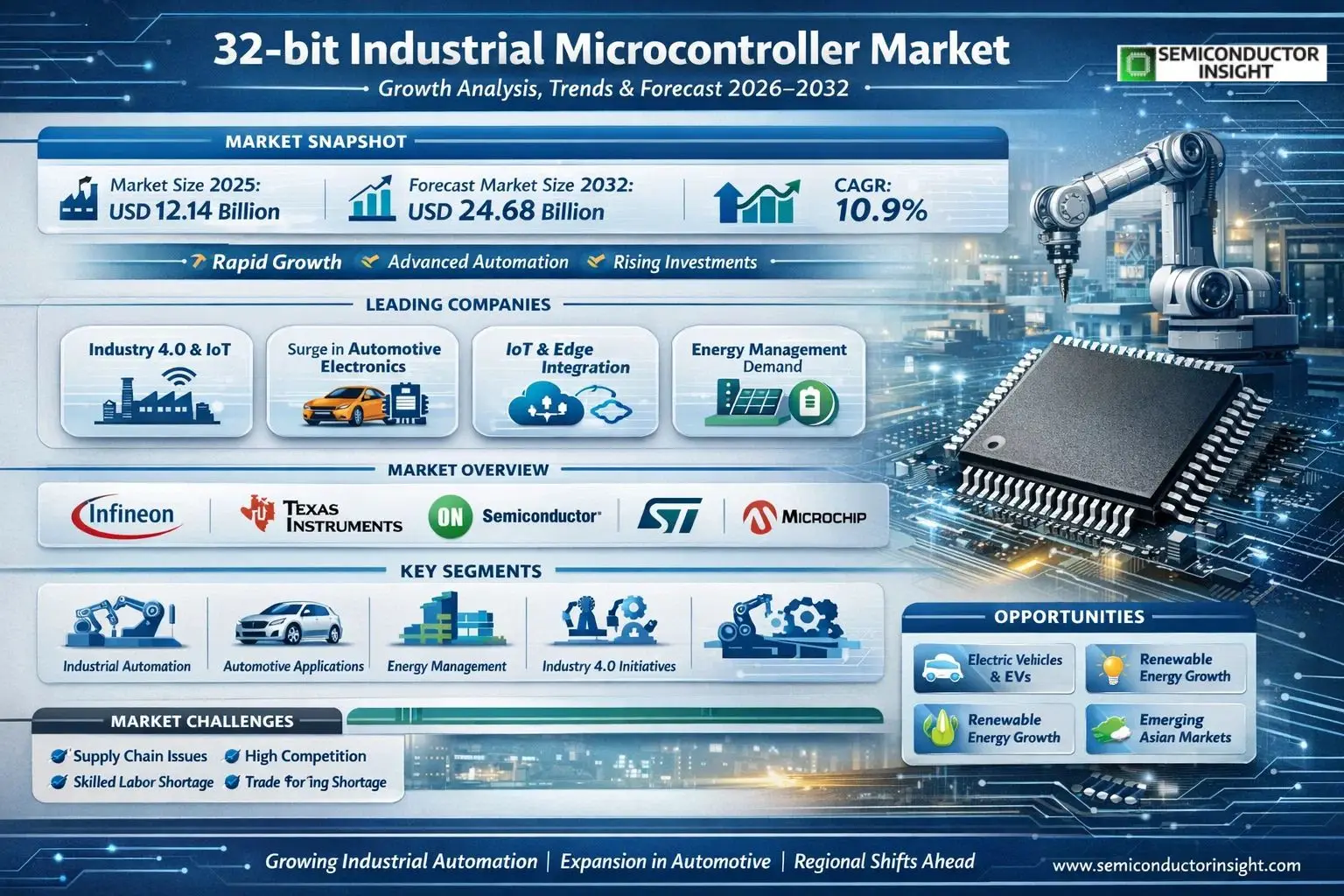
Global 32-bit Industrial Microcontroller market was valued at USD 12.14 billion in 2025 and is projected to reach USD 24.68 billion by 2032, exhibiting a CAGR of 10.9% during the forecast period.
32-bit industrial microcontrollers are essential components in modern industrial applications, providing the processing power and versatility required for sophisticated control and automation tasks. Their robust features and capabilities enable the development of reliable, efficient, and intelligent systems in various industrial sectors.
The market is experiencing rapid growth due to several factors, including surging demand for industrial automation, advancements in IoT integration, and the rise of Industry 4.0 initiatives. Additionally, increasing adoption in automotive electronics and energy management systems is contributing to expansion. Initiatives by key players are expected to further fuel growth. Infineon Technologies, Texas Instruments, ON Semiconductor, Renesas Electronics, STMicroelectronics, Microchip Technology, NXP Semiconductors, Analog Devices, Silicon Labs, and Maxim Integrated are some of the key players operating in the market with diverse portfolios.
MARKET DRIVERS
Industry 4.0 and IIoT Adoption
32-bit Industrial Microcontroller Market is propelled by the accelerating shift toward Industry 4.0, where smart manufacturing demands robust processing for real-time control. These microcontrollers offer superior performance over 8/16-bit alternatives, handling complex algorithms in automation systems with clock speeds exceeding 200 MHz in many applications.
Energy Efficiency and Harsh Environment Resilience
Advancements in low-power 32-bit architectures enable extended operation in battery-powered industrial sensors, reducing energy consumption by up to 40% compared to legacy designs. Their rugged design withstands temperatures from -40°C to 125°C, critical for sectors like oil & gas and automotive assembly.
➤ Growing demand in predictive maintenance: 32-bit MCUs integrate AI peripherals, boosting market growth at 7.2% CAGR through 2028
Increasing integration with edge computing further drives adoption, as these devices support connectivity protocols like EtherCAT and PROFIBUS, enhancing 32-bit Industrial Microcontroller Market in factory automation.
Global automation investments, reaching $250 billion annually, underscore the pivotal role of reliable 32-bit processing in scaling industrial IoT deployments.
MARKET CHALLENGES
Supply Chain Disruptions
32-bit Industrial Microcontroller Market faces volatility from semiconductor shortages, with lead times stretching to 50 weeks in 2023, impacting production in automotive and robotics sectors. Manufacturers struggle to meet demand amid geopolitical tensions affecting raw material supplies.
Other Challenges
Competition from Advanced Architectures
Emerging 64-bit and RISC-V alternatives offer higher performance per watt, pressuring 32-bit dominance and requiring vendors to innovate on cost structures to retain market share estimated at 45% in industrial applications.
Skilled engineering shortages hinder custom firmware development, delaying deployments in complex systems like PLCs and HMIs.
Regulatory compliance for functional safety standards like ISO 26262 adds development cycles, challenging smaller players in 32-bit Industrial Microcontroller Market.
MARKET RESTRAINTS
High Development and Certification Costs
Elevated upfront investments in 32-bit Industrial Microcontroller designs, often surpassing $5 million per project, restrain smaller enterprises from entering the market. Certification processes for SIL 3 safety levels extend timelines by 12-18 months.Legacy system compatibility issues limit migration from entrenched 16-bit ecosystems, with only 30% of industrial plants fully transitioned, slowing overall 32-bit Industrial Microcontroller Market penetration.Power supply variability in remote industrial sites necessitates additional conditioning circuitry, inflating system costs by 15-20% and deterring adoption in cost-sensitive regions.Intellectual property protection concerns in open-source alternatives further constrain proprietary 32-bit innovations.
MARKET OPPORTUNITIES
Expansion in Electric Vehicles and Renewables
32-bit Industrial Microcontroller Market stands to gain from EV inverter controls and renewable energy inverters, projected to add $12 billion in demand by 2030. These applications leverage 32-bit precision for motor control and power conversion efficiency.Smart grid implementations offer growth avenues, with microcontrollers enabling demand-response systems handling 1,000+ I/O points seamlessly.Emerging markets in Asia-Pacific, with 8% annual industrialization growth, present untapped potential for localized 32-bit solutions tailored to regional standards.Hybrid cloud-edge architectures will amplify opportunities, as 32-bit MCUs bridge on-premise controls with AI-driven analytics platforms.
32-bit Industrial Microcontroller Market Trends
Growing Demand in Industrial Automation
32-bit Industrial Microcontroller Market is witnessing robust growth driven by the escalating need for advanced control and automation in manufacturing environments. These microcontrollers offer superior processing power, enabling complex algorithms for real-time monitoring and precise machinery operation. Their versatility supports integration into programmable logic controllers and robotic systems, enhancing operational efficiency across factories worldwide. As industries prioritize smart manufacturing, adoption accelerates, with key features like high reliability under harsh conditions positioning them as core components in Industry 4.0 initiatives.
Other Trends
Expansion in Automotive Applications
In 32-bit Industrial Microcontroller Market, automotive applications represent a dynamic growth area, where these devices facilitate advanced driver-assistance systems and electric vehicle powertrains. The shift toward electrification and autonomous features demands robust, high-performance MCUs capable of handling sensor fusion and communication protocols. Leading manufacturers are optimizing designs for safety-critical functions, aligning with stringent regulatory standards and fostering deeper market penetration.
Regional Shifts and Manufacturer Innovations
Geographically, 32-bit Industrial Microcontroller Market shows pronounced momentum in Asia, particularly in China, Japan, and South Korea, fueled by rapid industrialization and energy management projects. North America and Europe maintain strong footholds through established automation infrastructures. Meanwhile, key players such as Infineon Technologies, Texas Instruments, Renesas Electronics, STMicroelectronics, and NXP Semiconductors dominate, investing in enhanced architectures like higher clock speeds up to 144MHz variants. These innovations address challenges in power efficiency and connectivity, supporting diverse segments including energy management. Overall, competitive dynamics emphasize mergers, product developments, and supply chain optimizations, ensuring sustained market evolution amid drivers like IoT integration and restrictive factors such as semiconductor shortages.
COMPETITIVE LANDSCAPE
Key Industry Players
Top Manufacturers Driving 32-bit Industrial Microcontroller Market
32-bit Industrial Microcontroller Market exhibits a concentrated competitive structure dominated by established semiconductor leaders offering high-performance ARM-based and proprietary cores optimized for rugged industrial environments. Infineon Technologies, Texas Instruments, and Renesas Electronics emerge as frontrunners, leveraging their robust portfolios in industrial automation and energy management applications. In 2025, the top five players, including ON Semiconductor and STMicroelectronics, collectively command a significant revenue share, driven by innovations in real-time processing, low-power efficiency, and integrated peripherals. This oligopolistic landscape fosters intense rivalry, spurring advancements amid a projected market growth from $12,140 million in 2025 to $24,680 million by 2032 at a 10.9% CAGR.
Complementing the market leaders, niche players like Microchip Technology, NXP Semiconductors, and Analog Devices provide specialized solutions emphasizing connectivity, precision analog integration, and scalability for automotive and IoT-enabled systems. Silicon Labs and Maxim Integrated (now part of Analog Devices) focus on ultra-low power and secure features, while Toshiba and Holtek Semiconductor cater to cost-sensitive segments with reliable, application-specific controllers. These contributors enhance diversity, addressing varied demands in industrial segments such as 80MHz to 144MHz RAM configurations, and regional preferences across North America, Europe, and Asia-Pacific.
List of Key 32-bit Industrial Microcontroller Companies Profiled
- Infineon Technologies
- Texas Instruments
- ON Semiconductor
- Renesas Electronics
- STMicroelectronics
- Microchip Technology
- NXP Semiconductors
- Analog Devices
- Silicon Labs
- Maxim Integrated
- Toshiba
- Holtek Semiconductor
Segment Analysis:
| Segment Category | Sub-Segments | Key Insights |
| By Type |
|
80MHz
|
| By Application |
|
Industrial Automation
|
| By End User |
|
Machinery Manufacturers
|
| By Core Architecture |
|
ARM Cortex-M
|
| By Connectivity Support |
|
Fieldbus (CAN, Profibus)
|
Regional Analysis: 32-bit Industrial Microcontroller Market
Asia-Pacific
The region’s unparalleled manufacturing infrastructure propels 32-bit Industrial Microcontroller Market, with vast factories deploying these chips for automated production lines. Dense clusters of suppliers ensure seamless integration, reducing lead times and costs in sectors like consumer electronics and heavy machinery.
Cutting-edge R&D centers drive advancements in 32-bit microcontroller architectures, emphasizing low-power designs and connectivity features. Collaborations with universities and tech firms accelerate deployment in smart factories, enhancing 32-bit Industrial Microcontroller Market’s evolution.
Robust ecosystems mitigate global disruptions, supporting reliable sourcing for 32-bit industrial microcontrollers. Proximity of fabs and end-users fosters agility, vital for industrial applications demanding high reliability and customization.
Favorable policies incentivize semiconductor investments, bolstering 32-bit Industrial Microcontroller Market. Subsidies and tech parks cultivate local expertise, positioning the region to lead in next-generation industrial computing solutions.
North America
North America exhibits strong dynamics in 32-bit Industrial Microcontroller Market, driven by innovation hubs in the United States and Canada. Leading semiconductor firms pioneer advanced architectures with integrated security and AI capabilities, catering to demanding industrial automation and aerospace applications. The region’s emphasis on software ecosystems and open standards facilitates seamless integration into complex systems like predictive maintenance platforms. Investments in reshoring manufacturing bolster domestic production, reducing dependency on overseas supplies. However, high development costs challenge smaller players, yet collaborative ventures with industries like oil and gas enhance adoption. North America’s focus on sustainability pushes for energy-efficient 32-bit microcontrollers in smart grids and renewable projects, ensuring sustained growth aligned with broader Industry 4.0 trends.
Europe
Europe’s 32-bit industrial microcontroller market thrives on its automotive prowess and stringent regulatory frameworks, particularly in Germany, France, and Italy. Precision engineering demands high-reliability chips for robotics and machinery control, with the EU’s Green Deal accelerating eco-friendly designs. Collaborative R&D through initiatives like Horizon Europe fosters innovations in functional safety and real-time processing. Supply chain diversification efforts mitigate risks, while a skilled workforce supports customization for sector-specific needs. Challenges include energy costs and compliance burdens, but these spur efficiency-focused advancements, positioning Europe as a quality leader in 32-bit Industrial Microcontroller Market.
South America
South America is an emerging force in 32-bit Industrial Microcontroller Market, with Brazil and Mexico leading through expanding manufacturing bases. Industrial upgrades in mining, agriculture, and food processing drive demand for rugged, cost-effective controllers. Government incentives for digital transformation encourage adoption in automation projects, bridging infrastructure gaps. Local partnerships with global suppliers enhance technology transfer, though import reliance poses hurdles. Growing urbanization fuels IoT integrations, promising accelerated market penetration as economic stability improves.
Middle East & Africa
The Middle East & Africa region shows promising trajectories in 32-bit Industrial Microcontroller Market, propelled by oil-rich economies diversifying into smart infrastructure. Gulf Cooperation Council nations invest heavily in automation for petrochemicals and logistics, favoring secure, high-performance chips. Africa’s renewable energy boom and mining mechanization create niches for durable microcontrollers. Skill development programs and foreign direct investments bridge technological gaps, despite logistical challenges. Strategic visions like Saudi Vision 2030 amplify growth potential in industrial digitalization.
Report Scope
This market research report provides a comprehensive analysis of 32-bit Industrial Microcontroller Market, covering the forecast period 2026–2034. It offers detailed insights into market dynamics, technological advancements, competitive landscape, and key trends shaping the industry.
Key focus areas of the report include:
- Market Overview: The report begins with an overview outlining its current market scenario, key growth indicators, and industry transformation drivers. It discusses macroeconomic factors, demand–supply balance, regulatory landscape, and the strategic role of semiconductors in powering advancements across industries such as automotive, telecommunications, consumer electronics, and industrial automation.
- Market Size & Forecast: Historical data and future projections for revenue, unit shipments, and market value across major regions and segments.
- Segmentation Analysis: Detailed breakdown by product type, technology, application, and end-user industry to identify high-growth segments and investment opportunities.
- Regional Insights: Insights into market performance across North America, Europe, Asia-Pacific, Latin America, and the Middle East & Africa, including country-level analysis where relevant.
- Competitive Landscape: Profiles of leading market participants, including their product offerings, R&D focus, manufacturing capacity, pricing strategies, and recent developments such as mergers, acquisitions, and partnerships.
- Technology Trends & Innovation: Assessment of emerging technologies, integration of AI/IoT, semiconductor design trends, fabrication techniques, and evolving industry standards.
- Market Drivers & Restraints: Evaluation of factors driving market growth along with challenges, supply chain constraints, regulatory issues, and market-entry barriers.
- Stakeholder Insights: Insights for component suppliers, OEMs, system integrators, investors, and policymakers regarding the evolving ecosystem and strategic opportunities.
Primary and secondary research methods are employed, including interviews with industry experts, data from verified sources, and real-time market intelligence to ensure the accuracy and reliability of the insights presented.
FREQUENTLY ASKED QUESTIONS:
What is the current market size of 32-bit Industrial Microcontroller Market?
-> Global 32-bit Industrial Microcontroller market was valued at USD 12,140 million in 2025 and is projected to reach USD 24,680 million by 2032, at a CAGR of 10.9% during the forecast period.
Which key companies operate in 32-bit Industrial Microcontroller Market?
-> Key players include Infineon Technologies, Texas Instruments, ON Semiconductor, Renesas Electronics, STMicroelectronics, Microchip Technology, NXP Semiconductors, Analog Devices, Silicon Labs, and Maxim Integrated, among others.
What are the key growth drivers?
-> Key growth drivers include demand for processing power in sophisticated industrial control and automation tasks, robust features for reliable systems in industrial sectors.
Which region dominates the market?
-> Asia exhibits strong growth potential with key countries like China and Japan, while North America (U.S.) holds a significant market position.
What are the emerging trends?
-> Emerging trends include advancements in RAM segments such as 80MHz, 120MHz, and 144MHz, and increasing adoption in industrial automation, automotive, and energy management.

Get Sample Report PDF for Exclusive Insights
Report Sample Includes
- Table of Contents
- List of Tables & Figures
- Charts, Research Methodology, and more...
 Download Sample Report PDF