2D material (WS2) transistor-based chip for flexible NFC Market Insights
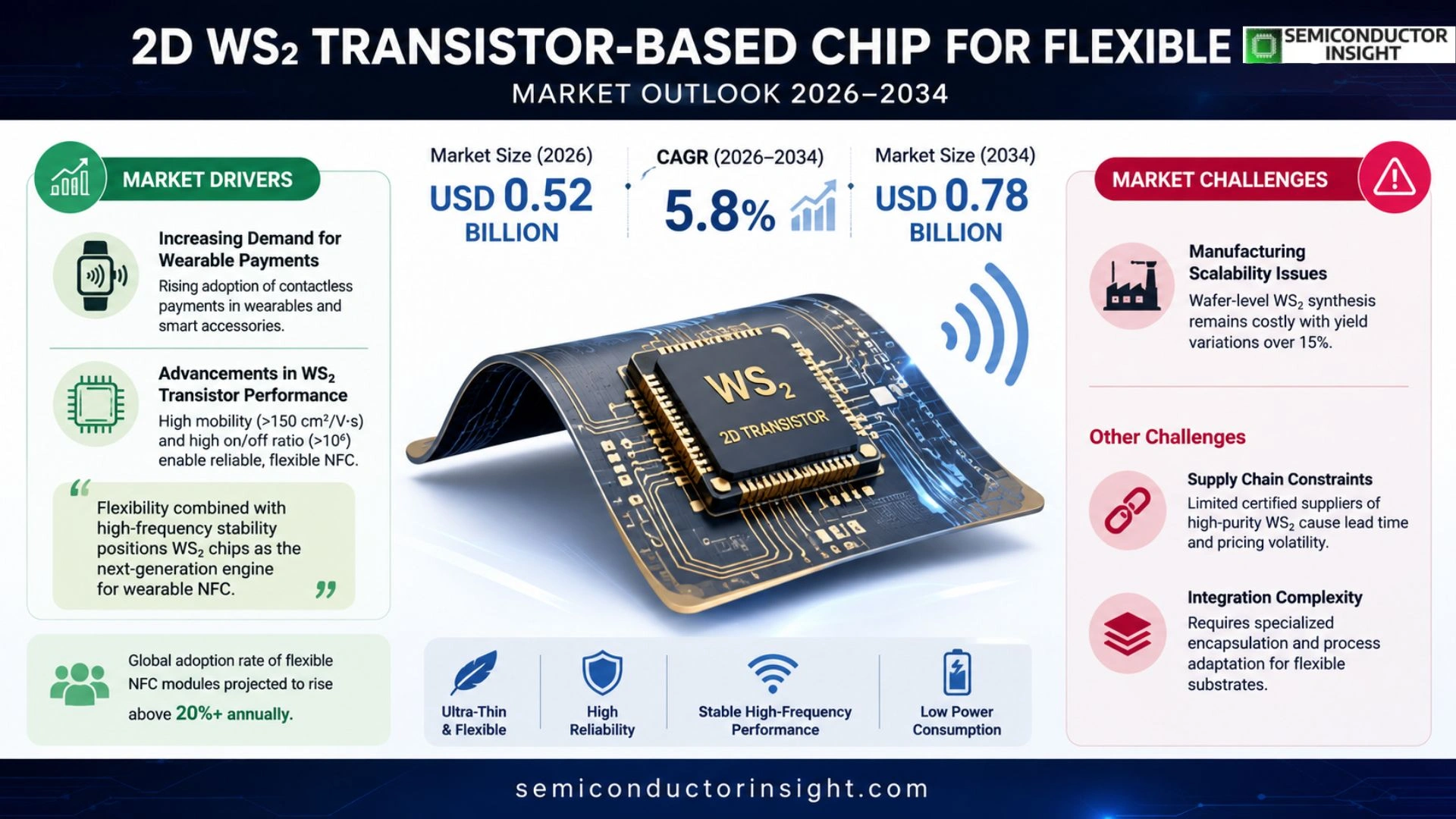
Global 2D Material (WS2) transistor-based chip for flexible NFC market size was valued at USD 0.45 billion in 2025. The market is projected to grow from USD 0.52 billion in 2026 to USD 0.78 billion by 2034, exhibiting a CAGR of 5.8% during the forecast period.
WS₂‑based transistor chip integrates atomically thin tungsten disulfide layers onto bendable substrates, enabling high‑mobility charge transport while maintaining mechanical flexibility. These chips serve as the core active component in near‑field communication (NFC) tags that can conform to curved surfaces such as wearables, smart packaging, and IoT sensors, delivering faster data rates and lower power consumption compared with conventional silicon counterparts.
The market is experiencing rapid growth because manufacturers are investing heavily in flexible electronics and the demand for contactless payment solutions is surging worldwide. Furthermore, advances in large‑area CVD synthesis of WS₂ and roll‑to‑roll printing have lowered production costs, encouraging adoption across consumer electronics and automotive sectors.
MARKET DRIVERS
Increasing Demand for Wearable Payments
The rise of contactless transactions in smartphones and wearables has created a significant pull for ultra‑thin, flexible NFC solutions. Consumers now expect seamless payment experiences on accessories such as smart bracelets and health bands, driving manufacturers to seek chips that can bend without performance loss.
Advancements in WS2 Transistor Performance
Recent breakthroughs in 2D material (WS2) transistor technology have delivered carrier mobilities exceeding 150 cm²/V·s and on/off ratios above 10⁶, enabling reliable data transmission in flexible form factors. These metrics are narrowing the gap with traditional silicon while offering superior mechanical resilience.
➤ “Flexibility combined with high‑frequency stability positions WS2 chips as the next‑generation engine for wearable NFC.”
Analysts project that the global adoption rate of flexible NFC modules will rise above 20 % annually, reinforcing the market’s growth trajectory for WS2‑based chips.
MARKET CHALLENGES
Manufacturing Scalability Issues
Scaling wafer‑level synthesis of WS2 monolayers remains cost‑intensive, with yield variations that can exceed 15 % across large batches. This inconsistency hampers volume production for mainstream consumer electronics.
Other Challenges
Supply Chain Constraints
The limited number of certified suppliers for high‑purity WS2 powder creates bottlenecks, elevating component lead times and pricing volatility.
Furthermore, integrating WS2 transistors with existing flexible substrate processes requires specialized encapsulation, adding another layer of complexity to the design pipeline.
MARKET RESTRAINTS
High Production Costs
The proprietary CVD equipment needed for uniform WS2 film deposition incurs capital expenditures that are 2‑3 times higher than conventional silicon fabs, limiting entry for smaller manufacturers.
In addition, the energy consumption of high‑temperature growth processes contributes to operational overhead, discouraging widespread adoption in cost‑sensitive product segments.
Market surveys indicate that price‑sensitive OEMs may postpone WS2 integration until economies of scale drive unit costs below $0.25 per chip.
MARKET OPPORTUNITIES
Emerging IoT Applications
Smart packaging, health monitoring patches, and flexible RFID tags present new revenue streams where the thin profile of WS2 transistors offers a distinct advantage over rigid alternatives.
The convergence of 5G‑enabled IoT devices with NFC authentication creates cross‑technology synergies, encouraging investment in multifunctional flexible chips.
Projected market research estimates a compound annual growth rate of roughly 22 % for the WS2‑based flexible NFC segment through 2030, highlighting a robust upside for early movers.
2D material (WS2) transistor-based chip for flexible NFC Market Trends
Growth Fueled by Flexible Electronics Adoption
The market is experiencing rapid expansion as manufacturers integrate atomically thin tungsten disulfide layers onto bendable substrates, creating 2D material (WS2) transistor-based chip for flexible NFC solutions that combine high carrier mobility with robust mechanical resilience. This technology enables NFC tags to conform to curved surfaces on wearables, smart packaging, and IoT sensors while delivering faster data rates and lower power draw than conventional silicon‑based alternatives. The surge in demand for contactless payment and secure identification across consumer and automotive domains is prompting original equipment manufacturers to prioritize these flexible chips in next‑generation product roadmaps.
Other Trends
Scaling Production with CVD and Roll‑to‑Roll Processes
Advances in large‑area chemical vapor deposition (CVD) have made it possible to synthesize uniform WS₂ films over meter‑scale substrates, reducing defect density and improving electronic consistency. Coupled with roll‑to‑roll printing techniques, manufacturers can now pattern transistor arrays directly onto polymer films in a continuous flow, dramatically lowering material waste and processing time. These cost‑effective manufacturing pathways are encouraging broader adoption among mid‑tier suppliers, expanding the ecosystem beyond the early‑stage innovators.
Strategic Partnerships Accelerate Ecosystem Development
Industry leaders such as Samsung Electronics, Sony Corporation, and imec are forging collaborative programs to fast‑track the integration of WS₂ transistors into commercial NFC tags. Notably, a March 2024 announcement highlighted imec’s partnership with a leading RFID provider to pilot next‑generation flexible tags in supply‑chain tracking applications. Similar joint initiatives are emerging in automotive infotainment systems, where flexible NFC modules are evaluated for seamless embedding into interior panels. These alliances are shortening development cycles, standardizing qualification criteria, and reinforcing confidence among downstream adopters, thereby sustaining the upward momentum of the flexible NFC market.
COMPETITIVE LANDSCAPE
Key Industry Players
Emerging WS₂ Transistor NFC Chip Landscape 2024‑2034
WS₂‑based transistor chip has become the anchor technology for flexible NFC tags, driving a market that grew from USD 0.45 billion in 2025 to an estimated USD 0.78 billion by 2034 at a 5.8 % CAGR. Samsung Electronics leads the commercial rollout with its flexible‑substrate fabs, leveraging large‑area CVD to achieve high‑mobility channels at scale. Sony Corporation follows closely, integrating WS₂ transistors into its wearable payment ecosystem, while imec’s partnership with a major RFID provider accelerates pilot production and sets a benchmark for roll‑to‑roll printing efficiency. These incumbents shape a tiered market structure where vertically integrated giants dominate volume manufacturing, and specialized fabless firms focus on niche applications such as smart packaging and automotive interior sensors.
Beyond the headline leaders, a cohort of niche players is expanding the ecosystem. NXP Semiconductors and STMicroelectronics are investing in hybrid silicon‑WS₂ platforms to enhance data throughput. Infineon Technologies and Qualcomm explore ultra‑low‑power architectures for IoT nodes, whereas Broadcom Inc. targets high‑frequency NFC use‑cases. Emerging contributors such as Murata Manufacturing, TSMC, and Flex Ltd. provide advanced wafer‑level packaging and roll‑to‑roll logistics. Academic‑industry consortia led by Arizona State University and Contactless Solutions Ltd. drive standards adoption, while Molex and Intel augment supply‑chain resilience through diversified sourcing of 2D‑material precursors.
List of Key 2D Material (WS2) Transistor-Based Chip for Flexible NFC Companies Profiled
- Samsung Electronics
- Sony Corporation
- imec
- NXP Semiconductors
- STMicroelectronics
- Infineon Technologies
- Broadcom Inc.
- Qualcomm
- Murata Manufacturing
- TSMC
- Intel
- Flex Ltd.
- Arizona State University
- Contactless Solutions Ltd.
- Molex
Segment Analysis:
| Segment Category | Sub-Segments | Key Insights |
| By Type |
|
Thin‑Film Transistor (TFT) WS₂
|
| By Application |
|
Wearable Payments
|
| By End User |
|
Consumer Electronics
|
| By Integration Approach |
|
Roll‑to‑Roll Printing
|
| By Form Factor |
|
Flexible Tags
|
Regional Analysis: North America
The North American market benefits from strong research institutions and a skilled workforce adept at handling complex semiconductor technologies. Continuous advancements in materials science and chip fabrication are enabling the development of more efficient and reliable 2D material (WS2) transistors.
The primary applications driving demand in North America include contactless payment systems, secure identification, access control, and integration into wearable devices like smartwatches and fitness trackers. The growing Internet of Things (IoT) ecosystem also presents significant opportunities.
The North American market features a mix of established semiconductor companies and innovative startups focused on developing next-generation flexible NFC chips based on 2D materials. Competition revolves around performance, cost-effectiveness, and integration capabilities.
Stringent regulatory standards regarding data security and privacy in North America influence the development and deployment of NFC technologies. Compliance with these regulations is a crucial factor for market players.
Europe
Europe presents a significant and steadily growing market for 2D material (WS2) transistor-based chips for flexible NFC. Several factors contribute to this growth, including a strong emphasis on technological innovation, a well-established industrial base, and a proactive approach to digital transformation. The region’s commitment to sustainability and energy efficiency is also driving the adoption of flexible NFC solutions in applications like smart grids and connected devices. Furthermore, the presence of major automotive manufacturers and a burgeoning electric vehicle market are creating new avenues for NFC integration in key functionalities like keyless entry and mobile payments. However, varying regulatory landscapes across European countries can pose challenges to market harmonization. The strong focus on data protection, as exemplified by GDPR, necessitates robust security measures in NFC chip design and implementation. The European Union’s initiatives to promote a digital single market are expected to further accelerate the adoption of these advanced technologies.
Asia-Pacific
Asia-Pacific is poised to become the largest and fastest-growing market for 2D material (WS2) transistor-based chips for flexible NFC. The region’s immense consumer base, rapid economic growth, and increasing adoption of smartphones and mobile payments are primary drivers. China, in particular, is a dominant force in this market, with significant investments in 5G infrastructure and the development of smart cities. The growing demand for flexible NFC in applications like public transportation ticketing, e-commerce, and supply chain management is further propelling market expansion. The presence of numerous electronics manufacturers and a vibrant startup ecosystem in countries like South Korea, Japan, and Taiwan provides a strong foundation for innovation. However, concerns regarding intellectual property protection and geopolitical uncertainties represent potential challenges. The increasing government support for technological innovation in several APAC nations is expected to fuel further growth.
South America
South America represents an emerging market for 2D material (WS2) transistor-based chips for flexible NFC, albeit at a relatively early stage of development. Growing urbanization, increasing smartphone penetration, and a rising middle class are creating demand for contactless payment solutions and other NFC-enabled applications. Brazil and Argentina are key markets in the region, with significant potential for growth in areas like financial services, retail, and government initiatives. However, infrastructure limitations, economic volatility, and varying regulatory environments present challenges to market expansion. The adoption of flexible NFC is expected to be driven by the increasing need for secure and convenient payment options, particularly in regions with limited access to traditional banking services. Further investment in regional infrastructure and the development of localized NFC solutions are crucial for realizing the full potential of this market.
Middle East & Africa
The Middle East and Africa offer promising growth opportunities for 2D material (WS2) transistor-based chips for flexible NFC, driven by increasing investments in smart infrastructure, rapid urbanization, and a growing focus on digital transformation. The region’s expanding e-commerce sector and the increasing adoption of mobile payment systems are key drivers. Countries like the UAE, Saudi Arabia, and South Africa are leading the way in adopting these advanced technologies. The development of smart city initiatives and the expansion of government services through digital platforms are creating new avenues for NFC integration. However, the market faces challenges related to infrastructure development, regulatory inconsistencies, and economic uncertainties in some countries. The increasing focus on financial inclusion and the drive towards cashless societies are expected to fuel further adoption of flexible NFC solutions in the region.
Report Scope
This market research report provides a comprehensive analysis of the 2D material (WS2) transistor-based chip for flexible NFC Market , covering the forecast period 2026–2034. It offers detailed insights into market dynamics, technological advancements, competitive landscape, and key trends shaping the industry.
Key focus areas of the report include:
- Market Overview: The report begins with an overview outlining its current market scenario, key growth indicators, and industry transformation drivers. It discusses macroeconomic factors, demand–supply balance, regulatory landscape, and the strategic role of semiconductors in powering advancements across industries such as automotive, telecommunications, consumer electronics, and industrial automation.
- Market Size & Forecast: Historical data and future projections for revenue, unit shipments, and market value across major regions and segments.
- Segmentation Analysis: Detailed breakdown by product type, technology, application, and end-user industry to identify high-growth segments and investment opportunities.
- Regional Insights: Insights into market performance across North America, Europe, Asia-Pacific, Latin America, and the Middle East & Africa, including country-level analysis where relevant.
- Competitive Landscape: Profiles of leading market participants, including their product offerings, R&D focus, manufacturing capacity, pricing strategies, and recent developments such as mergers, acquisitions, and partnerships.
- Technology Trends & Innovation: Assessment of emerging technologies, integration of AI/IoT, semiconductor design trends, fabrication techniques, and evolving industry standards.
- Market Drivers & Restraints: Evaluation of factors driving market growth along with challenges, supply chain constraints, regulatory issues, and market-entry barriers.
- Stakeholder Insights: Insights for component suppliers, OEMs, system integrators, investors, and policymakers regarding the evolving ecosystem and strategic opportunities.
Primary and secondary research methods are employed, including interviews with industry experts, data from verified sources, and real-time market intelligence to ensure the accuracy and reliability of the insights presented.
FREQUENTLY ASKED QUESTIONS:
What is the current market size of 2D material (WS2) transistor-based chip for flexible NFC Market?
-> 2D material (WS2) transistor-based chip for flexible NFC Market was valued at USD 0.45 billion in 2025 and is expected to reach USD 0.78 billion by 2034.
Which key companies operate in 2D material (WS2) transistor-based chip for flexible NFC Market?
-> Key players include Samsung Electronics, Sony Corporation, and imec, among others.
What are the key growth drivers?
-> Key growth drivers include strong investments in flexible electronics, rising demand for contactless payment solutions, advances in large‑area CVD synthesis of WS₂, and roll‑to‑roll printing that reduce production costs.
Which region dominates the market?
-> The reference does not specify a dominant region.
What are the emerging trends?
-> Emerging trends include large‑area CVD synthesis of WS₂, roll‑to‑roll printing for scalable manufacturing, and integration of WS₂ transistors into wearables, smart packaging, and IoT sensor NFC tags.
Get Sample Report PDF for Exclusive Insights
Report Sample Includes
- Table of Contents
- List of Tables & Figures
- Charts, Research Methodology, and more...