16-bit Automotive Microcontrollers (MCU) Market Insights
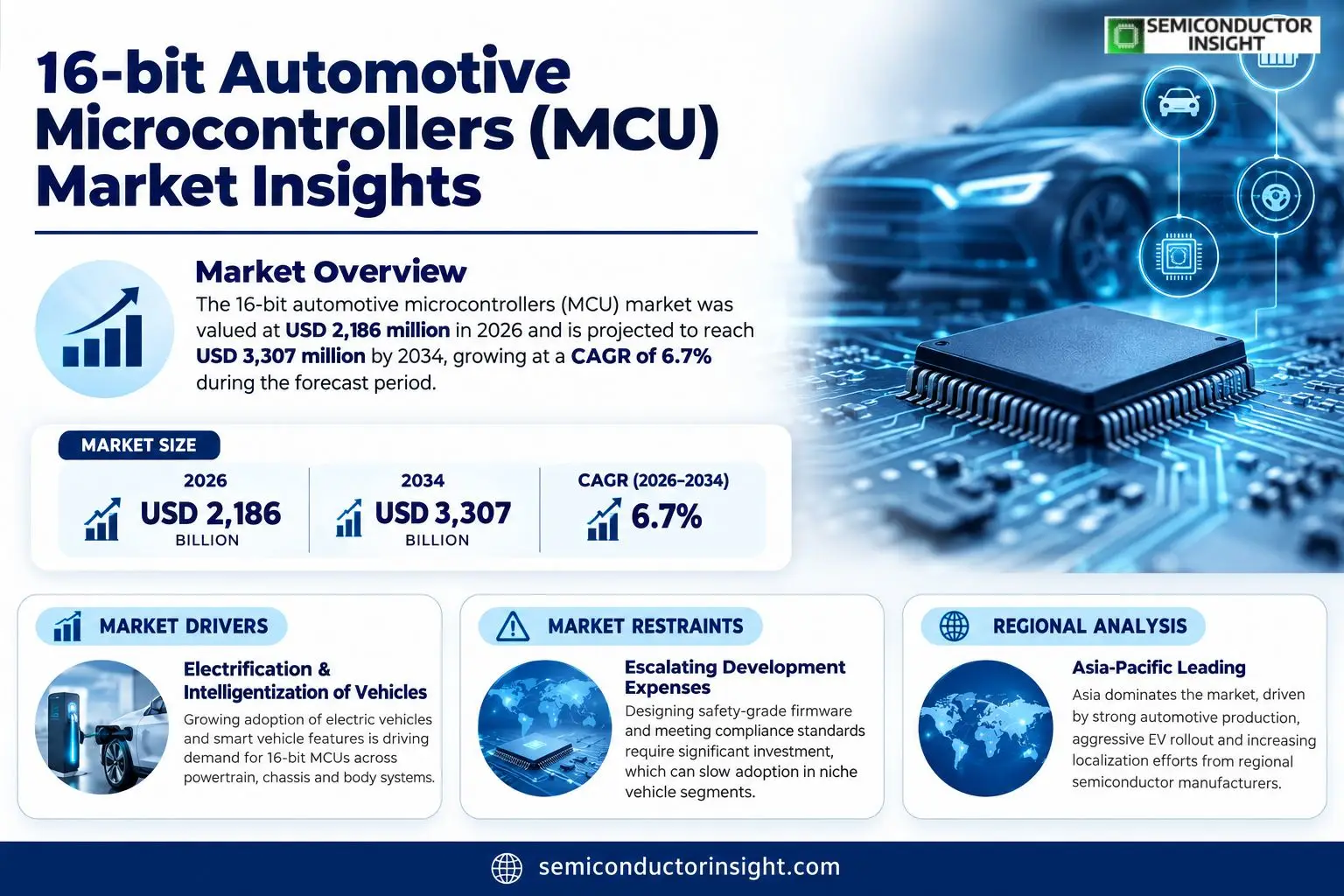
16-bit Automotive Microcontrollers (MCU) Market Insights measured USD 2.186 billion in 2026 and will rise to USD 3.307 billion by 2034, delivering a compound annual growth rate of roughly 6.7 % over the forecast horizon.
A 16-bit automotive microcontroller integrates a CPU, ROM/RAM/Flash memory, I/O interfaces and peripherals such as ADC, PWM and CAN bus on a single chip, enabling moderately complex real‑time control for powertrain, chassis and body‑electronics functions while balancing performance against cost.Growth stems from expanding electric‑vehicle architectures that require additional mid‑range control units, tighter functional‑safety mandates pushing low‑power designs, and regional policies promoting domestic semiconductor sourcing.
MARKET DRIVERS
Growing ECU Complexity
Vehicle manufacturers are consolidating multiple control functions into single electronic control units (ECUs). This consolidation pushes designers toward 16-bit automotive microcontrollers (MCU) that can deliver higher processing throughput while keeping power draw modest. The shift reduces wiring complexity, shortens development cycles, and creates a tangible cost advantage for Tier‑1 suppliers.
Stringent Functional‑Safety Requirements
Regulatory frameworks such as ISO 26262 mandate fault‑tolerant architectures for safety‑critical systems. 16-bit automotive microcontrollers (MCU) equipped with built‑in self‑test (BIST) and error‑correction code (ECC) modules satisfy these mandates without the need for additional hardware layers. Consequently, OEMs favor these devices to streamline certification pathways.
➤ “Performance per watt has become the decisive metric for next‑generation power‑train control, and 16‑bit MCU families are delivering that balance today.”
Finally, the rollout of vehicle‑to‑everything (V2X) communications demands processors that can handle diverse protocol stacks in real time. 16-bit automotive microcontrollers (MCU) provide sufficient address space for modern connectivity stacks while preserving deterministic latency, a combination that directly supports automakers’ rollout timelines.
MARKET CHALLENGES
Integration with Legacy Architectures
Many automotive platforms still rely on 8‑bit or proprietary controllers. Migrating to 16-bit MCU requires redesign of PCB layouts, firmware migration, and staff retraining. These transition costs can outweigh the perceived benefits for low‑volume models, prompting manufacturers to defer upgrades.
Other Challenges
Supply Chain Volatility
Global semiconductor shortages have amplified lead‑time uncertainty for 16-bit automotive microcontrollers (MCU). Automakers are forced to hold larger safety stocks, which inflates inventory costs and compresses margins across the supply chain.
MARKET RESTRAINTS
Escalating Development Expenses
Designing safety‑grade firmware for 16-bit automotive microcontrollers (MCU) entails extensive verification, validation, and compliance testing. These activities add millions of dollars to program budgets, especially for niche vehicle segments where volume cannot amortize the overhead.
MARKET OPPORTUNITIES
Advanced Driver‑Assistance Systems (ADAS)
The proliferation of driver‑assistance features such as lane‑keep assist and adaptive cruise control creates demand for processors that can handle sensor fusion and real‑time decision logic. 16-bit automotive microcontrollers (MCU) are positioned to serve as the central hub for these workloads, offering a sweet spot between computational capability and cost.Furthermore, electric‑vehicle power‑train control modules are increasingly adopting digital torque‑vectoring algorithms that require deterministic execution at higher clock rates. Leveraging 16-bit MCU architectures enables OEMs to extract additional efficiency from existing hardware platforms without a complete redesign.
16-bit Automotive Microcontrollers (MCU) Market Trends
Electrification and Smart‑Cockpit Expansion
The shift toward electric drivetrains and increasingly digital cabins is reshaping demand for 16-bit Automotive Microcontrollers (MCU) Market components. Battery‑management systems and motor‑control units in EVs each require a dedicated MCU, while advanced infotainment and driver‑assistance modules push the total MCU count per vehicle from roughly 70 in conventional models to well over 250 in contemporary electric and autonomous platforms. Because mid‑range control taskssuch as sensor fusion, actuator coordination, and power‑train torque regulationbalance performance with cost, manufacturers favor 16‑bit devices for these functions. Consequently, the volume of units sold is climbing steadily, prompting Tier 1 suppliers to secure larger design‑win agreements and to integrate 16‑bit MCU libraries into their standard vehicle platforms.
Other Trends
Functional Safety and Low‑Power Innovation
Stringent durability requirements, often exceeding 15 years of operation across temperature extremes from –40 °C to 150 °C, compel OEMs to prioritize safety‑critical microcontrollers. Recent silicon revisions embed hardware CRC, enhanced electromagnetic‑interference shielding, and dynamic voltage scaling, thereby extending battery life without sacrificing deterministic response times. Parallel to these hardware upgrades, a subset of vendors has embraced the RISC‑V open‑source core, reducing development expenses and fostering a broader ecosystem for safety‑grade 16‑bit MCUs. The combined effect is a noticeable uplift in gross marginstypically ranging from 40 % to 55 %as suppliers can charge a premium for verified reliability while still offering a cost‑effective solution for mid‑tier vehicle functions.
Domestic Substitution and Supply‑Chain Resilience
Geopolitical uncertainties and historic reliance on foreign fab capacity have accelerated localization efforts within the 16‑bit Automotive Microcontrollers (MCU) Market. National policies now provide tax credits and R&D subsidies for firms achieving AEC‑Q100 and ISO 26262 certifications, enabling domestic players such as GigaDevice and Chipsea Technologies to ship volume‑qualified parts. Automakers, wary of single‑source exposure, are inserting locally sourced MCUs into power‑train, chassis, and body‑electronics modules, thereby diversifying risk and shortening lead times. While the domestic share remains modest compared with established multinational manufacturers, the trend creates a strategic opening for companies that can scale production while maintaining functional‑safety credentials.
COMPETITIVE LANDSCAPEKey Industry Players
Competitive dynamics in the 16‑bit automotive MCU segment
Infineon Technologies commands the upper tier of the 16‑bit automotive MCU arena, leveraging its IDM model to retain tight control over silicon, packaging, and automotive‑grade qualification. The company’s portfolio covers powertrain, chassis and body‑electronics domains, allowing it to capture the bulk of OEM spend on mid‑range control functions. Its breadth of safety‑rated product families and deep R&D pipeline create high entry barriers for newcomers. Parallel to Infineon, NXP Semiconductors and Renesas Electronics maintain a comparable footprint, each operating hybrid fab‑less/IDM structures that enable rapid adaptation to changing automotive standards while preserving margin discipline. The concentration of these three firms accounts for a sizeable share of global shipments, shaping pricing trends and dictating the cadence of new‑function releases across the supply chain.Beyond the dominant trio, a cluster of specialized and emerging players enriches the competitive set. STMicroelectronics and Texas Instruments provide niche differentiators through analog‑centric peripherals that appeal to chassis‑control designers. Silicon Labs, Analog Devices and Toshiba focus on low‑power architectures that meet the tightening energy budgets of electrified power‑train modules. Domestic Chinese firms such as GigaDevice Semiconductor and Chipsea Technologies have achieved AEC‑Q100 certification, positioning themselves as viable alternatives for automakers seeking supply‑chain resilience. ON Semiconductor and Cypress (now part of Infineon) contribute targeted safety‑rated devices that address specific functional‑safety regimes. This diversified ecosystem fosters a modest yet steady cadence of new product introductions, each tailored to incremental shifts in vehicle electronics architecture.
List of Key 16‑bit Automotive MCU Companies Profiled
- Infineon Technologies
- NXP Semiconductors
- Renesas Electronics
- Microchip Technology
- STMicroelectronics
- Texas Instruments
- Analog Devices
- Silicon Laboratories
- Toshiba
- GigaDevice Semiconductor
- Chipsea Technologies
- ON Semiconductor
- Cypress Semiconductor
Segment Analysis:
| Segment Category | Sub-Segments | Key Insights |
| By Type |
|
General‑Purpose MCUs dominate early‑stage vehicle electronics because they balance cost and capability. – Provide reliable real‑time control for powertrain sub‑systems. – Offer a mature development ecosystem that accelerates time‑to‑market. – Seamlessly integrate with CAN and PWM peripherals, meeting most mid‑range control requirements. |
| By Application |
|
Powertrain Control remains the flagship application for 16‑bit MCUs, driven by electrification trends. – Enables precise motor torque management and regenerative braking. – Supports integrated sensor fusion for efficiency optimization. – Offers a cost‑effective alternative to 32‑bit devices for auxiliary functions. |
| By End User |
|
OEMs drive specification standards, emphasizing durability and safety compliance. – Prioritize chips that meet AEC‑Q100 and ISO 26262. – Favor suppliers with proven long‑term reliability records. – Seek scalable families to reduce BOM complexity across vehicle platforms. |
| By Functional Safety |
|
ISO 26262 Certified MCUs are increasingly mandated for safety‑critical modules. – Provide deterministic execution to meet ASIL‑B/C requirements. – Incorporate hardware error‑checking that reduces software mitigation effort. – Facilitate faster certification pathways for new vehicle platforms. |
| By Power Domain |
|
Power‑Domain MCUs gain prominence as EV adoption rises. – Optimize low‑power operation to extend vehicle range. – Integrate high‑precision ADCs for cell‑level monitoring. – Offer flexible voltage scaling that aligns with diverse BMS architectures. |
Regional Analysis: 16-bit Automotive Microcontrollers (MCU) Market
Europe
Recent EU directives on functional safety and electromagnetic compatibility compel manufacturers to certify 16-bit MCU designs against tighter benchmarks. The resulting pressure accelerates adoption of safety‑critical cores, compelling suppliers to embed diagnostic and redundancy features directly in silicon.
European automotive manufacturers are reshoring key component sourcing, favoring local fab capacity and diversified wafer suppliers. This strategic shift mitigates geopolitical risk and shortens lead times for critical MCU deliveries.
Engineers are integrating mixed‑signal blockssuch as ADCs and PWM generatorsinto 16-bit cores to reduce board complexity. The move reflects a desire to meet tighter packaging constraints while maintaining processing headroom for emerging vehicle functions.
Tier‑one suppliers report that European OEMs now request configurable firmware alongside silicon, turning the MCU into a service platform. This shift elevates the importance of long‑term support contracts and rapid firmware rollout capabilities.
North America
The United States and Canada exhibit a pragmatic approach to 16-bit Automotive Microcontrollers (MCU) Market dynamics, anchored by a strong emphasis on cost efficiency and scalability. OEMs leverage the region’s extensive design ecosystem to rapidly prototype vehicle subsystems, especially in commercial trucks where durability outweighs cutting‑edge performance. Suppliers respond by offering modular MCU families that can be tailored to a wide spectrum of powertrain configurations. This flexibility translates into shorter development cycles for manufacturers who must balance fleet turnover rates with the need for incremental feature upgrades. As a result, partnerships are increasingly predicated on joint road‑mapping exercises, where silicon providers and vehicle makers align product releases with regulatory milestones, ensuring that compliance obligations are met without sacrificing budgetary discipline.
Asia-Pacific
In Asia‑Pacific, 16-bit Automotive Microcontrollers (MCU) Market is propelled by a confluence of rapid vehicle production growth and aggressive cost‑competitiveness pressures. Chinese and Indian manufacturers dominate volume output, encouraging MCU vendors to pursue high‑density wafer processes that drive down per‑unit cost. Simultaneously, regional safety regulations are tightening, nudging OEMs toward more reliable microcontroller architectures. The net effect is a market where price sensitivity coexists with a growing appetite for functional safety features, prompting suppliers to bundle robust error‑checking mechanisms with low‑cost silicon. Companies that can reconcile these divergent demands are poised to secure sizeable design wins across multiple vehicle segments.
South America
South American automotive firms adopt 16-bit Automotive Microcontrollers (MCU) primarily to extend the service life of legacy vehicle platforms while integrating modest electronic enhancements. The region’s market is characterised by a cautious upgrade path, where cost containment outweighs the pursuit of advanced driver‑assist functionalities. Nonetheless, an emerging middle class is raising expectations for vehicle reliability, prompting OEMs to select MCU solutions that offer enhanced diagnostics without inflating the bill of materials. Suppliers respond by offering extended temperature ranges and long‑term availability guarantees, which align with the region’s emphasis on durability in diverse climatic conditions.
Middle East & Africa
The Middle East & Africa present a niche but evolving landscape for 16-bit Automotive Microcontrollers (MCU) Market, driven largely by infrastructure projects and a growing fleet of commercial vehicles. Harsh environmental factorsextreme heat and dustnecessitate MCUs with reinforced packaging and robust thermal management. Regional OEMs therefore prioritize vendors that can certify silicon against stringent reliability tests. At the same time, incremental digitisation of public transport systems invites microcontroller designers to embed connectivity modules that support basic telematics, laying the groundwork for future over‑the‑air updates and remote diagnostics.
Report Scope
This market research report provides a comprehensive analysis of the 16-bit Automotive Microcontrollers (MCU) Market , covering the forecast period 2026–2034. It offers detailed insights into market dynamics, technological advancements, competitive landscape, and key trends shaping the industry.
Key focus areas of the report include:
- Market Overview: The report begins with an overview outlining its current market scenario, key growth indicators, and industry transformation drivers. It discusses macroeconomic factors, demand–supply balance, regulatory landscape, and the strategic role of semiconductors in powering advancements across industries such as automotive, telecommunications, consumer electronics, and industrial automation.
- Market Size & Forecast: Historical data and future projections for revenue, unit shipments, and market value across major regions and segments.
- Segmentation Analysis: Detailed breakdown by product type, technology, application, and end-user industry to identify high-growth segments and investment opportunities.
- Regional Insights: Insights into market performance across North America, Europe, Asia-Pacific, Latin America, and the Middle East & Africa, including country-level analysis where relevant.
- Competitive Landscape: Profiles of leading market participants, including their product offerings, R&D focus, manufacturing capacity, pricing strategies, and recent developments such as mergers, acquisitions, and partnerships.
- Technology Trends & Innovation: Assessment of emerging technologies, integration of AI/IoT, semiconductor design trends, fabrication techniques, and evolving industry standards.
- Market Drivers & Restraints: Evaluation of factors driving market growth along with challenges, supply chain constraints, regulatory issues, and market-entry barriers.
- Stakeholder Insights: Insights for component suppliers, OEMs, system integrators, investors, and policymakers regarding the evolving ecosystem and strategic opportunities.
Primary and secondary research methods are employed, including interviews with industry experts, data from verified sources, and real-time market intelligence to ensure the accuracy and reliability of the insights presented.
FREQUENTLY ASKED QUESTIONS:
What is the current market size of 16-bit Automotive Microcontrollers (MCU) Market?
-> 16-bit Automotive Microcontrollers (MCU) Market was valued at USD 2,186 million in 2026 and is expected to reach USD 3,307 million by 2034, growing at a CAGR of 6.7% over the forecast period.
Which key companies operate in 16-bit Automotive Microcontrollers (MCU) Market?
-> Key players include Infineon Technologies, NXP Semiconductors, Renesas Electronics, Microchip Technology, STMicroelectronics, Texas Instruments, Analog Devices, Silicon Laboratories, Toshiba, and Giga Device Semiconductor.
What are the key growth drivers?
-> Key growth drivers include accelerated electrification and intelligentization of vehicles, rising demand for MCUs in electric powertrain, battery management and advanced driver assistance systems, functional safety and low‑power requirements, and domestic substitution policies enhancing local supply chain security.
Which region dominates ?
-> Asia dominates the 16-bit Automotive MCU market, driven by strong automotive production, aggressive EV rollout, and increasing localization efforts from regional semiconductor manufacturers.
What are the emerging trends?
-> Emerging trends include adoption of RISC‑V open‑source architecture for cost‑effective design, integration of low‑power dynamic voltage regulation, and enhanced functional‑safety features to meet ISO 26262 and AEC‑Q100 standards.
Get Sample Report PDF for Exclusive Insights
Report Sample Includes
- Table of Contents
- List of Tables & Figures
- Charts, Research Methodology, and more...