12V Automotive Bridge ICs Market Insights
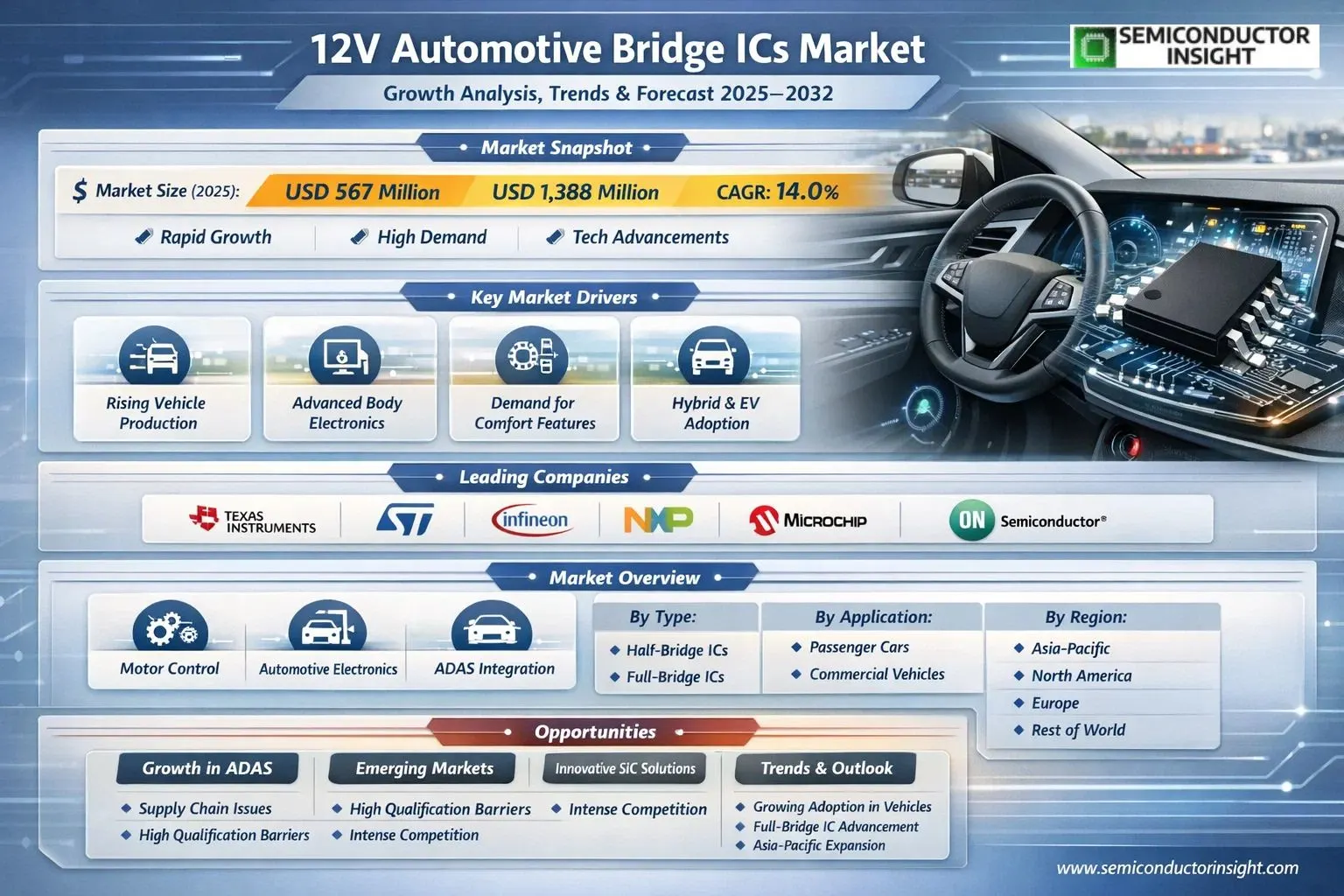
Global 12V Automotive Bridge ICs market size was valued at USD 567 million in 2025. The market is projected to reach USD 1,388 million by 2032, exhibiting a CAGR of 14.0% during the forecast period.
12V Automotive Bridge ICs are integrated circuits specifically designed for driving DC motors, stepper motors, or other inductive loads in automotive applications. They typically operate at a nominal voltage of 12 volts, which is standard for most automotive electrical systems. These bridge ICs allow for bidirectional control of motors, making them suitable for applications like power windows and seat adjustments.
The market is experiencing rapid growth due to several factors, including surging global vehicle production, rising demand for advanced body electronics and comfort features, and the persistent need for reliable motor drivers in conventional and hybrid vehicles. Furthermore, ongoing advancements in power management and semiconductor integration enhance efficiency and performance. Initiatives by key players continue to drive innovation. Texas Instruments, STMicroelectronics, Infineon Technologies, NXP Semiconductors, Microchip Technology, ON Semiconductor, Maxim Integrated, Toshiba, Analog Devices, and Renesas Electronics are prominent companies in the market, offering diverse portfolios tailored to automotive requirements.
MARKET DRIVERS
Rising Demand for Vehicle Electrification
12V Automotive Bridge ICs Market is propelled by the growing adoption of electric vehicles and hybrid systems, where 12V bridge ICs control auxiliary motors for features like power seats and sunroofs. These ICs ensure efficient bidirectional motor driving, supporting the shift toward electrified architectures that maintain 12V for legacy systems.
Advancements in Comfort and Convenience Features
Automakers are integrating more smart actuators in passenger vehicles, boosting the need for robust 12V bridge ICs capable of handling high currents up to 5A per channel. Market growth is evident with global automotive production reaching over 90 million units in 2023, driving demand for reliable motor drivers.
➤ Bridge ICs enable precise control in ADAS actuators, contributing to a 12% CAGR in automotive semiconductors through 2028.
Regulatory pushes for energy efficiency further accelerate adoption, as these ICs integrate diagnostics and protection features compliant with AEC-Q100 standards, enhancing overall vehicle performance.
MARKET CHALLENGES
Supply Chain Disruptions
12V Automotive Bridge ICs Market faces hurdles from ongoing semiconductor shortages, delaying production timelines for OEMs and increasing lead times to 40-50 weeks. This impacts just-in-time manufacturing in the automotive sector.
Other Challenges
High Qualification Barriers
Automotive-grade certification demands rigorous testing for thermal management and EMI suppression, raising development costs by 20-30% compared to consumer ICs.
Intense Competition
Key players like Infineon and STMicroelectronics dominate with integrated solutions, pressuring smaller firms to innovate amid price wars and rapid tech cycles.
MARKET RESTRAINTS
Stringent Regulatory Compliance
Compliance with ISO 26262 for functional safety restricts 12V Automotive Bridge ICs Market, requiring ASIL-B capable designs that escalate costs and extend time-to-market by up to 18 months. This limits entry for new suppliers.Shifting preferences toward 48V architectures in premium EVs pose a threat, as 12V systems may see reduced penetration beyond auxiliary roles, capping market expansion at 7-8% annually.Raw material price volatility, particularly silicon wafers, adds further pressure, with costs fluctuating 15% in 2023, squeezing margins in a competitive landscape.
MARKET OPPORTUNITIES
Expansion in ADAS and Autonomous Vehicles
12V Automotive Bridge ICs Market stands to benefit from ADAS proliferation, with precise motor control for mirrors and wipers integral to Level 2+ systems. Projections indicate over 50% of vehicles equipped by 2027.Growth in emerging markets like Asia-Pacific, where vehicle production surges 5% yearly, opens avenues for cost-effective 12V bridge ICs in entry-level models.Innovations in low-voltage SiC integration promise higher efficiency, targeting a market segment expected to grow from $500 million in 2023 to $1.2 billion by 2030.
12V Automotive Bridge ICs Market Trends
Growing Adoption in Passenger Vehicles
In 12V Automotive Bridge ICs Market, passenger vehicles represent a dominant application segment, driven by the need for reliable control of DC motors and inductive loads such as power windows, seat adjustments, and sunroofs. These ICs enable bidirectional motor operation essential for modern comfort features, with manufacturers focusing on enhanced thermal management and fault protection to meet stringent automotive standards. The shift towards more automated and feature-rich interiors in passenger cars is accelerating demand for robust 12V solutions compatible with existing electrical architectures.
Other Trends
Advancements in Full-Bridge Configurations
Full-bridge ICs are gaining prominence in 12V Automotive Bridge ICs Market due to their capability for precise bidirectional control, outperforming half-bridge variants in applications requiring reversible motion. Leading players like Texas Instruments and STMicroelectronics are prioritizing full-bridge designs with integrated diagnostics and overcurrent protection, aligning with evolving safety regulations and the push for higher integration levels to reduce system complexity and board space in vehicles.
Regional Expansion in Asia-Pacific
The Asia-Pacific region, particularly China, Japan, and South Korea, is witnessing accelerated growth in 12V Automotive Bridge ICs Market, fueled by rising vehicle production and localization efforts by global OEMs. Key manufacturers including Infineon Technologies and NXP Semiconductors are expanding production capacities to support the surging demand for automotive electronics in this area. This trend is supported by increasing exports and the development of next-generation ICs tailored for commercial vehicles, enhancing market penetration amid competitive pricing pressures.
Competition among top players such as Microchip Technology, ON Semiconductor, and Renesas Electronics is intensifying, with emphasis on innovation in low-power dissipation and AEC-Q100 qualification. 12V Automotive Bridge ICs Market benefits from this rivalry through faster product cycles and customized solutions for diverse applications, from passenger to commercial cars. Challenges like supply chain disruptions are prompting diversification strategies, while opportunities in emerging markets bolster long-term prospects.
COMPETITIVE LANDSCAPE
Key Industry Players
Leading Manufacturers in the Global 12V Automotive Bridge ICs Market
12V Automotive Bridge ICs Market is dominated by a few leading semiconductor giants, with the global top five players collectively holding a significant revenue share in 2025. Texas Instruments, STMicroelectronics, Infineon Technologies, NXP Semiconductors, and Microchip Technology stand out as primary leaders, leveraging their extensive portfolios in power management and motor driver solutions tailored for automotive applications such as power windows, seat adjustments, and other inductive loads. These companies benefit from strong R&D investments, robust manufacturing capabilities, and deep integration into automotive supply chains, contributing to the market’s projected growth from US$567 million in 2025 to US$1,388 million by 2032 at a CAGR of 14.0%. The market structure remains moderately concentrated, with full-bridge ICs gaining traction over half-bridge variants due to enhanced bidirectional control features.
Beyond the top tier, several niche players like onsemi, Analog Devices, Renesas Electronics, Toshiba, Rohm Semiconductor, Melexis, and Allegro MicroSystems play crucial roles, focusing on specialized high-efficiency bridge drivers for passenger and commercial vehicles. These firms differentiate through innovations in low-power consumption, fault protection, and AEC-Q100 qualification, addressing challenges like electrification trends and stringent automotive standards. Their combined efforts foster competition, driving advancements in diagnostics and integration with 12V systems amid rising demand in regions like Asia-Pacific and North America.
List of Key 12V Automotive Bridge ICs Companies Profiled
- Texas Instruments
- STMicroelectronics
- Infineon Technologies
- NXP Semiconductors
- Microchip Technology
- onsemi
- Analog Devices
- Renesas Electronics
- Toshiba Semiconductor
- Rohm Semiconductor
- Melexis
- Allegro MicroSystems
- Monolithic Power Systems (MPS)
Segment Analysis:
| Segment Category | Sub-Segments | Key Insights |
| By Type |
|
Full-bridge ICs
|
| By Application |
|
Passenger Cars
|
| By End User |
|
Automotive OEMs
|
| By Load Type |
|
DC Motors
|
| By Distribution Channel |
|
OEM Direct
|
Regional Analysis: 12V Automotive Bridge ICs Market
Asia-Pacific
Rapid integration of 12V Automotive Bridge ICs in passenger and commercial vehicles underscores Asia-Pacific’s market leadership. Manufacturers favor these ICs for their ability to handle reverse polarity and overcurrent protection, essential for dense electronic architectures. The push for lightweight designs and energy efficiency drives preference for advanced MOSFET-based bridges.
Key players in Asia-Pacific leverage local fabrication to offer cost-effective 12V Automotive Bridge ICs tailored for high-volume production. Strategic partnerships with tier-1 suppliers enhance customization, focusing on automotive-grade reliability and AEC-Q100 qualification, solidifying the region’s supply dominance.
Mature supply chains in Asia-Pacific minimize disruptions for 12V Automotive Bridge ICs, with proximity to assembly plants enabling just-in-time delivery. Emphasis on vertical integration reduces lead times, while diversification strategies mitigate raw material volatility.
Urbanization and rising vehicle electrification propel 12V Automotive Bridge ICs demand in Asia-Pacific. Focus on enhancing battery management and load switching capabilities aligns with consumer preferences for durable, smart power systems in next-generation automobiles.
North America
North America exhibits steady growth in 12V Automotive Bridge ICs Market, fueled by premium vehicle segments and innovation in safety features. Automakers emphasize robust power management for ADAS and autonomous driving technologies, where bridge ICs ensure stable 12V supply to sensors and actuators. Stringent regulatory standards for electromagnetic compatibility drive adoption of high-performance ICs. The region’s strong aftermarket sector supports retrofitting with efficient bridge solutions. Collaborations between chipmakers and OEMs accelerate development of integrated modules, enhancing system reliability. Focus on sustainability pushes for low-power designs, positioning North America as a key market for advanced 12V architectures.
Europe
Europe’s 12V Automotive Bridge ICs market thrives on rigorous emissions and safety regulations, integrating these components into sophisticated power distribution networks. Luxury and electric vehicle manufacturers prioritize bridge ICs for precise control in 12V auxiliary systems alongside high-voltage setups. Emphasis on modularity and scalability supports diverse vehicle platforms. Local semiconductor expertise fosters innovation in fault-tolerant designs. The push for connected ecosystems amplifies demand for ICs with diagnostic features, ensuring compliance with industry standards and bolstering market maturity.
South America
South America shows emerging potential in 12V Automotive Bridge ICs Market, driven by expanding automotive assembly and cost-conscious consumers. Bridge ICs gain traction for basic power protection in compact cars and light trucks prevalent in the region. Infrastructure challenges spur demand for durable, ruggedized solutions. Local content requirements encourage partnerships with regional suppliers, gradually elevating technology adoption. Urban mobility trends further integrate these ICs into entry-level vehicles, laying groundwork for broader market penetration.
Middle East & Africa
The Middle East & Africa region witnesses niche growth in 12V Automotive Bridge ICs Market, centered on luxury imports and off-road vehicles. Harsh environmental conditions necessitate robust ICs with superior thermal management for 12V systems in premium SUVs. Oil-driven economies support high-end electronics integration. Emerging African markets focus on affordable reliability for public transport. Supply chain adaptations to regional logistics enhance availability, positioning the area for steady expansion in automotive power electronics.
Report Scope
This market research report provides a comprehensive analysis of 12V Automotive Bridge ICs Market, covering the forecast period 2025–2032. It offers detailed insights into market dynamics, technological advancements, competitive landscape, and key trends shaping the industry.
Key focus areas of the report include:
- Market Overview: The report begins with an overview outlining its current market scenario, key growth indicators, and industry transformation drivers. It discusses macroeconomic factors, demand–supply balance, regulatory landscape, and the strategic role of semiconductors in powering advancements across industries such as automotive, telecommunications, consumer electronics, and industrial automation.
- Market Size & Forecast: Historical data and future projections for revenue, unit shipments, and market value across major regions and segments.
- Segmentation Analysis: Detailed breakdown by product type, technology, application, and end-user industry to identify high-growth segments and investment opportunities.
- Regional Insights: Insights into market performance across North America, Europe, Asia-Pacific, Latin America, and the Middle East & Africa, including country-level analysis where relevant.
- Competitive Landscape: Profiles of leading market participants, including their product offerings, R&D focus, manufacturing capacity, pricing strategies, and recent developments such as mergers, acquisitions, and partnerships.
- Technology Trends & Innovation: Assessment of emerging technologies, integration of AI/IoT, semiconductor design trends, fabrication techniques, and evolving industry standards.
- Market Drivers & Restraints: Evaluation of factors driving market growth along with challenges, supply chain constraints, regulatory issues, and market-entry barriers.
- Stakeholder Insights: Insights for component suppliers, OEMs, system integrators, investors, and policymakers regarding the evolving ecosystem and strategic opportunities.
Primary and secondary research methods are employed, including interviews with industry experts, data from verified sources, and real-time market intelligence to ensure the accuracy and reliability of the insights presented.
FREQUENTLY ASKED QUESTIONS:
What is the current market size of 12V Automotive Bridge ICs Market?
-> 12V Automotive Bridge ICs Market was valued at USD 567 million in 2025 and is expected to reach USD 1,388 million by 2032, at a CAGR of 14.0% during the forecast period.
Which key companies operate in 12V Automotive Bridge ICs Market?
-> Key players include Texas Instruments, STMicroelectronics, Infineon Technologies, NXP Semiconductors, Microchip Technology, ON Semiconductor, Maxim Integrated, Toshiba, Analog Devices, Renesas Electronics, among others.
What are the key growth drivers?
-> Key growth drivers include demand for bidirectional motor control in automotive applications like power windows and seat adjustments, rising vehicle production in passenger cars and commercial vehicles.
Which region dominates the market?
-> Asia is the fastest-growing region, while North America remains a dominant market.
What are the emerging trends?
-> Emerging trends include advancements in half-bridge and full-bridge ICs, integration for DC motors and inductive loads in automotive systems.

Get Sample Report PDF for Exclusive Insights
Report Sample Includes
- Table of Contents
- List of Tables & Figures
- Charts, Research Methodology, and more...
 Download Sample Report PDF