120MHz Industrial Microcontroller Market Insights
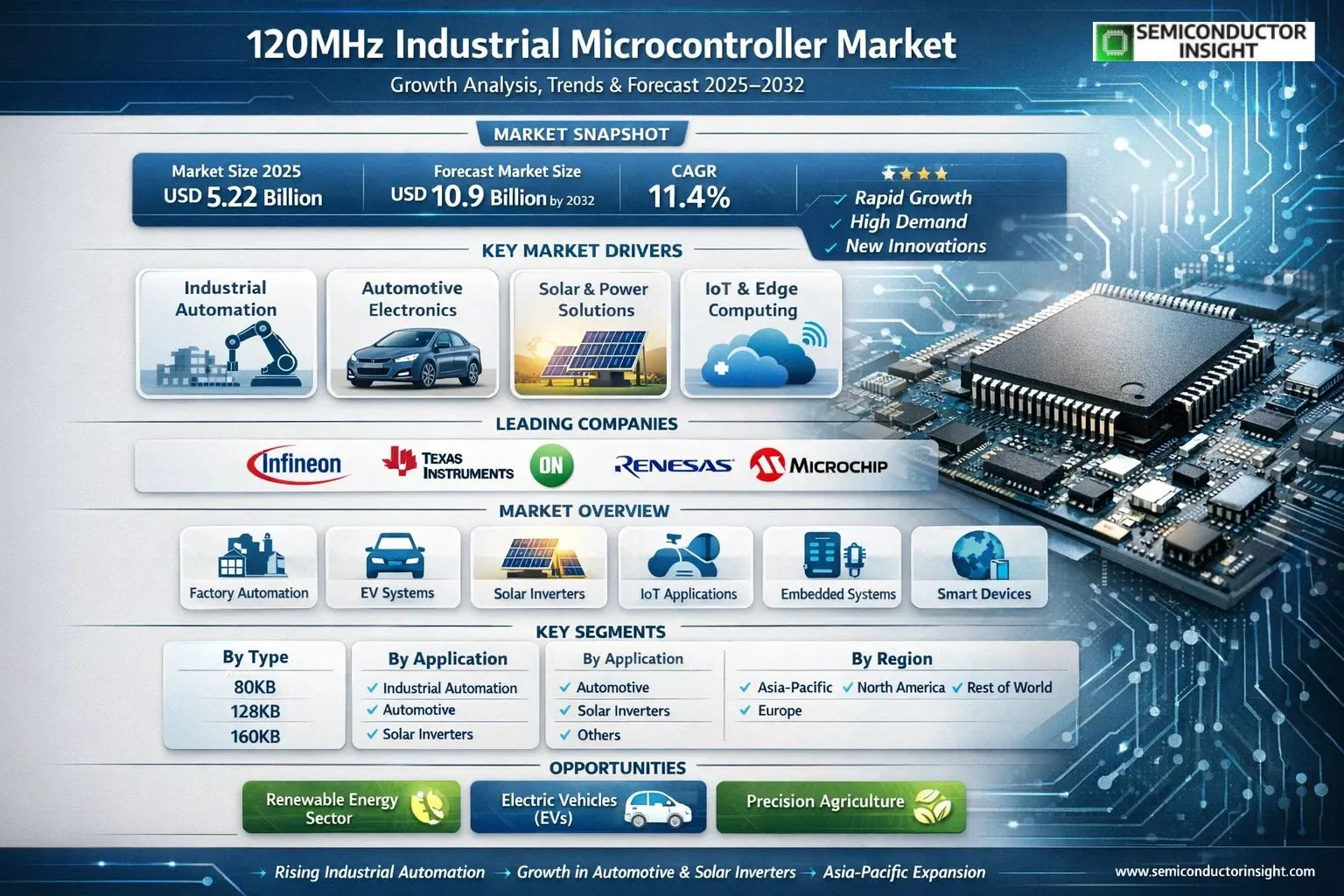
Global 120MHz Industrial Microcontroller market size was valued at USD 5.22 billion in 2025. The market is projected to reach USD 10.9 billion by 2032, exhibiting a CAGR of 11.4% during the forecast period.
120MHz industrial microcontroller is a type of microcontroller designed for use in industrial applications that operates at a maximum clock frequency of 120 megahertz (MHz). This frequency indicates the speed at which the microcontroller’s central processing unit (CPU) can execute instructions, influencing its performance in processing tasks.
The market is experiencing rapid growth due to several factors, including heightened demand for industrial automation, expansion in automotive electronics, and rising adoption in solar inverters and other power management systems. Additionally, advancements in semiconductor fabrication and the integration of IoT capabilities are contributing to market expansion. Initiatives by the key players in the market are also expected to fuel the growth. Infineon Technologies, Texas Instruments, ON Semiconductor, Renesas Electronics, STMicroelectronics, Microchip Technology, NXP Semiconductors, Analog Devices, Silicon Labs, and Maxim Integrated are some of the key players that operate in the market with a wide range of portfolios.
MARKET DRIVERS
Industry 4.0 Adoption Accelerates Demand
120MHz Industrial Microcontroller Market is propelled by the widespread adoption of Industry 4.0 technologies, where high-performance processors are essential for real-time data processing in smart factories. These microcontrollers, operating at 120MHz clock speeds, enable precise control in automation systems, supporting complex algorithms for predictive maintenance and machine learning at the edge. Market growth is evident as industrial automation spending reached approximately $200 billion globally in 2023, with microcontrollers forming a core component.
IoT Integration and Edge Computing
Integration with IoT ecosystems drives 120MHz Industrial Microcontroller Market, as devices require robust processing for handling multiple sensors and communication protocols simultaneously. At 120MHz, these MCUs deliver the computational power needed for edge analytics, reducing latency in industrial applications like robotics and process control. Recent trends show a 25% year-over-year increase in deployments for connected machinery.
➤ High-speed processing supports advanced HMI interfaces and vision systems, boosting operational efficiency by up to 30% in manufacturing environments.
Furthermore, the push for energy-efficient industrial solutions amplifies demand, with 120MHz industrial microcontrollers optimizing power usage through dynamic scaling, aligning with global sustainability goals in heavy industries.
MARKET CHALLENGES
Supply Chain Disruptions Impact Availability
120MHz Industrial Microcontroller Market faces significant hurdles from ongoing supply chain volatility, particularly shortages of semiconductor wafers and packaging materials, leading to production delays for end-users in automotive and manufacturing sectors. Pricing fluctuations have increased component costs by 15-20% in the past year, straining budgets for industrial upgrades.
Other Challenges
Compatibility and Legacy System Integration
Aging infrastructure in factories complicates the adoption of 120MHz industrial microcontrollers, requiring extensive retrofitting to interface with legacy protocols like Modbus. This integration challenge slows market penetration, as enterprises balance upgrade costs against performance gains.Additionally, cybersecurity vulnerabilities in connected industrial systems pose risks, demanding enhanced security features in these high-speed MCUs, which adds development complexity and time-to-market pressures.
MARKET RESTRAINTS
High Development and Certification Costs
Development expenses in 120MHz Industrial Microcontroller Market remain a key restraint, with rigorous certification processes for safety standards like IEC 61508 driving costs up by an average of 40% compared to consumer-grade MCUs. This deters smaller manufacturers from entering the space.Power consumption at elevated clock speeds, such as 120MHz, limits applications in battery-powered industrial devices, necessitating advanced low-power architectures that increase design complexity and extend time-to-market.Moreover, intense competition from lower-cost alternatives operating at 80-100MHz restricts premium pricing for 120MHz variants, capping market expansion in cost-sensitive regions like Asia-Pacific.Regulatory compliance for electromagnetic compatibility (EMC) further burdens the market, requiring iterative testing that can delay product launches by 6-12 months.
MARKET OPPORTUNITIES
Expansion in Renewable Energy and EVs
120MHz Industrial Microcontroller Market holds strong potential in renewable energy sectors, powering inverters and grid management systems that demand high-speed control for efficiency. With global solar installations projected to grow 20% annually, these MCUs enable precise power conversion and monitoring.Electric vehicle manufacturing presents another avenue, where 120MHz processing supports advanced motor control and battery management systems (BMS), aligning with the EV market’s 30% CAGR through 2030.Opportunities also emerge in precision agriculture, utilizing 120MHz industrial microcontrollers for automated irrigation and drone-based monitoring, tapping into a sector expected to reach $15 billion by 2028.
120MHz Industrial Microcontroller Market Trends
Increasing Demand in Industrial Automation
120MHz Industrial Microcontroller Market is witnessing robust growth driven by the expansion of industrial automation applications. These microcontrollers, operating at a maximum clock frequency of 120MHz, deliver high performance for processing complex tasks in factory settings. Key segments such as 80KB, 128KB, and 160KB RAM variants are gaining traction as manufacturers prioritize efficiency in programmable logic controllers and robotics. Leading players like Infineon Technologies and Texas Instruments are enhancing their portfolios to meet the needs of Industry 4.0 initiatives, where real-time data processing is critical.
Other Trends
Growth in Automotive and Solar Inverter Applications
Automotive applications represent a significant trend in 120MHz Industrial Microcontroller Market, with adoption in electric vehicle controls and advanced driver-assistance systems. Solar inverters also contribute notably, supporting renewable energy integration where high-speed execution handles power conversion efficiently. The “Others” category includes emerging uses in consumer electronics and medical devices, broadening the market scope beyond traditional industrial uses.
Regional Expansion Led by Asia-Pacific
Asia-Pacific regions, particularly China, Japan, and South Korea, are pivotal in shaping 120MHz Industrial Microcontroller Market trends through rapid industrialization and manufacturing hubs. North America and Europe follow with strong footholds in the U.S., Germany, and France, focusing on precision engineering. Global key manufacturers including Renesas Electronics, STMicroelectronics, NXP Semiconductors, and Microchip Technology are intensifying competition via product innovations and regional supply chain optimizations. This analysis, derived from surveys of manufacturers, suppliers, and industry experts, highlights sustained demand influenced by technological advancements and application diversification.
COMPETITIVE LANDSCAPE
Key Industry Players
Leading Manufacturers in 120MHz Industrial Microcontroller Market
120MHz Industrial Microcontroller Market exhibits a moderately concentrated structure, led by established semiconductor giants such as Infineon Technologies, Texas Instruments, and Renesas Electronics. These top-tier players command substantial revenue shares, with the global top five manufacturers collectively holding a dominant position in 2025. Infineon Technologies stands out with its robust portfolio of high-performance microcontrollers optimized for industrial applications, emphasizing reliability and real-time processing capabilities at 120MHz clock speeds. Texas Instruments follows closely, leveraging its extensive ecosystem of development tools and analog integration expertise to capture significant market segments like industrial automation and automotive controls. The market’s growth trajectory, from US$5,220 million in 2025 to a projected US$10,900 million by 2032 at a CAGR of 11.4%, underscores the competitive intensity driven by innovation in power efficiency and integration for demanding environments.
Beyond the frontrunners, niche players like ON Semiconductor, STMicroelectronics, and Microchip Technology contribute specialized offerings tailored to applications such as solar inverters and other industrial uses. NXP Semiconductors and Analog Devices provide advanced connectivity and signal processing features, enhancing microcontroller performance in automation and automotive sectors. Silicon Labs and Maxim Integrated focus on low-power, precise control solutions, while emerging Asian contenders including MindMotion and Artery Technology are expanding through cost-effective designs and regional supply chain strengths. This diverse competitive landscape fosters ongoing advancements in RAM configurations (e.g., 80KB, 128KB, 160KB segments) and regional demands, particularly in North America, Europe, and Asia-Pacific, compelling all players to prioritize R&D, strategic partnerships, and supply chain resilience to maintain market positioning.
List of Key 120MHz Industrial Microcontroller Companies Profiled
- Infineon Technologies
- Texas Instruments
- ON Semiconductor
- Renesas Electronics
- STMicroelectronics
- Microchip Technology
- NXP Semiconductors
- Analog Devices
- Silicon Labs
- Maxim Integrated
- MindMotion
- Artery Technology
Segment Analysis:
| Segment Category | Sub-Segments | Key Insights |
| By Type |
|
80KB
|
| By Application |
|
Industrial Automation
|
| By End User |
|
Manufacturing Plants
|
| By Package Type |
|
LQFP
|
| By Temperature Grade |
|
Industrial (-40°C to 85°C)
|
Regional Analysis: 120MHz Industrial Microcontroller Market
Asia-Pacific
Asia-Pacific’s dense cluster of semiconductor foundries and assembly plants underpins its supremacy in 120MHz Industrial Microcontroller Market. Efficient supply chains minimize lead times, enabling quick scaling for high-volume industrial demands in automation equipment.
Thriving R&D centers foster cutting-edge developments in high-speed processing for rugged applications. Collaborations between tech firms and academia yield resilient microcontroller designs optimized for extreme temperatures and vibrations prevalent in regional industries.
Widespread use in smart manufacturing and robotics highlights mature integration. The shift toward edge computing amplifies reliance on 120MHz capabilities for real-time control in expansive factory floors and automated assembly lines.
National strategies emphasizing technological sovereignty and green manufacturing incentivize domestic production of advanced microcontrollers, ensuring sustained momentum in 120MHz Industrial Microcontroller Market through targeted subsidies and infrastructure investments.
North America
North America exhibits strong dynamics in 120MHz Industrial Microcontroller Market, propelled by technological innovation and a focus on advanced automation. The U.S. and Canada lead in developing high-reliability solutions for aerospace, defense, and oil & gas sectors, where precise control in mission-critical systems is paramount. Venture capital inflows support startups pioneering energy-efficient designs, aligning with sustainability goals. Proximity to leading semiconductor designers facilitates rapid prototyping and customization for industrial IoT platforms. However, higher costs challenge scalability compared to Asia-Pacific peers. Regulatory emphasis on cybersecurity enhances microcontroller security features, fostering trust in connected industrial environments. As Industry 4.0 evolves, North America’s emphasis on software-hardware integration positions it for steady expansion through 2034.
Europe
Europe’s 120MHz Industrial Microcontroller Market thrives on stringent quality standards and a mature automotive sector. Germany, France, and Italy drive demand through precision engineering in machinery and renewable energy systems. EU directives on energy efficiency and data privacy spur adoption of high-performance, low-power variants ideal for smart grids and EV manufacturing. Collaborative research consortia accelerate hybrid microcontroller architectures blending analog and digital functions for complex industrial controls. Supply chain diversification efforts mitigate geopolitical risks, promoting localized production. The region’s focus on sustainable practices integrates eco-friendly materials into chip designs, aligning with circular economy principles. Steady growth is anticipated as digital twins and predictive maintenance gain traction in heavy industries up to 2034.
South America
South America shows emerging potential in 120MHz Industrial Microcontroller Market, centered on resource extraction and agribusiness modernization. Brazil and Argentina prioritize rugged solutions for mining equipment and precision agriculture, where real-time data processing optimizes operations in remote areas. Infrastructure investments facilitate broader IoT deployment in manufacturing hubs. Local assemblers adapt imported technologies for tropical climates, enhancing durability against humidity and dust. Economic stabilization supports increased imports of advanced chips, bridging technology gaps. Partnerships with global firms transfer knowledge, boosting domestic capabilities in embedded systems for industrial automation. Gradual maturation promises heightened activity as regional industries embrace digital transformation through 2034.
Middle East & Africa
The Middle East & Africa region in 120MHz Industrial Microcontroller Market is gaining traction via oil & gas diversification and urbanization projects. UAE and Saudi Arabia invest in smart city infrastructures requiring high-speed controllers for building automation and desalination plants. South Africa’s manufacturing revival incorporates these chips into process control for mining and utilities. Harsh environmental adaptations, such as heat-resistant packaging, are key differentiators. International collaborations introduce best practices in system integration, addressing skill shortages. Visionary economic plans accelerate adoption in renewable energy and logistics, fostering a nascent yet promising ecosystem poised for accelerated development toward 2034.
Report Scope
This market research report provides a comprehensive analysis of 120MHz Industrial Microcontroller Market, covering the forecast period 2025–2032. It offers detailed insights into market dynamics, technological advancements, competitive landscape, and key trends shaping the industry.
Key focus areas of the report include:
- Market Overview: The report begins with an overview outlining its current market scenario, key growth indicators, and industry transformation drivers. It discusses macroeconomic factors, demand–supply balance, regulatory landscape, and the strategic role of semiconductors in powering advancements across industries such as automotive, telecommunications, consumer electronics, and industrial automation.
- Market Size & Forecast: Historical data and future projections for revenue, unit shipments, and market value across major regions and segments.
- Segmentation Analysis: Detailed breakdown by product type, technology, application, and end-user industry to identify high-growth segments and investment opportunities.
- Regional Insights: Insights into market performance across North America, Europe, Asia-Pacific, Latin America, and the Middle East & Africa, including country-level analysis where relevant.
- Competitive Landscape: Profiles of leading market participants, including their product offerings, R&D focus, manufacturing capacity, pricing strategies, and recent developments such as mergers, acquisitions, and partnerships.
- Technology Trends & Innovation: Assessment of emerging technologies, integration of AI/IoT, semiconductor design trends, fabrication techniques, and evolving industry standards.
- Market Drivers & Restraints: Evaluation of factors driving market growth along with challenges, supply chain constraints, regulatory issues, and market-entry barriers.
- Stakeholder Insights: Insights for component suppliers, OEMs, system integrators, investors, and policymakers regarding the evolving ecosystem and strategic opportunities.
Primary and secondary research methods are employed, including interviews with industry experts, data from verified sources, and real-time market intelligence to ensure the accuracy and reliability of the insights presented.
FREQUENTLY ASKED QUESTIONS:
What is the current market size of 120MHz Industrial Microcontroller Market?
-> Global 120MHz Industrial Microcontroller market was valued at USD 5220 million in 2025 and is expected to reach USD 10900 million by 2032, at a CAGR of 11.4% during the forecast period.
Which key companies operate in 120MHz Industrial Microcontroller Market?
-> Key players include Infineon Technologies, Texas Instruments, ON Semiconductor, Renesas Electronics, STMicroelectronics, Microchip Technology, NXP Semiconductors, Analog Devices, Silicon Labs, Maxim Integrated, among others.
What are the key growth drivers?
-> Key growth drivers include demand in industrial automation, automotive, and solar inverters applications.
Which region dominates the market?
-> Asia is the fastest-growing region, while North America remains a significant market.
What are the emerging trends?
-> Emerging trends include segments by RAM such as 80KB, 128KB, and 160KB, and growth in renewable energy applications like solar inverters.

Get Sample Report PDF for Exclusive Insights
Report Sample Includes
- Table of Contents
- List of Tables & Figures
- Charts, Research Methodology, and more...
 Download Sample Report PDF