Temperature Measurement Sensor Market Insights
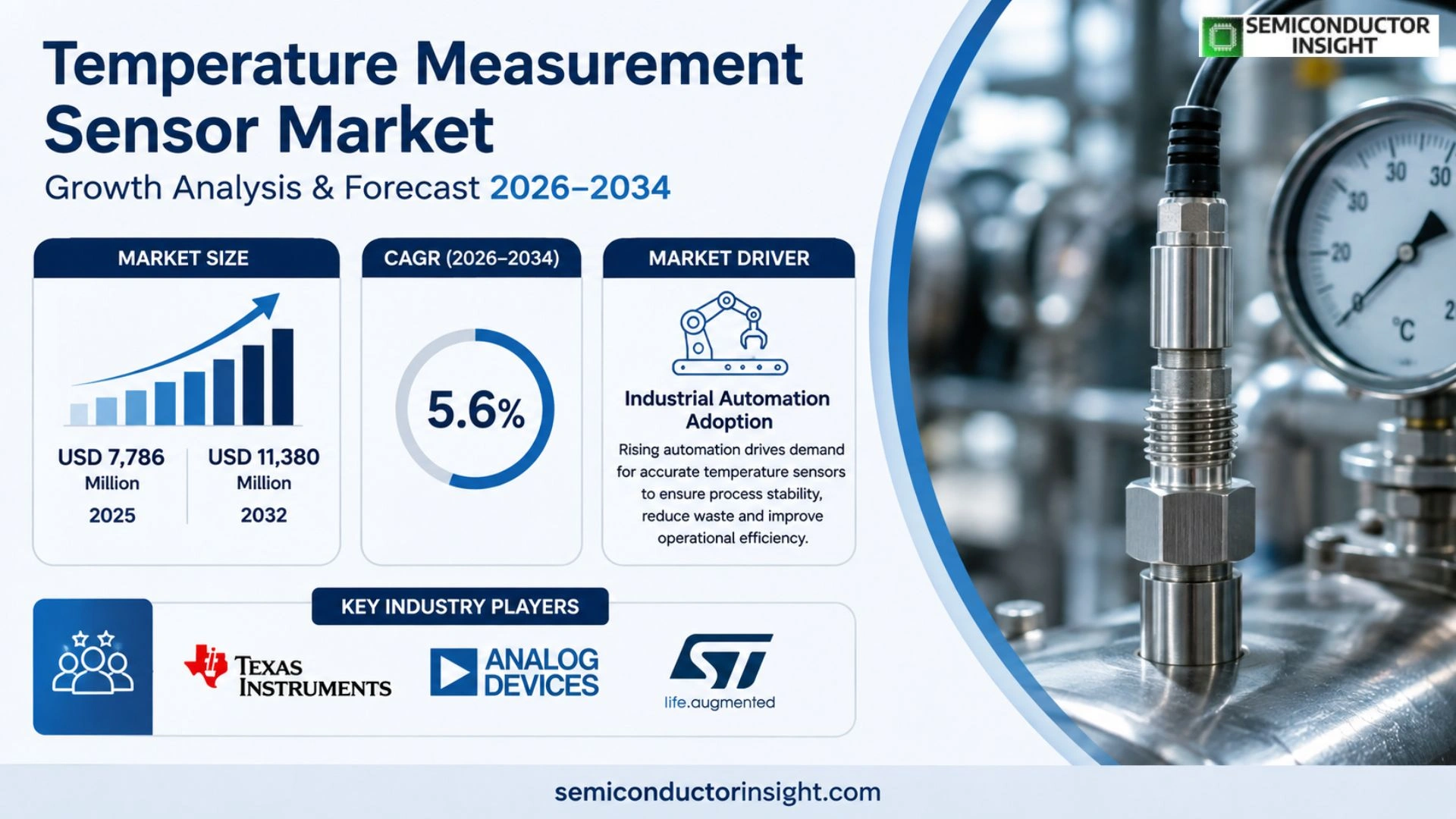
Temperature Measurement Sensor market size was valued at USD 7,786 million in 2026 and is expected to reach USD 11,380 million by 2034, reflecting a CAGR of 5.6% over the forecast period.
Temperature measurement sensors are components that translate the temperature of a target, medium or environment into an electrical output for monitoring or control purposes. The scope covers contact devices such as thermistors (NTC/PTC), resistance temperature detectors (RTDs), thermocouples and semiconductor/IC temperature sensors, together with non‑contact infrared solutions like thermopile or IR‑thermometer ICs; full thermostats, standalone data loggers and process transmitters are excluded unless the sensing element itself is sold.
The market gains momentum because electrified powertrains demand precise battery‑thermal management, data‑center operators require dense thermal monitoring to safeguard uptime, and industrial automation seeks tighter process control through additional temperature points. At the same time, manufacturers confront challenges in preserving long‑term accuracy across harsh environments, satisfying automotive (AEC‑Q) and medical certifications, and coping with cost pressure on commodity sensor tiers while differentiating through stability, drift performance and customized packaging.
MARKET DRIVERS
Industrial Automation Adoption
The surge in automated production lines has increased the reliance on precise thermal feedback. Manufacturers are integrating Temperature Measurement Sensor Market solutions to maintain process stability, reducing waste and boosting throughput. As factories pursue tighter tolerances, sensor accuracy becomes a competitive differentiator.
Regulatory Temperature Control Requirements
Stringent safety and emissions standards across automotive, aerospace, and food processing sectors compel firms to monitor temperature continuously. Compliance mandates have turned thermal monitoring from an optional add‑on into a mandatory component of product certifications, driving demand for high‑reliability sensors.
➤ End‑users are willing to pay a premium for sensors that combine robustness with low latency, because any downtime translates directly into revenue loss.
Beyond compliance, the rise of predictive maintenance programs encourages the deployment of sensors that feed real‑time data into analytics platforms. This shift not only improves equipment lifespan but also opens subscription‑based services, adding a new revenue stream for sensor manufacturers.
MARKET CHALLENGES
Supply Chain Volatility
Global shortages of specialty alloys and semiconductor wafers have elongated lead times for temperature sensing modules. Companies that cannot secure reliable component supplies face production bottlenecks, which erodes confidence among downstream OEMs.
Other Challenges
Cost Competitiveness
Price pressure from low‑cost entrants, especially in commodity applications, forces established players to streamline manufacturing while preserving performance, a balance that is increasingly difficult to achieve.
MARKET RESTRAINTS
Material Cost Pressures
Escalating costs of rare‑earth elements and high‑purity silicon directly inflate the bill of materials for premium temperature sensors. When material expenses outpace end‑user willingness to absorb price hikes, adoption rates can stall.
Furthermore, the need for rigorous testing and certification adds overhead that small‑scale suppliers struggle to amortize, limiting market entry for innovative but under‑capitalized firms.
These financial constraints also impact research budgets, slowing the rollout of next‑generation sensing technologies that could otherwise unlock new applications.
MARKET OPPORTUNITIES
Smart Manufacturing Integration
Industry 4.0 initiatives create a fertile environment for highly networked temperature sensors. Embedding sensors with edge‑computing capabilities enables localized decision‑making, reducing latency and bandwidth consumption.
Additionally, the expansion of renewable energy systems,particularly battery storage,requires robust thermal monitoring to prevent overheating events. Suppliers that tailor solutions for high‑energy‑density environments stand to capture a growing share of this niche.
The convergence of IoT platforms and advanced analytics presents a lucrative avenue for service‑based models. By offering continuous monitoring contracts, sensor vendors can generate recurring revenue while providing customers with actionable insights that enhance operational efficiency.
Temperature Measurement Sensor Market Trends
Electrified Powertrains and Data‑Center Thermal Management
The surge in electric‑vehicle adoption and the rollout of high‑capacity battery packs have turned temperature measurement from a peripheral component into a design cornerstone. Battery‑management systems now rely on continuous thermal feedback to protect cells from runaway, extend usable life, and optimise charging speed. In parallel, hyperscale data centers and edge‑computing clusters install dense arrays of infrared and semiconductor temperature sensors to guard against hot‑spot formation that can precipitate downtime. Manufacturers that embed calibrated sensor ICs directly onto power‑stage modules benefit from reduced board space and simplified calibration, enabling faster time‑to‑market for next‑generation platforms. This convergence of automotive electrification and digital‑infrastructure expansion lifts demand for both contact probes capable of withstanding harsh media and non‑contact IR devices for rapid surface checks.
Other Trends
Integration and Miniaturization
System‑level engineers increasingly press for sensor solutions that occupy minimal footprint while offering digital interfaces such as I²C or SPI. The trend encourages semiconductor firms to deliver temperature ICs that combine linearisation algorithms with built‑in self‑test features, reducing the need for external calibration equipment. At the same time, traditional RTDs and thermocouples are being packaged into micro‑probe assemblies that can be soldered directly onto printed‑circuit boards, delivering higher accuracy in confined spaces. This shift not only cuts assembly labor but also improves repeatability across high‑volume production runs, a factor that resonates with automotive Tier‑1s and consumer‑electronics OEMs alike.
Supply Chain and Certification Pressures
While price sensitivity remains acute, the decisive factor for many end‑users is long‑term reliability under demanding standards such as AEC‑Q100 for automotive or IEC 60601 for medical devices. Qualification cycles now span multiple years, compelling sensor suppliers to invest in robust material sourcing,high‑purity platinum, corrosion‑resistant alloys, and low‑drift semiconductors. Companies that can demonstrate traceable material certification and consistent drift performance gain a competitive edge, especially when OEMs seek multi‑sourcing options to mitigate geopolitical risk. Additionally, the rise of cyber‑physical systems introduces requirements for electromagnetic compatibility and secure firmware updates, prompting vendors to embed hardened interfaces and long‑term product‑life guarantees into their portfolios.
COMPETITIVE LANDSCAPE
Key Industry Players
Temperature Measurement Sensor Market – Competitive Overview
Texas Instruments, Analog Devices and STMicroelectronics together capture a sizable share of the global temperature‑sensor market. Their dominance stems from deep semiconductor expertise, extensive automotive‑qualifications (AEC‑Q100, ISO‑26262) and the ability to integrate analog front‑ends with digital interfaces, which shortens design cycles for Tier‑1 OEMs. Both firms have broadened their portfolios beyond classic NTC thermistors to include high‑accuracy CMOS‑based ICs and ruggedized probe assemblies that meet the stringent drift‑over‑life requirements of electric‑vehicle battery‑management systems. This concentration at the top forces midsize manufacturers to either specialize in niche temperature ranges,such as cryogenic RTDs,or to compete on cost‑effective commodity thermistors, where margin compression is acute. The overall structure therefore resembles a tiered ecosystem: a handful of vertically integrated leaders, a second tier of diversified component houses, and a long tail of application‑specific makers that address medical‑grade skin‑contact sensors or industrial‑process probes.
Beyond the three market leaders, a broader set of players is shaping segment growth. TDK and Littelfuse leverage their passive‑component heritage to supply high‑precision thermistors for consumer electronics, while Sensata and TE Connectivity dominate the probe‑assembly space for automotive HVAC and power‑train cooling. Amphenol, Molex and Honeywell focus on ruggedized connectors and sealed sensor modules for oil‑&‑gas and aerospace applications. Siemens, ABB and Panasonic offer system‑level temperature‑monitoring solutions that integrate directly with PLCs and SCADA platforms. Specialty firms such as Fluke, Delphi and OMRON provide calibrated reference instruments and field‑service kits, whereas Microchip Technology and ON Semiconductor continue to push low‑power digital temperature ICs for edge‑computing devices. Medical‑device oriented suppliers,including Medtronic, Medline Industries and 3M,address disposable skin‑contact sensors that meet stringent regulatory standards, completing a competitive tapestry that spans pure silicon manufacturers to system integrators.
List of Key Temperature Measurement Sensor Companies Profiled
- Texas Instruments
- Analog Devices
- STMicroelectronics
- TDK
- Littelfuse
- Sensata Technologies
- Amphenol
- TE Connectivity
- Molex
- Honeywell
- Siemens
- ABB
- Panasonic
- Fluke
- Delphi Technologies
- OMRON
- Microchip Technology
- ON Semiconductor
- 3M
- MEDTRONIC
- Medline Industries
Segment Analysis:
| Segment Category | Sub-Segments | Key Insights |
| By Type |
|
Contact Sensors remain the leading segment because they deliver proven accuracy and can be engineered for extreme temperature ranges.
|
| By Application |
|
Automotive & Energy dominate application‑level demand as system designers prioritize thermal safety and performance.
|
| By End User |
|
Automotive OEMs are the primary end‑user group, driven by stringent reliability standards and long product lifecycles.
|
| By Technology Integration |
|
Digital Temperature ICs are emerging as the preferred integration path because they simplify system design and support automated calibration.
|
| By Market Drivers |
|
Electrification acts as a catalyst for sensor adoption, as temperature directly influences performance, safety and longevity.
|
Regional Analysis: Temperature Measurement Sensor Market
North America
Manufacturers are retrofitting assembly lines with sensors that can survive harsh thermal cycles while delivering millidegree accuracy. The drive toward autonomous production lines means temperature data is now a core input for machine‑learning models that adjust process parameters on the fly, translating into tighter quality control and reduced warranty claims.
Electrified powertrains demand thermal monitoring that can withstand rapid temperature fluctuations. Sensor vendors are focusing on compact, low‑weight designs that integrate directly into battery management systems, supporting manufacturers’ goals of extending driving range while safeguarding component lifespan.
Clinical equipment manufacturers are embedding precise temperature sensors to meet stringent patient‑safety standards. The trend toward portable diagnostic tools amplifies the need for sensors that combine high fidelity with minimal power consumption, influencing procurement decisions in hospital networks.
Power generation facilities are upgrading turbine and substation monitoring suites, recognizing that granular thermal data can preempt equipment fatigue. The move towards renewable integration further fuels demand for sensors that operate reliably across wider temperature envelopes.
Europe
European manufacturers are leveraging the region’s strong standards framework to differentiate sensor offerings through compliance certifications. Energy‑efficiency directives compel industrial plants to adopt continuous temperature monitoring, creating a niche for suppliers that can certify low‑emission performance. Moreover, collaboration between automotive clusters in Germany and sensor innovators accelerates the rollout of thermally resilient components for electric vehicles, reinforcing Europe’s reputation for high‑quality, safety‑focused solutions.
Asia‑Pacific
The Asia‑Pacific arena is characterized by rapid capacity expansion in electronics assembly and heavy‑industry fabrication. While cost considerations dominate, there is a palpable shift toward higher‑precision sensors as multinational firms establish regional R&D hubs. Nations such as China and South Korea are investing heavily in smart‑factory initiatives, prompting a transition from basic temperature probes to networked, analytics‑ready devices that can be integrated into broader Industry 4.0 ecosystems.
South America
In South America, emerging investments in agro‑processing and mineral extraction are reshaping demand for robust temperature monitoring. Companies operating in Brazil and Chile are prioritizing sensors that can endure corrosive environments while delivering reliable data for process optimization. The region’s growing emphasis on export‑grade product consistency is driving adoption of sensors that support stringent quality‑assurance protocols.
Middle East & Africa
The Middle East & Africa sees temperature sensing applications expanding beyond oil & gas, into data‑center cooling and renewable‑energy projects. Harsh ambient conditions demand sensors with exceptional thermal stability and resistance to dust ingress. As regional governments invest in smart‑city infrastructure, there is a rising appetite for sensors that integrate with building‑management platforms, offering both energy‑saving insights and operational resilience.
Report Scope
This market research report provides a comprehensive analysis of the Temperature Measurement Sensor Market , covering the forecast period 2026–2034. It offers detailed insights into market dynamics, technological advancements, competitive landscape, and key trends shaping the industry.
Key focus areas of the report include:
- Market Overview: The report begins with an overview outlining its current market scenario, key growth indicators, and industry transformation drivers. It discusses macroeconomic factors, demand–supply balance, regulatory landscape, and the strategic role of semiconductors in powering advancements across industries such as automotive, telecommunications, consumer electronics, and industrial automation.
- Market Size & Forecast: Historical data and future projections for revenue, unit shipments, and market value across major regions and segments.
- Segmentation Analysis: Detailed breakdown by product type, technology, application, and end-user industry to identify high-growth segments and investment opportunities.
- Regional Insights: Insights into market performance across North America, Europe, Asia-Pacific, Latin America, and the Middle East & Africa, including country-level analysis where relevant.
- Competitive Landscape: Profiles of leading market participants, including their product offerings, R&D focus, manufacturing capacity, pricing strategies, and recent developments such as mergers, acquisitions, and partnerships.
- Technology Trends & Innovation: Assessment of emerging technologies, integration of AI/IoT, semiconductor design trends, fabrication techniques, and evolving industry standards.
- Market Drivers & Restraints: Evaluation of factors driving market growth along with challenges, supply chain constraints, regulatory issues, and market-entry barriers.
- Stakeholder Insights: Insights for component suppliers, OEMs, system integrators, investors, and policymakers regarding the evolving ecosystem and strategic opportunities.
Primary and secondary research methods are employed, including interviews with industry experts, data from verified sources, and real-time market intelligence to ensure the accuracy and reliability of the insights presented.
FREQUENTLY ASKED QUESTIONS:
What is the current market size of Temperature Measurement Sensor Market?
-> Temperature Measurement Sensor Market size was valued at USD 8.21 billion in 2026 to USD 11.38 billion by 2034, exhibiting a CAGR of 5.6%
Which key companies operate in Temperature Measurement Sensor Market?
-> Key players include Texas Instruments, Analog Devices, STMicroelectronics, TDK, Littelfuse, Emerson, Sensata, Amphenol, TE Connectivity, Molex, Honeywell, Siemens, ABB, Panasonic, Fluke, Delphi, OMRON, Microchip Technology, ON Semiconductor, 3M, MEDTRONIC, and Medline Industries.
What are the key growth drivers?
-> Key growth drivers include the rapid electrification of powertrains and high‑power batteries, expansion of power electronics and fast‑charging infrastructure, growth of data‑centers and edge‑computing requiring dense thermal monitoring, tighter industrial process control and predictive maintenance, and increased adoption of wearable medical devices needing accurate skin‑contact temperature sensing.
Which region dominates the market?
-> Asia‑Pacific currently holds the largest market share, driven by strong automotive electrification programs, extensive consumer electronics manufacturing, and large‑scale data‑center deployment, while North America and Europe also show robust growth.
What are the emerging trends?
-> Emerging trends include integration of digital interfaces and calibration‑free temperature ICs, miniaturized semiconductor temperature sensors co‑existing with traditional RTDs and thermocouples, and the development of application‑specific, ruggedized probe assemblies for harsh industrial and medical environments.

Get Sample Report PDF for Exclusive Insights
Report Sample Includes
- Table of Contents
- List of Tables & Figures
- Charts, Research Methodology, and more...
 Download Sample Report PDF