
Temperature Compensated Xtal Oscillator Market Insights
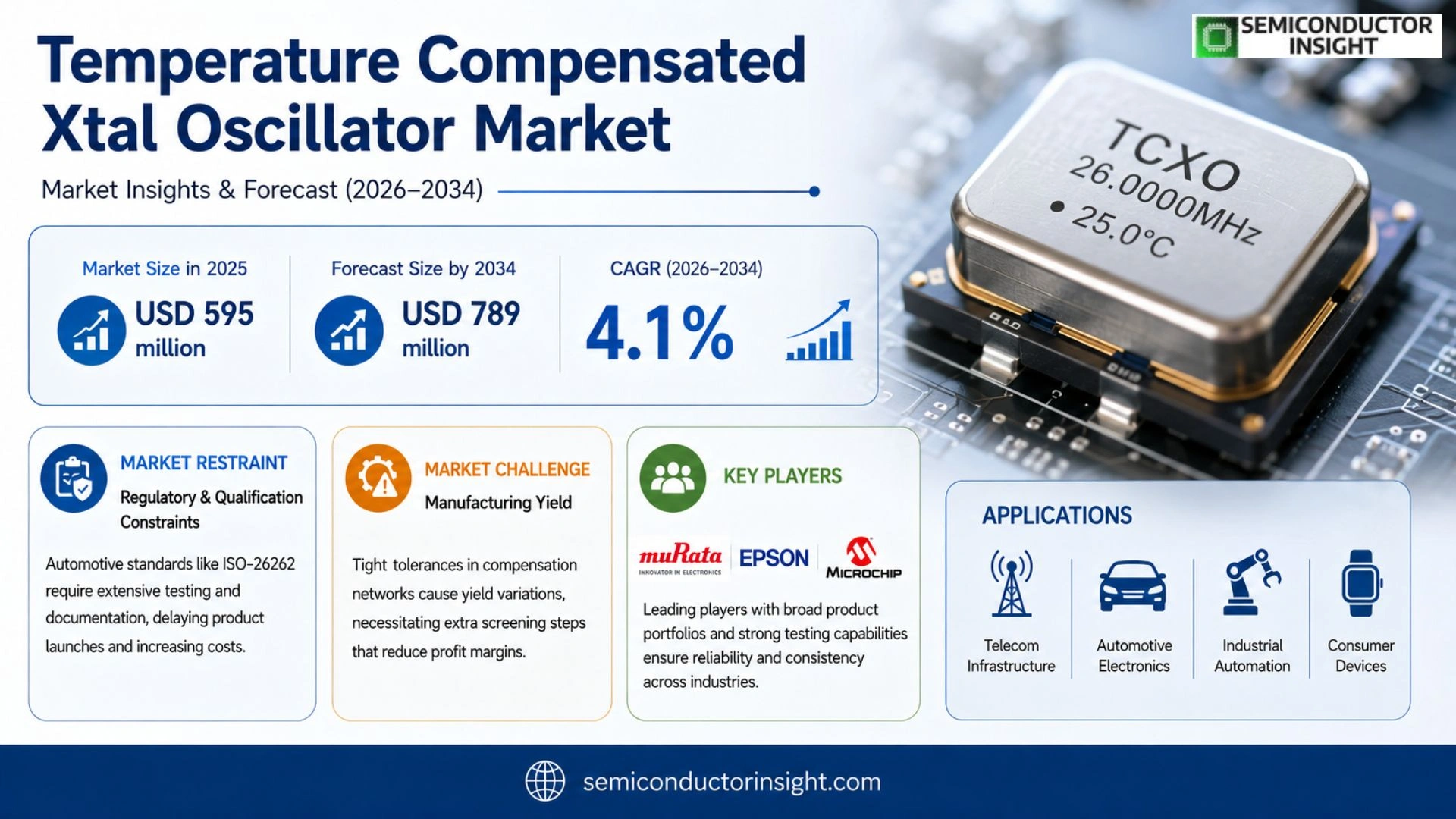
Global Temperature Compensated Xtal Oscillator market size was valued at USD 595 million in 2025 and will grow to USD 789 million by 2034, reflecting a CAGR of 4.1 % over the forecast period.
A Temperature Compensated Crystal Oscillator (TCXO) is a quartz‑based timing device that stabilises frequency across temperature variations by embedding a temperature sensor and compensation network within the oscillator architecture. The crystal resonator provides the frequency‑selective element while analog or digitally assisted correction circuitry mitigates drift caused by ambient swings, self‑heating or thermal transients, delivering predictable stability without the power or size penalties of oven‑controlled solutions.
The market expands because wireless modules, GNSS positioning, industrial IoT and test‑and‑measurement equipment demand tighter phase‑noise and short‑term stability. Consumer electronics remain the largest segment, yet automotive and aerospace applications are pushing higher‑grade TCXOs for reliability across wide temperature ranges. Leading vendors such as Microchip, SiTime, Renesas and Murata differentiate through family portfolios covering PIN and SMD packages, multiple voltage grades and digital calibration features, while customers increasingly require dual‑sourcing and clear substitution rules to manage long‑term platform qualification.
MARKET DRIVERS
Demand for High‑Precision Timing
Designers of wireless infrastructure and advanced automotive electronics increasingly require timing accuracy that remains stable across temperature swings. Temperature Compensated Xtal Oscillator Market benefits because manufacturers can replace bulkier temperature‑controlled crystal solutions with a single, calibrated device, reducing board space and power draw.
Cost‑Effective Integration
Supply‑chain pressures have pushed OEMs toward components that combine performance and affordability. Integrated temperature‑compensated oscillators meet that need by eliminating ancillary temperature sensors and control loops, which translates into lower Bill‑of‑Materials for smartphones, wearables, and industrial controllers.
➤ “Clients are choosing temperature‑compensated crystals because they deliver the same jitter profile as oven‑controlled units at a fraction of the cost.”
In addition, the migration toward 5G radio modules has amplified the importance of stable reference clocks. As carrier aggregation expands, timing drift becomes a source of signal degradation; therefore, Temperature Compensated Xtal Oscillator Market experiences a natural uplift from telecom equipment upgrades.
MARKET CHALLENGES
Technical Barriers to Miniaturization
While device footprints shrink, achieving the same level of temperature stability in a smaller package remains difficult. Engineers must balance crystal cut, package material, and compensation algorithm, which can lengthen development cycles and increase test overhead.
Other Challenges
Manufacturing Yield
Yield variations arise from tight tolerances on the compensation network. Even a minor deviation in resistor values can shift the temperature coefficient, forcing manufacturers to implement additional screening steps that erode profit margins.
MARKET RESTRAINTS
Regulatory and Qualification Constraints
Automotive safety standards such as ISO‑26262 and functional‑safety qualifications demand extensive documentation and testing for every timing component. The time and expense needed to certify temperature‑compensated oscillators delay product launches, especially for Tier‑1 suppliers serving global OEMs.
Similarly, aerospace programs impose stringent environmental tests that many low‑cost crystal solutions cannot survive without redesign, limiting the addressable market for certain high‑reliability segments.
MARKET OPPORTUNITIES
Emerging Automotive and IoT Segments
Advanced driver‑assistance systems (ADAS) and electric‑vehicle power‑train controllers rely on precise clock references to synchronize sensors and power electronics. The shift toward electric mobility therefore opens a sizable niche for temperature‑compensated oscillators that can operate from –40 °C to 150 °C without external heating.
At the same time, the proliferation of edge‑computing nodes in industrial IoT environments creates demand for rugged timing sources that function reliably in harsh temperature ranges. Companies that can bundle the oscillator with a simple calibration interface stand to capture a growing share of that market.
Finally, emerging standards for 6G research call for sub‑nanosecond jitter performance. Early entrants that adapt compensation algorithms to meet those specifications may secure strategic partnerships with telecom vendors before the next generation of network equipment is mass‑produced.
Temperature Compensated Xtal Oscillator Market Trends
Shift Toward Digitally Assisted Compensation
The most visible evolution in Temperature Compensated Xtal Oscillator Market is the migration from purely analog temperature‑compensation networks to digitally assisted schemes. Manufacturers are embedding fine‑grained temperature lookup tables and on‑chip calibration engines, which permit real‑time correction of frequency drift without increasing quiescent current. This approach aligns with the broader push for lower supply voltages and smaller footprints in wearable and edge‑computing devices. Because the digital logic can be updated via firmware, designers gain the ability to fine‑tune performance after silicon tape‑out, reducing costly redesign cycles. The net effect is a higher value proposition for system integrators that need both tight phase‑noise specifications and aggressive power budgets.
Other Trends
Industrial IoT and Automotive Adoption
Industrial and automotive platforms are demanding tighter full‑temperature stability as sensors and control loops become more latency‑sensitive. In factory automation, a drift of even a few parts per million can translate into timing errors that disrupt synchronized motion control. Automotive infotainment and advanced driver‑assistance systems similarly rely on precise clock references to maintain GNSS lock and high‑speed Ethernet timing. TCXOs that combine a compact SMD package with a 1.8 V supply and a digitally calibrated temperature profile are increasingly specified over older oven‑controlled parts because they offer comparable jitter at a fraction of the power and board‑space cost. This preference is prompting Tier‑1 suppliers to expand their portfolio of industrial‑grade devices, often with stricter qualification documentation to satisfy long‑term availability requirements.
Supply Chain Consolidation and Dual‑Sourcing Strategies
On the supply side, the market is moving toward a tighter group of tier‑1 vendors that can guarantee consistent compensation curves across multiyear production runs. Clients are insisting on dual‑sourcing agreements that include clear substitution rules, which pushes smaller manufacturers to align their process windows with the dominant players or risk being excluded from high‑volume programs. The result is a gradual reduction in SKU proliferation, allowing foundries to optimise test‑and‑binning throughput while maintaining the 20‑30 % gross‑margin envelope observed in 2025. For end users, this trend translates into reduced lead‑times and more predictable total‑cost‑of‑ownership calculations, especially for platforms that undergo frequent hardware refresh cycles.
COMPETITIVE LANDSCAPE
Key Industry Players
Competitive Dynamics in the Global TCXO Market
The TCXO arena is dominated by a handful of firms that command the bulk of volume across consumer, telecom and industrial segments. Murata, Epson and Microchip each run extensive product families that span from tiny SMD packages to rugged military‑grade units, leveraging deep quartz‑processing expertise and large‑scale test infrastructure to guarantee lot‑to‑lot consistency. Their platforms are embedded in the reference clocks of most smartphones, Wi‑Fi modules and GNSS receivers, granting them leverage in price negotiations and long‑term supply contracts. The market exhibits a clear tiered structure: top‑tier vendors provide a full spectrum of voltage options, temperature grades and output configurations, while mid‑tier suppliers focus on niche grades such as low‑power or high‑stability variants to serve specific automotive and aerospace programs. This segmentation forces OEMs to adopt dual‑sourcing strategies, balancing cost against performance guarantees.
Beyond the giants, a cohort of specialized manufacturers adds depth to the competitive picture. Companies like NEL Frequency Controls, Bliley Technologies and Abracon differentiate through bespoke compensation algorithms and rapid‑turnaround calibration services, targeting high‑precision test‑and‑measurement equipment and secure‑communications gear. Rakon, TXC and SiTime have invested heavily in digitally assisted compensation, offering DTCXO products that meet the tightening jitter and phase‑noise budgets of emerging 5G and edge‑AI hardware. Regional players such as Kyocera (Japan) and CTS Corp (USA) sustain local supply chains, while newcomers like Taitien and NEL leverage advanced packaging to compete on miniaturization. Their agility allows them to capture niche orders that larger firms may overlook, reinforcing a competitive environment where innovation at the component level can translate into meaningful market share gains.
List of Key Temperature Compensated Xtal Oscillator Companies Profiled
- Murata Manufacturing Co., Ltd.
- Epson Corporation
- Microchip Technology Inc.
- SiTime Corporation
- Renesas Electronics Corp.
- Kyocera Corporation
- Murata
- Rakon Limited
- TXC Corporation
- Nihon Dempa Kogyo (NDK)
- onsemi
- CTS Corp.
- Taitien Electronic Co., Ltd.
- NEL Frequency Controls
- Bliley Technologies
- Abracon LLC
Segment Analysis:
| Segment Category | Sub-Segments | Key Insights |
| By Type |
|
PIN Shape is emerging as the preferred configuration for high‑performance timing modules due to its superior thermal coupling and mechanical stability.
|
| By Application |
|
Telecom Infrastructure drives the bulk of TCXO adoption because network equipment demands tight phase‑noise performance and unwavering frequency stability across harsh environmental conditions.
|
| By End User |
|
Consumer Electronics remains the dominant end‑user group, leveraging TCXOs for smartphones, wearables, and portable media devices that require compact size without sacrificing stability.
|
Regional Analysis: Temperature Compensated Xtal Oscillator Market
Europe
European directives on electromagnetic compatibility and automotive functional safety exert a decisive influence on oscillator design. Vendors that embed built‑in‑self‑test capabilities and traceable calibration data enjoy smoother certification pathways, reducing project friction for OEMs.
End‑users across automotive, industrial automation and telecom sectors demand devices that retain frequency accuracy from sub‑zero conditions to extreme heat. The ability to guarantee low phase noise under thermal stress differentiates winning suppliers.
Proximity to silicon fabs and packaging houses allows European firms to iterate designs within weeks rather than months. This agility supports rapid response to emerging standards such as 5G NR timing requirements.
Collaborative research programs between universities and equipment makers foster breakthroughs in temperature‑compensation algorithms, feeding directly into next‑generation oscillator families.
North America
North America balances a strong defense sector with a fast‑moving consumer electronics landscape. Military contracts regularly stipulate stringent jitter and drift specifications, prompting suppliers to embed redundant calibration loops. Simultaneously, the proliferation of edge‑compute nodes in data‑center environments creates a distinct demand for oscillators that can operate reliably across fluctuating thermal zones in densely packed servers. Companies that can service both high‑volume commodity and niche defence applications capture a wider revenue base.
Asia‑Pacific
The Asia‑Pacific region thrives on scale. Massive manufacturing hubs in China, South Korea, and Taiwan drive volume orders for timing solutions that meet diverse climate profiles, from tropical humidity to harsh desert heat. OEMs prioritize cost‑effective designs without sacrificing the core temperature‑compensation attributes required for automotive infotainment and smart‑city infrastructure. Localization of design services enables regional players to adapt global oscillator platforms to local regulatory nuances swiftly.
South America
In South America, the market is still coalescing around industrial automation and renewable‑energy projects. Wind‑farm controllers and solar‑inverter systems rely on stable frequency references to synchronize grid interconnections. Suppliers that can provide robust temperature‑stable devices while navigating import‑tariff complexities gain a competitive edge, especially as regional utilities invest in smarter grid architectures.
Middle East & Africa
The Middle East & Africa region presents a distinctive thermal challenge, with ambient temperatures often exceeding typical design envelopes. Oil‑and‑gas installations and emerging telecom back‑haul networks demand oscillators that maintain accuracy in extreme heat. Vendors focusing on hardened packaging and extended temperature ranges find receptive customers eager to mitigate downtime caused by frequency drift.
Report Scope
This market research report provides a comprehensive analysis of the Temperature Compensated Xtal Oscillator Market , covering the forecast period 2026–2034. It offers detailed insights into market dynamics, technological advancements, competitive landscape, and key trends shaping the industry.
Key focus areas of the report include:
- Market Overview: The report begins with an overview outlining its current market scenario, key growth indicators, and industry transformation drivers. It discusses macroeconomic factors, demand–supply balance, regulatory landscape, and the strategic role of semiconductors in powering advancements across industries such as automotive, telecommunications, consumer electronics, and industrial automation.
- Market Size & Forecast: Historical data and future projections for revenue, unit shipments, and market value across major regions and segments.
- Segmentation Analysis: Detailed breakdown by product type, technology, application, and end-user industry to identify high-growth segments and investment opportunities.
- Regional Insights: Insights into market performance across North America, Europe, Asia-Pacific, Latin America, and the Middle East & Africa, including country-level analysis where relevant.
- Competitive Landscape: Profiles of leading market participants, including their product offerings, R&D focus, manufacturing capacity, pricing strategies, and recent developments such as mergers, acquisitions, and partnerships.
- Technology Trends & Innovation: Assessment of emerging technologies, integration of AI/IoT, semiconductor design trends, fabrication techniques, and evolving industry standards.
- Market Drivers & Restraints: Evaluation of factors driving market growth along with challenges, supply chain constraints, regulatory issues, and market-entry barriers.
- Stakeholder Insights: Insights for component suppliers, OEMs, system integrators, investors, and policymakers regarding the evolving ecosystem and strategic opportunities.
Primary and secondary research methods are employed, including interviews with industry experts, data from verified sources, and real-time market intelligence to ensure the accuracy and reliability of the insights presented.
FREQUENTLY ASKED QUESTIONS:
What is the current market size of Temperature Compensated Xtal Oscillator Market?
-> Temperature Compensated Xtal Oscillator market will grow to USD 789 million by 2034, reflecting a CAGR of 4.1 % over the forecast period.
Which key companies operate in Temperature Compensated Xtal Oscillator Market?
-> Key players include Microchip, Epson, SiTime, Renesas, Kyocera Corporation, Murata, Rakon, TXC Corporation, Nihon Dempa Kogyo, Onsemi, CTS Corp, Taitien, NEL Frequency Controls, Bliley Technologies, Abracon, among others.
What are the key growth drivers?
-> Key growth drivers include the continued proliferation of wireless connectivity, expanding positioning and timing functions in consumer and industrial devices, upgrades in automotive and industrial platforms requiring stable temperature performance, and the shift toward miniaturized, low‑power timing solutions.
Which region dominates the market?
-> Asia-Pacific remains the largest and fastest‑growing region, driven by high demand for mobile communications, IoT devices, and automotive electronics.
What are the emerging trends?
-> Emerging trends include miniaturization to smaller package sizes, lower supply voltages, digitally assisted compensation (DTCXO), tighter integration with PLLs and clock distribution networks, and increased co‑application guidance to improve system‑level jitter and phase‑noise performance.
Get Sample Report PDF for Exclusive Insights
Report Sample Includes
- Table of Contents
- List of Tables & Figures
- Charts, Research Methodology, and more...
 Download Sample Report PDF




