Probe Card Market Insights
Probe Card market was valued at USD 3,324 million in 2025 and is expected to reach USD 6,940 million by 2034, reflecting a compound annual growth rate of 9.1 %.
Semiconductor probe cards serve as the essential interface consumables that link test equipment with wafers during chip‑on‑wafer (COW) testing. By contacting solder pads or bumps via precision probestypically made from tungsten, rhenium‑tungsten or beryllium copperthey transmit electrical signals for functional and parametric verification, allowing defective dies to be screened out before packaging and thereby protecting yield.The expansion of high‑performance computing, automotive electronics and advanced packaging drives demand for higher‑density, high‑frequency probe cards capable of sub‑20 µm pitch operation. Material cost volatilityespecially for probes that represent roughly half of a card’s bill of materialsencourages domestic substitution strategies such as beryllium‑copper alloys and ceramic substrates. Leading suppliers including Technoprobe S.p.A., FormFactor, Micronics Japan (MJC) and MPI Corporation continue investing in MEMS micro‑fabrication equipment and automated placement systems to meet tighter tolerances required by sub‑5 nm nodes.
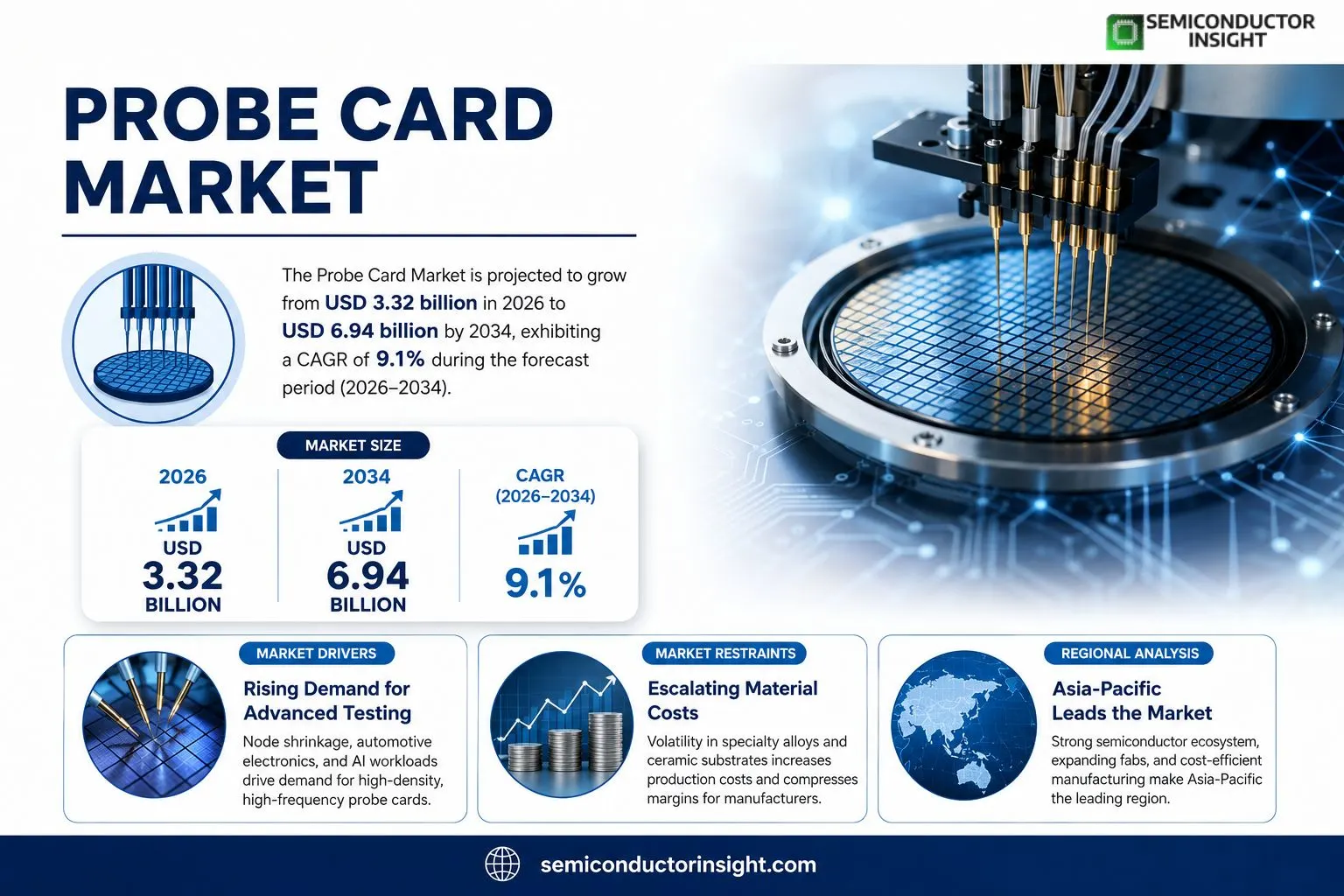
MARKET DRIVERS
Rising Demand for Advanced Semiconductor Testing
The acceleration of logic‑node shrinkage below 10 nm forces OEMs to adopt wafer‑level test solutions that can verify electrical performance without compromising yield. Probe Card Market players that offer finer pitch and higher pin‑count capabilities are therefore benefitting from a surge in equipment orders as fabs chase tighter defect budgets.
Shift Toward High‑Density Interconnects
Emerging packaging formats such as fan‑out wafer‑level packaging (FOWLP) and system‑in‑package (SiP) require probe cards capable of accessing tens of thousands of contact points per die. Companies that can integrate flexible‑substrate probes into their product lines are seeing double‑digit revenue growth driven by OEMs seeking faster time‑to‑market.
➤ “Precision probing has become the decisive factor in capital allocation for leading semiconductor fabs.”
Beyond technology, regional expansion of semiconductor fabs in Southeast Asia creates a new customer base eager for locally supported services. This geographic diversification reduces lead times and strengthens the competitive positioning of firms that have established Asian footprint.
MARKET CHALLENGES
Escalating Cost of Materials
High‑purity quartz and specialty alloys used in probe card fabrication have risen sharply in price, compressing margins for manufacturers that rely on volume discounts. Probe Card Market therefore faces a cost‑pressure cycle that can delay capital‑budget approvals from end‑users.
Other Challenges
Supply‑Chain Constraints
Limited capacity at a handful of certified vendors for ultra‑thin shank probes creates bottlenecks, especially during peak test‑season demand spikes. Buyers often resort to multi‑source strategies that increase procurement complexity and inventory holding costs.
MARKET RESTRAINTS
Stringent Reliability Standards
Automotive‑grade and aerospace‑grade applications impose failure‑rate thresholds below 10⁻⁹, compelling probe card suppliers to invest heavily in qualification testing. The heightened compliance burden discourages smaller entrants and narrows the competitive set within Probe Card Market.
MARKET OPPORTUNITIES
Emergence of 3D‑Stacked Chip Architectures
Three‑dimensional integration introduces through‑silicon vias (TSVs) that demand probe cards with vertical access capabilities. Innovators that can deliver modular probe solutions for TSV testing stand to capture a fast‑growing niche, as designers increasingly adopt 3D stacking to overcome planar density limits.
Probe Card Market Trends
Rising Demand from Advanced Node Testing
The shift toward sub‑5 nm logic and 3‑D packaging has forced semiconductor manufacturers to tighten test tolerances. Because probe cards translate electrical signals from wafer‑level pads to test instruments, their geometry must support pitches below 20 µm while preserving signal integrity. In 2025, Probe Card Market supplied roughly 278 481 K pins at an average price of $13.07 each, reflecting the premium placed on precision. As node dimensions shrink, a single defect detected early can save millions in downstream rework, which explains why fabs are allocating a larger share of testing budgets to high‑performance probe solutions. This trend pushes vendors to accelerate MEMS‑based designs that offer sub‑micron alignment, directly influencing capital‑expenditure cycles for test equipment suppliers and reshaping the competitive landscape of Probe Card Market.
Other Trends
Material Cost Volatility and Localization
Probesprimarily tungsten, rhenium‑tungsten alloys, and beryllium‑copperrepresent about half of a card’s bill of materials. Recent fluctuations in alloy prices have compressed margins for manufacturers that rely on imported raw material streams. In response, several Asian producers have introduced domestic ceramic substrates (alumina, aluminum nitride) and alternative copper‑based wires, reducing exposure to external price swings. This substitution not only improves cost predictability but also strengthens bargaining power with OEMs, especially in regions where trade policies favor local sourcing. Consequently, firms that successfully integrate locally‑sourced components can offer more competitive pricing without sacrificing the mechanical‑electrical reliability demanded by high‑volume production lines.
Integration with High‑Frequency Test Platforms
Emerging applications such as AI accelerators, automotive‑grade processors, and 5G/6G RF front‑ends require test frequencies that exceed 10 GHz and channel counts that surpass traditional limits. Test stations now co‑design probe cards and probing modules to achieve impedance matching and sub‑nanosecond latency. The need for multi‑channel, low‑noise interfaces forces card designers to embed finer interconnects and adopt advanced PCB materials, while test system vendors invest in faster signal‑conditioning circuitry. This symbiotic development accelerates the rollout of next‑generation probe cards, creating a feedback loop where improved test capability unlocks higher‑performance silicon, further driving demand across Probe Card Market.
COMPETITIVE LANDSCAPE
Key Industry Players
Competitive dynamics of probe‑card sector
The probe‑card market remains anchored by a handful of firms that control the majority of high‑volume, high‑precision sales. Technoprobe S.p.A., with its deep heritage in cantilever and MEMS technologies, continues to dominate the European segment by leveraging a vertically integrated supply chain that secures probe material availability and reduces lead‑time exposure. FormFactor (formerly Micronics) benefits from a broad portfolio covering vertical, cantilever, and MEMS cards, and its close partnership with major test‑equipment manufacturers gives it preferential access to next‑generation testing platforms. In North America, MPI Corporation and MaxOne have captured substantial market share by offering customized solutions for AI‑focused, sub‑5nm nodes, where card reliability directly influences wafer yield. This concentration of power creates a tiered pricing structure: premium pricing for fully integrated, high‑frequency cards and competitive bids for standard‑volume orders, compelling smaller entrants to specialize in niche applications or regional markets.Beyond the tier‑one group, a diverse set of specialists fuels innovation in particular process windows and material choices. Japan Electronic Materials (JEM) and SV Probe focus on advanced ceramic substrates that address the increasing demand for thermal‑mechanical‑electrical resilience in automotive‑grade chips. Korean players such as Korea Instrument and Will Technology exploit domestic material substitution strategies, reducing reliance on imported beryllium‑copper alloys and enhancing cost competitiveness. Emerging Chinese firmsShenzhen DGT, Protec MEMS Technology, and Suzhou Silicon Test Systemare accelerating their R&D pipelines to serve the fast‑growing 5G/6G and IoT segments, often partnering with regional foundries to co‑develop test solutions. This layered ecosystem, where niche innovators complement the capabilities of the dominant few, enriches the overall value chain and offers customers a spectrum of options aligned with specific technology nodes and application requirements.
List of Key Probe Card Companies Profiled
- Technoprobe S.p.A.
- FormFactor
- Micronics Japan (MJC)
- MPI Corporation
- MaxOne
- SV Probe
- Japan Electronic Materials (JEM)
- Korea Instrument
- Will Technology
- Feinmetall
- Shenzhen DGT
- Protec MEMS Technology
- Synergie Cad Probe
- Suozhou Silicon Test System
- STAr Technologies, Inc.
Segment Analysis:
| Segment Category | Sub-Segments | Key Insights |
| By Type |
|
MEMS Probe Card is emerging as the preferred architecture for high‑density testing due to its sub‑micron pitch capability. – Provides superior electrical performance for advanced nodes (5 nm and below). – Enables integration with multi‑channel test systems, supporting AI and HPC workloads. – Offers design flexibility that aligns with 3D‑IC and heterogeneous integration trends. |
| By Application |
|
Foundry & Logic drives the majority of probe‑card innovation. – Rapid scaling of logic nodes forces continuous refinement of probe geometry and material choices. – Close co‑design between card manufacturers and fab test engineers accelerates time‑to‑market for new process technologies. – Emphasis on reliability and low‑noise performance to meet stringent yield requirements. |
| By End User |
|
Semiconductor Manufacturers seek probe cards that can sustain high‑temperature cycling and mechanical stress. – Automotive‑grade chips require cards with enhanced thermal‑mechanical‑electrical (TME) coupling designs. – Volume scalability is critical as fabs transition to 3D‑stacked architectures. – Close partnership with probe‑card suppliers enables early adoption of next‑generation testing capabilities. |
| By Technology |
|
3D technology is reshaping probe‑card requirements. – Enables dense bump access for through‑silicon‑via (TSV) testing. – Necessitates advanced MEMS fabrication to achieve ultra‑fine pitch and vertical interconnects. – Aligns with industry movement toward heterogeneous integration and advanced packaging. |
| By Sales Channel |
|
Direct Sales channel is gaining traction among leading fab customers. – Provides tighter technical collaboration and faster feedback loops. – Allows customized card designs that match specific process nodes. – Enhances supply‑chain transparency, reducing lead times for critical test phases. |
Regional Analysis: Probe Card Market
Adoption curves accelerate as OEMs embed real‑time signal integrity monitoring into probe cards, allowing fabs to fine‑tune test parameters without halting production. This shift reduces waste and shortens the feedback loop between design and manufacture, a capability highly valued by North American chipmakers pursuing sub‑5 nm processes.
Recent disruptions have spurred a strategic pivot toward dual‑sourcing of critical probe‑card components. Firms are establishing secondary fabs in Canada and Mexico, thereby diversifying risk while preserving proximity to major customers in the United States.
The region benefits from a predictable regulatory environment, with export‑control regimes that protect high‑value technologies without imposing excessive compliance burdens. This balance encourages sustained investment in proprietary probe‑card architectures.
Market incumbents leverage deep customer relationships to bundle probe‑card upgrades with service contracts, creating sticky revenue streams. New entrants must differentiate through ultra‑high‑density interconnects or disruptive manufacturing techniques to gain traction.
Europe
European players focus on precision engineering and sustainability, integrating eco‑design principles into probe‑card production. The region’s strong standards bodies drive harmonisation of test‑interface specifications, enabling cross‑border equipment interoperability. Manufacturers exploit the EU’s skilled workforce to cultivate niche expertise in high‑frequency probing, aligning with the continent’s broader shift toward advanced automotive and industrial‑IoT silicon. While funding for capital‑intensive projects is comparatively restrained, public‑private partnerships mitigate the gap, allowing European firms to maintain a respectable share of Probe Card Market.
Asia‑Pacific
Asia‑Pacific’s rapid capacity expansion fuels demand for cost‑efficient probe solutions. Fab clusters in Taiwan, South Korea, and Singapore are scaling to meet the volume needs of memory and logic foundries, prompting local suppliers to optimise wafer‑level testing throughput. The region’s price sensitivity encourages the adoption of modular probe‑card designs that can be reconfigured for multiple product families. Government incentives for semiconductor self‑sufficiency further stimulate domestic R&D, positioning the area as a growing hub for next‑generation test technologies within Probe Card Market.
South America
South America remains a modest but strategically important market segment, anchored by emerging electronics assembly hubs in Brazil and Chile. Companies here value the flexibility of probe‑card kits that can be rapidly re‑programmed for diverse product mixes, supporting a nascent ecosystem of specialty ASICs for fintech and agricultural sensors. Limited local manufacturing capacity drives reliance on imported solutions, yet trade‑adjustment programmes are encouraging regional assemblers to develop ancillary services, gradually increasing the continent’s contribution to probe‑card landscape.
Middle East & Africa
In the Middle East and Africa, investment in data‑center infrastructure and defense electronics is creating niche demand for high‑reliability probe cards. UAE and Saudi Arabia’s sovereign wealth funds are allocating capital to attract test‑equipment vendors, while South Africa’s established engineering universities feed a talent pool skilled in micro‑fabrication. Although market size is comparatively small, the focus on secure, mission‑critical applications drives a premium pricing environment, offering opportunities for specialized providers within Probe Card Market.
Report Scope
This market research report provides a comprehensive analysis of the Probe Card Market , covering the forecast period 2026–2034. It offers detailed insights into market dynamics, technological advancements, competitive landscape, and key trends shaping the industry.
Key focus areas of the report include:
-
Market Overview: The report begins with an overview outlining its current market scenario, key growth indicators, and industry transformation drivers. It discusses macroeconomic factors, demand–supply balance, regulatory landscape, and the strategic role of semiconductors in powering advancements across industries such as automotive, telecommunications, consumer electronics, and industrial automation.
- Market Size & Forecast: Historical data and future projections for revenue, unit shipments, and market value across major regions and segments.
- Segmentation Analysis: Detailed breakdown by product type, technology, application, and end-user industry to identify high-growth segments and investment opportunities.
- Regional Insights: Insights into market performance across North America, Europe, Asia-Pacific, Latin America, and the Middle East & Africa, including country-level analysis where relevant.
- Competitive Landscape: Profiles of leading market participants, including their product offerings, R&D focus, manufacturing capacity, pricing strategies, and recent developments such as mergers, acquisitions, and partnerships.
- Technology Trends & Innovation: Assessment of emerging technologies, integration of AI/IoT, semiconductor design trends, fabrication techniques, and evolving industry standards.
- Market Drivers & Restraints: Evaluation of factors driving market growth along with challenges, supply chain constraints, regulatory issues, and market-entry barriers.
- Stakeholder Insights: Insights for component suppliers, OEMs, system integrators, investors, and policymakers regarding the evolving ecosystem and strategic opportunities.
Primary and secondary research methods are employed, including interviews with industry experts, data from verified sources, and real-time market intelligence to ensure the accuracy and reliability of the insights presented.
FREQUENTLY ASKED QUESTIONS:
What is the current market size of Probe Card Market?
-> Probe Card Market was valued at USD 3324 million in 2025 and is expected to reach USD 6940 million by 2034, growing at a CAGR of 9.1% during the forecast period.
Which key companies operate in Probe Card Market?
-> Key players include Technoprobe S.p.A., FormFactor, Micronics Japan (MJC), MPI Corporation, Japan Electronic Materials (JEM), MaxOne, SV Probe, CHPT, TSE, Will Technology, Korea Instrument, Feinmetall, Shenzhen DGT, Protec MEMS Technology, Synergie Cad Probe, Suzhou Silicon Test System, STAr Technologies, Inc., TIPS Messtechnik GmbH.
What are the key growth drivers?
-> Key growth drivers include increasing demand from AI & High‑Performance Computing, automotive electronics, 5G/6G and IoT applications, the shift to sub‑5nm processes and 3D packaging, and the need for high‑frequency, high‑density testing solutions.
Which region dominates the market?
-> Asia holds the largest share of Probe Card Market, driven by extensive semiconductor manufacturing bases in China, Japan, South Korea, and Taiwan.
What are the emerging trends?
-> Emerging trends include the adoption of MEMS‑based probe cards for sub‑micron pitch, integration of AI‑enabled test analytics, and the development of high‑frequency, multi‑channel probing systems for advanced 5G/6G and automotive applications.
Get Sample Report PDF for Exclusive Insights
Report Sample Includes
- Table of Contents
- List of Tables & Figures
- Charts, Research Methodology, and more...
 Download Sample Report PDF