Photocopier Drum Market Insights
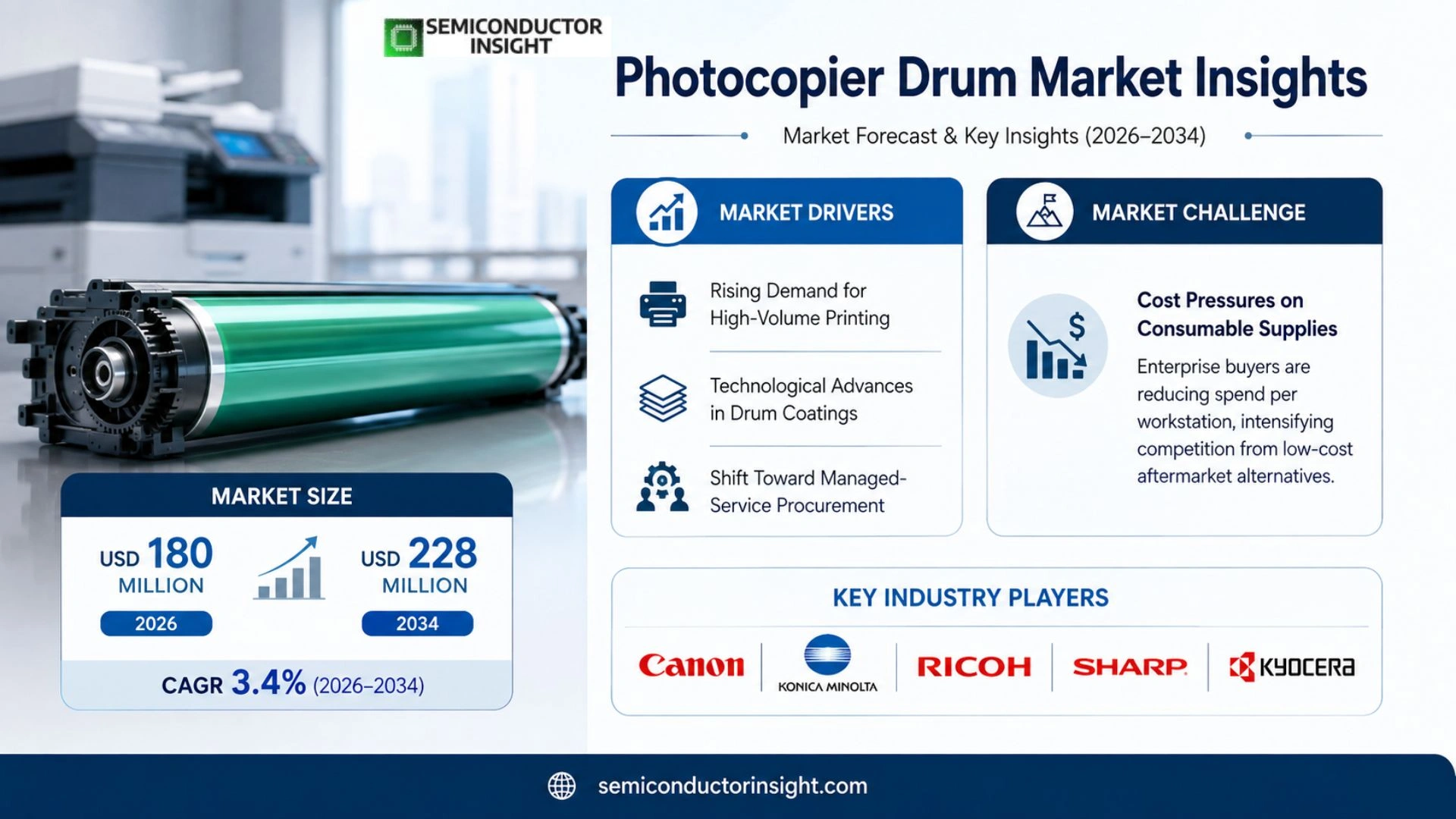
Photocopier Drum market is projected to grow from USD 180 million in 2026 to USD 228 million by 2034, exhibiting a CAGR of 3.4%.
The photoconductor drum is a core component of the copier’s electrostatic imaging system. It employs photoconductive materials that create an electrostatic latent image after exposure; this latent charge then attracts toner particles, enabling precise transfer and producing clear, stable copies of documents and images.
Upstream suppliers chiefly provide aluminum‑based tubing, OPC photoconductive layers, resin blends, functional coating chemicals, precision machining tools, molds and testing equipment. Downstream users include copier assemblers, office‑printing service providers, consumable‑replacement firms and remanufacturing operations.
MARKET DRIVERS
Rising Demand for High‑Volume Printing
Corporate offices and educational campuses are processing more than 4 million pages per year on average, prompting procurement teams to favour cartridges that promise extended drum life. This trend pushes Photocopier Drum Market toward higher‑capacity offerings and creates a premium niche for vendors that can guarantee fewer replacements per annum.
Technological Advances in Drum Coatings
Recent breakthroughs in ceramic‑based photoconductive layers have lifted the durability ceiling from 12 000 to 25 000 impressions per unit. Manufacturers that integrate these coatings can command price premiums while customers reap savings from reduced downtime. The shift also encourages OEMs to redesign printer firmware to exploit the longer service intervals.
➤ The move toward low‑toner‑consumption models is reshaping inventory strategies across multinational corporations.
As firms prioritize operational efficiency, they are increasingly sourcing drums through managed‑service contracts rather than ad‑hoc purchases. This creates a predictable revenue stream for suppliers and forces competitors to differentiate on service‑level agreements rather than on mere unit price.
MARKET CHALLENGES
Cost Pressures on Consumable Supplies
Enterprise buyers are squeezing margins on all printer consumables, with annual spend per workstation falling by roughly 3 % year‑over‑year. The pressure forces drum producers to either reduce material costs or risk losing share to low‑cost aftermarket alternatives that often compromise on reliability.
Other Challenges
Supply Chain Volatility
Geopolitical tensions and semiconductor shortages have introduced lead times that can exceed 90 days for specialty drum components. Companies that lack diversified sourcing face stock‑outs, which translates into lost printing capacity for end‑users and erodes confidence in traditional OEM channels.
MARKET RESTRAINTS
Regulatory Constraints on Toner Materials
Stricter European Union directives on hazardous substances now limit the use of certain heavy metals in drum formulations. Compliance requires reformulation, a process that adds 12‑18 months to product development cycles and raises R&D expenditures for smaller players.
In addition, many jurisdictions are imposing extended producer‑responsibility (EPR) fees that charge manufacturers based on the volume of drums placed on the market. These levies increase the total cost of ownership and push cost‑sensitive buyers toward refurbished or third‑party options.
MARKET OPPORTUNITIES
Managed Print Services (MPS) Expansion
Enterprises that outsource their printing infrastructure to MPS providers are standardizing on a limited set of high‑efficiency drum models. This consolidation creates a clear channel for vendors to secure multi‑year supply contracts and to introduce value‑added services such as predictive maintenance analytics.
Eco‑Friendly Drum Designs
Growing environmental awareness is driving demand for drums manufactured from recyclable polymers and low‑VOC adhesives. Companies that can certify a reduced carbon footprint for their drum lifecycle stand to capture the premium segment of customers seeking green procurement solutions.
Photocopier Drum Market Trends
Shift Toward Sustainable Materials
Manufacturers are responding to tightening environmental legislation by redesigning the drum substrate and coating chemistry. Aluminum‑based tubing now incorporates recycled alloys, while photoconductive polymers are formulated with lower‑volatile organic compounds. This shift reduces disposal costs for end‑users and opens a pricing lever for suppliers that can certify a circular‑use profile. The result is a modest premium on green‑label drums, offset by longer service intervals and a lower total cost of ownership for large office fleets. Companies that embed sustainability into their supply chain are better positioned to lock in contracts with government agencies that prioritize eco‑friendly procurement.
Other Trends
Performance Enhancements in Photoconductive Layers
The demand for higher image fidelity drives investment in multi‑layer OPC formulations. By stacking a high‑sensitivity surface over a wear‑resistant base, vendors achieve a 20 % increase in resolution without compromising drum lifespan. Concurrently, advances in precision machining reduce thickness variance to under 5 µm, tightening the tolerance window for high‑speed copiers. These technical gains translate into fewer service calls and a measurable uplift in margin, as premium‑priced drums capture value from enterprises that run continuous, high‑volume printing jobs.
Remanufacturing and Circular Economy Gains
Remanufacturing now accounts for roughly 12 % of total output, a figure that is climbing as OEMs establish certified refurbishing networks. The process extracts the core aluminum shell, applies a fresh photoconductive coating, and re‑certifies the drum for up to 30 % additional cycles. This approach mitigates raw‑material exposure and offers a cost‑effective alternative for cost‑sensitive markets, especially in regions where regulatory pressure on waste disposal is strongest. Players that integrate remanufacturing into their product portfolio can smooth revenue streams during demand fluctuations, while also differentiating themselves through a lower‑carbon footprint.
COMPETITIVE LANDSCAPE
Key Industry Players
Photocopier Drum Competitive Landscape Overview
The market is anchored by a handful of integrated manufacturers whose scale and control over upstream photoconductive material sourcing grant them pricing leverage and rapid product‑life‑cycle rollout. Fuji Electric, with a global footprint and a vertically aligned supply chain spanning aluminum tubing to precision coating chemicals, commands roughly a quarter of total unit shipments. Its focus on high‑resolution OPC and a‑Si formulations aligns with enterprise demand for extended drum life and low failure rates, reinforcing its premium positioning. Mitsubishi and Kyocera follow as second‑tier powerhouses, each leveraging strong OEM relationships in North America and Europe to sustain a robust aftermarket network. The concentration around these three firms creates a competitive environment where marginal improvements in coating uniformity or recycling capability can shift market share quickly.
Beyond the dominant trio, a diverse set of niche specialists injects innovation into specific segments. GPI and KR OPC excel in custom‑tuned multi‑layer coatings for color drum applications, while A&G Optoelectronics has built a reputation for low‑temperature resin systems that reduce energy consumption during production. HG Technologies focuses on compact drums for high‑speed office devices, and Wellsure differentiates through a certified circular‑economy remanufacturing program. Emerging Asian players such as Suzhou Goldengreen Technologies, Zhuhal Tian Ying Technology, and Hitec‑Imaging are expanding capacity to serve the growing commercial printer base in China and Southeast Asia, often partnering with regional distributors to capture price‑sensitive segments. Collectively, these firms sustain a dynamic ecosystem where product differentiation, regulatory compliance, and after‑sales service remain decisive factors.
List of Key Photocopier Drum Companies Profiled
- Fuji Electric
- Mitsubishi
- Kyocera
- GPI
- KR OPC
- A&G Optoelectronics
- HG Technologies
- Wellsure
- Suzhou Goldengreen Technologies
- Zhuhal Tian Ying Technology
- Hitec‑Imaging
- Canon Solutions America
- Lexmark
- Ricoh
- Brother Industries
Segment Analysis:
| Segment Category | Sub-Segments | Key Insights |
| By Type |
|
OPC remains the dominant technology because it balances cost, durability and image quality.
|
| By Application |
|
Commercial drives the most sustained demand because office and government entities require reliable, high‑volume copying.
|
| By End User |
|
Office printing services dominate because they represent the largest volume of routine copying.
|
| By Material |
|
Aluminum‑based substrate continues to be preferred for its excellent conductivity and dimensional stability.
|
| By Sustainability |
|
Remanufacturing is emerging as a strategic pillar because it aligns cost optimization with regulatory pressure.
|
Regional Analysis: Photocopier Drum Market
North America
Manufacturers have invested in diversified sourcing for raw polymers, mitigating disruptions that historically affected inventory levels. Near‑shoring initiatives in Mexico and the Midwest shorten transit routes, allowing distributors to respond swiftly to sudden spikes in drum replacement orders.
Stringent environmental regulations in the United States compel producers to adopt recyclable drum casings and low‑emission manufacturing processes. Compliance audits have become a differentiator, with OEMs showcasing certifications to win enterprise contracts.
The rise of AI‑driven predictive maintenance platforms enables IT departments to forecast drum wear, aligning replacement cycles with budgetary windows and reducing unexpected downtime.
Independent aftermarket players are targeting cost‑sensitive segments, compelling OEMs to reinforce after‑sales service quality and extend warranty terms to preserve market share.
Europe
European firms exhibit a cautious procurement stance, reflecting broader fiscal prudence across the region. Multinational corporations favor standardized drum specifications to streamline cross‑border logistics, while local distributors emphasize compliance with REACH directives. The emphasis on circular economies has spurred collaborations between OEMs and recycling firms, creating secondary markets for refurbished drums. As office design evolves toward modular layouts, vendors are adapting packaging to facilitate rapid deployment in satellite locations, thereby preserving service continuity.
Asia‑Pacific
Asia‑Pacific’s rapid office expansion fuels a growing base of first‑time drum purchasers, particularly in emerging economies such as India and Indonesia. While price sensitivity dominates, a parallel trend toward digital transformation encourages adoption of high‑efficiency drums that reduce waste. Regional manufacturers are leveraging cost‑effective labor pools to produce competitive offerings, yet they face pressure to meet quality benchmarks set by established global brands. Strategic partnerships with local system integrators help bridge the gap between volume demand and service capability.
South America
In South America, fluctuating currency rates influence procurement cycles, prompting organizations to lock in multi‑year supply contracts for Photocopier Drum Market components. Brazil’s regulatory framework encourages the use of environmentally certified consumables, nudging suppliers toward greener product lines. Distribution networks remain fragmented, leading OEMs to prioritize direct‑to‑customer channels to ensure consistent availability and after‑sales support in remote markets.
Middle East & Africa
The Middle East & Africa region shows a dichotomy between high‑spending Gulf states and emerging African markets. Wealthier economies invest heavily in state‑of‑the‑art office equipment, driving demand for premium drums with extended lifespans. Conversely, African enterprises prioritize affordability, creating space for robust aftermarket solutions. Infrastructure development projects and a surge in corporate establishments across the UAE and Saudi Arabia are set to sustain a steady cadence of drum replacements, while logistics improvements in Sub‑Saharan corridors enhance distribution reach.
Report Scope
This market research report provides a comprehensive analysis of the Photocopier Drum Market , covering the forecast period 2026–2034. It offers detailed insights into market dynamics, technological advancements, competitive landscape, and key trends shaping the industry.
Key focus areas of the report include:
- Market Overview: The report begins with an overview outlining its current market scenario, key growth indicators, and industry transformation drivers. It discusses macroeconomic factors, demand–supply balance, regulatory landscape, and the strategic role of semiconductors in powering advancements across industries such as automotive, telecommunications, consumer electronics, and industrial automation.
- Market Size & Forecast: Historical data and future projections for revenue, unit shipments, and market value across major regions and segments.
- Segmentation Analysis: Detailed breakdown by product type, technology, application, and end-user industry to identify high-growth segments and investment opportunities.
- Regional Insights: Insights into market performance across North America, Europe, Asia-Pacific, Latin America, and the Middle East & Africa, including country-level analysis where relevant.
- Competitive Landscape: Profiles of leading market participants, including their product offerings, R&D focus, manufacturing capacity, pricing strategies, and recent developments such as mergers, acquisitions, and partnerships.
- Technology Trends & Innovation: Assessment of emerging technologies, integration of AI/IoT, semiconductor design trends, fabrication techniques, and evolving industry standards.
- Market Drivers & Restraints: Evaluation of factors driving market growth along with challenges, supply chain constraints, regulatory issues, and market-entry barriers.
- Stakeholder Insights: Insights for component suppliers, OEMs, system integrators, investors, and policymakers regarding the evolving ecosystem and strategic opportunities.
Primary and secondary research methods are employed, including interviews with industry experts, data from verified sources, and real-time market intelligence to ensure the accuracy and reliability of the insights presented.
FREQUENTLY ASKED QUESTIONS:
What is the current market size of Photocopier Drum Market?
-> Photocopier Drum market is projected to grow from USD 180 million in 2026 to USD 228 million by 2034, exhibiting a CAGR of 3.4%.
Which key companies operate in Photocopier Drum Market?
-> Key players include FUJI Electric, Mitsubishi, Kyocera, GPI, KR OPC, A&G Optoelectronics, HG Technologies, Wellsure, Suzhou Goldengreen Technologies, Zhuhal Tian Ying Technology, and Hitec-Imaging, among others.
What are the key growth drivers?
-> Key growth drivers include increasing demand for high‑resolution imaging, longer drum lifespan, low failure rates, enhanced wear resistance, high‑speed continuous output, and regulatory pressures encouraging green recycling, remanufacturing, and low‑pollution production solutions.
Which region dominates the market?
-> The Asia‑Pacific region demonstrates the strongest demand, driven by extensive commercial office printing activities and a large manufacturing base for copier components.
What are the emerging trends?
-> Emerging trends include development of high‑performance photoconductive materials, multi‑layer functional coatings, circular‑economy recycling initiatives, and low‑pollution production technologies.

Get Sample Report PDF for Exclusive Insights
Report Sample Includes
- Table of Contents
- List of Tables & Figures
- Charts, Research Methodology, and more...
 Download Sample Report PDF