Mobile Camera Auto Focus Driver IC Market Insights
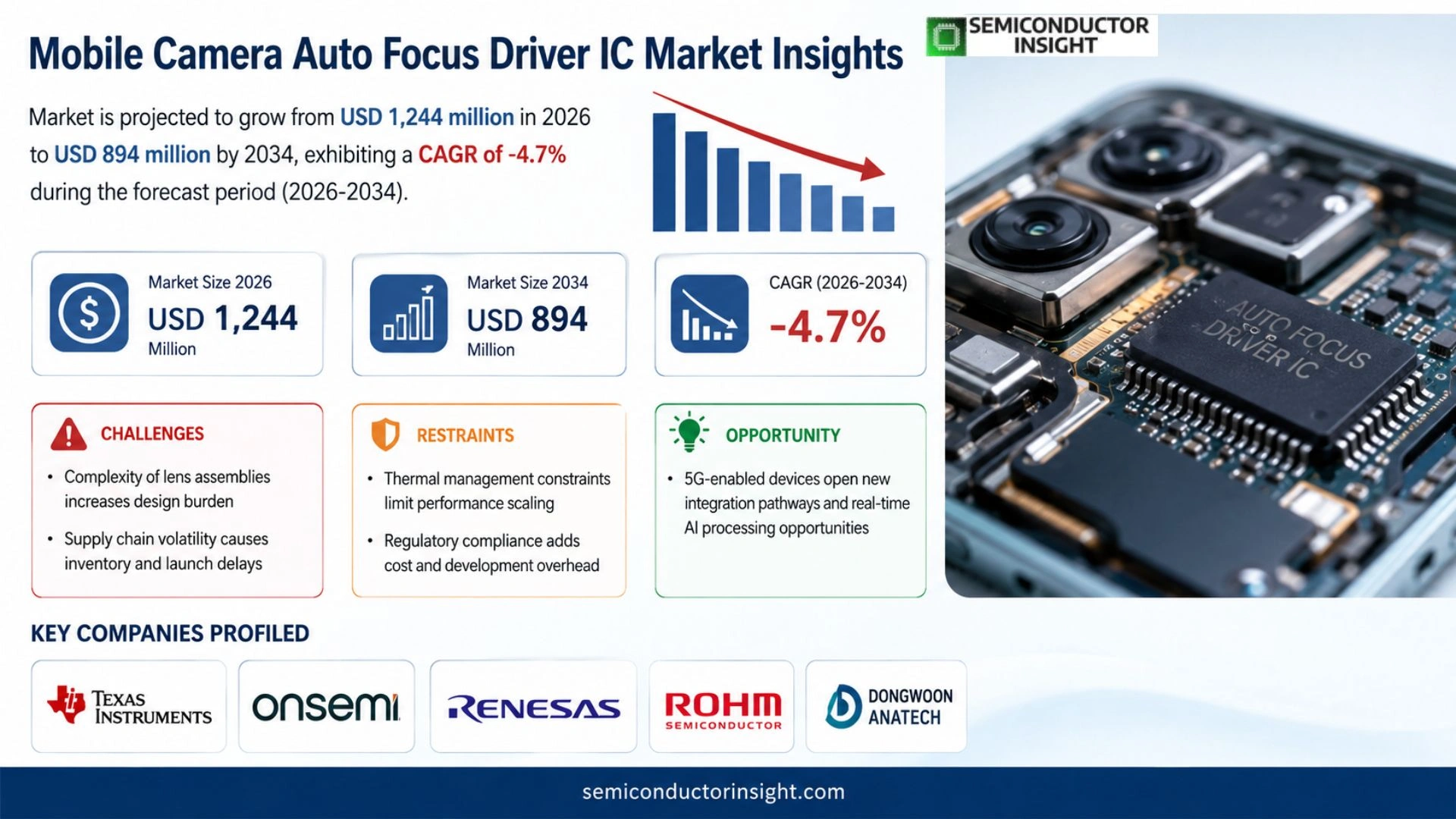
Mobile Camera Auto Focus Driver IC market is projected to grow from USD 1,244 million in 2026 to USD 894 million by 2034, exhibiting a CAGR of -4.7% during the forecast period.
A mobile camera auto focus driver IC is a control chip that converts autofocus algorithms into precise actuator motion for voice‑coil motors or lens actuators equipped with Hall feedback. By delivering rapid, stable lens displacement with low power draw, it addresses focus speed, positioning accuracy and image‑stability challenges across close‑range, low‑light and telephoto scenarios. Key technology paths include open‑loop AF, closed‑loop AF and combined AF‑plus‑OIS solutions; higher‑end devices may embed MCU, DSP, PID control and EEPROM for advanced multi‑camera coordination.
The market’s trajectory reflects shifting demand from sheer camera count toward richer imaging capability. While overall smartphone shipments show short‑term volatility (IDC), OEMs are consolidating around fewer but higher‑resolution sensors, driving the need for more sophisticated driver ICs that manage complex control loops and integrate functions such as OIS and memory storage. Regional supply chains are diversifying,Japanese firms excel in precision analog control, Korean players dominate dedicated AF/OIS products, U.S. companies leverage broad platform expertise, and Chinese vendors are expanding full‑line offerings,prompting brands to adopt multi‑region sourcing strategies for resilience.
MARKET DRIVERS
Smartphone Imaging Demands Elevate Driver IC Requirements
The proliferation of high‑megapixel sensors in flagship devices forces Mobile Camera Auto Focus Driver IC Market to deliver faster response times and finer focus granularity. Consumers now expect instant focus on subjects that move across the frame, which pushes designers toward driver architectures that support per‑pixel phase‑detect autofocus and hybrid algorithms. This shift not only raises the functional bar for driver ICs but also creates a clear incentive for silicon vendors to embed predictive AI logic directly into the chip.
CMOS Process Maturation Lowers Unit Cost
Recent iterations of 28 nm and 14 nm CMOS processes have stabilized, allowing manufacturers to achieve higher yields while trimming wafer‑level expenses. The cost advantage translates into more competitive pricing for end‑users, encouraging OEMs to adopt advanced autofocus driver solutions even in mid‑tier smartphones. A tighter cost structure also enables broader adoption of multi‑focus lens stacks without compromising profit margins.
➤ Integrating AI‑assisted focus control at the driver IC level shortens product development cycles and improves launch readiness for new handset models.
Overall, the convergence of consumer expectations for seamless imaging and the economic benefits of mature semiconductor nodes fuels sustained investment in Mobile Camera Auto Focus Driver IC Market. Companies that align their roadmaps with these pressures are better positioned to capture market share.
MARKET CHALLENGES
Complexity of Lens Assemblies Increases Design Burden
Modern mobile devices now incorporate four‑to‑six lens elements to achieve optical zoom ranges previously reserved for dedicated cameras. Each additional element introduces mechanical tolerances that the autofocus driver must compensate for in real time. Engineering teams face tighter timing budgets and heightened risk of calibration drift, which can erode yield and inflate R&D spend.
Other Challenges
Supply Chain Volatility
Component shortages in upstream semiconductor fabs have intermittently throttled production capacity for driver ICs. When a fab prioritizes high‑margin logic chips, autofocus driver inventories may experience delayed replenishment, forcing handset manufacturers to either over‑stock or postpone launch dates.
MARKET RESTRAINTS
Thermal Management Constraints Limit Performance Scaling
As driver ICs integrate more processing blocks, power density climbs, creating heat pockets within the confined space of a smartphone chassis. Excessive thermal load can degrade focus accuracy and shorten component lifespan. Designers must therefore allocate silicon area for heat‑dissipation structures, which counteracts the drive toward ever‑smaller footprints.
Regulatory Compliance Adds Overhead
Electromagnetic interference (EMI) standards and safety certifications demand additional shielding and testing procedures for autofocus driver circuits. The compliance burden raises the overall cost of bringing a new driver IC to market and can deter smaller players from entering Mobile Camera Auto Focus Driver IC Market.
MARKET OPPORTUNITIES
Emerging 5G‑Enabled Devices Open New Integration Pathways
5G smartphones support higher data throughput, enabling real‑time transmission of raw sensor data to cloud‑based AI services. This capability encourages the development of driver ICs that can offload complex focus calculations to edge servers, reducing on‑chip compute requirements while maintaining high‑speed performance. Vendors that create hybrid on‑device/off‑device autofocus solutions stand to capture a growing niche.
Automotive and Wearable Segments Offer Adjacent Growth
Advanced driver assistance systems (ADAS) and smart wearables increasingly rely on miniature cameras that demand rapid autofocus. The same driver IC technology used in smartphones can be repurposed for these verticals, providing a diversification route for companies entrenched in Mobile Camera Auto Focus Driver IC Market. Tailoring packages for rugged automotive environments or low‑power wearables creates fresh revenue streams beyond the saturated handset arena.
Mobile Camera Auto Focus Driver IC Market Trends
Consolidation Towards Integrated AF‑OIS Platforms
The segment has moved from single‑function current sources to highly integrated driver platforms that combine autofocus, optical‑image‑stabilization, Hall feedback, PID control, and on‑chip memory. Suppliers such as onsemi, Renesas, Zinitix and HMI now offer solutions where the same silicon manages lens motion, vibration suppression and firmware‑level tuning. This architectural shift reduces bill‑of‑materials for smartphone makers, shortens module layout, and improves power efficiency,attributes that directly influence photo quality and video steadiness. The forecast indicates a modest contraction in overall revenue, slipping from roughly $1.24 billion in 2025 to about $894 million by 2034, a trend that reflects the market’s transition from volume‑based pricing to value‑added integration.
Other Trends
Regional Supply‑Chain Realignment
Japanese firms continue to dominate high‑reliability analog control, while Korean players focus on dedicated AF and OIS silicon. U.S. companies leverage broad analog expertise to deliver platform‑level chips, and mainland Chinese vendors are expanding product breadth and tiered customer coverage. Since 2025, tariff uncertainty and the need for dual‑sourcing have pushed smartphone brands to diversify across these regions, favoring partners that can guarantee stable delivery and rapid module‑level tuning. Companies that expose public roadmaps, maintain stocked inventory and provide reference designs are increasingly securing design‑win opportunities across premium and mid‑range device programs.
Premium Imaging Features Reshape Demand
Even as average lens counts per handset decline, manufacturers are reallocating resources toward higher‑resolution main sensors, periscope telephoto optics and front‑camera autofocus. Each of these advanced optics requires tighter focus accuracy, faster response and more sophisticated feedback loops, compelling IC designers to embed higher bandwidth I²C interfaces and richer DSP blocks. The outcome is a market that rewards functional convergence over simple unit growth; firms that can deliver compact packages with combined AF‑OIS control and programmable memory stand to capture a larger share of the premium segment, while also supporting the emerging need for multi‑camera coordination in video‑centric use cases.
COMPETITIVE LANDSCAPE
Key Industry Players
Competitive Overview of Mobile Camera Auto‑Focus Driver IC Suppliers
Texas Instruments continues to dominate the upper tier of the mobile camera AF driver segment, leveraging its deep analog expertise and a broad portfolio that spans open‑loop, closed‑loop, and combined AF‑OIS solutions. Its products are favored by flagship OEMs that demand tight focus latency and robust power budgets, allowing TI to secure a sizeable share of design wins in premium smartphones. The company’s ability to offer standard catalog parts together with customizable variants gives it flexibility to serve both high‑volume and niche applications, reinforcing its position as a reference supplier in the ecosystem.
Beyond the market leader, several regional and specialist firms have carved out meaningful niches. Korean suppliers such as ROHM and Dongwoon Anatech provide compact, high‑precision drivers tuned for cost‑sensitive mid‑range devices, while U.S. player onsemi differentiates through integrated MCU/DSP blocks that simplify board‑level design for emerging dual‑camera modules. Japanese firm Renesas and Chinese companies Awinic, Giantec, Zinitix, JADARD, Chipsemi, and HMI each focus on particular control architectures,ranging from pure driver‑only ICs to highly integrated platforms that embed Hall feedback, PID loops, and EEPROM storage. Their collective emphasis on ultra‑small footprints and multi‑camera coordination makes them attractive partners for OEMs pursuing functional convergence without inflating bill‑of‑materials.
List of Key Mobile Camera Auto Focus Driver IC Companies Profiled
- Texas Instruments
- onsemi
- Renesas Electronics Corporation
- ROHM Co., Ltd.
- Dongwoon Anatech Co., Ltd.
- Zinitix Co., Ltd.
- Shanghai Awinic Technology Co., Ltd.
- Giantec Semiconductor Corporation
- JADARD TECHNOLOGY INC.
- Chipsemi Semiconductor (Ningbo) Co., Ltd.
- HMI
- Qualcomm Incorporated
- STMicroelectronics
- MediaTek Inc.
- Samsung Electronics
Segment Analysis:
| Segment Category | Sub-Segments | Key Insights |
| By Type |
|
Closed Loop AF
|
| By Application |
|
Main Camera Autofocus
|
| By End User |
|
Smartphone OEMs
|
| By Integration Level |
|
Fully Integrated MCU/DSP Platforms
|
| By Control Architecture |
|
AF + OIS Composite Control
|
Regional Analysis: Mobile Camera Auto Focus Driver IC Market
Asia‑Pacific
Leading fabs in Taiwan and South Korea have announced multi‑year expansions targeting higher wafer outputs for driver ICs. The added capacity eases previous bottlenecks, allowing OEMs to secure larger allocations without premium pricing, and it also creates room for trial production of novel autofocus topologies.
Rapid migration to 28 nm and 22 nm processes is evident as manufacturers chase lower power consumption and tighter integration. This shift enables more compact driver chips that can be embedded directly beneath camera sensors, a design trend gaining traction among flagship device makers.
Regional standards bodies are harmonizing electromagnetic compatibility requirements, reducing the need for disparate certification across markets. Consistency in compliance lowers development overhead and accelerates product rollout timelines for global brands.
End‑users are increasingly valuing low‑light performance and instant focus, prompting OEMs to specify driver ICs with faster response times and higher precision. This demand is steering design houses toward algorithms that couple autofocus control more tightly with sensor data streams.
North America
In North America, the market is shaped by premium‑segment device launches that prioritize advanced camera functionality. U.S. design firms leverage sophisticated simulation tools to optimize driver performance, while Canadian research institutes contribute incremental improvements in low‑power autofocus algorithms. Despite a smaller manufacturing footprint, the region’s emphasis on intellectual property creates a high‑value niche for custom driver solutions tailored to flagship smartphones.
Europe
European players differentiate themselves through stringent quality standards and close collaboration with automotive camera suppliers. The focus on robustness and reliability drives demand for driver ICs that can withstand wider temperature ranges, supporting both mobile and emerging ADAS applications. Strategic alliances between German semiconductor houses and lens manufacturers foster co‑engineered modules that enhance overall imaging fidelity.
South America
South America’s growth is anchored in mid‑range smartphone penetration, where cost‑effective autofocus drivers are essential to maintain competitive pricing. Local assemblers increasingly source components from regional distributors, creating a modest but steady demand pipeline. Market entrants often adapt existing designs to meet price constraints while preserving acceptable focusing speed.
Middle East & Africa
The Middle East & Africa region reflects a heterogeneous landscape, with affluent Gulf markets demanding high‑end imaging capabilities, while African nations prioritize affordability. This dichotomy compels global vendors to offer tiered driver IC portfolios,premium parts for luxury devices and stripped‑down versions for budget phones,allowing them to capture diverse consumer segments without overextending supply chains.
Report Scope
This market research report provides a comprehensive analysis of the Mobile Camera Auto Focus Driver IC Market , covering the forecast period 2026–2034. It offers detailed insights into market dynamics, technological advancements, competitive landscape, and key trends shaping the industry.
Key focus areas of the report include:
- Market Overview: The report begins with an overview outlining its current market scenario, key growth indicators, and industry transformation drivers. It discusses macroeconomic factors, demand–supply balance, regulatory landscape, and the strategic role of semiconductors in powering advancements across industries such as automotive, telecommunications, consumer electronics, and industrial automation.
- Market Size & Forecast: Historical data and future projections for revenue, unit shipments, and market value across major regions and segments.
- Segmentation Analysis: Detailed breakdown by product type, technology, application, and end-user industry to identify high-growth segments and investment opportunities.
- Regional Insights: Insights into market performance across North America, Europe, Asia-Pacific, Latin America, and the Middle East & Africa, including country-level analysis where relevant.
- Competitive Landscape: Profiles of leading market participants, including their product offerings, R&D focus, manufacturing capacity, pricing strategies, and recent developments such as mergers, acquisitions, and partnerships.
- Technology Trends & Innovation: Assessment of emerging technologies, integration of AI/IoT, semiconductor design trends, fabrication techniques, and evolving industry standards.
- Market Drivers & Restraints: Evaluation of factors driving market growth along with challenges, supply chain constraints, regulatory issues, and market-entry barriers.
- Stakeholder Insights: Insights for component suppliers, OEMs, system integrators, investors, and policymakers regarding the evolving ecosystem and strategic opportunities.
Primary and secondary research methods are employed, including interviews with industry experts, data from verified sources, and real-time market intelligence to ensure the accuracy and reliability of the insights presented.
FREQUENTLY ASKED QUESTIONS:
What is the current market size of Mobile Camera Auto Focus Driver IC Market?
-> Mobile Camera Auto Focus Driver IC market is projected to grow from USD 1,244 million in 2026 to USD 894 million by 2034, exhibiting a CAGR of -4.7%
Which key companies operate in Mobile Camera Auto Focus Driver IC Market?
-> Key players include Texas Instruments, onsemi, Renesas Electronics Corporation, ROHM Co., Ltd., Dongwoon Anatech Co., Ltd., Zinitix Co., Ltd., Shanghai Awinic Technology Co., Ltd., Giantec Semiconductor Corporation, JADARD TECHNOLOGY INC., Chipsemi Semiconductor (Ningbo) Co., Ltd., and HMI.
What are the key growth drivers?
-> Key growth drivers include increasing demand for high‑resolution smartphone cameras, premiumization of imaging capabilities, integration of autofocus (AF) with optical image stabilization (OIS), and the shift toward functional convergence and platform upgrades in mobile imaging.
Which region dominates the market?
-> Asia‑Pacific dominates the market, driven by strong smartphone manufacturing bases and extensive supplier ecosystems in China, South Korea, Japan, and other regional hubs.
What are the emerging trends?
-> Emerging trends include combined AF plus OIS control, closed‑loop feedback architectures, higher integration of MCU/DSP on a single driver IC, and ultra‑compact packaging to meet thin‑module requirements.

Get Sample Report PDF for Exclusive Insights
Report Sample Includes
- Table of Contents
- List of Tables & Figures
- Charts, Research Methodology, and more...
 Download Sample Report PDF