
Metal Wire Grid Polarizer Market Insights
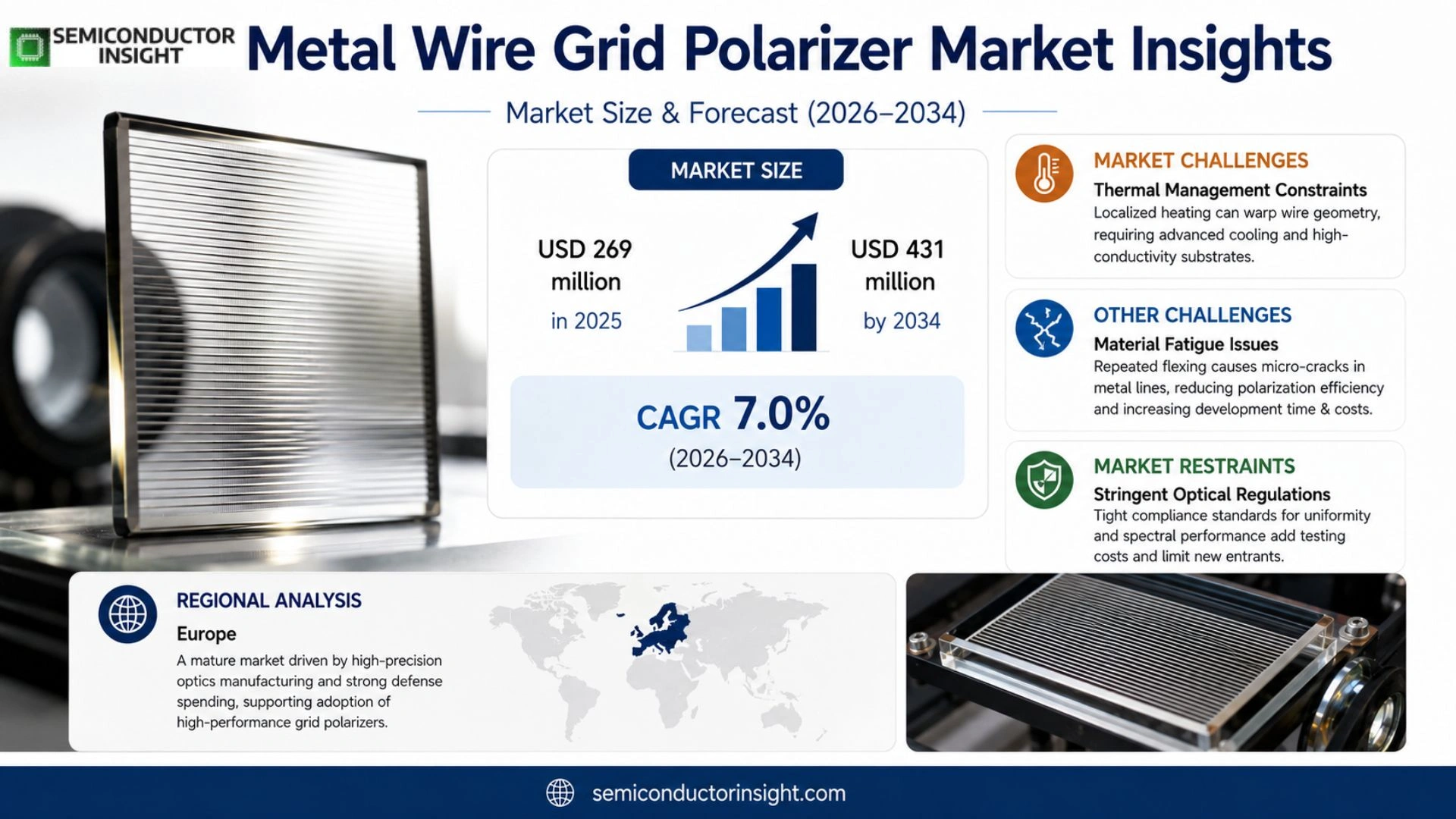
Global Metal Wire Grid Polarizer market size was valued at USD 269 million in 2025 and is forecasted to rise to USD 431 million by 2034, reflecting a CAGR of 7.0% during the period.
Metal Wire Grid Polarizers are optical components that selectively transmit or block polarized light based on orientation. Constructed from a precise array of thin metal wires spaced below the wavelength of light, the grid absorbs waves vibrating in one direction while allowing orthogonal waves to pass, thereby producing polarized output. Typical applications include LCD displays, infrared imaging systems, projection devices, AR/VR headsets, and scientific instrumentation.
The expansion of this market stems from growing adoption of infrared imaging in defense and automotive sectors, increased integration of projection technology in consumer electronics, and rising interest in head‑up displays for intelligent vehicles. Advances in nano‑imprint lithography and holographic lithography have lowered production costs, enabling broader deployment across emerging fields such as medical diagnostics and consumer wearables.
MARKET DRIVERS
Increasing Adoption in Augmented Reality Devices
The surge in consumer‑focused AR headsets has forced OEMs to prioritize optical components that can deliver crisp image contrast while occupying minimal volume. Metal Wire Grid Polarizer Market suppliers are capitalising on this need by offering ultra‑thin grid structures that integrate seamlessly with micro‑display stacks, thereby unlocking new form‑factors for wearable tech.
Manufacturing Advances Reducing Cost
Recent breakthroughs in roll‑to‑roll lithography and laser‑driven etching have trimmed unit costs by double‑digit percentages. These process efficiencies translate into more competitive pricing for end‑users, encouraging broader deployment in automotive heads‑up displays and industrial inspection systems.
➤ Design teams now iterate polarization layouts in weeks rather than months, accelerating time‑to‑market for next‑generation imaging solutions.
Combined, the technology push and price compression are reshaping buying cycles, prompting buyers to replace legacy polarizers with grid‑based alternatives that promise higher durability and lower maintenance overhead.
MARKET CHALLENGES
Thermal Management Constraints
High‑power laser applications generate localized heating that can warp the delicate wire geometry, degrading extinction ratios. Engineers must therefore embed active cooling or select substrates with superior thermal conductivity, adding complexity to system design.
Other Challenges
Material Fatigue Issues
Repeated mechanical flexing, especially in foldable displays, can induce micro‑cracks in the metal lines. Such fatigue compromises polarization efficiency over the product lifecycle, forcing manufacturers to adopt more resilient alloy formulations.
Addressing these reliability concerns often requires additional qualification steps, extending development timelines and inflating R&D budgets.
MARKET RESTRAINTS
Stringent Optical Specification Regulations
Regulatory bodies in aerospace and medical imaging impose tight tolerances on polarization uniformity and spectral performance. Compliance testing adds a layer of expense that can deter smaller players from entering Metal Wire Grid Polarizer market.
Certification cycles often span six to twelve months, creating a lag between product innovation and market availability. This delay can erode the competitive edge of firms that rely on rapid iteration.
Furthermore, export controls on high‑precision optical components restrict cross‑border sales, limiting growth avenues for manufacturers targeting emerging economies.
MARKET OPPORTUNITIES
Emerging Applications in Quantum Communication
Quantum key distribution (QKD) systems demand polarizers with exceptionally low loss and high extinction across narrow wavelength bands. Grid‑based devices meet these criteria, opening a niche yet lucrative segment for suppliers attuned to photonic security markets.
Parallel advances in integrated photonic chips are driving demand for on‑chip polarizers that occupy sub‑micron footprints. Companies that can merge metal wire grids with silicon‑based waveguides stand to capture early‑adopter contracts.
Finally, the rollout of 5G/6G backhaul infrastructure incorporates millimeter‑wave antennas that benefit from polarisation control. Aligning product roadmaps with telecom rollout schedules could unlock multi‑year revenue streams for forward‑looking manufacturers.
Metal Wire Grid Polarizer Market Trends
Infrared Imaging and Automotive HUD Fuel Market Momentum
The most visible catalyst for Metal Wire Grid Polarizer market today is the surge in infrared imaging systems used for defense, surveillance, and industrial inspection. These devices depend on polarizers that can handle long‑wave radiation while preserving high extinction ratios, and the grid‑type architecture meets those technical requirements with minimal loss. At the same time, the rollout of head‑up displays in next‑generation vehicles creates a parallel demand stream: HUDs require transparent, broadband polarizers that can survive harsh automotive environments. Together, these two sectors have pushed annual production to roughly 147 k pieces in 2025, with an average price of USD 2,000 per unit, and they form the backbone of the market’s revenue trajectory toward USD 431 million by 2034.
Other Trends
Manufacturing Innovation Centers on Nanoimprint Techniques
Traditional electron‑beam lithography delivers precision but struggles with volume. Nanoimprint processes, by contrast, replicate the sub‑wavelength wire spacing across large substrates in a single step, reducing cycle time and material waste. An emerging hybrid that merges holographic lithography with oblique metal evaporation has shown extinction ratios that rival bespoke e‑beam runs while keeping per‑unit cost in check. The shift toward such scalable methods explains why the top four global suppliers now control over 80 % of output, as they can invest in high‑throughput lines without sacrificing optical performance.
Geographic Shift Toward Asian Production Capacity
Historically, North America retained the largest market share, thanks to early adoption in aerospace and defense. However, China’s rapid expansion of semiconductor‑grade foundries and its aggressive investment in nano‑fabrication have begun to erode that lead. Domestic players such as Nanjing Jcoptix and Shenzhen Beamwayoe are closing the technology gap, leveraging government incentives to fund pilot lines that specialize in ultra‑broadband grid designs. This geographic rebalancing is likely to diversify supply sources, lower logistics costs for Asian OEMs, and introduce competitive pricing pressure across the whole value chain.
COMPETITIVE LANDSCAPE
Key Industry Players
Metal Wire Grid Polarizer Market – Competitive Overview
The market is heavily concentrated among a few large manufacturers that dominate the supply chain for high‑performance grid polarizers. Thorlabs and Edmund Optics together command well over three‑quarters of global shipments, leveraging extensive distribution networks in North America and Europe to serve OEMs in LCD, imaging and infrared systems. Their ability to integrate nano‑imprint and electron‑beam lithography into volume production gives them a clear cost‑advantage, allowing price points that smaller rivals struggle to match. This duopoly has shaped pricing tiers and set the benchmark for extinction ratio and durability, prompting downstream customers to align product roadmaps with the capabilities offered by these incumbents.
Beneath the top tier, a cohort of specialized firms is carving niches through material innovation or application‑specific designs. Companies such as Moxtek, Ushio and Asahi Kasei focus on silver‑coated grids for infrared surveillance, while PureWave Polarizers and Meadowlark Optics target ultra‑broadband performance for AR/VR head‑sets. Chinese players,including Nanjing Jcoptix, Shenzhen Beamwayoe Optoelectronics and Tydex,are rapidly expanding capacity by adopting holographic lithography combined with oblique evaporation, a process that reduces cycle time and enables competitive pricing for consumer electronics. European outfits like Optometrics, Specac and Bolder Vision Optik maintain a foothold in scientific instrumentation by offering custom‑geometry grids, whereas emerging entrants such as Hamamatsu Photonics are exploring hybrid metal‑dielectric structures to push extinction ratios beyond conventional limits.
List of Key Metal Wire Grid Polarizer Companies Profiled
- Thorlabs
- Edmund Optics
- Moxtek
- Ushio
- Asahi Kasei
- PureWave Polarizers
- Meadowlark Optics
- Optometrics
- Specac
- Bolder Vision Optik
- Tydex
- Nanjing Jcoptix
- Shenzhen Beamwayoe Optoelectronics Technology
- Hamamatsu Photonics
- Hoya Corporation
Segment Analysis:
| Segment Category | Sub-Segments | Key Insights |
| By Type |
|
Infrared Wire Grid Polarizer is emerging as the predominant type because it aligns closely with the expanding demand for infrared imaging in defence and scientific research. – Its ability to maintain high extinction ratios while tolerating thermal variations makes it a preferred choice for rugged field equipment. – Manufacturers are focusing on nano‑imprinting processes that reduce cost and improve scalability, thereby strengthening its market leadership. – The technology is increasingly integrated into emerging AR/VR platforms that require precise infrared filtering for eye‑tracking and depth sensing. Visible Light Wire Grid Polarizer continues to dominate display and projection markets, driven by the need for high‑contrast, low‑glare solutions. – Advancements in holographic lithography enable finer wire spacing, supporting higher resolution displays. – The segment benefits from strong OEM partnerships in consumer electronics, reinforcing its stable demand base. |
| By Application |
|
Infrared Imaging Systems are shaping the future demand curve, as they underpin emerging autonomous vehicle sensors and advanced surveillance platforms. – The high‑precision polarization offered by metal wire grids enhances signal‑to‑noise ratios, essential for low‑light environments. – Collaborative development between optics firms and automotive OEMs accelerates adoption, creating a virtuous cycle of innovation. – Continuous improvements in manufacturing tolerances are expanding the suitability of these polarizers for compact, integrated modules. AR/VR Headsets represent a rapid growth frontier, where lightweight, broadband polarizers enable vivid visual experiences without compromising device ergonomics. – The convergence of display technology with immersive content drives manufacturers to prioritize low‑profile, high‑efficiency designs. |
| By End User |
|
Optical Equipment Manufacturers are the primary end users, leveraging metal wire grid polarizers for high‑performance microscopes, spectrometers, and laser systems. – Their emphasis on reliability and repeatable optical performance drives a preference for premium materials such as gold and silver coatings. – Ongoing collaboration with material scientists fosters incremental enhancements in durability and wavelength coverage. Defense & Aerospace Contractors value the robust thermal and mechanical characteristics of these polarizers, especially for missile guidance and night‑vision platforms. – Stringent qualification processes encourage suppliers to adopt advanced nano‑fabrication methods that ensure consistent grid geometry across large volumes. |
Regional Analysis: Metal Wire Grid Polarizer Market
Europe
Car manufacturers are integrating metal wire grid polarizers into augmented‑reality windshields, attracted by the component’s ability to preserve brightness while filtering glare. This shift supports Europe’s push toward premium electric‑vehicle interiors.
Military contracts often specify grid‑based polarizers for night‑vision and targeting optics, where durability under extreme conditions is non‑negotiable. European defense firms therefore prioritize in‑house production capabilities.
Hospitals across the EU are upgrading endoscopic equipment with polarizers that reduce speckle, improving diagnostic confidence. Suppliers benefit from tighter regulatory validation pathways in this sector.
High‑end projectors and virtual‑reality headsets marketed in Europe increasingly rely on wire‑grid optics to achieve deeper contrast, reflecting consumer willingness to invest in premium visual experiences.
North America
North America’s market activity is anchored by strong venture capital infusion into photonic startups. Companies in the United States are experimenting with grid polarizers for quantum‑communication devices, where polarization purity directly impacts data fidelity. The region also sees a gradual shift from traditional film‑based polarizers to metal wire variants in data‑center display farms, motivated by energy‑efficiency mandates set by the Environmental Protection Agency. Although the overall spend is comparable to Europe, the pace of product iteration tends to be faster, encouraging a cascade of niche applications across silicon‑photonic platforms.
Asia‑Pacific
In the Asia‑Pacific, rapid industrialization fuels a broadening of use cases for metal wire grid polarizers. Chinese manufacturers are scaling production to meet domestic demand for 4K and 8K display panels, while Japanese firms exploit the technology for high‑precision lithography tools used in semiconductor fabs. Southeast Asian countries, notably Singapore and South Korea, are leveraging government‑backed research clusters to prototype polarizer‑enhanced LiDAR sensors for autonomous vehicles. The region’s cost‑focused manufacturing ethos drives suppliers to balance performance with price, leading to a diversification of product tiers that cater to both premium and volume markets.
South America
South America exhibits cautious adoption, primarily within Brazil’s defense procurement programs and Argentina’s scientific research institutes. Limited local production capacity forces many firms to import components, which in turn raises overall system costs. Nevertheless, regional trade agreements are lowering tariff barriers, prompting a modest uptick in pilot projects that explore polarizer integration in agricultural drones, where glare reduction can improve imaging accuracy.
Middle East & Africa
The Middle East & Africa region is characterized by sporadic but high‑value deployments, especially in oil‑field inspection equipment that requires resilient optics under harsh environmental conditions. United Arab Emirates’ investment in smart‑city infrastructure includes trials of polarizer‑based holographic displays for public information kiosks. Meanwhile, African research hubs are beginning to assess grid polarizers for solar‑energy monitoring systems, recognizing the component’s ability to filter polarized sunlight and enhance sensor reliability.
Report Scope
This market research report provides a comprehensive analysis of the Metal Wire Grid Polarizer Market , covering the forecast period 2026–2034. It offers detailed insights into market dynamics, technological advancements, competitive landscape, and key trends shaping the industry.
Key focus areas of the report include:
- Market Overview: The report begins with an overview outlining its current market scenario, key growth indicators, and industry transformation drivers. It discusses macroeconomic factors, demand–supply balance, regulatory landscape, and the strategic role of semiconductors in powering advancements across industries such as automotive, telecommunications, consumer electronics, and industrial automation.
- Market Size & Forecast: Historical data and future projections for revenue, unit shipments, and market value across major regions and segments.
- Segmentation Analysis: Detailed breakdown by product type, technology, application, and end-user industry to identify high-growth segments and investment opportunities.
- Regional Insights: Insights into market performance across North America, Europe, Asia-Pacific, Latin America, and the Middle East & Africa, including country-level analysis where relevant.
- Competitive Landscape: Profiles of leading market participants, including their product offerings, R&D focus, manufacturing capacity, pricing strategies, and recent developments such as mergers, acquisitions, and partnerships.
- Technology Trends & Innovation: Assessment of emerging technologies, integration of AI/IoT, semiconductor design trends, fabrication techniques, and evolving industry standards.
- Market Drivers & Restraints: Evaluation of factors driving market growth along with challenges, supply chain constraints, regulatory issues, and market-entry barriers.
- Stakeholder Insights: Insights for component suppliers, OEMs, system integrators, investors, and policymakers regarding the evolving ecosystem and strategic opportunities.
Primary and secondary research methods are employed, including interviews with industry experts, data from verified sources, and real-time market intelligence to ensure the accuracy and reliability of the insights presented.
FREQUENTLY ASKED QUESTIONS:
What is the current market size of Metal Wire Grid Polarizer Market?
-> Metal Wire Grid Polarizer market is forecasted to rise to USD 431 million by 2034, reflecting a CAGR of 7.0%
Which key companies operate in Metal Wire Grid Polarizer Market?
-> Key players include Thorlabs, Edmund Optics, Moxtek, Ushio, Asahi Kasei, PureWavePolarizers, Meadowlark Optics, Optometrics, Specac, Bolder Vision Optik, Tydex, Nanjing Jcoptix, Shenzhen Beamwayoe Optoelectronics Technology.
What are the key growth drivers?
-> Key growth drivers include infrared imaging demand, projection display, AR/VR equipment, HUD (head‑up display) adoption in intelligent automobiles, and expansion into consumer electronics and medical health applications.
Which region dominates the market?
-> North America is the current market leader, while China is emerging as a fast‑growing contributor.
What are the emerging trends?
-> Emerging trends include nanoimprinting mass‑production techniques, holographic lithography combined with oblique metal evaporation, cost‑reduction innovations, and broader application scope across consumer electronics and medical health sectors.

Get Sample Report PDF for Exclusive Insights
Report Sample Includes
- Table of Contents
- List of Tables & Figures
- Charts, Research Methodology, and more...
 Download Sample Report PDF



