Key Statistics
Key Takeaways
- Remote Control is the leading source-defined product type because centralized and mobile access is a core user benefit across homes, hotels and commercial buildings, while energy-management products gain strategic importance as efficiency requirements tighten.
- Residential Buildings are the largest application segment, representing 53% of KNX applications on the source page, supported by premium housing, whole-home control and the ability to integrate lighting, HVAC, security and shading.
- Twisted Pair remains the preferred technology in many fixed installations because it offers deterministic wired communication, a large installed base and broad device compatibility; RF and IP/Ethernet broaden retrofit and backbone options.
- Europe is the largest regional market. Regulation is a concrete demand catalyst: EU rules extend building automation and control requirements to non-residential systems above 70 kW by the end of 2029 where technically and economically feasible.
- Asia Pacific has the strongest structural expansion opportunity. Singapore’s Green Building Masterplan reported that 66% of building floor area was greened by December 2025, with an 80% target by 2030, illustrating the region’s policy-driven smart-building momentum.
KNX Products Market Overview
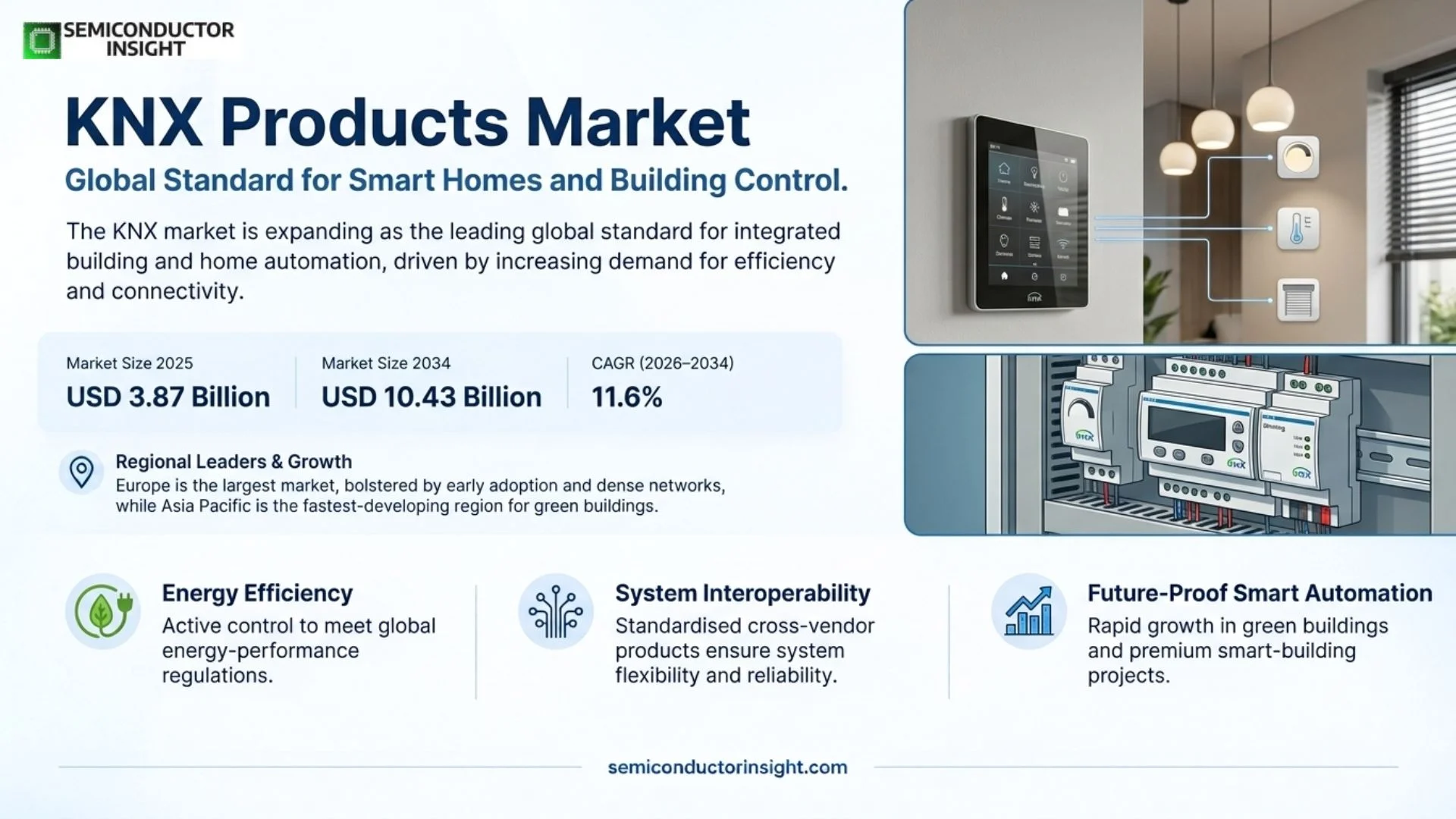
KNX products market was valued at USD 3.87 billion in 2025 and is projected to reach USD 10.43 billion by 2034, expanding at a 11.6% CAGR during 2026–2034. Europe is the largest regional market, supported by a mature installer network, a dense base of KNX manufacturers and building-efficiency regulations, while Asia Pacific is the fastest-developing opportunity as green-building requirements and premium smart-building adoption expand.
KNX is an open building-automation standard used to connect lighting, HVAC, shading, metering, security, energy-management and other building functions on a common control architecture. KNX installations can operate over twisted pair, powerline, RF and IP/Ethernet, allowing designers to select media according to new-build, retrofit and system-integration requirements. Products include actuators, sensors, room controllers, gateways, power supplies, interfaces, visualization devices and software-supported automation components.
The ecosystem is unusually broad for a building-control platform. KNX Association listed 709 manufacturers in its manufacturer directory in 2026, alongside a large international community of trained partners, certification laboratories and training centers. That breadth matters commercially because a building owner can source interoperable devices from multiple vendors while integrators retain a common engineering and commissioning framework, reducing the risk of a single-vendor proprietary lock-in over a building’s operating life.
Growth is increasingly tied to measurable energy-performance requirements rather than smart-home convenience alone. The EU Energy Performance of Buildings Directive requires, where technically and economically feasible, building automation and control systems in non-residential buildings with heating or air-conditioning output above 70 kW by 31 December 2029. In Singapore, 66% of building floor area had been greened by December 2025 under the national Green Building Masterplan, reinforcing demand for connected control, monitoring and energy-management systems.
Segment Analysis: By Type
By type, the source-defined market includes Energy Management, HVAC Systems, Lighting, Remote Control, and Security Systems. Remote Control holds the leading position on the source page because users increasingly expect convenient centralized access, while energy-management and HVAC functions benefit directly from building-efficiency regulations and rising electricity-cost awareness.
| Type | Technical / functional role | Market position and purchasing logic |
|---|---|---|
| Energy Management | Metering, load monitoring, demand response, tariff-aware control and coordination of building energy use across connected devices. KNX energy functions can combine measured consumption with occupancy, HVAC and lighting logic to reduce waste without requiring a separate control network. | A strategically important growth segment because building owners increasingly need verifiable energy performance. The commercial sale extends beyond hardware into engineering, dashboards and integration with building-management platforms, creating recurring upgrade opportunities as reporting and flexibility requirements expand. |
| HVAC Systems | Room controllers, thermostats, valve actuators, fan-coil interfaces, ventilation control and gateways coordinate heating and cooling according to occupancy, schedule and environmental conditions. HVAC is often the largest controllable energy load in commercial buildings. | Demand is regulation and operating-cost driven. Customers value interoperability with chillers, boilers, variable-air-volume systems and sensors, while integrators compete on commissioning quality and the ability to maintain comfort while reducing unnecessary runtime. |
| Lighting | KNX lighting products include switching and dimming actuators, presence sensors, gateways and scene controllers that coordinate luminaires by time, occupancy and daylight. KNX commonly integrates with lighting-specific systems such as DALI through gateways. | A large installed application in offices, hospitality and high-end residential projects. Growth comes from occupancy-based control, retrofit modernization and tighter energy standards, while price competition is stronger because several alternative lighting-control ecosystems also address the same use cases. |
| Remote Control | User interfaces, mobile access, visualization panels and integrated controls allow occupants or facility managers to operate multiple KNX functions from a single interface. The function spans residential convenience and commercial supervisory control. | Leading source-defined type. Remote access improves usability and is especially important when a KNX installation integrates many subsystems. Suppliers differentiate through user experience, secure connectivity, app integration and the ability to maintain local control when cloud services are unavailable. |
| Security Systems | KNX devices can integrate access signals, presence detection, alarms, window contacts and safety-related status information with lighting, shading and building-management responses. Dedicated life-safety systems remain governed by their own standards, while KNX provides coordination and visualization. | Security integration adds value in premium residential, hospitality and commercial projects where customers want a common automation experience. Purchasing depends heavily on system design, cybersecurity, reliable interfaces and clear separation between convenience automation and regulated safety functions. |
Why interoperability is the central product value
KNX product economics are shaped by the installed system rather than any single actuator or sensor. A device gains value when it can be commissioned with standard engineering tools, interoperate with other certified products and remain maintainable as a building changes owners or service providers. That creates a strong ecosystem effect: manufacturers compete at the product level, but the shared protocol expands the addressable project by lowering integration risk across multi-vendor installations.
Segment Analysis: By Application
By application, the source-defined market includes Residential Buildings, Commercial Buildings, Industrial Facilities, and Hospitality Sector. Residential Buildings hold the strongest adoption position on the source page, while commercial and hospitality projects often generate higher device counts per site because HVAC, lighting, shading, metering and room controls are integrated across many zones.
| Application | Demand characteristics |
|---|---|
| Residential Buildings | Largest application, with 53% of applications stated on the source page. Homeowners and developers use KNX for whole-home lighting, climate, blinds, security integration and energy management. The key purchase trigger is a durable, interoperable platform that can support premium user interfaces without tying the building to one device brand. |
| Commercial Buildings | Offices, retail, education, healthcare and public buildings use KNX to coordinate large numbers of zones and connect room-level controls to supervisory systems. Energy performance, occupancy management and facility-maintenance requirements make commissioning, analytics and integration with broader building-management systems central to the project economics. |
| Industrial Facilities | Industrial sites use KNX primarily for building services around production areas, including lighting, HVAC, offices, utility rooms and ancillary energy monitoring. The protocol complements rather than replaces industrial control systems, and the purchase decision emphasizes reliability, maintainability and integration boundaries between building and process automation. |
| Hospitality Sector | Hotels use KNX for guest-room control, key-card or occupancy logic, lighting scenes, HVAC setbacks, shading and integration with property-management or room-management systems. The commercial value comes from repeatable room templates and the ability to lower energy use when rooms are unoccupied while preserving guest comfort and premium control features. |
Additional segmentation dimensions
| Axis | Source-defined segments | Commercial interpretation |
|---|---|---|
| By End User | Homeowners; Building Contractors; System Integrators; Facility Management | System integrators are strategically important because they design, commission and maintain multi-vendor installations. Homeowners and facility managers influence user requirements, while contractors affect specification and installation economics in new construction. |
| By Installation Type | New Constructions; Retrofit Projects; Building Renovations | New construction provides the cleanest path for wired KNX because bus cabling can be planned alongside electrical systems. Retrofit and renovation demand is increasingly served by KNX RF, IP gateways and selective rewiring where opening walls is costly. |
| By Technology | Twisted Pair; Powerline; RF Wireless; IP/Ethernet | Twisted Pair is the established field medium for reliability and broad installed compatibility. RF expands retrofit coverage, while IP/Ethernet is important for backbone communication, gateways, remote management and KNX IoT integration. Powerline remains a specialized option where existing mains wiring is used. |
Regional Analysis
Europe is the largest KNX products market because the standard originated in Europe, manufacturer and installer density is high, and energy-performance regulation increasingly requires active control in larger buildings. Asia Pacific is the strongest expansion market, while North America remains a more competitive multi-protocol environment. South America and the Middle East & Africa are project-led markets where premium residential, hospitality and commercial developments create concentrated opportunities.
Which measurable building trends support regional KNX adoption?
The regional opportunity is best understood through building stock, regulation and green-building policy rather than unsupported market-share percentages. The EU’s recast Energy Performance of Buildings Directive creates a clear compliance pathway for building automation. Singapore’s Green Building Masterplan reports 66% of building floor area greened by December 2025. In the United States, the 2018 Commercial Buildings Energy Consumption Survey counted 5.918 million commercial buildings with 96.423 billion square feet of floorspace, illustrating the scale of the retrofitable building base even where KNX competes with other protocols.
| Region | Position | Growth outlook | Demand profile | Evidence-led market logic |
|---|---|---|---|---|
| Europe | Largest | Strong | Regulation and mature ecosystem | EU rules require building automation and control in qualifying non-residential buildings above 70 kW by end-2029 where feasible, reinforcing a large installed market with deep KNX expertise. |
| Asia Pacific | Fastest structural expansion | High | Green buildings and new construction | Singapore had greened 66% of building floor area by December 2025 and targets 80% by 2030; large new-build markets also create opportunities to specify automation at design stage. |
| North America | Established niche | Moderate | Retrofit and premium projects | The U.S. had 5.918 million commercial buildings and 96.423 billion square feet of commercial floorspace in the 2018 CBECS, creating a broad modernization base but strong protocol competition. |
| South America | Emerging | Selective | Premium residential and commercial | Adoption is project-led and depends on certified integrator availability, imported product access and customer willingness to fund higher upfront automation costs. |
| Middle East & Africa | Project-led | Strong in selected cities | Hospitality and high-spec buildings | Large hospitality, mixed-use and premium residential projects can support dense automation packages, while demand outside major development hubs remains less standardized. |
Competitive Landscape
Competition combines large multinational electrical groups, European building-automation specialists and Asian manufacturers. Because KNX is an open standard, suppliers cannot rely on protocol ownership to lock in customers; they compete through portfolio breadth, industrial design, commissioning tools, cybersecurity, system-integration support, channel reach and the strength of their certified product offering.
Schneider Electric, ABB and Siemens compete with broad portfolios spanning electrical distribution, room automation, energy management and building systems. Their advantage is the ability to package KNX devices into larger commercial projects and support multinational customers through established engineering and service channels. Hager, Legrand, Somfy and other European groups add strong positions in wiring devices, shading, room control and residential automation.
Specialists such as JUNG, GIRA, STEINEL, Theben AG and B.E.G. differentiate through user interfaces, sensors, lighting control and premium smart-building functions. Their products are often selected by architects and integrators for design quality, functional depth and compatibility with the wider KNX ecosystem. Asian suppliers including HDL, DALITEK, Tiansu and others expand choice in price-sensitive and rapidly growing construction markets.
The ecosystem itself is a competitive advantage. KNX Association’s 2026 manufacturer directory listed 709 manufacturers, which gives integrators a large catalog but also creates intense product-level competition. Suppliers therefore invest in certification, application libraries, training, technical documentation and partner relationships so that their devices are easier to specify and commission than functionally similar alternatives.
| Competitive tier | Representative companies | How they compete |
|---|---|---|
| Global electrical & automation groups | Schneider Electric; ABB; SIEMENS; Hager (Berker); Legrand; Somfy | Compete through broad portfolios, international channels, building-management integration and the ability to bundle KNX devices with electrical distribution, HVAC or energy-management solutions. |
| European specialists | JUNG; GIRA; STEINEL; Urmet; GVS; B.E.G.; Theben AG | Differentiate through sensors, user interfaces, smart-home functions, lighting control, design quality and deep installer relationships in mature KNX markets. |
| Asian growth suppliers | HDL; DALITEK; JOBO Smartech; Tiansu; Rishun Technology | Expand through competitive pricing, localized product portfolios and support for fast-growing residential and commercial automation markets in Asia and other cost-sensitive regions. |
Key Participants
Production Capacity Analysis
KNX capacity is distributed across hundreds of certified manufacturers rather than concentrated in one device category. Effective supply depends on electronics assembly, sensor and actuator production, firmware engineering, certification, and regional distribution. The bottleneck for many projects is not factory output alone; it is the combination of certified product availability and trained integration capacity needed to commission a multi-vendor building system correctly.
The hardware supply chain uses standard electronics manufacturing processes for power supplies, actuators, sensors, switches, gateways and room controllers, but KNX certification and software compatibility add a protocol-specific quality layer. Manufacturers must maintain application programs, documentation and firmware over long product lifecycles because buildings can remain in service for decades and owners expect replacements to interoperate with installed devices.
KNX Association’s manufacturer directory listed 709 manufacturers in 2026. That breadth reduces dependence on a small hardware supplier set, but the device mix is fragmented: a lighting actuator, HVAC controller, RF coupler and IP gateway require different components and production capabilities. Suppliers with broad certified portfolios can simplify procurement for system integrators and reduce the number of vendors on a project.
Installation capacity is equally important. A building can have adequate hardware supply but still face schedule risk if qualified engineers are unavailable for design, ETS commissioning, integration testing and handover. Manufacturers therefore treat training centers, system-integrator partnerships and local technical support as extensions of production capacity because these resources determine how quickly product inventory can be converted into functioning projects.
Market Dynamics
The market is moving from convenience-led automation toward energy-performance, interoperability and lifecycle-management requirements. Europe provides a large mature installed base and stronger regulatory pull, while Asia Pacific adds new construction and green-building policy momentum. The strongest suppliers will combine certified hardware with IP integration, secure commissioning and installer support, while high upfront engineering cost and protocol competition remain the main barriers.
Market Drivers
Growth drivers and directional market impact
| Driver | Directional impact* | Why it matters |
|---|---|---|
| Building energy-performance regulation | High | The EU Energy Performance of Buildings Directive creates a specific control requirement for qualifying non-residential buildings above 70 kW by the end of 2029 where feasible. Regulation converts energy automation from a discretionary feature into a compliance and asset-performance issue for a large part of the commercial building stock. |
| Green-building and decarbonization targets | High | Singapore’s Green Building Masterplan targets 80% green buildings by 2030 and reported 66% already greened by December 2025. Similar policy frameworks encourage metering, occupancy control, HVAC optimization and automated lighting, all of which expand the addressable market for interoperable building controls. |
| Large interoperable manufacturer ecosystem | Medium to High | With 709 manufacturers listed by KNX Association in 2026, specifiers can combine products from many brands. This reduces single-vendor dependency and supports long-lived buildings where devices may need replacement or extension years after initial commissioning. |
| IP and IoT integration | Medium to High | KNX IoT broadens the standard’s fit with IP-native building architectures and cloud or edge services. Gateways and IP-enabled devices allow existing KNX field systems to participate in broader analytics, energy management and smart-building platforms without replacing the installed control network. |
Building energy-performance regulation
The EU Energy Performance of Buildings Directive creates a specific control requirement for qualifying non-residential buildings above 70 kW by the end of 2029 where feasible. Regulation converts energy automation from a discretionary feature into a compliance and asset-performance issue for a large part of the commercial building stock.
Green-building and decarbonization targets
Singapore’s Green Building Masterplan targets 80% green buildings by 2030 and reported 66% already greened by December 2025. Similar policy frameworks encourage metering, occupancy control, HVAC optimization and automated lighting, all of which expand the addressable market for interoperable building controls.
Large interoperable manufacturer ecosystem
With 709 manufacturers listed by KNX Association in 2026, specifiers can combine products from many brands. This reduces single-vendor dependency and supports long-lived buildings where devices may need replacement or extension years after initial commissioning.
IP and IoT integration
KNX IoT broadens the standard’s fit with IP-native building architectures and cloud or edge services. Gateways and IP-enabled devices allow existing KNX field systems to participate in broader analytics, energy management and smart-building platforms without replacing the installed control network.
Market Restraints
Constraints and directional market impact
| Restraint | Directional impact* | Commercial effect |
|---|---|---|
| Higher upfront engineering and installation cost | Medium | A properly engineered KNX system requires design, bus infrastructure, certified devices, programming and commissioning. These costs can exceed simpler standalone or consumer wireless solutions, especially in small buildings, so customers need a clear lifecycle, energy or functionality benefit to justify the investment. |
| Competition from other protocols and ecosystems | Medium | BACnet, DALI, proprietary building-management platforms and consumer wireless standards can overlap with KNX applications. Integrators must define where KNX delivers unique value and design gateways when multiple systems coexist, adding engineering complexity to some projects. |
| Installer and commissioning skills | Medium | System performance depends on correct topology, addressing, application programming and integration. In markets with fewer trained partners, project risk and commissioning cost can slow adoption even when certified products are readily available. |
| Cybersecurity and remote-access requirements | Low to Medium | As KNX systems connect to IP networks and remote services, customers need secure commissioning, authentication, segmentation and lifecycle patching. Weak implementation can undermine trust in smart-building platforms, increasing demand for security-capable devices and disciplined integrator practices. |
Higher upfront engineering and installation cost
A properly engineered KNX system requires design, bus infrastructure, certified devices, programming and commissioning. These costs can exceed simpler standalone or consumer wireless solutions, especially in small buildings, so customers need a clear lifecycle, energy or functionality benefit to justify the investment.
Competition from other protocols and ecosystems
BACnet, DALI, proprietary building-management platforms and consumer wireless standards can overlap with KNX applications. Integrators must define where KNX delivers unique value and design gateways when multiple systems coexist, adding engineering complexity to some projects.
Installer and commissioning skills
System performance depends on correct topology, addressing, application programming and integration. In markets with fewer trained partners, project risk and commissioning cost can slow adoption even when certified products are readily available.
Cybersecurity and remote-access requirements
As KNX systems connect to IP networks and remote services, customers need secure commissioning, authentication, segmentation and lifecycle patching. Weak implementation can undermine trust in smart-building platforms, increasing demand for security-capable devices and disciplined integrator practices.
Market Opportunities
Energy management in existing commercial buildings
The largest near-term opportunity is to add monitoring and control to existing offices, schools, hotels and public buildings that need better energy performance. KNX can combine room-level control with gateways to existing building-management systems, allowing phased modernization rather than complete replacement of legacy equipment.
RF and IP retrofits
KNX RF and IP connectivity reduce the amount of new cabling required in renovations, opening older buildings where a wired bus was previously uneconomic. Suppliers that package wireless sensors, couplers, gateways and commissioning tools can address retrofit customers without abandoning compatibility with the wider KNX ecosystem.
Asia Pacific green construction
Rapid urban development and stronger green-building requirements create an opportunity to specify KNX during design, when cabling and control panels can be integrated at lower incremental cost. Singapore’s 80-80-80 framework illustrates how policy can pull smart-building technologies into mainstream projects.
KNX IoT and data services
IP-native KNX capabilities enable deeper integration with analytics, digital twins, energy orchestration and enterprise IT systems. Manufacturers and integrators can capture value beyond hardware through dashboards, optimization services, remote diagnostics and lifecycle upgrades while preserving interoperable field devices.
Supply Chain Analysis
1. Electronic components & sensors
2. Certified device manufacturing
3. Distribution & system integration
4. Building operation & lifecycle service
Electronic components & sensors
Component suppliers provide the processors, power stages, sensing elements and communication hardware used in KNX devices. Availability, cybersecurity capability and long component lifecycles matter because building products are supported for many years.
Certified device manufacturing
Manufacturers design hardware and application software, complete KNX certification and produce devices through internal or contract electronics assembly. Portfolio breadth and firmware support are key value drivers.
Distribution & system integration
Products move through electrical channels and specialist integrators. System design, ETS configuration, gateway integration and commissioning turn certified devices into a working building system, making channel skill a major part of delivered value.
Building operation & lifecycle service
Owners and facility teams use the installed system for energy management, comfort and maintenance. Changes in room use, equipment replacement and new energy targets create recurring demand for software updates, devices and integration services.
Recent Developments
KNX Association advanced KNX IoT integration
KNX Association described KNX IoT as the next evolution of the platform, bringing the mature KNX ecosystem into IP-native connected-building architectures. The development strengthens the standard’s position where customers want interoperability with broader IoT and IT systems. KNX source
EU building-automation requirements continued under the consolidated EPBD
The consolidated EU Energy Performance of Buildings Directive requires qualifying non-residential buildings above 70 kW to have building automation and control systems by the end of 2029 where technically and economically feasible, supporting long-cycle commercial demand. EUR-Lex source
Singapore updated Green Building Masterplan progress
Singapore’s BCA reported 66% of building floor area greened by December 2025, 33% progress toward the new-development Super Low Energy metric and 72% energy-efficiency improvement for best-in-class green buildings. Singapore BCA source
KNX Standard Version 3.0.4 released
The KNX Standard 3.0.4 introduced new energy-management features and enhanced testing, and became the official reference for registration and certification from the end of August 2025. This improves product interoperability and gives manufacturers an updated certification baseline. KNX source
Report Scope & Segmentation
| Attribute | Scope |
|---|---|
| Market | KNX Products |
| Base Year | 2025 |
| Estimated Year | 2026 |
| Forecast Period | 2026–2034 |
| 2025 Market Size | USD 3.87 billion |
| 2034 Market Size | USD 10.43 billion |
| CAGR | 11.6% (2026–2034) |
| Largest Market | Europe |
| By Type | Energy Management; HVAC Systems; Lighting; Remote Control; Security Systems |
| By Application | Residential Buildings; Commercial Buildings; Industrial Facilities; Hospitality Sector |
| By End User | Homeowners; Building Contractors; System Integrators; Facility Management |
| By Installation Type | New Constructions; Retrofit Projects; Building Renovations |
| By Technology | Twisted Pair; Powerline; RF Wireless; IP/Ethernet |
| Regions | North America; Europe; Asia Pacific; South America; Middle East & Africa |
| Key Companies | Schneider Electric, ABB, SIEMENS, Hager (Berker), Legrand, Somfy, JUNG, GIRA, HDL, STEINEL, Urmet, GVS, B.E.G., DALITEK, JOBO Smartech, Tiansu, Theben AG, Rishun Technology |
Frequently Asked Questions
What is the KNX Products market size in 2025?
The global KNX Products market is valued at USD 3.87 billion in 2025. The market includes certified products used for energy management, HVAC, lighting, remote control and security integration across residential, commercial, industrial and hospitality buildings. Growth is supported by energy-efficiency regulation, green-building investment and a broad multi-vendor ecosystem that allows interoperable system design.
What will the KNX Products market reach by 2034?
The market is projected to reach USD 10.43 billion by 2034, representing an 11.6% CAGR during 2026–2034 when the published 2025 and 2033 size anchors are extended consistently. The outlook reflects strong demand for connected energy control, retrofit modernization, IP integration and new smart-building construction across Europe, Asia Pacific and other major regions.
Which region is the largest KNX market?
Europe is the largest regional market in 2025 because it combines a mature KNX installer and manufacturer ecosystem with strong building-efficiency regulation. The EU’s Energy Performance of Buildings Directive requires qualifying non-residential buildings above 70 kW to have building automation and control systems by the end of 2029 where technically and economically feasible, supporting sustained commercial demand.
Which application is the largest?
Residential Buildings are the largest source-defined application and account for 53% of KNX applications on the report page. Homeowners and developers use KNX to integrate lighting, HVAC, shading, security and user interfaces. Commercial Buildings remain a major value pool because each project can contain many zones, sensors, actuators, gateways and energy-management functions.
Which product type leads?
Remote Control is the leading source-defined product type because centralized control is a core value proposition in both residential and commercial systems. User interfaces, mobile access and visualization allow occupants or facility managers to operate several building functions from one environment, while suppliers differentiate through security, usability, local control and integration with broader smart-building platforms.
Why does twisted pair remain important?
Twisted Pair remains an important KNX technology because it provides a dedicated, reliable field bus with a large installed base and broad device compatibility. It is especially attractive in new construction where cable can be planned with the electrical system. RF and IP/Ethernet complement wired installations by supporting retrofit devices, backbones, gateways and modern IoT integration.
What are the main growth drivers?
The key drivers are building energy-performance regulation, green-building targets, the large installed base of commercial buildings that can be modernized, and the continued expansion of the KNX manufacturer ecosystem. IP and IoT integration also extend the standard into analytics, remote diagnostics and enterprise-connected building platforms, increasing the value of both new and existing installations.
What are the main restraints?
The main restraints are higher upfront design and commissioning cost, competition from other building protocols and proprietary ecosystems, uneven availability of trained integrators, and cybersecurity requirements as systems become more connected. These factors can slow adoption in price-sensitive projects, particularly when customers only need a narrow automation function rather than a whole-building interoperable platform.
Who are the key KNX Products companies?
Key companies include Schneider Electric, ABB, SIEMENS, Hager (Berker), Legrand, Somfy, JUNG, GIRA, HDL, STEINEL, Urmet, GVS, B.E.G., DALITEK, JOBO Smartech, Tiansu, Theben AG and Rishun Technology. They compete through portfolio breadth, design, certified interoperability, installation support, price positioning and integration with broader building-management or smart-home systems.
What is the 2026–2034 opportunity?
The strongest opportunities are energy-management retrofits, RF and IP modernization of existing buildings, green new construction in Asia Pacific and KNX IoT integration with broader data platforms. Suppliers that pair certified hardware with strong integrator training, cybersecurity, commissioning tools and lifecycle support can capture more value than vendors competing only on device price, because project performance depends on system-level engineering.
Research Sources & Evidence Base
View research sources used for this overview
- KNX Association. Manufacturers Directory, manufacturer ecosystem count and product breadth, accessed in 2026.
- KNX Association. KNX Launches KNX Standard Version 3.0.4, energy-management and certification update, 22 August 2025.
- KNX Association. KNX IoT: the next evolution of KNX, IP-native KNX ecosystem development, 19 May 2026.
- European Union / EUR-Lex. Directive (EU) 2024/1275 on the energy performance of buildings, consolidated text, building automation and automatic lighting control requirements.
- Singapore Building and Construction Authority. Singapore Green Building Masterplan, 80-80-80 targets and December 2025 progress indicators.
- U.S. Energy Information Administration. 2018 Commercial Buildings Energy Consumption Survey, Table B1, U.S. commercial building count and floorspace evidence.

Get Sample Report PDF for Exclusive Insights
Report Sample Includes
- Table of Contents
- List of Tables & Figures
- Charts, Research Methodology, and more...
 Download Sample Report PDF