Iris Recognition Technology Market Insights
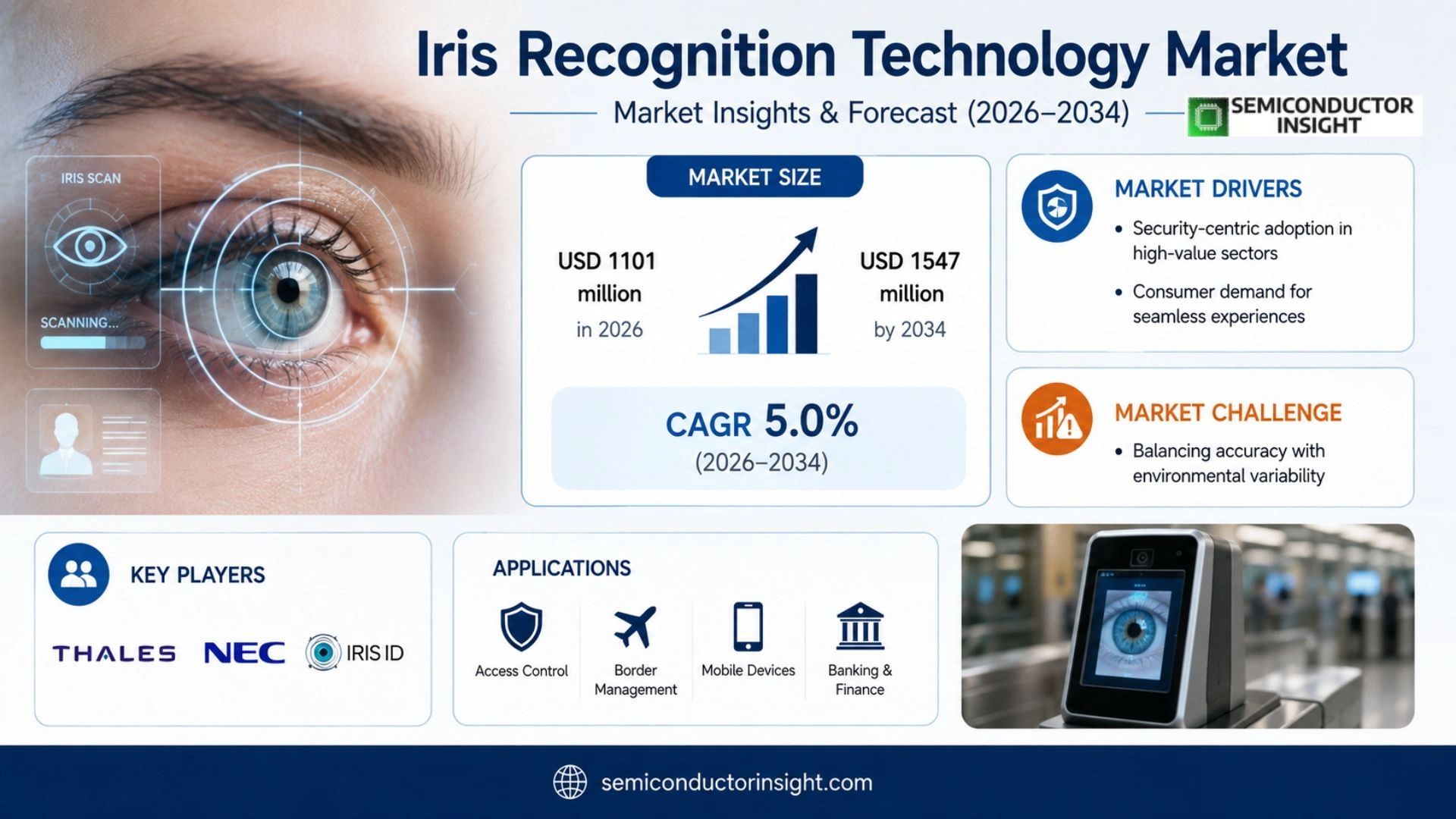
Global Iris Recognition Technology market is expected to increase from USD 1101 million in 2026 to USD 1547 million by 2034, showing a CAGR of 5.0 % over the forecast period.
Iris recognition technology is a biometric method that authenticates individuals by analysing the unique patterns of the iris – the coloured ring surrounding the pupil. High‑resolution near‑infrared cameras capture detailed images which are then processed through segmentation, feature extraction and matching algorithms. Because iris patterns remain stable throughout life and are unaffected by age or most environmental factors, the technique delivers high accuracy while remaining non‑contact and hygienic.
The market gains momentum thanks to expanding border‑control programmes, rising demand for secure access in financial services and growing integration of iris scanners into smartphones and healthcare devices. Advances in NIR illumination LEDs/VCSELs, edge‑AI processors and robust liveness‑detection modules reduce acquisition friction under challenging lighting or off‑angle conditions. Companies such as Thales, NEC, IDEMIA, HID (ASSA ABLOY), IriTech and IrisGuard continue to broaden their portfolios through new sensor releases and strategic collaborations with government agencies.
MARKET DRIVERS
Security‑Centric Adoption in High‑Value Sectors
The rising incidence of identity fraud has compelled banks, airports, and government agencies to seek biometric methods that are difficult to replicate. Iris Recognition Technology Market solutions meet this need because the iris pattern remains stable over a lifetime and cannot be forged with conventional tools. This strengthens authentication pipelines and reduces operational losses.
Consumer Demand for Seamless Experiences
Mobile manufacturers are embedding iris scanners into flagship devices, responding to user expectations for frictionless unlocking and payment. The convenience of a glance‑based login encourages broader acceptance, which in turn fuels vendor investment in miniaturised sensors and software optimisation.
➤ “A single‑eye scan can replace passwords, tokens, and cards, consolidating multiple security layers into one effortless action.”
Enterprise data‑center operators are also trialing iris‑based access control for server rooms, where tight physical security combines with digital safeguards. The resulting reduction in credential‑management overhead is prompting a wave of pilot projects that are likely to become permanent deployments.
MARKET CHALLENGES
Balancing Accuracy with Environmental Variability
While iris patterns are intrinsically reliable, real‑world conditions such as bright sunlight, reflections from glasses, or rapid eye movement can impair capture quality. Vendors must invest in advanced illumination and anti‑glare optics, which raises device cost and may deter price‑sensitive buyers.
Other Challenges
Regulatory and Privacy Concerns
Legislations in several jurisdictions now require explicit consent and clear data‑retention policies for biometric information. Companies that overlook these requirements risk legal penalties and erosion of public trust, slowing rollout speed.
MARKET RESTRAINTS
High Initial Capital Outlay
Deploying iris recognition systems typically involves procurement of specialised cameras, secure processing units, and integration services. For organisations operating on thin margins, the upfront expense can outweigh the perceived immediate benefits, leading to postponed adoption cycles.
In addition, legacy infrastructure that relies on legacy card or password mechanisms may require substantial redesign to accommodate biometric workflows, creating another layer of financial and operational friction.
Finally, the scarcity of trained technicians who can calibrate and maintain high‑precision sensors adds a hidden cost, constraining market penetration in regions where such expertise is not readily available.
MARKET OPPORTUNITIES
Integration with Emerging AI‑Powered Analytics
Artificial‑intelligence algorithms now enable real‑time liveness detection and multi‑modal fusion, where iris data is combined with facial or voice cues. This synergy opens avenues for Iris Recognition Technology Market providers to deliver comprehensive identity solutions that command premium pricing.
Healthcare facilities are exploring iris scanning for patient identification, aiming to reduce medication errors and streamline electronic health‑record access. The sector’s strict compliance protocols create a niche where accuracy and non‑invasiveness are highly valued.
Public‑sector smart‑city initiatives are another fertile ground, as municipalities seek contactless entry points for public transport and municipal buildings. Funding earmarked for digital transformation can accelerate large‑scale deployments, expanding the addressable market considerably.
Iris Recognition Technology Market Trends
Expansion of Iris Recognition in Border Control Programs
Iris Recognition Technology Market is witnessing heightened interest from government agencies that manage cross‑border movement. Recent deployments in major airports demonstrate that the immutable iris pattern satisfies the stringent false‑match thresholds required for high‑security checks. Operators value the technology’s resilience to environmental wear, which translates into lower re‑enrollment rates compared with alternatives. As national identity schemes incorporate biometric verification, iris scanners are being positioned as the definitive layer for high‑assurance verification, especially where rapid throughput meets uncompromising security. The result is a measurable shift in procurement budgets toward integrated iris capture stations that feed directly into watch‑list databases, reinforcing the relevance of iris as a cornerstone of modern border management.
Other Trends
Sensor Innovation Reduces Capture Challenges
Advances in near‑infrared illumination and CMOS sensor design are addressing the most cited friction points in iris acquisition. Vendors now ship cameras that operate reliably under off‑angle gaze, partial occlusion from glasses, and variable lighting,situations that previously limited deployment in busy public spaces. Embedded edge‑AI processors execute segmentation and quality assessment in real time, allowing devices to prompt users for a second attempt only when image fidelity falls below threshold. This hardware evolution shortens user interaction time and lowers the need for auxiliary lighting rigs, making iris readers more attractive for retail and healthcare venues that demand both speed and hygiene.
Shift Toward On‑Device Matching for Data Privacy
Regulatory scrutiny over biometric data storage is prompting a migration toward on‑device matching, where encrypted templates never leave the acquisition hardware. This architectural change reduces exposure to centralized breaches and aligns with emerging data‑protection statutes across Europe and North America. Companies that embed secure elements and cryptographic safeguards within the scanner differentiate themselves by offering audit trails and consent mechanisms built into the matching workflow. The strategic implication for Iris Recognition Technology Market is clear: providers must blend robust capture capability with privacy‑first design to secure contracts in regulated sectors such as banking and public welfare.
COMPETITIVE LANDSCAPE
Key Industry Players
Iris Recognition Technology Market – Competitive Overview
The hardware tier is dominated by a handful of global integrators that command the majority of scanner shipments. Thales, with its extensive defense and security portfolio, supplies high‑volume binocular units for border checkpoints, while NEC leverages its imaging expertise to deliver NIR‑optimized CMOS sensors for large‑scale enrollment centers. Their scale enables cost efficiencies and deep collaborations with national ID programs, creating a de‑facto tiered supply chain where smaller vendors rely on these OEMs for core components. Software‑centric firms such as IDEMIA and Aware occupy the upper‑middle segment, providing SDKs that embed iris matching into multimodal platforms; their algorithms differentiate on liveness detection and template protection, qualities that regulators increasingly demand.
Beyond the headline names, a constellation of specialized players fuels innovation at niche edges. HID Global (ASSA ABLOY) tailors compact readers for corporate access control, whereas IriTech focuses on mobile‑first solutions that bring iris capture to smartphones. Iris ID and IrisGuard maintain strong footholds in aviation and law‑enforcement markets through rugged, field‑ready devices. Emerging participants like Princeton Identity, CMITech, Innovatrics, Neurotechnology, ROC.ai, and Swallow Incubate contribute breakthrough work in edge‑AI processing and cloud‑based verification services. Their agility allows rapid adaptation to certification requirements and to the growing need for on‑device matching, which mitigates privacy concerns while preserving high assurance.
List of Key Iris Recognition Technology Companies Profiled
- Thales
- NEC
- IDEMIA
- HID Global (ASSA ABLOY)
- IriTech
- Iris ID
- IrisGuard
- Princeton Identity
- CMITech
- Innovatrics
- Aware
- Neurotechnology
- ROC.ai
- Swallow Incubate
Segment Analysis:
| Segment Category | Sub-Segments | Key Insights |
| By Type |
|
Hardware-driven Solutions
|
| By Application |
|
High‑Assurance Use Cases
|
| By End User |
|
Strategic End‑User Priorities
|
| By Device Type |
|
Device‑Centric Differentiation
|
| By Integration Approach |
|
Integration Strategies
|
Regional Analysis: Iris Recognition Technology Market
North America
Federal and state guidelines in the United States prioritize biometric consent and data minimization, prompting vendors to embed local storage options. Canada’s privacy act emphasizes auditability, which fuels demand for transparent log‑keeping within iris systems.
Fortune‑500 firms are integrating iris scanners into multi‑factor authentication suites, especially for remote‑work environments where password fatigue undermines security posture.
Start‑ups are leveraging silicon‑photonic sensors to shrink hardware footprints, while established players refine deep‑learning algorithms that compensate for lighting variations in real‑time.
Companies that bundle iris verification with identity‑as‑a‑service platforms gain a cross‑sell advantage, allowing banks and airlines to expand their digital identity portfolios efficiently.
Europe
European markets are characterized by a mosaic of national biometric strategies, yet a common trend is the integration of iris verification into border‑control and e‑government services. GDPR’s strict data‑processing rules have forced providers to design systems that anonymize raw templates after enrollment, fostering a wave of privacy‑first solutions. Financial institutions across the UK and Germany are piloting iris‑based login for high‑net‑worth clients, leveraging the technology’s low latency to improve user experience. The region’s strong research base, particularly in Scandinavia, fuels collaborative projects that explore multimodal biometrics, positioning Europe as an incubator for next‑generation authentication frameworks.
Asia-Pacific
In Asia‑Pacific, government‑led digital identity initiatives are accelerating iris adoption, especially in Singapore and South Korea where smart‑city projects demand seamless citizen verification. While cost considerations remain pivotal for emerging economies such as India and Indonesia, mobile‑first deployments are driving the development of compact, battery‑efficient iris modules that can attach to smartphones. The competitive landscape is fragmented, with local manufacturers challenging global incumbents by offering customized solutions that align with regional privacy expectations. This blend of public‑sector drive and consumer‑device innovation creates a fertile ground for differentiated market entries.
South America
South American economies are gradually moving beyond pilot phases, with Brazil’s banking sector embracing iris authentication to meet rising fraud concerns in digital payments. Regulatory bodies are beginning to outline biometric consent frameworks, encouraging a shift toward permanent enrollment rather than ad‑hoc verification. Market participants note that the region’s high mobile penetration offers a conduit for iris‑enabled smartphones, though price sensitivity dictates a focus on cost‑effective hardware. Partnerships between multinational vendors and local system integrators are emerging as a pragmatic route to scale deployments across public and private sectors.
Middle East & Africa
The Middle East & Africa segment is distinguished by a strong appetite for high‑security solutions in oil‑and‑gas facilities and luxury hospitality venues. Nations such as the United Arab Emirates are embedding iris scanners in smart‑border initiatives, leveraging the technology’s speed to streamline passenger flows. In Africa, pilot projects in Kenya and Nigeria are exploring iris verification for voter identification, reflecting an awareness of the technology’s potential to strengthen democratic processes. Despite infrastructure challenges, the region’s investment climate, buoyed by sovereign wealth funds, supports a steady influx of capital into biometric startups focused on ruggedized, low‑maintenance iris devices.
Report Scope
This market research report provides a comprehensive analysis of the Iris Recognition Technology Market , covering the forecast period 2026–2034. It offers detailed insights into market dynamics, technological advancements, competitive landscape, and key trends shaping the industry.
Key focus areas of the report include:
- Market Overview: The report begins with an overview outlining its current market scenario, key growth indicators, and industry transformation drivers. It discusses macroeconomic factors, demand–supply balance, regulatory landscape, and the strategic role of semiconductors in powering advancements across industries such as automotive, telecommunications, consumer electronics, and industrial automation.
- Market Size & Forecast: Historical data and future projections for revenue, unit shipments, and market value across major regions and segments.
- Segmentation Analysis: Detailed breakdown by product type, technology, application, and end-user industry to identify high-growth segments and investment opportunities.
- Regional Insights: Insights into market performance across North America, Europe, Asia-Pacific, Latin America, and the Middle East & Africa, including country-level analysis where relevant.
- Competitive Landscape: Profiles of leading market participants, including their product offerings, R&D focus, manufacturing capacity, pricing strategies, and recent developments such as mergers, acquisitions, and partnerships.
- Technology Trends & Innovation: Assessment of emerging technologies, integration of AI/IoT, semiconductor design trends, fabrication techniques, and evolving industry standards.
- Market Drivers & Restraints: Evaluation of factors driving market growth along with challenges, supply chain constraints, regulatory issues, and market-entry barriers.
- Stakeholder Insights: Insights for component suppliers, OEMs, system integrators, investors, and policymakers regarding the evolving ecosystem and strategic opportunities.
Primary and secondary research methods are employed, including interviews with industry experts, data from verified sources, and real-time market intelligence to ensure the accuracy and reliability of the insights presented.
FREQUENTLY ASKED QUESTIONS:
What is the current market size of Iris Recognition Technology Market?
-> Iris Recognition Technology Market is expected to increase from USD 1101 million in 2026 to USD 1547 million by 2034, showing a CAGR of 5.0 %
Which key companies operate in Iris Recognition Technology Market?
-> Key players include Thales, NEC, IDEMIA, HID (ASSA ABLOY), IriTech, Iris ID, IrisGuard, Princeton Identity, CMITech, Innovatrics, Aware, Neurotechnology, ROC.ai, Swallow Incubate, among others.
What are the key growth drivers?
-> Key growth drivers include increasing demand for high‑assurance biometrics in border security, access control, and regulated sectors such as finance and healthcare; advancements in NIR imaging, edge AI processing, and liveness detection; and heightened privacy and regulatory requirements prompting on‑device matching and template protection.
Which region dominates the market?
-> Asia is the fastest‑growing region, driven by large‑scale biometric initiatives in China, India, and Southeast Asia, while North America remains a dominant market in terms of revenue share.
What are the emerging trends?
-> Emerging trends include multimodal authentication combining iris with facial or fingerprint data, AI‑enhanced capture algorithms for off‑angle and masked eyes, on‑device secure matching, and stronger presentation‑attack detection mechanisms.

Get Sample Report PDF for Exclusive Insights
Report Sample Includes
- Table of Contents
- List of Tables & Figures
- Charts, Research Methodology, and more...
 Download Sample Report PDF