Embedded Fingerprint Sensor Market Insights
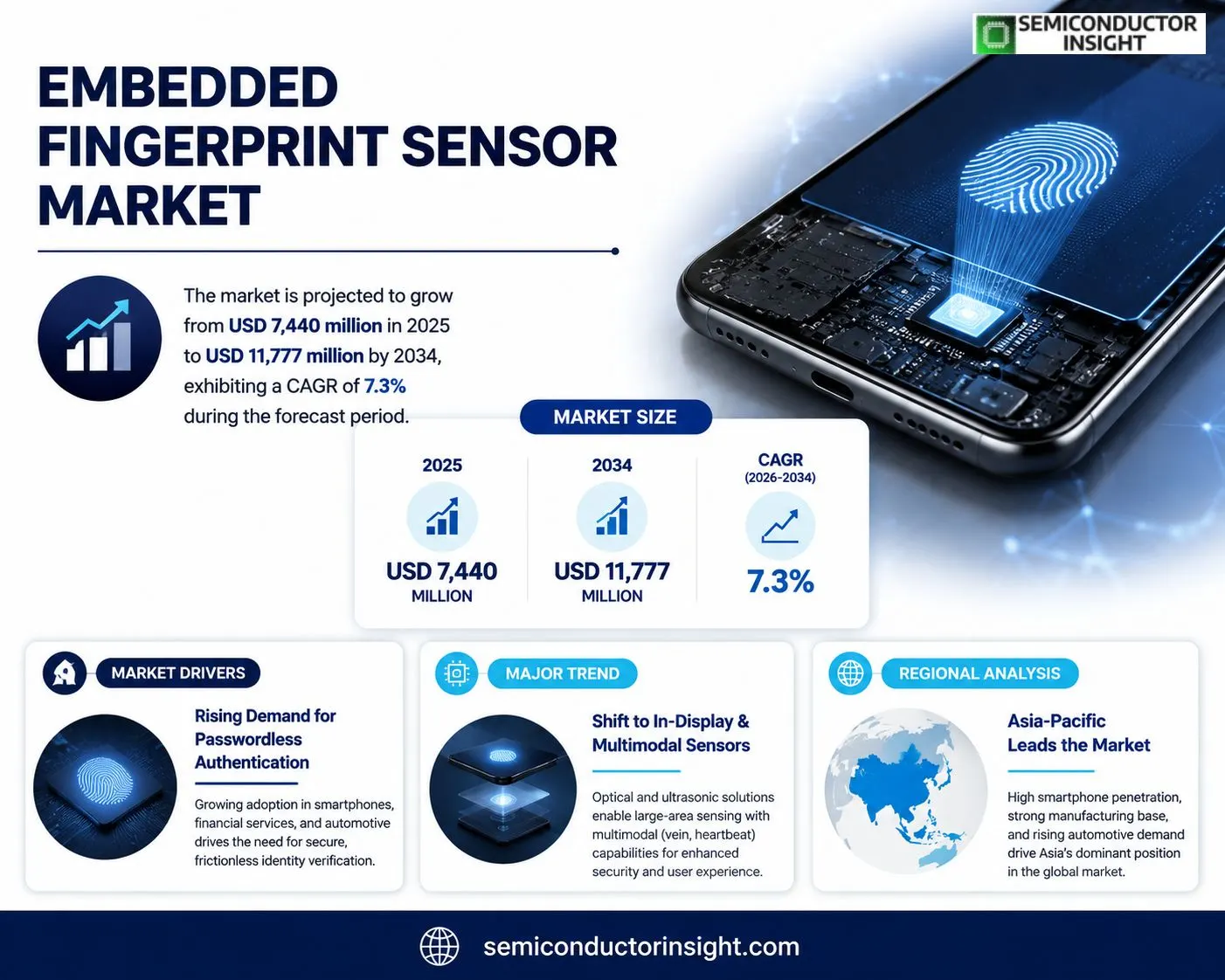
Embedded Fingerprint Sensor market size was valued at USD 7,440 million in 2025. The market is projected to grow from USD 7,440 million in 2025 to USD 11,777 million by 2034, exhibiting a CAGR of 7.3% during the forecast period.
An embedded fingerprint sensor is a compact biometric module integrated directly into devices such as smartphones, laptops or automotive dashboards to enable secure “frictionless” identity verification. By 2026 the technology has shifted from dedicated capacitive buttons to in‑display and under‑glass solutions, supporting large‑area and multimodal sensing.The expansion is fueled by rising demand for password‑less authentication across consumer electronics and automotive sectors, alongside increasing adoption of biometric payment cards that protect over USD 3 trillion in mobile transactions annually. Leading suppliers such as Qualcomm, Sony Semiconductor and Goodix Technology continue to innovate ultrasonic and optical designs, while OEMs like Apple and Samsung drive volume adoption through flagship device rollouts.
MARKET DRIVERS
Advances in Miniaturization
The relentless push toward smaller form factors has lowered the barrier for OEMs to embed biometric capability directly onto device boards. Component‑level integration now delivers fingerprint capture modules that occupy less than 1 mm², a size that would have been unattainable a few years ago. This spatial efficiency enables designers to allocate precious real estate for larger displays or additional sensors without compromising ergonomics.
Integration with Mobile Platforms
Smartphone manufacturers are increasingly treating fingerprint authentication as a baseline security feature rather than an optional upgrade. By embedding the sensor within the display stack, brands can offer seamless, on‑screen verification that matches consumer expectations for convenience. The resulting user‑experience advantage translates into higher device turnover, encouraging further adoption of the technology across mid‑range and premium segments.
➤ Embedding sensors at the chip level reduces latency by up to 30 %, delivering a perception of instant unlock that drives consumer preference.
Beyond consumer electronics, automotive infotainment systems are embracing embedded fingerprint scanners to enforce driver authentication and personalize cabin settings. This cross‑industry traction widens the addressable market, prompting chipmakers to accelerate development cycles and expand their product portfolios.
MARKET CHALLENGES
Manufacturing Yield Variability
Achieving high yields on ultra‑thin silicon dies remains a technical hurdle. Minor defects during wafer processing can render entire batches unsuitable for biometric use, inflating per‑unit costs and compressing margins for volume manufacturers. As a result, some suppliers opt for conservative production volumes, which can limit the speed at which new form‑factor innovations reach the market.
Other Challenges
Supply Chain Constraints
The reliance on specialty substrates and advanced lithography equipment creates a bottleneck when semiconductor demand spikes. Delays in raw material delivery cascade through the production line, forcing original equipment manufacturers to reassess launch timelines for devices that depend on embedded fingerprint capability.
MARKET RESTRAINTS
Cost Sensitivity in Tier‑2 Segments
Price‑conscious markets in emerging economies often prioritize basic functionality over advanced security features. The added expense of integrating a biometric sensorwhile modest in high‑end devicescan represent a significant proportion of the bill of materials for low‑cost smartphones and wearables. This price pressure curtails rapid penetration of the Embedded Fingerprint Sensor Market in those regions.
Furthermore, legacy authentication methods such as PIN codes remain culturally entrenched in several markets, diminishing the perceived urgency of upgrading to fingerprint solutions. Without strong incentives or regulatory nudges, adoption rates may plateau despite technological readiness.
MARKET OPPORTUNITIES
Expansion into IoT Edge Devices
Edge‑computing hardwareranging from smart locks to industrial control panelsis beginning to incorporate on‑board fingerprint verification to prevent unauthorized access. The convergence of low‑power sensor designs with integrated secure enclaves creates a compelling value proposition for manufacturers seeking to differentiate their products in a crowded IoT market.Regulatory trends that emphasize data protection and device authentication in sectors such as healthcare and finance further accelerate this opportunity. Companies that can certify compliance early stand to capture a sizable share of the emerging demand, positioning themselves as preferred suppliers for next‑generation secure devices.
Embedded Fingerprint Sensor Market Trends
Shift to In‑Display and Multimodal Sensors
The Embedded Fingerprint Sensor Market is witnessing a decisive move away from traditional capacitive pads toward in‑display and under‑glass architectures. Optical modules now claim roughly 64 % of shipments, while ultrasonic designs hold the remaining 36 %. The defining attribute of 2026‑era sensors is multimodality: fingerprint capture is combined with sub‑dermal vein imaging or heartbeat signals, enabling authentication across any point of a screen rather than a fixed sensor zone. This evolution reduces mechanical complexity, supports slimmer device chassis, and meets consumer expectations for “frictionless” access. Manufacturers that can integrate large‑area sensing while preserving low latency are gaining entry to premium smartphone lines, automotive dashboards, and emerging smart‑home panels, positioning the technology as the primary hardware gateway for the password‑free economy.
Other Trends
Supply‑Chain Constraints and Material Innovation
Upstream, the Embedded Fingerprint Sensor Market depends on high‑performance CMOS image sensors for optical variants and piezoelectric micro‑machined ultrasonic transducers for ultrasonic units. Core suppliers such as Sony, Samsung, and Qualcomm dominate the silicon side, while Corning and Schott provide the ultra‑pure quartz and glass substrates. In 2026 a notable bottleneck emerged around thin‑film transistor (TFT) production and specialty optical adhesives that must retain transparency over tens of millions of touch cycles. These constraints have nudged the average unit price toward US$ 6.30 and compressed gross margins to roughly 36 %. Companies that secure dedicated fab lines or develop proprietary adhesive formulations are better positioned to sustain profitability amid rising demand for larger‑area sensors.
Software Fusion and Liveness Detection Driving Downstream Value
Downstream, the Embedded Fingerprint Sensor Market derives most of its incremental revenue from biometric‑fusion software that links raw sensor data to secure enclaves such as Apple’s Secure Enclave or Android’s StrongBox. Automotive OEMs like BMW and Tesla now embed sensors to enable driver‑profile loading and one‑touch ignition, while the banking sector accounts for approximately 44 % of overall demand through biometric cards and ATM modules. A rapidly maturing layer of artificial‑intelligence‑based liveness detection distinguishes genuine fingertips from 3D‑printed replicas, reducing fraud exposure and justifying higher price points. For device OEMs, this translates into a competitive edge: integrating robust fusion stacks shortens time‑to‑market for password‑less solutions and opens licensing revenue streams with software providers. Consequently, firms that can co‑develop hardware‑software ecosystems are likely to capture disproportionate share of future growth.
COMPETITIVE LANDSCAPEKey Industry Players
Competitive positioning of leading embedded fingerprint sensor manufacturers in 2026
The market is heavily concentrated around a handful of firms that command the bulk of production capacity and technology leadership. Qualcomm dominates the ultrasonic segment by leveraging its 3‑D sensing chipset portfolio, which has been adopted in premium smartphones and emerging automotive cockpits. Sony Semiconductor supplies high‑resolution CMOS image sensors that underpin the optical majority, enabling large‑area, under‑glass implementations favored by consumer‑electronics giants. Goodix Technology has built a vertically integrated supply chain that couples sensor silicon with proprietary biometric‑fusion software, granting it a decisive edge in cost‑sensitive high‑volume devices. Synaptics, with its strong foothold in touch‑controller ecosystems, differentiates by offering multimodal packages that combine fingerprint capture with vein or heartbeat detection, a capability that is reshaping authentication standards across the mobile and financial sectors.Beyond the tier‑one suppliers, a diverse group of niche players fuels innovation and addresses specialized market segments. Idemia focuses on high‑security government and banking applications, where its hardened modules meet stringent certification requirements. Suprema targets enterprise access‑control and time‑attendance solutions, emphasizing durability and integration with cloud‑based identity platforms. ZKTeco and Betterlife concentrate on smart‑home and low‑cost IoT devices, leveraging compact designs that suit constrained form factors. Aratek, Egis Technology, and Camabio cater to automotive OEMs that demand ruggedized sensors capable of withstanding temperature extremes. The presence of these firms widens the competitive set, forcing the leaders to accelerate feature development and price optimization.
List of Key Embedded Fingerprint Sensor Companies Profiled
- Qualcomm
- Sony Semiconductor
- Goodix Technology
- Synaptics
- Idemia
- Suprema
- id3 Technologies
- ZKTeco
- Betterlife
- Aratek
- Egis Technology
- Camabio
- FPC
- HID
Segment Analysis:
| Segment Category | Sub-Segments | Key Insights |
| By Type |
|
Optical continues to dominate because it offers high resolution imaging that supports large‑area sensing and seamless integration under glass.
|
| By Application |
|
Consumer Electronics remains the primary driver, as manufacturers embed sensors to support password‑less authentication and seamless payment experiences.
|
| By End User |
|
Smartphone owners value the convenience of immediate access combined with robust security, driving OEMs to embed sensors as a differentiator.
|
| By Interface |
|
UART Interface is favored for its simplicity and low power consumption, making it popular in portable devices.
|
| By Security Feature |
|
Liveness Detection has become a critical differentiator as threats evolve, ensuring that sensors can discern genuine human tissue.
|
Regional Analysis: Embedded Fingerprint Sensor Market
North America
The pace of sensor mini‑miniaturization is reshaping design constraints for OEMs. Engineers are leveraging advanced MEMS processes to embed fingerprints beneath glass, eliminating visible scanner footprints. This shift is prompting a surge in cross‑disciplinary partnerships, where semiconductor firms align their process nodes with biometric algorithm developers to deliver integrated solutions that meet both performance and cost thresholds.
The United States’ biometric privacy framework, while still evolving, emphasizes consent and data minimization. Companies that embed secure enclave processing within sensors can demonstrate compliance without external data handling, granting them a competitive edge. This regulatory nuance drives firms to embed encryption and on‑device matching capabilities directly into the sensor architecture.
Tier‑1 manufacturers dominate high‑volume contracts, yet a wave of niche players is carving out space in specialized sectors such as medical wearables and secure access control. Their agility allows rapid customization, forcing incumbents to broaden portfolio breadth and accelerate feature rollouts to retain market share.
Beyond smartphones, embedded fingerprint sensors are gaining traction in automotive dashboards, where drivers demand frictionless yet secure vehicle entry. In enterprise environments, laptops equipped with on‑chip biometric verification are becoming the norm for remote‑work security policies, driving procurement cycles that favor integrated sensor solutions.
Europe
European manufacturers are capitalizing on stringent data‑protection directives, which have nurtured a market for on‑device biometric verification that sidesteps cloud dependencies. Automotive makers across Germany and France are embedding sensors into next‑generation infotainment units, aligning product design with EU safety standards. Meanwhile, the region’s strong emphasis on sustainability pushes suppliers to adopt low‑power sensor designs, positioning Europe as a hub for eco‑conscious biometric innovation.
Asia‑Pacific
The Asia‑Pacific arena blends rapid consumer uptake with cost‑sensitive production ecosystems. China’s expansive manufacturing base enables high‑volume sensor fabrication at competitive price points, while South Korea’s design‑forward culture fuels integration into premium smartphones and wearable devices. Nations such as India are witnessing a surge in government‑driven digital identity programs, prompting local device makers to embed fingerprint sensors that satisfy both security mandates and affordability constraints.
South America
In South America, market growth is anchored by rising smartphone penetration and an emerging focus on secure mobile payments. Brazil’s fintech sector, for instance, is encouraging device manufacturers to embed fingerprint sensors as a means to reinforce transactional trust. Additionally, regional automotive assemblers are beginning to adopt biometric entry systems to differentiate their offerings in a price‑competitive market, signaling an early stage of technology diffusion.
Middle East & Africa
The Middle East & Africa region reflects a mixed landscape where oil‑rich economies invest heavily in smart‑city infrastructure, integrating biometric authentication into public transportation and governmental services. Simultaneously, African markets are exploring low‑cost mobile devices with embedded sensors to expand financial inclusion initiatives. This duality creates opportunities for tiered sensor solutions that cater to high‑end security projects as well as mass‑market connectivity drives.
Report Scope
This market research report provides a comprehensive analysis of the Embedded Fingerprint Sensor Market , covering the forecast period 2026–2034. It offers detailed insights into market dynamics, technological advancements, competitive landscape, and key trends shaping the industry.
Key focus areas of the report include:
- Market Overview: The report begins with an overview outlining its current market scenario, key growth indicators, and industry transformation drivers. It discusses macroeconomic factors, demand–supply balance, regulatory landscape, and the strategic role of semiconductors in powering advancements across industries such as automotive, telecommunications, consumer electronics, and industrial automation.
- Market Size & Forecast: Historical data and future projections for revenue, unit shipments, and market value across major regions and segments.
- Segmentation Analysis: Detailed breakdown by product type, technology, application, and end-user industry to identify high-growth segments and investment opportunities.
- Regional Insights: Insights into market performance across North America, Europe, Asia-Pacific, Latin America, and the Middle East & Africa, including country-level analysis where relevant.
- Competitive Landscape: Profiles of leading market participants, including their product offerings, R&D focus, manufacturing capacity, pricing strategies, and recent developments such as mergers, acquisitions, and partnerships.
- Technology Trends & Innovation: Assessment of emerging technologies, integration of AI/IoT, semiconductor design trends, fabrication techniques, and evolving industry standards.
- Market Drivers & Restraints: Evaluation of factors driving market growth along with challenges, supply chain constraints, regulatory issues, and market-entry barriers.
- Stakeholder Insights: Insights for component suppliers, OEMs, system integrators, investors, and policymakers regarding the evolving ecosystem and strategic opportunities.
Primary and secondary research methods are employed, including interviews with industry experts, data from verified sources, and real-time market intelligence to ensure the accuracy and reliability of the insights presented.
FREQUENTLY ASKED QUESTIONS:
What is the current market size of Embedded Fingerprint Sensor Market?
-> Embedded Fingerprint Sensor Market was valued at USD 7,440 million in 2025 and is expected to reach USD 11,777 million by 2034, growing at a CAGR of 7.3%.
Which key companies operate in Embedded Fingerprint Sensor Market?
-> Key players include IDEMIA, id3 Technologies, Suprema, FPC, HID, NEXT Biometrics, Synaptics, CAMABIO, Goodix Technology, Qualcomm, Egis Technology, Betterlife, ZKTeco, Aratek.
What are the key growth drivers?
-> Key growth drivers include adoption of in‑display and under‑glass sensor designs, demand for passwordless authentication, expansion of mobile payments securing over USD 3 trillion annually, and increasing integration in automotive and financial sectors.
Which region dominates the market?
-> Asia holds the largest share of the Embedded Fingerprint Sensor market, driven by high demand for smartphones, consumer electronics, and automotive applications.
What are the emerging trends?
-> Emerging trends include multimodal sensors combining fingerprint with vein or heartbeat detection, large‑area sensing that allows touch anywhere on the screen, AI‑enabled liveness detection, and the shift toward passwordless ecosystems.

Get Sample Report PDF for Exclusive Insights
Report Sample Includes
- Table of Contents
- List of Tables & Figures
- Charts, Research Methodology, and more...
 Download Sample Report PDF