Palm Vein Module Market Insights
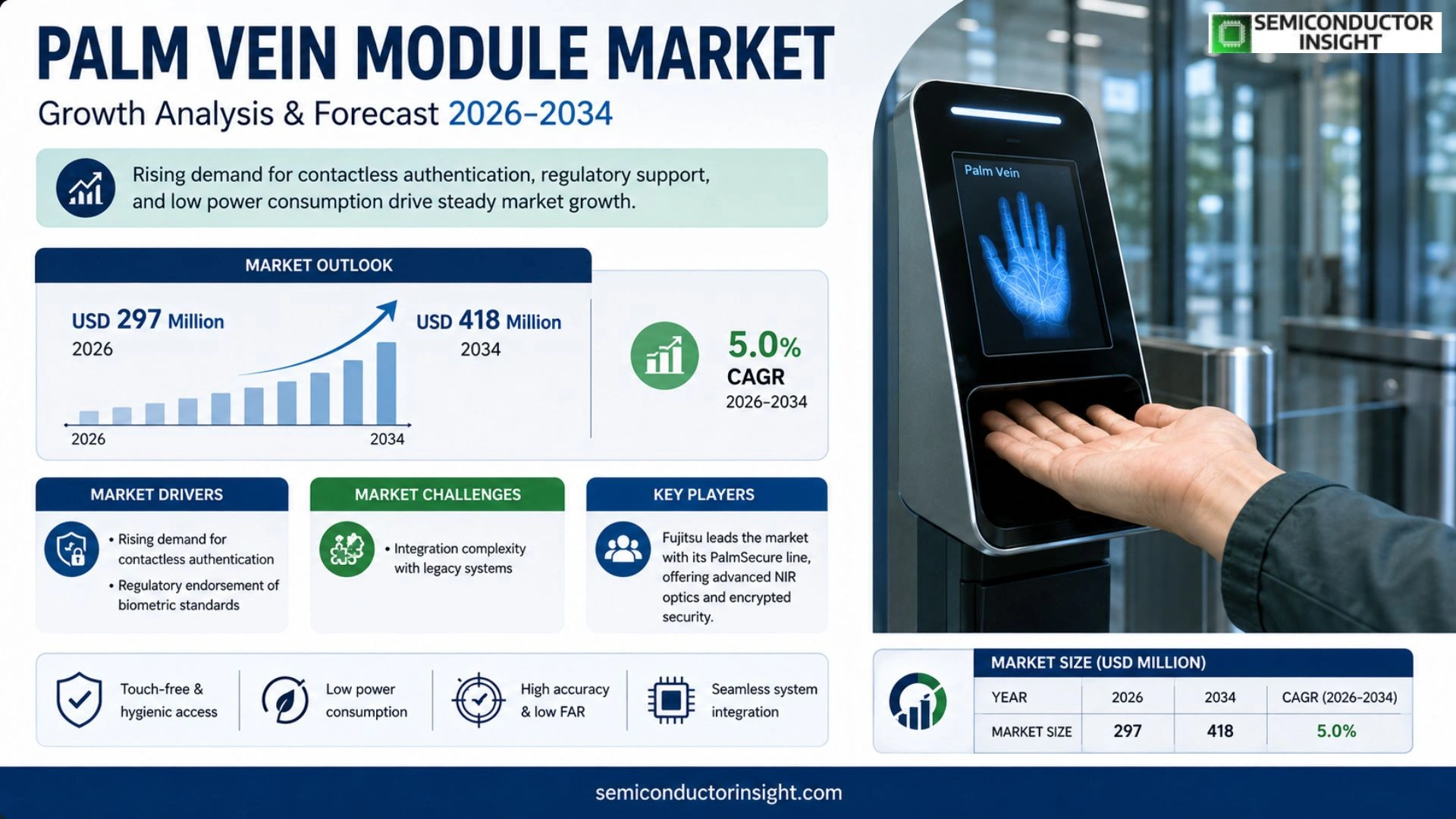
Palm Vein Module market is forecasted to increase from USD 297 million in 2026 to USD 418 million by 2034, reflecting a CAGR of 5.0% over the period.
A Palm Vein Module is a biometric authentication device that identifies or verifies a person by illuminating the palm with near‑infrared light to capture an image of the unique vein pattern beneath the skin, then converting that pattern into a digital template for matching during login, access control, or transaction approval. Because the vein pattern is internal and requires a “live” hand with blood flow, Palm Vein Modules are generally designed to be contactless or low‑contact and can be more resistant to surface‑level issues such as dirt, cuts, or worn fingerprints while supporting fast, repeatable identification.
The market is experiencing growth because hygiene requirements have intensified in healthcare and welfare facilities, regulatory focus on secure access control has tightened, and contactless authentication is gaining traction in high‑security settings like banking and public services. Initiatives by key players also influence expansion; for example, Fujitsu launched an updated PalmSecure scanner series in early 2024 with enhanced encryption capabilities, while Hitachi announced a partnership with a semiconductor supplier aimed at lowering component costs for OEM modules. Other notable participants such as NEC, M2SYS Technology and Hikvision continue broadening their portfolios across access control, time‑attendance and ATM applications.
MARKET DRIVERS
Rising Demand for Contactless Authentication
Palm Vein Module Market is gaining traction as enterprises prioritize hygienic, touch‑free access solutions. Palm‑vein recognition eliminates surface contamination, a factor that has become decisive for hospitals, airports, and high‑traffic retail outlets. Companies that embed these modules into entry points can differentiate their security posture while addressing public‑health concerns.
Regulatory Endorsement of Biometric Standards
Governmental agencies across Asia‑Pacific and Europe have begun codifying biometric requirements for critical infrastructure. This regulatory push creates a predictable procurement environment, prompting vendors to allocate R&D resources toward palm‑vein sensors that satisfy emerging certification schemes.
➤ “Enterprises that adopt palm‑vein modules now enjoy a measurable reduction in false‑accept rates compared with legacy fingerprint systems,” a senior biometric consultant noted.
Beyond security, the technology’s low power consumption aligns with sustainability goals. Organizations seeking to lower device‑level energy usage find palm‑vein modules attractive, especially when paired with IoT gateways that aggregate access logs for analytics.
MARKET CHALLENGES
Integration Complexity
Deploying palm‑vein sensors alongside legacy access control hardware often requires custom middleware. Small‑to‑mid‑size firms may lack the engineering bandwidth to develop such interfaces, leading to longer rollout timelines and higher upfront costs.
Other Challenges
Cost Sensitivity
While bulk pricing has improved, the unit cost of high‑resolution palm‑vein modules remains above that of conventional RFID tags. Price‑conscious sectors, such as public transportation, hesitate to replace existing systems without clear ROI evidence.
MARKET RESTRAINTS
Limited Public Awareness
Potential buyers often associate biometric security with fingerprint or facial recognition, overlooking palm‑vein’s distinct advantages. This knowledge gap slows adoption, as decision‑makers default to familiar technologies whose performance they already trust.
MARKET OPPORTUNITIES
Enterprise‑Level Integration Platforms
Software providers that bundle palm‑vein authentication into unified identity‑management suites stand to capture a growing slice of the market. By offering plug‑and‑play APIs, these platforms reduce integration friction, making the technology more accessible to organizations with limited in‑house expertise.
Palm Vein Module Market Trends
Cost Compression and Institutional Adoption
Palm Vein Module Market is feeling the pressure of price erosion as component suppliers negotiate larger volumes for NIR LEDs, CMOS sensors and secure processors. Unit costs for OEM‑grade modules have slipped from roughly $70 in 2022 to just above $45 today, a shift that widens the economic case for hospitals, welfare centers and regulated factories that value hygiene and low false‑accept rates. Because the technology remains contact‑less, infection‑control policies in post‑pandemic facilities act as a catalyst for replacing legacy fingerprint readers. Operators now justify the $150‑$300 price tag of turnstile‑ready terminals by citing reduced cleaning labor and lower spoof‑risk incidents, which translate into measurable operational savings over a three‑year horizon. This price‑performance balance is nudging more mid‑size enterprises toward standalone Palm Vein solutions, expanding the addressable base beyond a handful of high‑security campuses.
Other Trends
Supply‑Chain Consolidation
Upstream, the pool of NIR optoelectronic manufacturers has thinned as a few global foundries capture the bulk of wafer capacity, prompting tighter negotiation leverage for module assemblers. Midstream integrators are responding by forming strategic alliances with algorithm providers, enabling a single‑source bill of materials that reduces time‑to‑market for new form factors. Downstream, solution vendors are bundling Palm Vein readers with broader identity‑management suites, leveraging the module’s cryptographic element to meet emerging data‑privacy regulations. This vertical alignment shortens lead times, mitigates inventory risk, and creates a more predictable revenue stream for OEMs, especially in regions where public‑sector procurement cycles demand vetted, end‑to‑end solutions.
Integration with Identity Platforms
Enterprise software vendors increasingly expose APIs that accept Palm Vein biometric templates alongside fingerprint and facial data, allowing organizations to construct layered authentication policies without overhauling existing access control hardware. Palm Vein Module Market benefits from this trend because it positions the technology as a compliance‑friendly option for sectors such as banking and government, where anti‑spoofing capability is a regulatory prerequisite. As identity‑as‑a‑service offerings mature, vendors that package Palm Vein modules with cloud‑based verification services can command premium contracts, while downstream users gain the agility to roll out updates centrally. The net effect is a shift from isolated deployment projects toward subscription‑style engagements that embed Palm Vein hardware into a broader digital‑identity ecosystem.
COMPETITIVE LANDSCAPE
Key Industry Players
Competitive Overview of Palm Vein Module Providers
Fujitsu dominates the high‑end segment with its PalmSecure line, leveraging a vertically integrated model that couples proprietary NIR optics with advanced encryption firmware. This approach allows the company to command premium pricing for desktop scanners while supplying OEM‑grade modules to system integrators. The market’s supply chain remains tightly coupled: semiconductor firms provide NIR LEDs and CMOS sensors, niche optics houses produce lenses and filters, and a handful of software specialists deliver vein‑extraction algorithms. Because the technology requires precise calibration, a limited number of manufacturers can achieve the reliability demanded by healthcare facilities and regulated workplaces, resulting in a concentration of revenue among three to five large players.
Beyond the marquee brands, a diverse group of midsize firms sustains the ecosystem. Hitachi and NEC supply industrial‑grade modules to transportation hubs, whereas Hikvision focuses on surveillance‑linked access points. Companies such as M2SYS Technology, BioSec Group, Recogtech, and IDLink Systems differentiate through customizable SDKs that enable rapid integration with existing identity‑management platforms. Smaller innovators – Mantra Infotech, Imprivata, iDentyTech, Saint Deem, PCS Systemtechnik, and Tencent Cloud – target niche verticals like welfare facilities or fintech kiosks, often bundling palm‑vein sensors with multi‑modal biometric suites to broaden market appeal. Their aggressive pricing and localized support help offset the higher unit cost of palm‑vein hardware, gradually expanding adoption in regions where hygiene and anti‑spoofing are paramount.
List of Key Palm Vein Module Companies Profiled
- Fujitsu
- Hitachi
- NEC
- Hikvision
- M2SYS Technology
- BioSec Group
- Recogtech
- IDLink Systems
- Mantra Infotech
- Imprivata
- iDentyTech
- Saint Deem
- PCS Systemtechnik
- Tencent Cloud
Segment Analysis:
| Segment Category | Sub-Segments | Key Insights |
| By Type |
|
Non‑Contact Type is favored for high‑hygiene environments because it eliminates any physical touch, thereby reducing contamination risk and supporting stringent infection‑control protocols.
|
| By Application |
|
Physical Access Control drives adoption where secure perimeter protection is essential.
|
| By End User |
|
Healthcare & Welfare Facilities emerge as the leading end‑user segment because they prioritize contactless, hygienic verification for patients and staff.
|
| By Illumination Geometry |
|
Transmission Geometry is the preferred technology in high‑security deployments because the light passes through the palm, capturing a clearer vein pattern that is tougher to spoof.
|
| By Scale |
|
Standalone Readers dominate early‑stage installations where organizations seek turnkey devices that can be mounted at doors or turnstiles without extensive customization.
|
Regional Analysis: Palm Vein Module Market
North America
North American data‑privacy statutes, such as the CCPA and state‑level biometric laws, compel vendors to embed privacy‑by‑design principles. Consequently, manufacturers prioritize secure element integration, which differentiates premium palm vein modules from lower‑cost alternatives.
Financial institutions and government facilities dominate procurement, valuing the technology’s resistance to spoofing. Emerging adoption in smart‑building management further broadens the addressable base.
Advances in near‑infrared imaging and on‑chip AI inference enable real‑time vein pattern extraction, shrinking device footprints and opening opportunities in portable authentication terminals.
Leading suppliers leverage vertically integrated supply chains to control component quality, while niche players focus on bespoke solutions for high‑security environments, creating a layered market structure.
Europe
European adoption mirrors North America’s emphasis on security, yet cost considerations weigh more heavily. The EU’s GDPR framework drives biometric vendors to certify data‑handling modules, fostering a market where compliance readiness becomes a selling point. Industries such as transportation and hospitality are experimenting with palm vein scanners to complement RFID ticketing, aiming to reduce fraud without sacrificing passenger flow. Local OEMs benefit from strong cross‑border standardization, which smooths the path for multi‑country rollouts, but they face stiff competition from Asian manufacturers offering lower price points.
Asia‑Pacific
In the Asia‑Pacific region, rapid urbanization and expansive smart‑city initiatives create fertile ground for palm vein technology. Governments in China, Japan, and South Korea incorporate biometric access into public infrastructure, leveraging the technology’s hygienic appeal amid heightened health awareness. However, price sensitivity drives many adopters toward hybrid solutions that combine palm veins with less expensive modalities, prompting manufacturers to develop cost‑effective chipsets that do not compromise security fundamentals.
South America
South American markets are still nascent, with pilots primarily in banking corridors of Brazil and Chile. The primary barrier is limited local manufacturing capability, resulting in reliance on imports and longer supply chains. Nonetheless, growing awareness of biometric fraud is prompting regional regulators to endorse palm vein verification for high‑value transactions, a trend that could stimulate modest but steady growth in Palm Vein Module Market over the next decade.
Middle East & Africa
The Middle East exhibits selective uptake, driven by sovereign wealth funds investing in secure data‑centers and luxury hospitality venues. In Africa, adoption is constrained by infrastructure gaps, yet pockets of progress appear in Kenya’s fintech sector, where contactless identity verification aligns with mobile‑first strategies. Partnerships between global OEMs and local system integrators are emerging as the preferred route to navigate regulatory nuances and deliver culturally attuned solutions.
Report Scope
This market research report provides a comprehensive analysis of the Palm Vein Module Market , covering the forecast period 2026–2034. It offers detailed insights into market dynamics, technological advancements, competitive landscape, and key trends shaping the industry.
Key focus areas of the report include:
- Market Overview: The report begins with an overview outlining its current market scenario, key growth indicators, and industry transformation drivers. It discusses macroeconomic factors, demand–supply balance, regulatory landscape, and the strategic role of semiconductors in powering advancements across industries such as automotive, telecommunications, consumer electronics, and industrial automation.
- Market Size & Forecast: Historical data and future projections for revenue, unit shipments, and market value across major regions and segments.
- Segmentation Analysis: Detailed breakdown by product type, technology, application, and end-user industry to identify high-growth segments and investment opportunities.
- Regional Insights: Insights into market performance across North America, Europe, Asia-Pacific, Latin America, and the Middle East & Africa, including country-level analysis where relevant.
- Competitive Landscape: Profiles of leading market participants, including their product offerings, R&D focus, manufacturing capacity, pricing strategies, and recent developments such as mergers, acquisitions, and partnerships.
- Technology Trends & Innovation: Assessment of emerging technologies, integration of AI/IoT, semiconductor design trends, fabrication techniques, and evolving industry standards.
- Market Drivers & Restraints: Evaluation of factors driving market growth along with challenges, supply chain constraints, regulatory issues, and market-entry barriers.
- Stakeholder Insights: Insights for component suppliers, OEMs, system integrators, investors, and policymakers regarding the evolving ecosystem and strategic opportunities.
Primary and secondary research methods are employed, including interviews with industry experts, data from verified sources, and real-time market intelligence to ensure the accuracy and reliability of the insights presented.
FREQUENTLY ASKED QUESTIONS:
What is the current market size of Palm Vein Module Market?
-> Palm Vein Module market is forecasted to increase from USD 297 million in 2026 to USD 418 million by 2034, reflecting a CAGR of 5.0%
Which key companies operate in Palm Vein Module Market?
-> Key players include Fujitsu, Tencent Cloud, Hitachi, NEC, M2SYS Technology, BioSec Group, Recogtech, IDLink Systems, Hikvision, Mantra Infotech, Imprivata, iDentyTech, Saint Deem, PCS Systemtechnik, among others.
What are the key growth drivers?
-> Key growth drivers include hygiene‑focused deployments, strong anti‑spoofing capabilities, reliability in high‑security environments, infection‑control requirements in healthcare and welfare facilities, and ongoing cost‑reduction efforts.
Which region dominates the market?
-> Asia is the leading region, driven by rapid adoption in healthcare, enterprise security, and government‑backed biometric initiatives, while Europe and North America remain strong secondary markets.
What are the emerging trends?
-> Emerging trends include integration with AI‑enabled identity platforms, multi‑modal biometric systems, enhanced encryption for data security, and continued miniaturization to support plug‑and‑play and USB‑type deployments.
Get Sample Report PDF for Exclusive Insights
Report Sample Includes
- Table of Contents
- List of Tables & Figures
- Charts, Research Methodology, and more...
 Download Sample Report PDF