High Performance Plastic Parts for Semiconductor Equipment Market Insights
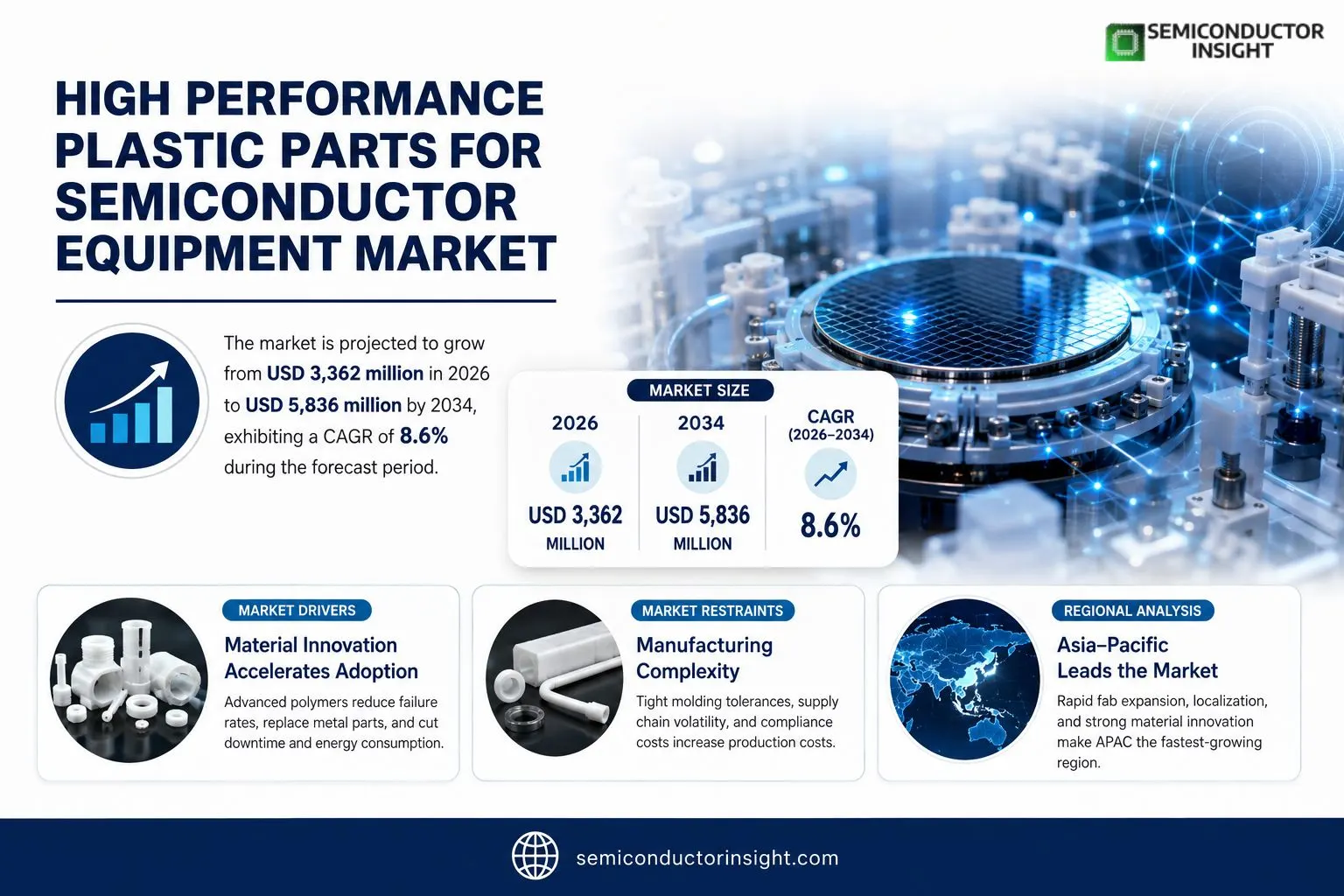
High Performance Plastic Parts for Semiconductor Equipment market was valued at USD 3,362 million in 2025 and will grow to USD 5,836 million by 2034, reflecting a CAGR of 8.6% over the forecast period.
High Performance Plastic Parts for Semiconductor Equipment refers to polymer‑based components and sub‑assemblies used in semiconductor tools and wafer‑fab utility systems where corrosion resistance, ultra‑cleanliness, low extractables/particles, dimensional stability, ESD control andwhere requiredlow outgassing are essential. The category is dominated by fluoropolymers such as PFA, PTFE and PVDF for wet/chemical service and by engineering plastics like PEEK, PPS and polyimide/PAI for high‑wear, high‑temperature or vacuum applications; General Engineering Plastics serve non‑wetted frames and fixtures.The upward trajectory stems from sustained fab investment and increasing material intensity per wafer. SEMI forecasts front‑end equipment spending near USD 110 billion in 2025 and total equipment sales approaching a record USD 156 billion by 2027, expanding the installed base that continuously consumes polymer components. At the same time stricter purity specifications such as SEMI F57 push suppliers toward qualification‑grade polymers with documented traceability.
MARKET DRIVERS
Material Innovation Accelerates Adoption
The introduction of high‑temperature resistant polymers and low‑dielectric constant blends has lowered failure rates of critical components inside lithography and etch tools. Manufacturers can now replace metal fixtures with lighter, corrosion‑free plastics, which translates into reduced downtime and lower energy consumption. Recent production data show a 7% annual increase in the share of plastic‑based parts for wafer‑handling modules.
Demand for Miniaturization Fuels Need
As node sizes shrink below 5 nm, equipment designers demand components that maintain dimensional stability at sub‑micron tolerances. High‑performance plastics meet these criteria while offering ease of molding for complex geometries. This shift enables cost‑effective scaling of advanced patterning tools, a factor that has driven procurement budgets toward polymer solutions for critical feed‑throughs.
➤ Design teams now prioritize polymer‑based inserts to achieve tighter tolerances without compromising thermal performance.
Collectively, these forces are reshaping the component supply base, prompting equipment OEMs to qualify new grades of polymeric material faster than in previous technology cycles.
MARKET CHALLENGES
Manufacturing Complexity
High‑performance plastics require precise extrusion and injection molding conditions to avoid internal stresses that could lead to out‑of‑spec dimensions. Small variations in temperature control can cause warpage, which jeopardizes the tight tolerances demanded by semiconductor fabs. Consequently, qualified suppliers invest heavily in specialized tooling, inflating the cost structure for end users.
Other Challenges
Supply Chain Volatility
Raw‑material shortages for engineering‑grade polymers have become more frequent, driven by geopolitical tensions and fluctuating petrochemical prices. The resulting lead‑time extensions force equipment manufacturers to hold larger safety stocks, eroding the lean‑inventory advantage traditionally associated with plastic components.
MARKET RESTRAINTS
Regulatory Compliance Costs
Stringent environmental and safety regulations governing the use of fluorinated polymers and flame‑retardant additives add layers of testing and certification. Compliance documentation must be updated for each new material batch, a process that extends time‑to‑market and adds overhead for both suppliers and equipment makers.
MARKET OPPORTUNITIES
Emerging Applications in Advanced Packaging
The rise of chip‑on‑wafer (CoW) and heterogeneous integration platforms calls for polymeric interposers that can endure repeated thermal cycling while maintaining electrical isolation. High‑performance plastics engineered for low moisture absorption are uniquely positioned to serve these niches. Early adopters report up to a 12% reduction in package assembly time, indicating a clear competitive edge for companies that can supply qualified components.
High Performance Plastic Parts for Semiconductor Equipment Market Trends
Surge in Ultra‑Pure Fluoropolymer Demand
The accelerating capital outlay across front‑end fabs has translated into a pronounced need for polymer components that survive aggressive wet chemistry while preserving particle‑free environments. Semiconductor‑grade fluoropolymers such as PFA, PTFE and PVDF now dominate the fluid‑handling chains of cleaning and wet‑process tools, because their intrinsic resistance to corrosive agents and low extractable profile meet the tighter defect budgets imposed by leading device manufacturers. Suppliers that can certify material purity in accordance with SEMI F57 have secured a preferred‑vendor status, prompting equipment OEMs to redesign coolant loops, valve trains and filtration housings around these grades. Consequently, High Performance Plastic Parts for Semiconductor Equipment Market has witnessed a shift from volume‑based pricing to value‑linked contracts where traceability and documentation carry premium margins.
Other Trends
Regional Growth Divergence
Regional dynamics add another layer of complexity. In North America, the roughly $1 billion base in 2025 has been reinforced by steady tool‑upgrade cycles, pushing the segment toward a mid‑single‑digit expansion rate. Europe’s more modest footprint reflects tighter environmental standards that favor low‑outgassing grades, yet the market still climbs as legacy fabs retrofit their chemical distribution networks. Asian hubs, particularly China, exhibit the steepest upward trajectory; a double‑digit compound‑annual increase stems from aggressive capacity expansion and a policy push to localize polymer qualification processes. Japan and South Korea maintain incremental growth, with domestic manufacturers aligning their product roadmaps to the stricter traceability mandates that dominate the OEM selection criteria.
Regulatory Pressure and Supply‑Chain Localization
Regulatory scrutiny over PFAS and related fluoropolymers is reshaping supplier strategies. EU disclosures and emerging North‑American guidelines compel manufacturers to document emissions pathways and explore alternative chemistries, prompting a modest reallocation of R&D budgets toward low‑PFAS grades without sacrificing corrosion resistance. At the same time, geopolitical considerations have accelerated the establishment of regional supply chains, allowing Asian producers to qualify parts under local specifications while reducing lead‑time for fab installations. These forces together generate a competitive environment where firms that combine compliance expertise with high‑purity production capabilities gain leverage in both new‑build and refurbishment projects. The net effect is a market that rewards technical differentiation and agile regulatory response more than sheer capacity.
COMPETITIVE LANDSCAPEKey Industry Players
Competitive Dynamics in High‑Performance Polymer Components for Semiconductor Tooling
Entegris commands the largest share of the high‑performance plastic parts market, leveraging an extensive portfolio that spans fluoropolymer tubing, ultra‑pure fluid fittings, and CMP‑grade retainers. Its dominance stems from deep integration with OEMs, rigorous qualification processes aligned with SEMI F57 standards, and a supply network that satisfies the exacting purity and traceability requirements of advanced fabs. The company’s scale enables it to offer both standard catalog items and bespoke engineered solutions, creating a barrier to entry for smaller outfits. Market structure is decidedly top‑heavy: the ten biggest firms collectively capture roughly 60 % of revenue, while a fragmented tier of specialist manufacturers supplies niche applications such as high‑temperature polyimide housings or low‑outgassing vacuum components.Beyond the headline players, a suite of mid‑size firms sustains the ecosystem by focusing on material specialisation or regional service. Shin‑Etsu Polymer and Daikin excel in fluoropolymer chemistries, delivering PFA and PTFE variants that meet the strict chemical‑resistance demands of wet‑process equipment. Parker Hannifin and GEMÜ Group provide precision‑engineered valve and fitting assemblies that are critical for ultra‑clean water distribution. European‑based entities such as Röchling Industrial and Saint‑Gobain contribute high‑performance engineering plastics (PEEK, PPS) for wear‑intensive CMP retainers, while Asian manufacturers like Gudeng Precision and Willbe S&T cater to domestic fab expansions with competitive pricing and rapid lead‑times. The collective focus on material qualification, supply‑chain resilience, and incremental innovation defines the competitive tempo of the sector.
List of Key High Performance Plastic Parts for Semiconductor Equipment Companies Profiled
- Entegris
- Pall Corporation
- Shin‑Etsu Polymer
- PILLAR Corporation
- Parker Hannifin
- Daikin
- GEMÜ Group
- SMC
- SIMONA AG
- Saint‑Gobain
- Röchling Industrial
- Willbe S&T
- DuPont
- Gudeng Precision
- NICHIAS Corporation
Segment Analysis:
| Segment Category | Sub-Segments | Key Insights |
| By Type |
|
Fluoropolymers dominate this segment because they deliver superior chemical resistance, ultra‑cleanliness, and low extractables that match semiconductor‑grade purity standards.
|
| By Application |
|
Cleaning & Wet Process Tools emerge as the leading application due to the pervasive need for corrosion‑resistant, particle‑free fluid paths throughout fab facilities.
|
| By End User |
|
Wafer Fab Facilities are the primary end‑users because they integrate polymer components directly into process modules and fluid distribution networks.
|
| By Plastic Type |
|
PFA stands out as the preferred plastic type for ultra‑pure fluid handling because of its unrivaled low extractable profile and broad chemical compatibility.
|
| By Functional Role |
|
Valves & Fittings are the leading functional role because they are the most critical points for leak prevention, contamination control, and pressure regulation.
|
Regional Analysis: High Performance Plastic Parts for Semiconductor Equipment Market
Companies are investing in regional extrusion lines to cut transit delays, allowing rapid prototyping of new polymer grades. This proximity helps manufacturers iterate designs in sync with equipment upgrades, preserving competitive advantage.
R&D hubs in Singapore and Japan concentrate on high‑modulus, low‑outgassing formulations, addressing the stringent cleanliness standards of EUV lithography clusters.
Regional standards bodies are harmonizing specifications for polymer durability, simplifying cross‑border component certification and encouraging broader market participation.
Leading fabs are co‑designing parts with suppliers, ensuring that thermal expansion coefficients match tool chassis tolerances, which reduces re‑work and extends equipment uptime.
North America
The United States maintains a strong foothold due to its mature fab infrastructure and a sizable portfolio of equipment makers that prioritize reliability. Here, the market is shaped by a focus on incremental performance gains rather than radical material changes, driven by stringent quality assurance protocols. Investment in additive manufacturing of polymer components is gaining traction, allowing OEMs to test design variants without large tooling costs. Meanwhile, Canadian research institutes contribute to niche applications, such as cryogenic cooling systems, where polymer resilience under extreme temperature differentials is essential. The overall environment encourages cautious adoption, balancing risk mitigation with the promise of longer tool lifespans.
Europe
European semiconductor hubs, notably in Germany and the Netherlands, are emphasizing sustainability alongside performance. The region’s regulatory climate pushes suppliers to demonstrate lower carbon footprints for polymer production, prompting a shift toward recyclable high‑temperature plastics. Equipment manufacturers are integrating these materials to meet the dual demand for energy efficiency and process precision. Collaborative programs between industry clusters and academia are exploring polymer composites that can endure the high‑pressure environments of advanced etch tools. The strategic emphasis on eco‑friendly sourcing is reshaping procurement criteria and influencing long‑term supplier relationships.
South America
In Brazil and Chile, market growth is modest but marked by an emerging interest in lightweight plastic components for emerging test‑and‑measure labs. Local firms are leveraging cost‑effective polymer blends to support the nascent production of semiconductor testing equipment, which relies heavily on parts that can withstand repetitive thermal cycling. Government incentives aimed at technology transfer have spurred joint ventures between regional plastics producers and foreign equipment vendors, fostering a knowledge base that could elevate the continent’s participation in the broader supply chain.
Middle East & Africa
The Middle East, led by the United Arab Emirates, is positioning itself as a hub for downstream semiconductor services, creating demand for high‑performance plastic parts that can operate reliably in hot, arid climates. Meanwhile, South Africa’s modest fab presence is focusing on niche markets such as power‑device testing, where polymer components must maintain integrity under high voltage stress. Partnerships with material suppliers are increasingly common, allowing local players to import advanced formulations while developing in‑house expertise for custom part design.
Report Scope
This market research report provides a comprehensive analysis of High Performance Plastic Parts for Semiconductor Equipment Market , covering the forecast period 2026–2034. It offers detailed insights into market dynamics, technological advancements, competitive landscape, and key trends shaping the industry.
Key focus areas of the report include:
- Market Overview: The report begins with an overview outlining its current market scenario, key growth indicators, and industry transformation drivers. It discusses macroeconomic factors, demand–supply balance, regulatory landscape, and the strategic role of semiconductors in powering advancements across industries such as automotive, telecommunications, consumer electronics, and industrial automation.
- Market Size & Forecast: Historical data and future projections for revenue, unit shipments, and market value across major regions and segments.
- Segmentation Analysis: Detailed breakdown by product type, technology, application, and end-user industry to identify high-growth segments and investment opportunities.
- Regional Insights: Insights into market performance across North America, Europe, Asia-Pacific, Latin America, and the Middle East & Africa, including country-level analysis where relevant.
- Competitive Landscape: Profiles of leading market participants, including their product offerings, R&D focus, manufacturing capacity, pricing strategies, and recent developments such as mergers, acquisitions, and partnerships.
- Technology Trends & Innovation: Assessment of emerging technologies, integration of AI/IoT, semiconductor design trends, fabrication techniques, and evolving industry standards.
- Market Drivers & Restraints: Evaluation of factors driving market growth along with challenges, supply chain constraints, regulatory issues, and market-entry barriers.
- Stakeholder Insights: Insights for component suppliers, OEMs, system integrators, investors, and policymakers regarding the evolving ecosystem and strategic opportunities.
Primary and secondary research methods are employed, including interviews with industry experts, data from verified sources, and real-time market intelligence to ensure the accuracy and reliability of the insights presented.
FREQUENTLY ASKED QUESTIONS:
What is the current market size of High Performance Plastic Parts for Semiconductor Equipment Market?
-> High Performance Plastic Parts for Semiconductor Equipment Market was valued at USD 3362 million in 2025 and is expected to reach USD 5836 million by 2034.
Which key companies operate in High Performance Plastic Parts for Semiconductor Equipment Market?
-> Key players include Entegris, Pall Corporation, Shin‑Etsu Polymer, PILLAR Corporation, Parker Hannifin, Gudeng Precision, Nichias Corporation, Daikin, Willbe S&T, GEMÜ Group, SMC, Miraial Co.,Ltd, Röchling Industrial, SIMONA AG and Saint‑Gobain, among others.
What are the key growth drivers?
-> Key growth drivers include sustained fab investment, rising wet‑process/material intensity per wafer, higher purity & lower defect budgets, ESD‑managed polymer systems, AI/HBM‑driven capex, supplier localization and increasing PFAS regulatory scrutiny.
Which region dominates the market?
-> North America dominates the market with a 2025 valuation of USD 1004 million, representing the largest regional share.
What are the emerging trends?
-> Emerging trends include adoption of semiconductor‑grade fluoropolymers for ultra‑low outgassing, development of conductive‑path PFA tubing for ESD control, AI‑enabled equipment increasing consumable turnover, regional qualification of UHP polymers, and strategic responses to PFAS regulatory pressures.
Get Sample Report PDF for Exclusive Insights
Report Sample Includes
- Table of Contents
- List of Tables & Figures
- Charts, Research Methodology, and more...