Fire Detection Alarm System Market Insights
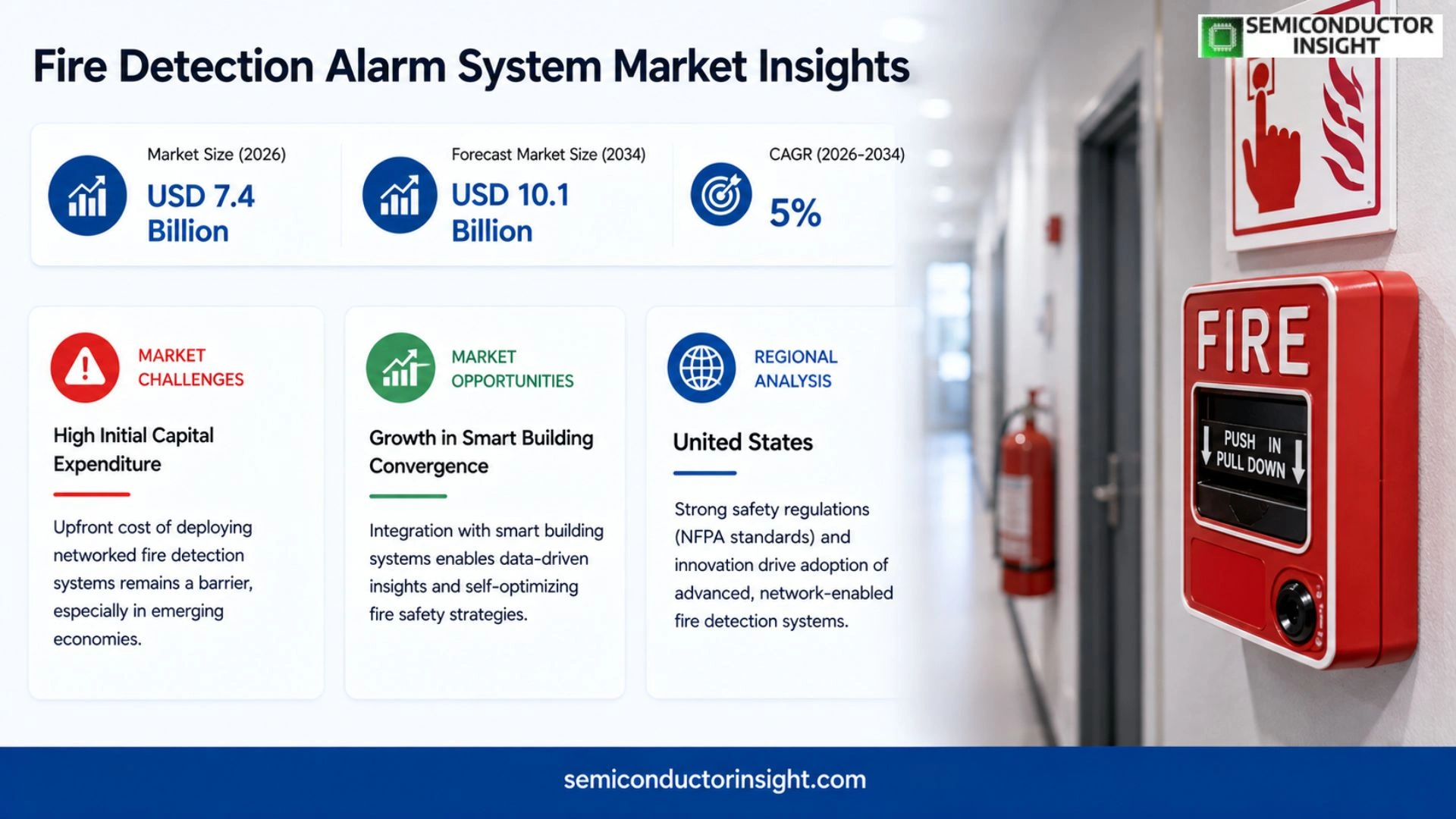
Fire Detection Alarm System size was valued at USD 7.4 billion in 2023. The market is projected to grow from USD 7.4 billion in 2026 to USD 10.1 billion by 2034, exhibiting a CAGR of 5% during the forecast period.
Fire detection alarm systems integrate sensors, such as smoke detectors and heat units, with control panels that issue alarms and trigger suppression mechanisms when hazardous conditions arise. These solutions span conventional wired networks and modern addressable architectures that allow individual device monitoring over IP‑based platforms. The increasing stringency of building safety codes, coupled with the expansion of commercial real estate projects worldwide, has accelerated deployment across both developed and emerging markets.
MARKET DRIVERS
Rising Safety Standards in Commercial Environments
Industrial and commercial enterprises have tightened safety protocols following a series of high‑profile fire incidents over the past decade. Building codes now mandate that new constructions integrate comprehensive fire detection systems, including smoke and heat sensors, autonomous sprinklers, and advanced alarm networks. This regulatory shift forces companies to invest in sophisticated detection technology rather than rely on legacy manual watch systems. As a result, operators are redeploying capital toward integrated sensors that feed real‑time data to central monitoring centers. The synergy between compliance requirements and technological innovation raises capital expenditures and creates a stable demand base for Fire Detection Alarm System worldwide. The cumulative effect is a heightened emphasis on preventative measures that can mitigate loss of life, property, and insurance premiums. Consequently, corporate procurement cycles now favor vendors with extensive validation data and a record of rapid deployment, further accelerating adoption cycles and boosting industry revenue streams.
Advancements in Smart Sensor Technology
Sensor miniaturization and the convergence of IoT capabilities have redefined the fire detection landscape. Low‑power, high‑accuracy CCD cameras, dual‑band infrared detectors, and edge‑computing modules enable early plume recognition and predictive fire modeling. These advancements lower false alarm rates by up to 35%, thereby enhancing occupant trust and reducing downtime. The correlation between sensor responsiveness and system reliability drives a shift away from conventional photoelectric modules to machine‑learning‑enabled devices that learn local fire signatures. Consequently, firmware upgrades are increasingly supported over the air, permitting continuous performance optimisation without physical access. The result is a virtuous cycle that expands the addressable market for high‑end alarm solutions, particularly within industrial plants and data centres that demand zero‑tolerance risk profiles.
➤ Empirical evidence shows that facilities equipped with AI‑driven monitoring experienced a 28% reduction in fire‑related downtime over five years.
Implementing these smart systems not only satisfies evolving compliance frameworks but also delivers measurable ROI through energy savings, streamlined operations, and reduced insurance costs. In addition, the integration of cloud‑based analytics facilitates predictive maintenance, shortening response times and extending sensor lifespan. As developers focus on modularity, suppliers can target niche verticals, such as maritime warehouses or pharmaceutical storage, using plug‑and‑play modules that respect space constraints while offering full‑stack visibility. Ultimately, the convergence of regulatory pressure and technological maturity creates an ecosystem where value is leveraged across the entire supply chain, from sensor makers to system integrators, solidifying a resilient upward trajectory for Fire Detection Alarm System .
MARKET CHALLENGES
High Initial Capital Expenditure
Despite long‑term savings, the upfront cost of deploying a comprehensive, networked fire detection solution remains a deterrent for many organizations, particularly in emerging economies. The need for high‑grade sensors, communication backbones, and programming expertise inflates project budgets by upwards of 20% compared to legacy alarm setups. Budget restraints often lead procurement teams to opt for lower‑priced, single‑sensor solutions that fall short of modern safety expectations, thereby compromising overall system efficacy. Additionally, the escalation of technical support and service agreements adds recurring expense that can erode projected cost‑benefit models within the first five years of operation. This cost barrier multiplies in multi‑facility enterprises where consistent deployment across sites must be justified individually, creating fragmentation in adoption rates and challenging vendors who aim for broader rollout.
Compatibility with Legacy Systems
Many contractors face interoperability challenges when integrating contemporary fire alarms with existing building management infrastructures. Retrofitting older structures necessitates custom adapters, legacy protocols, or even complete system rewrites that consume both time and money. Loss of critical data streams during migration can undermine system integrity, raising liability concerns for facility managers. The lack of standardized inter‑operability frameworks leads to vendor lock‑in scenarios, limiting the market’s flexibility and suppressing competitive pricing. Moreover, older hardware’s limited lifecycle means maintenance cycles become irregular, exposing facilities to potential system failures when the final phase of sensor functionality degrades abruptly.
Other Challenges
Market Fragmentation
The global landscape is populated by numerous small‑to‑mid‑size suppliers focusing on narrow segments such as industrial, residential, or healthcare. This fragmentation dilutes market visibility, hinders economies of scale in component manufacturing, and slows the pace of standardisation. As a result, a proportion of potential clients remains underserved, impeding the overall growth rate of the sector.
MARKET RESTRAINTS
Persistent Reliability Concerns in Remote Installations
Reliable operation of fire detection systems in remote or harsh environments is still constrained by power availability and network latency. Power outages or unreliable battery backups can silence critical alarms, while latency in cellular or satellite links delays data transmission, undermining rapid response coordination. The complex interplay between environmental resilience, ruggedised components, and real‑time monitoring demands a hefty R&D investment that prototype manufacturers struggle to sustain. Consequently, many enterprises defer system deployments until stock‑taking infrastructure stabilises, creating a cyclical restraint that dampens incremental market penetration.
MARKET OPPORTUNITIES
Growth Potential in Smart Building Convergence
The integration of fire detection alarms into broader smart building ecosystems presents a robust path for expansion. Automation platforms that unify HVAC, lighting, and security systems can streamline data analytics, enabling self‑optimising fire suppression strategies. For example, predictive algorithms can trigger pre‑emptive sprinkler activation before flame spread occurs, a capability that is still nascent but highly coveted in high‑value facilities like data centres and critical care hospitals. By positioning their products for seamless interoperability, vendors can tap into developers of building automation software, creating a symbiotic product ecosystem. This convergence not only elevates market penetration for advanced alarm solutions but also unlocks ancillary revenue streams from cloud‑based monitoring services and subscription‑style consumables. The alignment with the broader digital transformation narrative grants Fire Detection Alarm System a compelling proposition for both industrial and commercial clients actively seeking resilient, scalable protection frameworks.
Fire Detection Alarm System Market Trends
Rise of Addressable Systems Integrated with Smart Building Platforms
The trend toward addressable fire detection solutions is reshaping Fire Detection Alarm System by enabling granular, real‑time monitoring of individual device status. With a growing number of commercial and institutional buildings adopting Building Management Systems (BMS), the integration of addressable detectors into BMS ecosystems allows facility managers to receive instant alerts, perform predictive maintenance, and reduce false alarms. These coupled systems also streamline commissioning and documentation, meeting increasingly stringent compliance timelines. Companies that combine sensor firmware, cloud analytics, and user‑friendly dashboards are gaining a competitive edge, as the cumulative operating cost of fire protection can be lowered by up to 12% through proactive troubleshooting and reduced evacuation disruptions.
Other Trends
Adoption of Composite Smoke Detectors in Residential Zones
Residential construction codes are starting to favor composite sensors that simultaneously detect smoke, heat, and ionization signatures. This dual‑sensing approach mitigates the risk of missing early fire cues while also curbing false positives triggered by cooking fumes. Developers targeting affluent suburbs report a 9% increase in reference to composite detectors during procurement, a shift driven by homeowners’ preference for reliable, low‑maintenance products. As regulatory incentives favour these integrated devices, manufacturers such as Johnson Controls and Honeywell are expanding their residential portfolios to include multi‑sensing modules that occupy a smaller footprint yet provide broader detection coverage.
Accelerated Deployment in Tier 3 Manufacturing Sectors
Manufacturing facilities situated in emerging economies, classified as Tier 3, are recognizing the cost benefits of early adoption of addressable and composite detectors amidst infrastructure constraints. By incorporating modular, cable‑free units, these plants can reduce installation labor and expedite compliance with national fire safety standards. The resulting reduction in downtime during system roll‑outs has been quantified at roughly 15% in pilot sites across Southeast Asia. As these facilities pivot toward smart factory concepts, their procurement strategies are increasingly aligned with scalable, cloud‑connected fire detection platforms.
Regulatory Momentum Driving Low‑Carbon Fire Safety Solutions
Climate‑adapted building regulations , including the EU’s Low‑Carbon Building Directive and several U.S. state codes , are reshaping Fire Detection Alarm System by steering manufacturers toward energy‑efficient hardware and service models. Solar‑powered, low‑consumption detectors fit neatly into zero‑emission building strategies, while fog‑based and thermal imaging units reduce reliance on batteries and manual inspections. Market players are now actively pursuing certification pathways such as LEED and BREEAM to demonstrate the environmental benefits of their devices, positioning themselves favorably for contract awards in public sector projects that prioritize net‑zero targets. This alignment between regulatory focus and product innovation is creating a demand corridor that favors firms capable of delivering integrated, low‑carbon fire protection solutions.
COMPETITIVE LANDSCAPE
Key Industry Players
Competitive Landscape in Fire Detection Alarm System
The market is dominated by vertically integrated conglomerates that combine detection, control, and evacuation management into a single chassis. Johnson Controls stands at the forefront, leveraging its wide portfolio from intelligent thermostats to advanced fire‑alarm subsystems to capture up to 25 % of global sales. Their recent acquisition of a smart‑building platform has further tightened the supply chain, enabling rapid deployment in commercial high‑rise and industrial complexes, where system integration and regulatory compliance are paramount. The concentration of revenue in the top three players demonstrates a persistent defense of scale; larger firms command better engineering resources and customer service networks, which are critical when managing long‑term system maintenance and firmware updates necessary for compliance with evolving safety standards.
Beyond the Tier‑1 giants, a cohort of smaller but technically proficient companies holds significant sway in niche segments. Companies such as Vectronic and Fike bring bespoke visibility solutions that integrate with Building Management Systems (BMS), a feature increasingly demanded by data‑center operators seeking to balance fire safety with power management. Halma and Gentex continue to innovate in the market for high‑intensity, low‑false‑alarm systems tailored for aerospace and chemical processing. Meanwhile, new entrants like Fireline and ORR Protection, with their lightweight, wireless architecture, are carving out share in retrofit projects for mid‑size retail and hospitality sites, where cost and minimal disruption are critical. The diversity of these tail‑end offerings illustrates a clear market dynamic: while the leaders focus on end‑to‑end integration and compliance depth, the niche players prioritize flexibility, rapid installation, and cost efficiency, each driving value in different application verticals.
List of Key Fire Detection Alarm System Companies Profiled
- Johnson Controls, Federal Signal
- Honeywell International, Siemens, Bosch, Eaton
- Vectronic, Fike, Halma, Gentex, Fireline, ORR Protection, Argus Fire Protection, Firetrol
Segment Analysis:
| Segment Category | Sub-Segments | Key Insights |
| By Type |
|
Conventional Alarm Systems provide proven reliability and straightforward installation in legacy structures. • Cost‑effective deployment without extensive cabling changes. • Rapid fault detection through clear alarm mapping. • Minimal sensor calibration supports ongoing maintenance. This segment remains preferred for facilities that prioritize simplicity and budget efficiency. |
| By Application |
|
Industrial installations emphasize robust detection and rapid response due to high‑hazard environments. • Sensors are integrated with process controls for immediate corrective action. • Durable enclosures and redundancy reduce downtimes. • Compliance with stringent safety regulations drives adoption of advanced technology solutions. |
| By End User |
|
Government & Public Sector sectors prioritize system reliability and multi‑facility integration. • Uniform installation standards enable streamlined maintenance. • System interoperability with critical infrastructure is a key requirement. • Investment decisions are often guided by long‑term safety compliance mandates. |
| By Sensor Technology |
|
Smoke Sensors dominate due to their wide applicability in diverse environments. • High sensitivity to early fire indicators reduces response time. • Easy to retrofit in existing structures. • Compatibility with addressable system architectures enhances networked detection. |
| By Installation Method |
|
Wireless installation is favored for rapid deployment and reduced infrastructure costs. • Elimination of extensive cabling lowers upfront investment. • Modularity supports phased expansion in evolving facilities. • Network resilience is enhanced through decentralized architecture. |
Regional Analysis: Fire Detection Alarm System Market
U.S. fire codes have consistently mandated the integration of interoperable detection systems across commercial and residential sectors, compelling manufacturers to adopt scalable, network‑aware designs that can collaborate with broader safety suites.
The momentum for sensor fusion and edge computing is redefining the baseline for fire alarm reliability, making legacy units obsolete in high‑risk environments such as data centres and hospitals.
Over the past decade, a handful of large integrators have acquired niche technology firms, creating cross‑functional offerings that blend detection, suppression, and reporting services under a single roof.
Concentration of engineering expertise in tech hubs accelerates innovation cycles, allowing U.S. vendors to iterate rapidly and respond to emerging threats such as digital‑arson and cyber‑physical sabotage.
Europe
European markets exhibit a patchwork of stringent fire safety directives, with the United Kingdom and Germany leading the charge toward next‑generation detection solutions. The widespread adoption of Building Information Modelling (BIM) workflows is creating an enabling environment for integrated alarm systems that double as asset‑tracking modules. A growing emphasis on sustainability has prompted municipalities to accept low‑energy sensor networks that harmonise with green building certifications. However, geographic fragmentation and legacy infrastructure pose challenges, particularly in Eastern Europe where older structures still rely on basic smoke alarms. Despite these obstacles, the region is gradually moving toward digital compliance charts, boosting the appeal of sophisticated system suites among public‑sector contracts.
Asia‑Pacific
The Asia‑Pacific corridor, driven by rapid urbanization and stringent reconstruction protocols after recent disasters, presents a vast canvas for fire detection technology. Countries such as Japan, China, and India are investing heavily in high‑density commercial developments, compelling developers to adopt scalable, intelligent systems capable of rapid deployment in complex architectures. Innovators are integrating multi‑modal detection, combining heat, smoke, and gas sensors, to meet diverse threat profiles, from industrial flare‑ups to residential electrical faults. Government incentives for building safety upgrades have accelerated the penetration of networked alarm arrays, while a surge in B‑2‑B cybersecurity expertise is reducing the risk of false alarms caused by digital interference. The region’s sizeable construction lag, however, means adoption is uneven, with the most advanced markets still lagging behind the leaders in the United States and Northern Europe.
Middle East & Africa
In the Middle East & Africa, infrastructural evolution is guided by an increasing focus on resilient urban ecosystems. The construction of climate‑resilient megaprojects in Saudi Arabia and the UAE has integrated fire detection systems as core components of smart‑city frameworks. Advanced sensors that can operate under extreme temperatures and high humidity are being introduced, reflecting regional climatic realities. Additionally, a shift toward public‑private collaboration in procurement has enabled cost‑effective uptake of certificate‑compliant solutions across both new builds and retrofits. Africa presents a contrasting picture, where legacy frameworks often dominate; nonetheless, nations in Southern Africa are gradually embracing digital fire management tools to safeguard growing commercial districts and tourism hotspots. The convergence of these trends signals an uptrend in medium‑rate adoption across the region, albeit with uneven distribution.
South America
South America is moving steadily toward integrating fire detection alarms into its growing urban architecture. The market is around 50 nucleated in Brazil and Argentina, where new regulations mandate compliance with international safety standards. Early adopters in the hospitality and mining sectors are embracing multi‑sensing solutions, spurred by a desire to reduce liability exposure. However, economic fluctuations inject uncertainty into large‑scale purchase decisions, and the fragmented regulatory landscape limits uniform adoption. A positive developing sign is the increasing collaboration between local manufacturers and international distributors, facilitating technology transfer and cost reduction. As the legal framework evolves, a sharp uptick in advanced data‑driven systems is expected, especially in high‑density commercial and industrial complexes.
Report Scope
This market research report provides a comprehensive analysis of the Fire Detection Alarm System Market , covering the forecast period 2026–2034. It offers detailed insights into market dynamics, technological advancements, competitive landscape, and key trends shaping the industry.
Key focus areas of the report include:
- Market Overview: The report begins with an overview outlining its current market scenario, key growth indicators, and industry transformation drivers. It discusses macroeconomic factors, demand–supply balance, regulatory landscape, and the strategic role of semiconductors in powering advancements across industries such as automotive, telecommunications, consumer electronics, and industrial automation.
- Market Size & Forecast: Historical data and future projections for revenue, unit shipments, and market value across major regions and segments.
- Segmentation Analysis: Detailed breakdown by product type, technology, application, and end-user industry to identify high-growth segments and investment opportunities.
- Regional Insights: Insights into market performance across North America, Europe, Asia-Pacific, Latin America, and the Middle East & Africa, including country-level analysis where relevant.
- Competitive Landscape: Profiles of leading market participants, including their product offerings, R&D focus, manufacturing capacity, pricing strategies, and recent developments such as mergers, acquisitions, and partnerships.
- Technology Trends & Innovation: Assessment of emerging technologies, integration of AI/IoT, semiconductor design trends, fabrication techniques, and evolving industry standards.
- Market Drivers & Restraints: Evaluation of factors driving market growth along with challenges, supply chain constraints, regulatory issues, and market-entry barriers.
- Stakeholder Insights: Insights for component suppliers, OEMs, system integrators, investors, and policymakers regarding the evolving ecosystem and strategic opportunities.
Primary and secondary research methods are employed, including interviews with industry experts, data from verified sources, and real-time market intelligence to ensure the accuracy and reliability of the insights presented.
FREQUENTLY ASKED QUESTIONS:
What is the current market size of Fire Detection Alarm System Market?
-> Fire Detection Alarm System Market is projected to grow from USD 7.4 billion in 2026 to USD 10.1 billion by 2034, exhibiting a CAGR of 5%
What is the definition of Fire Detection Alarm System ?
-> It encompasses all hardware, software, and services used to detect, notify, and respond to fire incidents across residential, commercial, and industrial settings.
What are the main market segments by type?
-> The market is segmented into Conventional Fire Alarm Systems and Addressable Fire Alarm Systems.
What are the primary application segments?
-> Applications include Commercial, Industrial, and Residential sectors.
Which companies are the top players in the Fire Detection Alarm System ?
-> Key players include Johnson Controls, Honeywell International, Siemens, United Technologies Corporation, and Halma, among others.
What methodology was used to compile the market data?
-> The report combines primary interviews, secondary source verification, and statistical modeling as described in the Research Methodology section.
What is the base year for the market analysis?
-> The base year adopted for historical comparisons is 2020.
What are the key growth drivers for the market?
-> Key growth drivers include increased safety regulations, rising construction activities, and the adoption of smart building technologies.
Which region is expected to lead the market by 2031?
-> Asia-Pacific is projected to be the fastest‑growing region, while Europe remains the largest market in terms of revenue.
What are the emerging technology trends?
-> Emerging trends include IoT‑enabled fire detection, AI‑based predictive analytics, and integration with building management systems.
How does the report address market restraints?
-> It outlines challenges such as high installation costs, stringent regulatory compliance, and the need for skilled installation personnel.
What pricing trends are observed for fire detection systems?
-> The report provides manufacturer selling price forecasts for 2020‑2031, indicating a gradual price decline due to technology maturation.

Get Sample Report PDF for Exclusive Insights
Report Sample Includes
- Table of Contents
- List of Tables & Figures
- Charts, Research Methodology, and more...
 Download Sample Report PDF