Car Cockpit SoC Market Insights
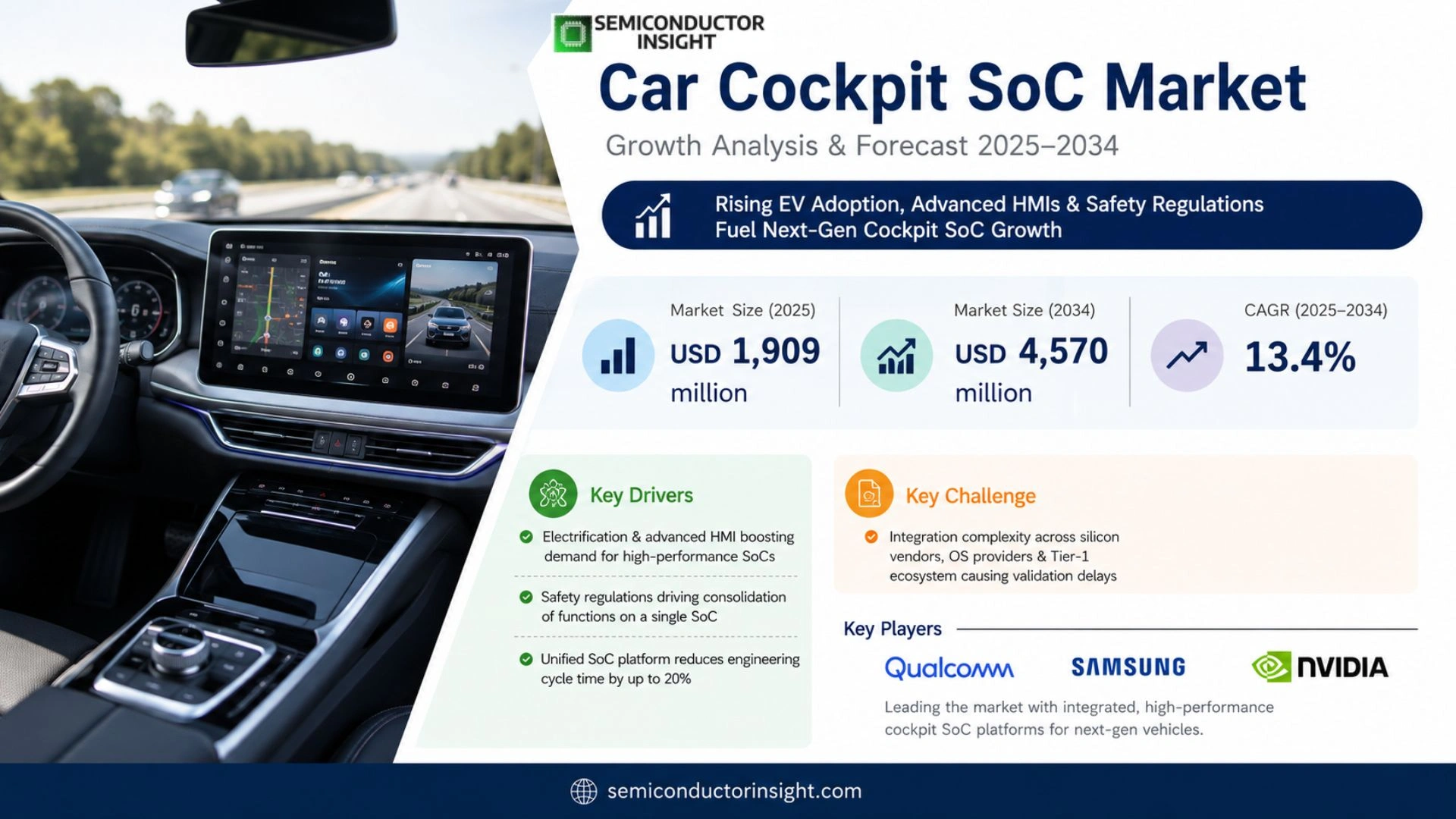
Car Cockpit SoC market was valued at USD 1,909 million in 2025 and will rise to USD 4,570 million by 2034, delivering a compound annual growth rate of 13.4% over the forecast horizon.
A Car cockpit SoC is an automotive‑grade main processor that unifies in‑cabin human‑machine interaction and multiple domain functions. Beyond a single infotainment screen, it integrates digital clusters, voice assistants, navigation, multi‑display output, audio processing, visual sensing and,where applicable,parking or driver‑assist capabilities onto one compute platform. This consolidation cuts wiring complexity, lowers power consumption and development cost, and simplifies OTA updates compared with distributed ECU architectures. Leading solutions stress high‑performance CPUs/GPGPUs, AI accelerators (NPUs), concurrent multi‑OS support, virtualization/isolation, rich video I/O, safety islands and compatibility with Android Automotive, Linux or QNX.
The shift from traditional IVI chips to full‑cockpit domain controllers reflects a broader industry move toward software‑defined vehicles; OEMs and Tier 1 suppliers now prioritize chips that enable immersive multi‑display experiences, real‑time generative AI interaction and seamless integration of DMS/OMS with surround‑view systems.
MARKET DRIVERS
Electrification and Advanced HMI Requirements
The surge in electric vehicle adoption forces manufacturers to embed more sophisticated human‑machine interfaces. Integrated System‑on‑Chip platforms enable real‑time graphics rendering, voice control, and OTA updates without overburdening the vehicle’s central computer, which is why OEMs prioritize these solutions for next‑generation cockpits.
Regulatory Pressure for Safety‑Critical Functions
New safety standards require redundant processing for driver assistance and instrument cluster data. By consolidating multiple processors onto a single SoC, suppliers can meet functional‑safety certifications while reducing silicon footprint, a cost advantage that resonates across volume and premium segments.
➤ Automakers that shift 70% of cockpit functions to a unified SoC can cut engineering cycle time by up to 20%.
Furthermore, the convergence of infotainment, telematics, and ADAS on a single chipset creates economies of scale, allowing component pricing to trend downward even as feature sets expand.
MARKET CHALLENGES
Integration Complexity Across Supplier Ecosystem
Designing a car cockpit SoC demands close coordination between silicon vendors, OS providers, and tier‑1 integrators. Misaligned roadmaps often result in delayed validation cycles, jeopardizing launch windows for new models.
Other Challenges
Thermal Management Constraints
High‑performance graphics and AI inference generate localized heat. Without advanced cooling strategies, thermal throttling can degrade user experience and compromise long‑term reliability.
MARKET RESTRAINTS
High Up‑Front R&D Investment
Developing a production‑grade cockpit SoC involves multi‑year silicon design, validation, and safety certification processes. Smaller OEMs may lack the capital to fund such programs, limiting market participation to a handful of large players.
In addition, the need for extensive firmware customization to support brand‑specific UI layouts adds to development overhead, slowing time‑to‑market for niche vehicle segments.
MARKET OPPORTUNITIES
AI‑Driven Personalization and Predictive Services
Embedding lightweight neural‑network accelerators within the cockpit SoC opens pathways for real‑time driver behavior analysis, adaptive climate control, and predictive navigation. Companies that can deliver these capabilities on a secure, automotive‑grade silicon platform will differentiate themselves in a crowded market.
Another promising avenue lies in cross‑vehicle platform licensing, where a single certified SoC architecture can be reused across multiple models and brands, unlocking revenue streams beyond the traditional one‑off sales model.
Car Cockpit SoC Market Trends
Convergence of In‑Cabin Computing Platforms
The latest generation of cockpit processors is no longer a single‑purpose infotainment chip. By consolidating digital clusters, voice assistants, navigation, multi‑camera input and even parking‑assist functions on a single die, manufacturers are cutting wiring harness weight and simplifying power budgeting. This integration also shortens development cycles because original equipment manufacturers can reuse a common software stack across several cabin domains, making over‑the‑air upgrades more predictable. The shift reflects OEMs’ desire to move from fragmented ECUs toward a unified computing fabric that can accommodate future software‑defined vehicle features without hardware redesign.
Other Trends
AI Acceleration and Multi‑OS Virtualization
Leading silicon vendors now tout AI engines delivering 8 TOPS to 23 TOPS while supporting concurrent operation of Android Automotive, Linux and QNX. Virtualization layers create isolated safety islands, enabling real‑time driver‑monitoring workloads to coexist with high‑bandwidth media streams. Multi‑display I/O capabilities,six to seven screens and dozens of camera inputs,are becoming a baseline requirement, pushing product roadmaps toward heterogeneous architectures where CPUs, GPUs and NPUs are tightly coupled. The practical outcome is a cockpit that can host generative‑AI voice agents and advanced perception algorithms without compromising functional safety.
Regional Supply‑Chain Diversification
Supply‑side dynamics show a multi‑regional rivalry among North America, Japan, South Korea, China and emerging European players. This competition fuels faster silicon iteration and gives vehicle makers a broader set of sources to mitigate geopolitical risk. Meanwhile, regulatory pressures,such as UNECE cybersecurity mandates and EU driver‑attention standards,are compelling OEMs to embed secure update mechanisms and high‑precision sensing in Car Cockpit SoC Market offerings. The combined effect of tighter safety rules and a more resilient supplier landscape is expanding the addressable scope of cockpit processors beyond pure entertainment, positioning them as foundational blocks for the next wave of vehicle electronics.
COMPETITIVE LANDSCAPE
Key Industry Players
Car Cockpit SoC Competitive Overview 2025‑2034
The market is presently dominated by a handful of silicon giants whose platforms integrate high‑throughput CPUs, GPU clusters, and AI‑centric NPU blocks on a single die. Qualcomm’s Snapdragon Automotive Cockpit series, Samsung’s Exynos Auto, and NVIDIA’s Drive Orin Cockpit are frequently selected by Tier‑1 integrators for flagship programs because they combine multi‑display support, safety‑grade isolation, and out‑of‑the‑box compatibility with Android Automotive, Linux, and QNX. Their breadth of IP enables OEMs to truncate development timelines, consolidate wiring harnesses, and preserve headroom for OTA‑driven feature sets. Consequently, these leaders occupy the upper tier of the supply chain, commanding sizable design‑win margins and shaping ecosystem standards through extensive developer kits and reference designs.
Beyond the headline players, a vibrant cohort of specialist firms is carving out niches that address emerging functional blocks. UNISOC and MediaTek are advancing cost‑effective chips with 8 TOPS AI capability and extensive camera I/O, targeting volume‑oriented models in China and Southeast Asia. Socionext focuses on display‑centric SoCs for digital clusters, leveraging its expertise in high‑resolution video pipelines. AutoChips, Hefei‑based, differentiates with integrated parking‑assist accelerators and support for up to seven in‑vehicle screens. Smaller yet technically proficient companies such as Nanjing Semidrive, SiEngine, and Allwinner contribute niche IP for infotainment‑only or low‑power cockpit domains, allowing OEMs to assemble heterogeneous architectures that balance performance and cost. This layered ecosystem suggests a market where platform consolidation co‑exists with targeted solutions for regional or application‑specific requirements.
List of Key Car Cockpit SoC Companies Profiled
- Qualcomm
- Samsung Electronics
- NVIDIA
- Intel
- MediaTek
- UNISOC (Shanghai) Technologies Co., Ltd.
- Socionext Inc.
- AutoChips (Hefei AutoChips Co., Ltd.)
- Renesas Electronics
- NXP Semiconductors
- TI (Texas Instruments)
- Nanjing Semidrive Technology
- SiEngine Technology Co., Ltd.
- Allwinner Technology Co., Ltd.
Segment Analysis:
| Segment Category | Sub-Segments | Key Insights |
| By Type |
|
AI‑Accelerated NPU‑focused SoCs are emerging as the preferred choice for next‑generation cockpit experiences because they:
|
| By Application |
|
Digital Cluster & Instrumentation is gaining traction as the core visual interface because it:
|
| By End User |
|
Premium Passenger Vehicles drive the most sophisticated SoC adoption because they:
|
| By Architecture |
|
Domain‑Consolidation SoCs are favored for their ability to:
|
| By Technology Layer |
|
Multi‑OS Virtualization Platforms are critical because they:
|
Regional Analysis: Car Cockpit SoC Market
Europe
Major European Tier‑1s have merged their electronic architecture divisions, enabling shared silicon roadmaps that span luxury and mainstream brands. This consolidation minimizes design duplication, cuts development cycles, and fosters a pool of reusable IP blocks, which in turn accelerates the rollout of advanced cockpit features across the continent.
EU directives on functional safety (ISO 26262) and cybersecurity (UNECE WP.29) compel manufacturers to integrate secure, fault‑tolerant SoCs. The regulatory pressure nudges OEMs toward standardized platforms that can be validated once and deployed across multiple models, reducing certification costs while ensuring compliance.
Recent component shortages have prompted European automakers to diversify wafer fab locations and lock in long‑term wafer‑level agreements. This strategic sourcing reduces lead times for SoC deliveries and mitigates the risk of production halts, a critical factor for maintaining steady model rollouts.
Drivers in Europe increasingly expect seamless integration between navigation, climate control and voice assistants. SoC designers respond by embedding heterogeneous cores and AI accelerators that enable real‑time personalization, thereby strengthening brand loyalty and opening avenues for subscription‑based digital services.
North America
In North America, Car Cockpit SoC Market is driven by a blend of high‑volume mainstream brands and technology‑forward premium marques. The continent’s open‑software ethos encourages automakers to adopt flexible SoC solutions that can host third‑party applications, a factor that fuels collaborations with silicon giants and cloud providers. While regulatory demands are less prescriptive than in Europe, consumer appetite for over‑the‑air updates and integrated digital ecosystems pushes OEMs to prioritize modularity and scalability in their cockpit designs. The competitive climate also spurs rapid iteration cycles, compelling suppliers to deliver shorter design‑to‑silicon timelines without sacrificing reliability.
Asia‑Pacific
Asia‑Pacific stands out for its aggressive volume growth and early adoption of next‑generation vehicle electronics. Markets such as China, Japan and South Korea blend domestic innovation with extensive manufacturing capacity, allowing rapid deployment of SoC‑based cockpits across both electric and conventional models. Local policy incentives that reward digital feature integration, coupled with a burgeoning demand for connected services, shape a landscape where cost‑efficient, high‑integration chips become essential. Suppliers therefore focus on delivering low‑power, highly integrated solutions that can be mass‑produced while supporting region‑specific connectivity standards.
South America
South America’s market dynamics are characterized by a gradual transition from legacy architectures toward more integrated SoC platforms. Automotive manufacturers are responding to rising consumer expectations for digital infotainment, yet remain sensitive to price pressures. Consequently, many OEMs opt for tiered SoC solutions that balance performance with affordability, often sourcing from regional partners that can provide localized support and faster time‑to‑market. The region’s regulatory environment, while evolving, still emphasizes emissions standards, indirectly encouraging the adoption of efficient cockpit processors that complement hybrid powertrains.
Middle East & Africa
In the Middle East and Africa, Car Cockpit SoC Market is nascent but gaining traction as premium vehicle imports increase. Luxury brands leverage advanced cockpit SoCs to differentiate their offerings in markets where consumers value high‑tech experiences. Simultaneously, emerging economies within Africa are witnessing the first wave of locally assembled vehicles equipped with basic but scalable SoC designs. Infrastructure constraints, such as limited high‑speed connectivity, shape a focus on on‑board processing power and offline capabilities, prompting suppliers to emphasize robust, self‑contained architectures.
Report Scope
This market research report provides a comprehensive analysis of the Car Cockpit SoC Market , covering the forecast period 2026–2034. It offers detailed insights into market dynamics, technological advancements, competitive landscape, and key trends shaping the industry.
Key focus areas of the report include:
- Market Overview: The report begins with an overview outlining its current market scenario, key growth indicators, and industry transformation drivers. It discusses macroeconomic factors, demand–supply balance, regulatory landscape, and the strategic role of semiconductors in powering advancements across industries such as automotive, telecommunications, consumer electronics, and industrial automation.
- Market Size & Forecast: Historical data and future projections for revenue, unit shipments, and market value across major regions and segments.
- Segmentation Analysis: Detailed breakdown by product type, technology, application, and end-user industry to identify high-growth segments and investment opportunities.
- Regional Insights: Insights into market performance across North America, Europe, Asia-Pacific, Latin America, and the Middle East & Africa, including country-level analysis where relevant.
- Competitive Landscape: Profiles of leading market participants, including their product offerings, R&D focus, manufacturing capacity, pricing strategies, and recent developments such as mergers, acquisitions, and partnerships.
- Technology Trends & Innovation: Assessment of emerging technologies, integration of AI/IoT, semiconductor design trends, fabrication techniques, and evolving industry standards.
- Market Drivers & Restraints: Evaluation of factors driving market growth along with challenges, supply chain constraints, regulatory issues, and market-entry barriers.
- Stakeholder Insights: Insights for component suppliers, OEMs, system integrators, investors, and policymakers regarding the evolving ecosystem and strategic opportunities.
Primary and secondary research methods are employed, including interviews with industry experts, data from verified sources, and real-time market intelligence to ensure the accuracy and reliability of the insights presented.
FREQUENTLY ASKED QUESTIONS:
What is the current market size of Car Cockpit SoC Market?
-> Car Cockpit SoC market will rise to USD 4,570 million by 2034, delivering a compound annual growth rate of 13.4% over the forecast horizon.
Which key companies operate in Car Cockpit SoC Market?
-> Key players include Qualcomm, Intel, NXP, Texas Instruments (TI), Renesas Electronics, Samsung, NVIDIA, Telechips, MediaTek, Nanjing Semidrive Technology, Socionext Inc., UNISOC (Shanghai) Technologies Co., Ltd., SiEngine Technology Co., Ltd., Hefei AutoChips Co., Ltd., Allwinner Technology Co., Ltd.
What are the key growth drivers?
-> Key growth drivers include rising demand for integrated digital clusters and multi‑display experiences, regulatory push for cybersecurity and OTA updates, accelerating adoption of generative AI and voice assistants in‑cabin, and the need for hardware consolidation to shorten development cycles and reduce cost.
Which region dominates the market?
-> Asia‑Pacific is the dominant region, led by strong activity in China, Japan, and South Korea, while North America and Europe also show significant adoption.
What are the emerging trends?
-> Emerging trends include generative AI and large‑model interaction within the cockpit, virtualization and multi‑OS support, safety‑island architectures, high‑performance AI acceleration (TOPS > 8), and increased focus on OTA‑driven feature expansion.

Get Sample Report PDF for Exclusive Insights
Report Sample Includes
- Table of Contents
- List of Tables & Figures
- Charts, Research Methodology, and more...
 Download Sample Report PDF