Automated X-ray Inspection (AXI) Market Insights
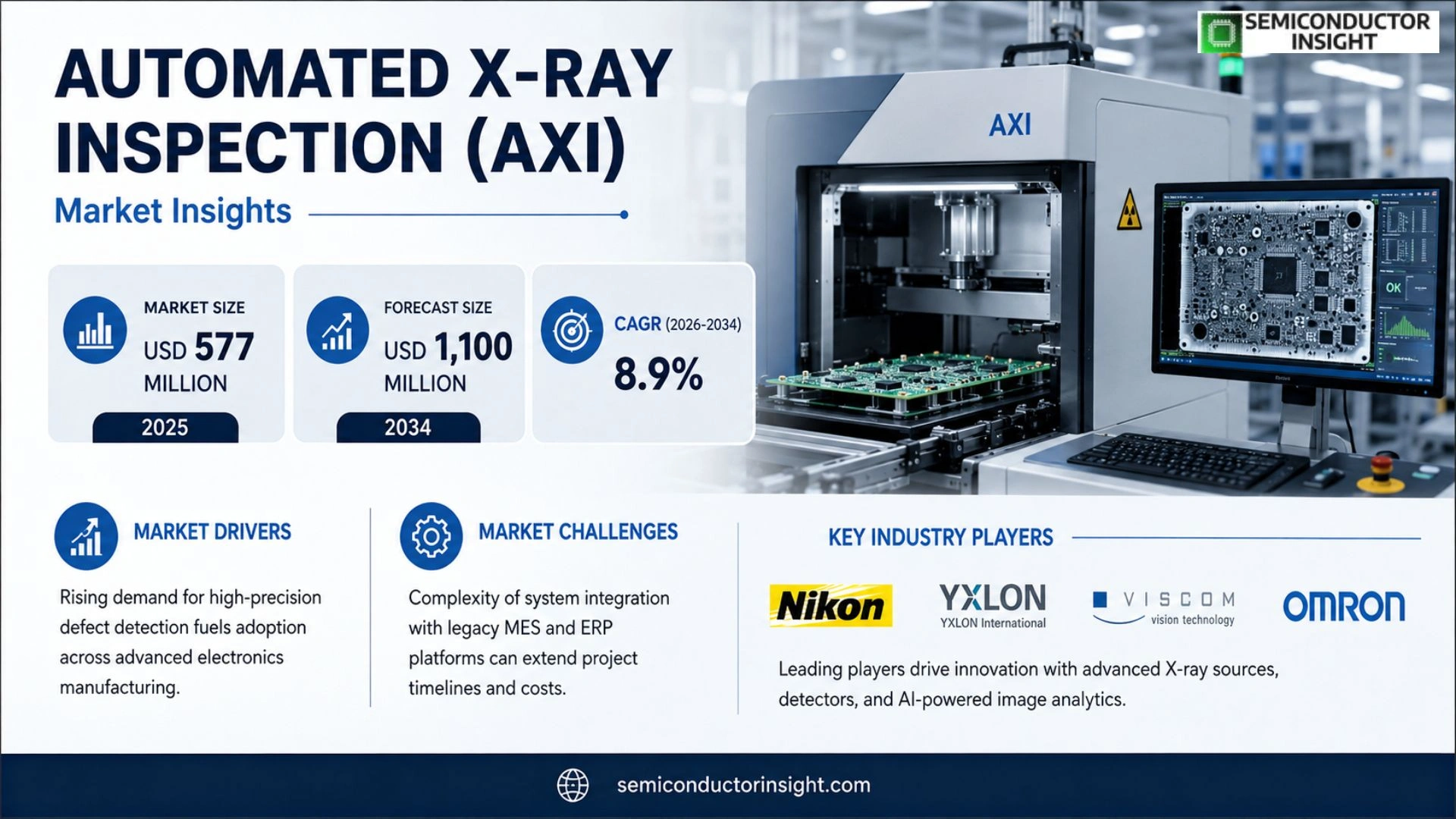
Automated X-ray Inspection (AXI) market was valued at USD 577 million in 2025 and will reach USD 1 100 million by 2034, reflecting an implied CAGR of roughly 8.9% over the period.
Automated X-ray Inspection (AXI) is an advanced non‑destructive testing technology that employs high‑energy X‑ray sources, precision motion systems and high‑resolution detectors to generate grayscale images of internal structures hidden from optical view. The technique is widely applied in printed circuit board assembly, semiconductor packaging, lithium‑battery modules, photovoltaic panels and die‑cast components to reveal voids, misalignments, cracks or other concealed defects that cannot be detected by conventional visual inspection.
Because AXI delivers real‑time defect detection and statistical quality data, manufacturers integrate the systems with MES or Industry 4.0 platforms to support traceability and continuous improvement.
MARKET DRIVERS
Rising Demand for High‑Precision Defect Detection
Automated X-ray Inspection (AXI) Market is benefiting from manufacturers’ need to identify sub‑micron anomalies that conventional visual systems miss. As electronic assemblies shrink and product reliability becomes a brand differentiator, firms are investing in AXI solutions that can differentiate between a solder bridge and a harmless filament at speeds exceeding 500 parts per minute. This shift reflects a broader industry move toward data‑driven quality assurance.
Regulatory Pressure for Traceability
Legislation in Europe and North America now mandates full traceability of critical components in aerospace and medical devices. AXI systems generate machine‑readable inspection logs that satisfy audit requirements without adding manual steps. Companies that adopt these platforms can demonstrate compliance faster, avoiding costly production holds.
➤ “Deploying AI‑enhanced AXI lowers false‑reject rates by up to 30 % while cutting inspection cycle time in half.”
Because AXI technology integrates seamlessly with Manufacturing Execution Systems, the data it produces feeds predictive maintenance models. The resulting insights enable factories to schedule downtime proactively, turning a quality checkpoint into an operational efficiency lever.
MARKET CHALLENGES
Complexity of System Integration
While AXI offers superior detection, aligning its output with legacy MES and ERP platforms can be technically demanding. Engineers frequently encounter mismatched data schemas, leading to integration projects that extend beyond the original budget and timeline.
Other Challenges
Capital Intensity
The upfront cost of a full‑scale AXI line, often exceeding $1.2 million, creates hesitation among mid‑size manufacturers who struggle to justify the expense against modest throughput increases.
MARKET RESTRAINTS
Limited ROI for Small‑Batch Operations
In niche markets where production runs are under 5 000 units per year, the payback period for AXI equipment stretches beyond three years. Operators in these segments often revert to manual X‑ray inspection or statistical sampling, thereby curbing broader market penetration.
MARKET OPPORTUNITIES
AI‑Augmented Image Analysis
Advances in deep‑learning algorithms are enabling AXI systems to differentiate between benign and critical defects with unprecedented accuracy. Vendors that embed these models into their scanners can offer subscription‑based analytics, opening recurring‑revenue streams and lowering the barrier to entry for smaller manufacturers.
Automated X-ray Inspection (AXI) Market Trends
Shift Toward Integrated 3D/CT Inspection
The most visible development in Automated X-ray Inspection (AXI) Market is the migration from conventional 2‑dimensional systems to hybrid 3D/CT platforms. Manufacturers of high‑density interconnects and solid‑state batteries report that the added depth perception of computed‑tomography reveals voids and delamination that plain radiographs miss. This transition is not merely a technology upgrade; it restructures inspection work‑flows. Production lines now schedule a blend of rapid 2D scans for routine boards and scheduled 3D passes for high‑value modules, thereby balancing throughput with diagnostic depth. The move also aligns with broader Industry 4.0 initiatives, as 3D data can be fed directly into statistical process control dashboards, creating a closed‑loop quality system that reduces scrap rates and warranty claims.
Other Trends
Supply‑Chain Consolidation and Margin Pressures
Component sourcing for AXI systems is increasingly concentrated among a handful of specialist manufacturers in East Asia and Western Europe. The high‑energy X‑ray tubes, detector arrays and motion‑control actuators are produced at scale by a limited pool of suppliers, which gives those firms leverage in pricing negotiations. End‑users therefore experience tighter margins when upgrading equipment, especially in the premium 3D segment where system cost remains a barrier. In response, system integrators are adding modular designs that allow customers to lease detector upgrades or swap core X‑ray sources, easing capex constraints while preserving performance.
AI‑Driven Defect Analytics as a Differentiator
Artificial‑intelligence algorithms are becoming the decisive factor for competitive advantage in the Automated X‑ray Inspection (AXI) Market. By training convolutional networks on large libraries of defect images, vendors offer predictive classification that distinguishes critical failures from benign variations. This capability shortens engineer review time and supports automated pass/fail decisions at line speed. Moreover, AI models can be continuously refined through feedback loops from manufacturing execution systems, enabling the inspection platform to adapt to new product families without extensive re‑calibration. Companies that embed these analytics into their hardware are seeing higher customer retention because the value proposition extends beyond a single inspection device to a continuous quality‑assurance service.
COMPETITIVE LANDSCAPE
Key Industry Players
Automated X‑ray Inspection (AXI) Market – Competitive Overview
The AXI sector is dominated by a handful of firms that combine in‑house X‑ray source engineering with advanced detector and AI‑enabled image analytics. ViTrox, headquartered in Singapore, leverages its proprietary high‑energy source platform to command the largest share of the premium 3D‑CT segment, where profitability exceeds 40 %. Nordson’s US‑based line focuses on high‑throughput inline solutions for electronics assembly, capturing a sizable portion of the volume‑driven offline market. Omron and Nikon complement the landscape with modular architectures that can be customised for battery‑cell inspection and aerospace component testing, thereby reinforcing a tiered structure where a few global integrators occupy the high‑margin niche while a broader base competes on cost‑effective 2D systems.
Beyond the four incumbents, a cluster of specialised manufacturers fuels diversification across verticals. Viscom of Germany supplies compact 2D AXI units tailored to LED and die‑casting lines, while Waygate Technologies (Baker Hughes) targets the petro‑chemical sector with radiation‑hard designs. Emerging players such as Unicomp Technology and Innometry introduce AI‑augmented defect classification that narrows the performance gap with legacy equipment. Companies like XAVIS Co., Ltd., ZEISS and Saki Corporation focus on niche applications, solar‑module inspection, medical device verification, and high‑precision semiconductor packaging, raising the overall competitive intensity and prompting larger firms to pursue strategic acquisitions or joint‑development programmes.
List of Key Automated X‑ray Inspection Companies Profiled
- ViTrox
- Nordson
- Omron
- NIKON
- Viscom
- Waygate Technologies (Baker Hughes)
- Unicomp Technology
- Innometry
- XAVIS Co., Ltd.
- ZEISS
- Saki Corporation
- Test Research Inc. (TRI)
- Comet Yxlon
- Seamark ZM
- DC Precision
Segment Analysis:
| Segment Category | Sub-Segments | Key Insights |
| By Type |
|
Inline AXI
|
| By Application |
|
PCB Industry
|
| By End User |
|
Electronics Manufacturers
|
| By Technology |
|
3D AXI
|
| By Deployment Mode |
|
Online/Inline Inspection
|
Regional Analysis: Automated X-ray Inspection (AXI) Market
OEMs are coupling AXI units with machine‑learning algorithms to flag subtle defect signatures, turning inspection data into predictive maintenance inputs for downstream processes.
By locating AXI stations at multiple nodes, manufacturers mitigate the risk of batch‑level recalls, a factor that has become a strategic priority after recent high‑profile safety incidents.
Federal agencies encourage non‑destructive testing in critical sectors; while guidelines stop short of mandates, compliance teams treat AXI as a best‑practice safeguard.
Universities and technical institutes are adding curriculum modules on X‑ray physics and data analytics, creating a pipeline of engineers versed in AXI system optimization.
Europe
European manufacturers balance stringent product safety directives with a strong emphasis on sustainability. AXI deployments are increasingly linked to circular‑economy initiatives, where detailed defect maps enable component reuse rather than outright discard. In high‑mix, low‑volume environments such as medical device production, the flexibility of modular AXI platforms supports rapid reconfiguration for different product lines. Collaborative standards bodies across Germany, France and the UK are converging on data‑exchange protocols, which eases integration with existing enterprise‑resource systems and reduces the learning curve for plant operators.
Asia‑Pacific
The Asia‑Pacific region showcases a dynamic blend of cost‑competitiveness and rapid technology rollout. While many factories prioritize volume, a growing segment of mid‑tier producers is recognizing that early defect detection lowers scrap rates and improves market access, especially for export‑oriented brands. Local equipment manufacturers are capitalizing on this shift by offering AXI solutions priced for incremental upgrades, allowing firms to adopt technology in stages. Concurrently, government incentives for advanced manufacturing are nudging smaller players toward digital inspection pathways.
South America
In South America, the AXI narrative is tied to the maturation of automotive and agro‑machinery sectors. Companies are adopting X‑ray inspection to comply with both regional safety standards and the expectations of multinational OEM partners. The market’s pace is moderated by investment cycles, yet the emergence of regional assembly hubs creates pockets where AXI technology can provide a competitive edge by shortening time‑to‑market for compliant products.
Middle East & Africa
The Middle East & Africa region is witnessing an incremental uptake of AXI driven by diversification strategies away from oil‑focused economies. Emerging aerospace maintenance, repair and overhaul (MRO) facilities view X‑ray inspection as a cornerstone of certification processes. In Africa, pilot projects within electronics assembly plants are demonstrating how AXI can support fledgling export markets by delivering consistent quality signals to overseas buyers.
Report Scope
This market research report provides a comprehensive analysis of the Automated X-ray Inspection (AXI) Market , covering the forecast period 2026–2034. It offers detailed insights into market dynamics, technological advancements, competitive landscape, and key trends shaping the industry.
Key focus areas of the report include:
- Market Overview: The report begins with an overview outlining its current market scenario, key growth indicators, and industry transformation drivers. It discusses macroeconomic factors, demand–supply balance, regulatory landscape, and the strategic role of semiconductors in powering advancements across industries such as automotive, telecommunications, consumer electronics, and industrial automation.
- Market Size & Forecast: Historical data and future projections for revenue, unit shipments, and market value across major regions and segments.
- Segmentation Analysis: Detailed breakdown by product type, technology, application, and end-user industry to identify high-growth segments and investment opportunities.
- Regional Insights: Insights into market performance across North America, Europe, Asia-Pacific, Latin America, and the Middle East & Africa, including country-level analysis where relevant.
- Competitive Landscape: Profiles of leading market participants, including their product offerings, R&D focus, manufacturing capacity, pricing strategies, and recent developments such as mergers, acquisitions, and partnerships.
- Technology Trends & Innovation: Assessment of emerging technologies, integration of AI/IoT, semiconductor design trends, fabrication techniques, and evolving industry standards.
- Market Drivers & Restraints: Evaluation of factors driving market growth along with challenges, supply chain constraints, regulatory issues, and market-entry barriers.
- Stakeholder Insights: Insights for component suppliers, OEMs, system integrators, investors, and policymakers regarding the evolving ecosystem and strategic opportunities.
Primary and secondary research methods are employed, including interviews with industry experts, data from verified sources, and real-time market intelligence to ensure the accuracy and reliability of the insights presented.
FREQUENTLY ASKED QUESTIONS:
What is the current market size of Automated X-ray Inspection (AXI) Market?
-> Automated X-ray Inspection (AXI) market will reach USD 1 100 million by 2034, reflecting an implied CAGR of roughly 8.9% over the period
Which key companies operate in Automated X-ray Inspection (AXI) Market?
-> Key players include ViTrox, Omron, Nordson, Viscom, Nikon, Unicomp Technology, Innometry, Waygate Technologies (Baker Hughes), Seamark ZM, Comet Yxlon, Zhengye Technology, Test Research Inc. (TRI), XAVIS Co., Ltd., ZEISS, Saki Corporation, SEC, Techvalley, Scienscope, SXRAY, DC Precision, Goepel Electronic, Creative Electron, among others.
What are the key growth drivers?
-> Key growth drivers include the proliferation of advanced packaging formats (BGAs, CSPs), rising demand for reliability in lithium‑battery and electric‑power modules, expanding automotive electronics and smart‑consumer devices, and the broader shift toward higher automation and Industry 4.0 in electronics manufacturing.
Which region dominates the market?
-> Asia‑Pacific holds the largest share of the AXI market, driven by major production hubs in China, Japan, and South Korea, while Europe and North America remain important growth regions.
What are the emerging trends?
-> Emerging trends include adoption of 3D/CT and AI‑enabled image analytics, integration of AXI data with MES/ERP systems for real‑time quality control, and expanding applications in new‑energy (lithium‑battery) and aerospace sectors.

Get Sample Report PDF for Exclusive Insights
Report Sample Includes
- Table of Contents
- List of Tables & Figures
- Charts, Research Methodology, and more...
 Download Sample Report PDF