Acceleration Sensors Market Insights
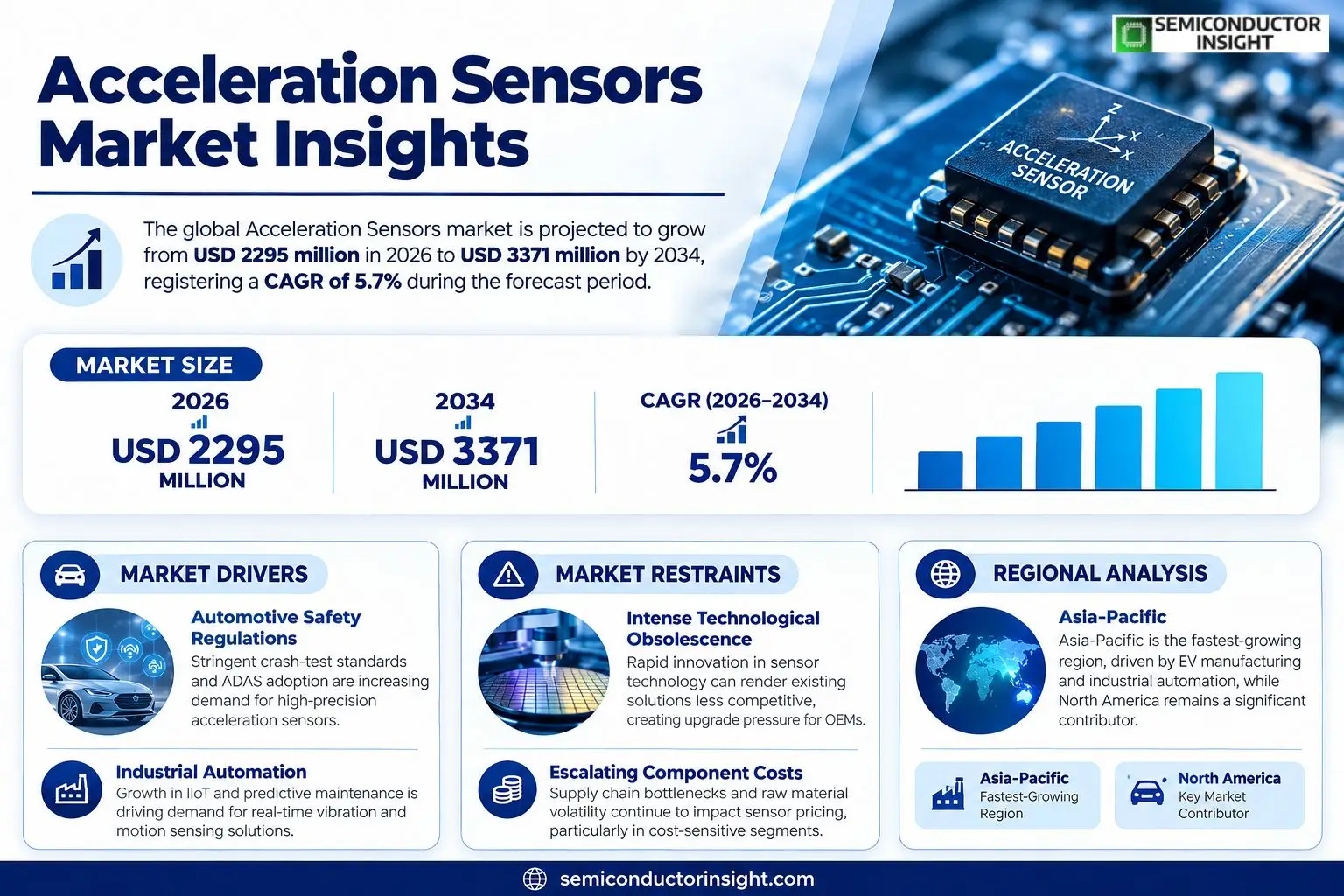
Acceleration Sensors market size was valued at USD 2295 million in 2026 to USD 3371 million by 2034, registering a CAGR of 5.7 % during the forecast period.
Acceleration sensors are devices that measure accelerationthe rate of change of velocity of an objectdetecting linear motion, tilt and orientation (via gravity), vibration and shock while converting these physical forces into electrical signals readable by electronic systems. Most units employ MEMS (Micro‑Electro‑Mechanical Systems) technology today, rendering them compact, low‑power, reliable and cost‑effective.
MARKET DRIVERS
Demand for Safety‑Critical Automotive Applications
Automotive OEMs are tightening crash‑testing protocols, requiring sensor arrays that capture deceleration with higher temporal resolution. The push to meet stringent Euro NCAP and NHTSA standards translates into a direct uptick in the volume of acceleration sensors embedded in modern vehicles, especially in advanced driver‑assist systems.
Industrial Automation Evolution
Manufacturing facilities are integrating motion‑control and predictive‑maintenance solutions that rely on real‑time vibration analysis. In this ecosystem, high‑bandwidth acceleration sensors become integral to detecting abnormal load patterns, reducing downtime and accelerating fault diagnosis.
➤ Precision, miniaturisation, and temperature resilience are the new bargaining chips in sensor procurement.
The convergence of distributed smart‑grid management and portable industrial robots widens the request baseline for robust, low‑power acceleration units. As factories adopt larger fleets of collaborative robots, the need for miniature chips that can survive harsh operational environments – from extreme heat in conveyor systems to vigorous seismic‑sensing requirements – steadily rises.
MARKET CHALLENGES
Escalating Component Expenditure
Although demand is surging, supply chains continue to experience bottlenecks in raw materials like rare earth elements and precision ceramics. The resulting price volatility directly impacts procurement budgets, discouraging rapid adoption of newer sensor models in cost‑sensitive segments such as commercial trucking fleets.
Other Challenges
Complex Regulatory Hurdles
Compliance with evolving safety and electromagnetic‑compatibility (EMC) standards can delay time‑to‑market, imposing additional certification costs that erode projected margins.
MARKET RESTRAINTS
Intense Technological Obsolescence
Rapid iteration in sensor technology – from MEMS to newer piezoelectric composites – often renders existing inventory less competitive. OEMs that rely on older sensing configurations risk cyclical upgrade mandates that strain capital allocations.Additionally, emerging battery‑management systems in electric vehicles demand sensors that can operate under deep‑charge cycling, a feature still under commercial adoption. The gap between current offerings and vendor delivery schedules creates a restraint that can stall larger deployment programs.
MARKET OPPORTUNITIES
Emerging Multidimensional Use Cases
Beyond traditional automotive and industrial arenas, high‑accuracy accelerometers can now power wearables, sports analytics devices, and autonomous drone navigation platforms. Entrepreneurs capitalising on niche markets – such as precision courier tracking or augmented‑reality motion capture – are tapping into underserved segments poised for structural growth.Technological synergies with edge‑AI processors open avenues for real‑time data analytics. Sensor manufacturers that pair their chips with integrated machine‑learning controllers can offer bundled solutions that differentiate their offerings and justify premium pricing in sectors demanding zero‑downtime operation.
Acceleration Sensors Market Trends
Rapid Expansion of Consumer Electronics Demand
The sustained surge in smartphone penetration, coupled with the explosive growth of wearables and smart home ecosystems, has made linear motion perception an indispensable feature in almost every touch‑centred consumer device. In 2026, the cumulative volume of accelerometers installed in handheld and embedded platforms exceeded 3.6 billion units, driven by the need for orientation, gesture mapping, and micro‑vibration analysis. Manufacturers now focus on reducing package size, cutting power draw to micro‑watt levels, and integrating sensor cores with digital signal processors, thereby keeping unit economics favorable even as average selling prices trend downward. This low‑cost reliability cycle creates a steady replenishment stream: each device cycle generates fresh sensor demand, encouraging continuous supply chain optimization and reinforcing the accelerometer’s role as a floor‑plan component in millions of consumer units worldwide.
Other Trends
Automotive Electrification and Safety Regulation
Automotive platforms are transforming from mechanical to software‑centric entities, and the resulting increase in electronic control units (ECUs) extends beyond infotainment. In the passenger‑car segment, the integration of electric propulsion, power‑train diagnostics, and advanced driver‑assist systems necessitates high‑reliability accelerometers for roll‑over detection, curb‑Slam assessments, and battery module vibration monitoring. Moreover, stricter crash‑worthiness mandates from global regulators compel automotive OEMs to embed a higher density of shock sensors within their safety architectures. Manufacturers that provide rugged, thermally stable MEMS solutions are positioned to capture the growing share of vehicles with expanded sensor footprints, as each additional configured function translates directly into incremental revenue per vehicle.
Industrial Automation and Predictive Maintenance
Industrial environments increasingly leverage the Industrial Internet of Things to monitor machinery health in real time. Vibration‑based diagnostics have become a pivotal element of predictive maintenance strategies, enabling early failure detection in rotating equipment such as motors, pumps, and turbo‑chargers. The shift from reactive to data‑driven maintenance reduces unplanned downtime by up to 30 % in pilot deployments, thereby creating a premium market for accelerometers that can withstand harsh operating conditions while delivering millimeter‑scale acceleration resolution. Firms that fuse advanced signal conditioning with scalable cloud analytics are well placed to command higher margins, as the industry seeks sensor architectures capable of continuous operation across temperature ranges and electromagnetic interference levels typical of factory floors.
COMPETITIVE LANDSCAPE
Key Industry Players
Acceleration Sensors Market: Competitive Dynamics
The market is anchored by a handful of established manufacturers that command the bulk of sales through a balanced mix of consumer and industrial offerings. Bosch, with its extensive MEMS portfolio and strong OEM relationships, sets the benchmark in design reliability and cost efficiency, enabling economies of scale that most competitors struggle to match. NXP Semiconductors and STMicroelectronics similarly leverage broader semiconductor ecosystems, integrating accelerometers into high‑performance automotive and connectivity modules. These incumbents focus on incremental enhancements in sensitivity and power consumption, positioning themselves as the default choice for automotive and aerospace safety systems where stringent qualification cycles hold firm precedence. Their global distribution networks and established brand recognition give them a decisive advantage in lock‑step follow‑on markets such as smart mobility and build‑better‑back‑in‑hardware solutions for IoT gateways.Beyond the mainstream incumbents, a growing cohort of niche players delivers specialized capabilities that capture emerging verticals. MEMSensing Microsystems and MiraMEMS specialise in ultra‑low‑power, miniature devices tailored for wearable health monitors and precision automotive state‑of‑the‑art motion sensors. QST Corporation offers high‑density multi‑axis solutions that excel in vibration analysis for industrial machinery, while Honeywell‑and‑TE Connectivity bring heritage in rugged, high‑temperature sensors that satisfy the harshest aerospace and defence environments. These specialists, though smaller in scale, create new entry points for venture‑backed venture growth and niche acquisition targets, and they increasingly disrupt traditional supply chains by delivering high‑performance, turnkey solutions that shave onboarding time for OEMs.
List of Key Acceleration Sensors Companies Profiled
- Bosch
- Bosch
- NXP Semiconductors
- NXP Semiconductors
- STMicroelectronics
- Analog Devices
- MiraMEMS Sensing Technology
- MEMSensing Microsystems
- QST Corporation
- Honeywell
- TE Connectivity
- Murata Manufacturing
- ROHM Semiconductor
- Meggitt Sensing Systems
- ROHM Semiconductor
Segment Analysis:
| Segment Category | Sub-Segments | Key Insights |
| By Type |
|
Leading Segment
|
| By Application |
|
Leading Segment
|
| By End User |
|
Leading Segment
|
| By Axis Configuration |
|
Leading Segment
|
| By Sensor Technology |
|
Leading Segment
|
Regional Analysis: Acceleration Sensors Market
Europe
In automotive electrification, tightening crash‑test standards, and the push for autonomous navigation, the appetite for high‑resolution acceleration readouts is steadily unfolding. Fuel‑cell stations and robotic pick‑and‑place lines also consistently seek sensors capable of sub‑millisecond response, reinforcing Europe’s migration from legacy analog units to digital integrated circuits.
The shift toward surface‑mounted MEMS accelerometers with on‑chip signal conditioning reflects an industry desire to reduce wiring complexity. Innovations in low‑dissipation power rails and quantum‑derived noise suppression further enhance dynamic range, enabling sensor layers to be embedded deeper into composite materials and engine blocks.
Europe’s 2030 greenhouse‑gas targets compel manufacturing plants to adopt vibration monitoring systems that preempt component degradation. Compliance mandates for austenitic stainless‑steel and ultra‑low‑lie-oxide sectors require electronics that endure temperatures beyond 400 °C, pushing suppliers toward high‑temperature resilient units.
Consolidation is evident as boutique sensor specialists form alliances with drivetrain OEMs, gaining early access to design specifications. Value‑added services such as firmware customization and diagnostic dashboards cement long‑term vendor relationships, creating a moat against commoditized aftermarket solutions.
North America
North America is strategically positioned to absorb the influx of acceleration sensors driven by the automotive industry’s shift toward electrification and the modernization of aerospace subsystems. The United States has an established ecosystem of suppliers that can rapidly translate research breakthroughs into production-ready modules. Still, intense price competition and a comparatively narrow margin environment constrain large‑scale rollouts of high‑end sensors, leading firms to pursue cost‑optimal, yet technically capable, solutions that meet regulatory safety requirements without compromising performance.
Asia-Pacific
In Asia‑Pacific, the acceleration sensor uptake is primarily catalyzed by the surge in electric vehicle manufacturing and the expansion of automation across smart factories. While regional manufacturing giants invest heavily in sensor integration, supply chain complexity and varying quality standards often create disparities in component reliability. Companies that can harmonize sensor design with local production protocols gain a unique advantage, as they can deliver tailored solutions that reduce maintenance cycles for fleets operating in diverse climatic conditions.
South America
South America presents an emerging yet fragmented market, where growing mining and logistics sectors are gradually incorporating sensor‐based monitoring tools. The lack of a unified regulatory framework hampers widespread deployment, yet localized demand for rugged, low‑power sensors is rising as infrastructure projects seek long‑term reliability. Firms entering the region must navigate variable tariff structures while maintaining voltage stability in sensors to accommodate prevalent power grid fluctuations.
Middle East & Africa
Middle East & Africa reveal a dual narrative: established petrochemical plants demand vibration management systems for high‑temperature processing lines, whereas newer automotive assembly plants in Gulf countries are integrating acceleration sensors into safety systems. This mixed landscape encourages suppliers to craft sensors that balance thermomechanical resilience with the capability to function in semi‑arid climates, aligning product offerings with the region’s diverse industrial footprint.
Report Scope
This market research report provides a comprehensive analysis of the Acceleration Sensors Market , covering the forecast period 2026–2034. It offers detailed insights into market dynamics, technological advancements, competitive landscape, and key trends shaping the industry.
Key focus areas of the report include:
- Market Overview: The report begins with an overview outlining its current market scenario, key growth indicators, and industry transformation drivers. It discusses macroeconomic factors, demand–supply balance, regulatory landscape, and the strategic role of semiconductors in powering advancements across industries such as automotive, telecommunications, consumer electronics, and industrial automation.
- Market Size & Forecast: Historical data and future projections for revenue, unit shipments, and market value across major regions and segments.
- Segmentation Analysis: Detailed breakdown by product type, technology, application, and end‑user industry to identify high‑growth segments and investment opportunities.
- Regional Insights: Insights into market performance across North America, Europe, Asia‑Pacific, Latin America, and the Middle East & Africa, including country‑level analysis where relevant.
- Competitive Landscape: Profiles of leading market participants, including their product offerings, R&D focus, manufacturing capacity, pricing strategies, and recent developments such as mergers, acquisitions, and partnerships.
- Technology Trends & Innovation: Assessment of emerging technologies, integration of AI/IoT, semiconductor design trends, fabrication techniques, and evolving industry standards.
- Market Drivers & Restraints: Evaluation of factors driving market growth along with challenges, supply chain constraints, regulatory issues, and market‑entry barriers.
- Stakeholder Insights: Insights for component suppliers, OEMs, system integrators, investors, and policymakers regarding the evolving ecosystem and strategic opportunities.
Primary and secondary research methods are employed, including interviews with industry experts, data from verified sources, and real‑time market intelligence to ensure the accuracy and reliability of the insights presented.
FREQUENTLY ASKED QUESTIONS:
What is the current market size of Acceleration Sensors Market?
-> Acceleration Sensors Market was valued at USD 2295 million in 2026 and is projected to reach USD 3371 million by 2034, reflecting a CAGR of 5.7%.
Which key companies operate in Acceleration Sensors Market?
-> Key players include Bosch, NXP Semiconductors, STMicroelectronics, Murata Manufacturing, PCB Piezotronics, Analog Devices, TDK, ROHM Semiconductor, Honeywell, TE Connectivity, Kistler, Meggitt Sensing Systems, Memsic, MiraMEMS Sensing Technology, Safran, HBK, Kyowa Electronic Instruments, MT Microsystems, QST Corporation, XDLK Microsystem, and Memsensing Microsystems.
What are the key growth drivers?
-> Key growth drivers include rapid adoption of smartphones, wearables and smart home devices, stringent automotive safety regulations, vehicle electrification, and the expansion of industrial automation coupled with IIoT and predictive maintenance.
Which region dominates the market?
-> Asia‑Pacific is the fastest‑growing region, while North America remains a significant market contributor.
What are the emerging trends?
-> Emerging trends include integration of AI and IoT in sensor design, advanced driver‑assistance systems (ADAS) for electric vehicles, and the proliferation of industrial IIoT deployments for predictive maintenance.
Get Sample Report PDF for Exclusive Insights
Report Sample Includes
- Table of Contents
- List of Tables & Figures
- Charts, Research Methodology, and more...