

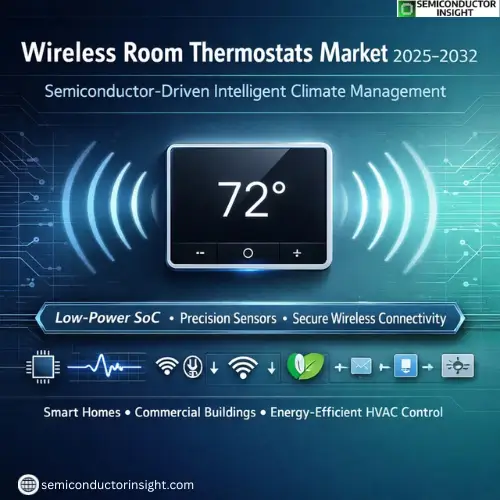
Wireless Room Thermostats Market Forecast Reflects Rising Demand for Connected Climate Control
Wireless room thermostats are electronic climate-control devices that regulate indoor temperature through wireless communication rather than fixed wiring. These systems rely heavily on embedded semiconductor components, including microcontrollers, wireless communication chips, sensors, and power management ICs, to enable accurate temperature control, remote access, and adaptive energy usage.
The market has shifted from basic on-off temperature regulation to intelligent climate orchestration, driven by advances in low-power semiconductors and integrated connectivity solutions. Wireless thermostats now function as smart nodes within broader home and building automation ecosystems.
Semiconductors Fuel Next-Gen Thermostat Development
At the core of every wireless thermostat is a compact semiconductor architecture that balances performance, energy efficiency, and reliability. Modern devices integrate system-on-chip (SoC) platforms that combine processing, memory, and wireless modules into a single package, reducing size while enhancing responsiveness.
Temperature sensing accuracy has also improved significantly due to advancements in digital thermal sensors and analog front-end components. These improvements allow thermostats to respond more precisely to environmental changes, enabling smoother heating and cooling cycles and reducing energy waste.
Equally important is power efficiency. Semiconductor manufacturers have optimized low-power modes and energy harvesting techniques, making battery-powered wireless thermostats viable for long-term use without frequent maintenance.
How Connectivity Technologies Shapes Market Direction?
Wireless room thermostats operate across multiple communication standards, including Wi-Fi, Zigbee, Z-Wave, Bluetooth Low Energy, and proprietary sub-GHz protocols. Each protocol choice reflects a balance between range, power consumption, data security, and system compatibility.
Semiconductor vendors are increasingly offering multi-protocol chipsets, allowing thermostat manufacturers to design flexible products that can integrate seamlessly into diverse smart home platforms. This adaptability is becoming a competitive differentiator as consumers demand interoperability rather than isolated systems.
For More Detailed Insights You Can Surf Our Latest Report Here:
https://semiconductorinsight.com/report/wireless-room-thermostats-market/
Application Expansion across Residential and Commercial Spaces
Residential adoption remains strong, particularly in smart homes where wireless thermostats integrate with voice assistants, mobile apps, and energy dashboards. Homeowners are prioritizing comfort personalization and real-time control, both of which are enabled by embedded processing and wireless communication chips.
Commercial buildings represent a growing opportunity. Offices, hotels, hospitals, and educational institutions are adopting wireless thermostats to support centralized building management systems. In these environments, semiconductor-driven automation allows facility managers to monitor occupancy patterns, optimize HVAC usage, and reduce operational costs.
Energy Efficiency Regulations Influencing Product Design
Energy conservation policies across multiple regions are accelerating adoption of wireless room thermostats. Governments and utilities increasingly incentivize smart temperature control solutions as part of broader energy efficiency programs.
This regulatory push has influenced semiconductor design priorities. Chipmakers are focusing on precision sensing, adaptive algorithms, and secure connectivity to ensure devices meet regulatory compliance while delivering measurable energy savings. As a result, thermostats are becoming not just control devices but compliance-enabling technologies.
Manufacturing and Supply Chain Considerations
- Wireless room thermostats market is closely linked to the broader semiconductor supply chain.
- Component availability, fabrication capacity, and packaging technologies directly impact product pricing and delivery timelines.
- Manufacturers are responding by diversifying semiconductor sourcing strategies and working closely with chip suppliers to secure long-term supply agreements.
- Some are also redesigning products around more readily available chip architectures to improve resilience against market disruptions.
Competitive Strategies and Product Differentiation
Leading thermostat manufacturers are investing in software-hardware co-design, where semiconductor capabilities are tightly aligned with firmware and user interfaces. This approach enables faster response times, predictive temperature control, and over-the-air updates.
Another strategic focus is cybersecurity at the silicon level. Secure elements, encrypted communication modules, and hardware-based authentication are being integrated to protect connected thermostats from cyber threats, particularly in commercial and multi-dwelling applications.
Emerging Trends Reshaping the Market
Artificial intelligence is gradually entering the wireless thermostat space through embedded learning algorithms. These systems analyze usage patterns, occupancy behavior, and environmental conditions to automatically adjust temperature settings without user input.
Additionally, edge processing is reducing reliance on cloud connectivity, improving responsiveness and data privacy. Semiconductor advances are making it possible to perform these calculations locally within the thermostat, enhancing reliability even during network interruptions.
Wireless room thermostats market is moving toward intelligent, autonomous climate management, with semiconductors acting as the primary enabler of this transformation. As buildings become more connected and energy-conscious, demand for advanced thermostat systems is expected to remain strong.
Future growth will depend on continued innovation in low-power electronics, secure wireless communication, and sensor integration. Manufacturers that successfully align semiconductor capabilities with real-world energy and comfort needs will be best positioned to lead this evolving market.

Comments (0)