
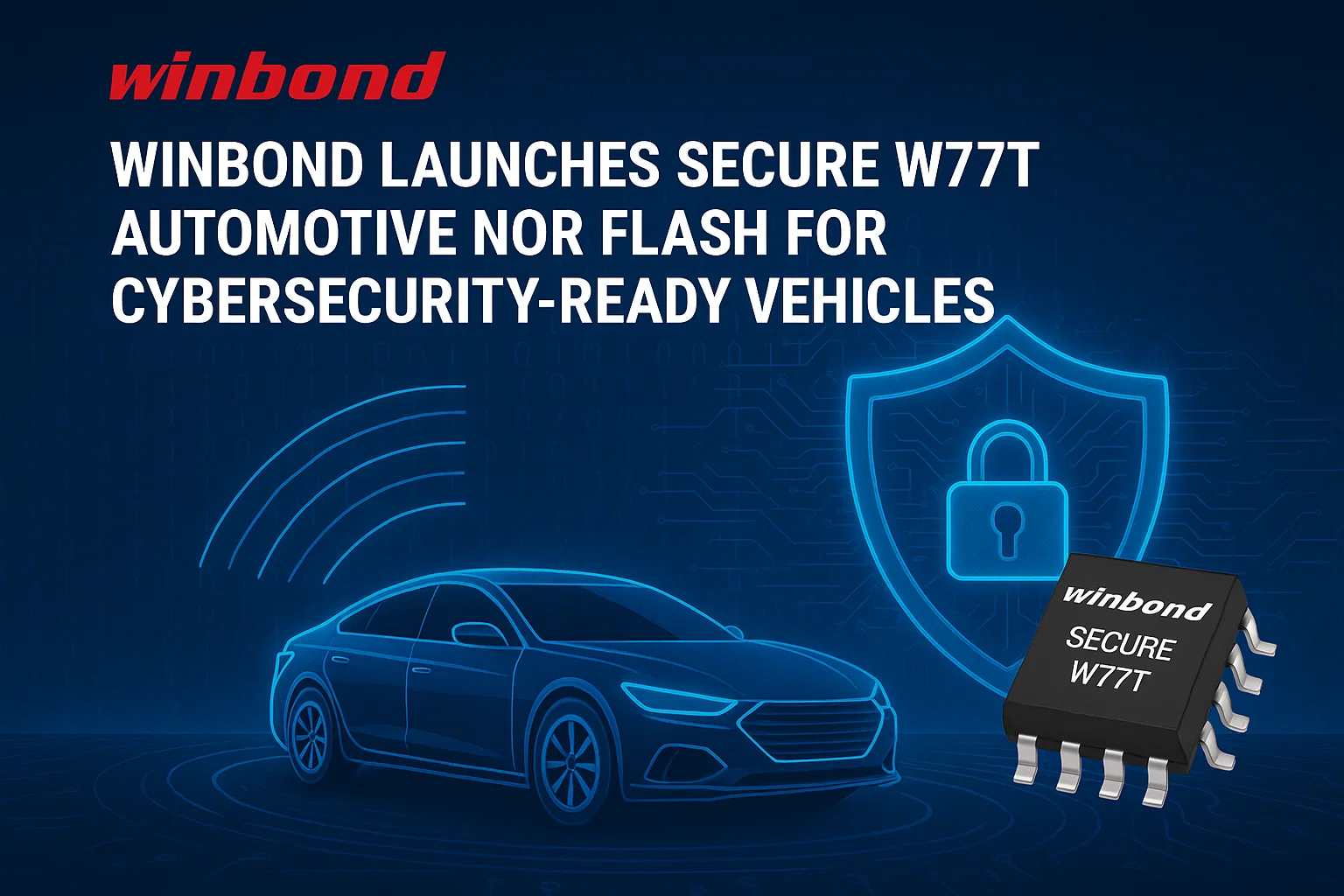
Winbond Launches Secure W77T Automotive NOR Flash for Cybersecurity-Ready Vehicles
The Automotive Grade NOR Flash market has been experiencing a rapid transformation driven by the increasing demand for high-performance memory solutions in modern vehicles. With the rise of autonomous driving, advanced driver-assistance systems (ADAS), connected cars, digital cockpits, and electrification, the role of reliable, high-speed, and secure memory has never been more critical. NOR Flash memory, renowned for its fast random read performance, high endurance, and reliability, is now at the forefront of this automotive technology evolution.
In 2024, the global Automotive Grade NOR Flash market was valued at USD 744 million. Projections indicate strong growth, with the market expected to reach USD 1.69 billion by 2032, expanding at a robust compound annual growth rate (CAGR) of 12.7% during the forecast period. This growth is underpinned by rapid advancements in automotive electronics, a shift toward software-defined vehicles (SDVs), and growing demand for secure storage to support complex automotive software ecosystems.
Access Your Free Sample Report- Automotive Grade NOR Flash Market
Why NOR Flash is Critical for Modern Automotive Systems
Before delving into the recent advancements, it is essential to understand why NOR Flash memory holds a unique position in automotive systems.
NOR Flash is characterized by:
- Fast random read speeds, making it ideal for code storage and execution in place (XiP).
- High reliability and endurance, essential for safety-critical automotive applications.
- Superior data retention, even in extreme temperature conditions.
- Scalability for secure boot and firmware storage, particularly important in modern automotive architectures.
These attributes make NOR Flash indispensable for a range of automotive use cases, including:
- ADAS and autonomous driving systems, where low latency and high reliability are essential.
- Infotainment and digital cockpits, which require rapid boot-up and smooth operation.
- Vehicle-to-everything (V2X) communication, supporting secure data exchange.
- Over-the-air (OTA) updates, ensuring seamless software updates to ECUs.
- Safety-critical systems, requiring ASIL-B or ASIL-D compliance.
As vehicles become increasingly software-driven, the amount of code stored in NOR Flash continues to grow exponentially. According to industry estimates, the software content in vehicles has doubled every five years, placing immense pressure on memory technologies to keep pace.
Recent Developments Shaping the Automotive Grade NOR Flash Industry
-
Macronix Breaks New Ground with 3D NOR Flash
One of the most significant breakthroughs in the industry came from Macronix International, which announced the world’s first 3D NOR Flash memory.
- Event: The innovation was unveiled at electronica 2024, signaling a new era in NOR Flash technology.
- Impact: Traditional NOR Flash has been limited by 2D planar scaling, which restricts capacity growth. Macronix’s 3D approach breaks these bottlenecks, allowing higher density storage without compromising performance or reliability.
- Availability: Sampling is expected by 2026, with full-scale production targeted for 2027.
This development directly addresses the challenge posed by the growing size of automotive firmware and ADAS datasets. A higher-density NOR Flash enables carmakers to integrate larger, more complex codebases, essential for software-defined vehicles and autonomous driving platforms.
Macronix also introduced its OctaBus architecture, which integrates Flash memory and RAM on a shared data bus.
- This approach reduces pin count, simplifies PCB design, and optimizes system cost for automotive electronic control units (ECUs).
- OctaBus technology is particularly attractive for space-constrained domains such as digital instrument clusters and infotainment systems.
-
Winbond’s Secure Automotive NOR Flash Solutions
With the growing importance of cybersecurity in connected vehicles, Winbond Electronics has been leading the charge with secure NOR Flash solutions.
- In late 2024, Winbond introduced the W77T Secure Flash family, designed specifically for automotive applications.
- These new products are backward compatible with the existing W25Q and W77Q families, making it easier for automotive OEMs to integrate them into current architectures.
- Key features include built-in cryptographic functions, secure boot capabilities, and enhanced protection against unauthorized access or firmware tampering.
Winbond’s focus on hardware-level security aligns with emerging automotive standards that require secure storage for critical system code. These secure NOR Flash solutions play a pivotal role in establishing trusted boot chains and preventing cyberattacks on vehicle electronics.
As vehicles become connected to cloud platforms and external devices, secure firmware storage has become a non-negotiable requirement. Winbond’s innovation provides automakers with the tools to meet stringent cybersecurity regulations, such as those outlined by UNECE WP.29.
-
GigaDevice Expands Automotive Flash Portfolio
GigaDevice, a rapidly growing memory supplier, showcased its expanded automotive NOR Flash lineup at electronica 2024.
- The company now offers NOR Flash capacities ranging from 2Mb to 2Gb, with high-speed octal SPI variants aimed at advanced applications.
- These high-speed interfaces are crucial for reducing boot times in complex systems like domain controllers and digital cockpits.
- GigaDevice also highlighted its focus on AEC-Q100 qualification, ensuring that its products meet the rigorous standards required for automotive environments.
By addressing the performance and reliability needs of modern vehicles, GigaDevice is positioning itself as a key player in both cost-sensitive and high-end automotive segments.
Download Sample Report PDF- Automotive Grade NOR Flash Market
-
Longsys and xSPI Innovations
Longsys, a specialist in automotive storage solutions, is driving innovation with xSPI NOR Flash technology.
- At electronica Munich, the company announced enhancements to its automotive-grade storage range, emphasizing high-speed, low-latency memory solutions for future vehicle architectures.
- xSPI (Expanded Serial Peripheral Interface) enables faster data transfer rates and supports emerging zonal architectures, where centralized controllers manage multiple vehicle domains.
This development reflects the broader industry trend toward software-defined vehicles, where rapid access to large codebases is essential for real-time decision-making and over-the-air updates.
-
Infineon’s Safety-Focused NOR Flash Strategy
Infineon Technologies, a leading supplier of automotive semiconductors, continues to emphasize functional safety and reliability in its NOR Flash portfolio.
- Infineon’s products are designed to meet AEC-Q100 standards, as well as ASIL-B, ASIL-D, and SIL-2 safety requirements.
- The company is deeply focused on applications such as ADAS, powertrain management, and safety-critical ECUs, where even the smallest memory failure can have catastrophic consequences.
By providing long lifecycle support and guaranteed reliability, Infineon addresses the needs of automotive OEMs seeking stable supply chains and consistent performance over the lifetime of a vehicle.
Market Drivers Accelerating Growth
The robust 12.7% CAGR projected for the Automotive Grade NOR Flash market is driven by several converging trends:
-
Rise of Software-Defined Vehicles (SDVs)
Modern vehicles are increasingly being defined by software rather than hardware.
- Automakers are deploying millions of lines of code to enable features like self-driving, predictive maintenance, and smart infotainment systems.
- NOR Flash provides the fast random read access needed for code execution, making it essential for SDV architectures.
-
Growth of ADAS and Autonomous Driving
ADAS features such as lane-keeping assist, collision avoidance, and adaptive cruise control require real-time data processing and reliable code storage.
- NOR Flash ensures these systems can boot quickly and operate without latency, a critical requirement for safety.
-
Connected Vehicle Ecosystem
With vehicles connected to the Internet of Things (IoT), secure storage becomes paramount.
- NOR Flash enables secure boot chains, protecting vehicles from cyberattacks that could compromise passenger safety or data privacy.
-
Electrification and Zonal Architectures
Electric vehicles (EVs) rely on zonal E/E architectures, where centralized domain controllers manage distributed nodes.
- These architectures demand high-speed NOR Flash interfaces to handle large volumes of code and real-time communication.
-
Over-the-Air (OTA) Updates
OTA updates are now a standard feature for many vehicles, allowing manufacturers to fix bugs, improve performance, and add new features remotely.
- NOR Flash plays a crucial role in storing update packages securely and enabling seamless rollbacks in case of update failures.
Challenges Facing the Industry
Despite its promising growth trajectory, the Automotive Grade NOR Flash market faces certain challenges:
- Rising Complexity: Firmware and codebases are growing exponentially, placing pressure on NOR Flash to scale in both capacity and speed.
- Cost vs. Performance Tradeoffs: As density increases, manufacturers must balance cost per bit with the performance required for automotive applications.
- Cybersecurity Threats: With vehicles becoming connected, memory-level security is now critical to prevent breaches.
- Supply Chain Volatility: Geopolitical tensions and semiconductor shortages can disrupt the availability of critical components.
Regional Insights
The demand for automotive-grade NOR Flash is distributed across key global markets:
- North America: Driven by leading automakers and high adoption of connected vehicle technologies.
- Europe: Strong focus on safety standards and EV adoption, particularly in Germany and the Nordics.
- Asia-Pacific: Rapid growth in China, Japan, and South Korea, with local suppliers like GigaDevice and Winbond playing key roles.
- Emerging Markets: Increasing adoption of advanced automotive electronics in India, Southeast Asia, and Latin America.
Click Here To Download Full Sample Report- Automotive Grade NOR Flash Market
Future Outlook
The next decade will see NOR Flash technology evolve dramatically, with several key trends shaping its future:
- 3D NOR Flash Adoption: Macronix’s pioneering work in 3D NOR will pave the way for higher-density solutions, enabling the next generation of autonomous and connected vehicles.
- Integration with AI Processors: As vehicles integrate AI-driven decision-making, NOR Flash will serve as the backbone for fast, secure code execution.
- Transition to xSPI and Octal Interfaces: These high-speed interfaces will become standard as boot times and performance demands increase.
- Enhanced Security Features: Secure NOR Flash will be a baseline requirement for compliance with emerging global cybersecurity regulations.
- Sustainability Focus: Manufacturers will also prioritize eco-friendly production processes and energy-efficient memory designs to align with global environmental goals.
The Automotive Grade NOR Flash market is at the center of a profound transformation in the automotive industry. As vehicles become more intelligent, connected, and autonomous, the demand for fast, reliable, and secure memory solutions will continue to surge.
With the market projected to grow from USD 744 million in 2024 to USD 1.69 billion by 2032 at a CAGR of 12.7%, there is immense opportunity for innovation and expansion. Recent developments, such as Macronix’s 3D NOR Flash, Winbond’s secure memory solutions, GigaDevice’s high-speed offerings, and Infineon’s safety-focused designs, highlight the dynamic and competitive nature of this industry.

Comments (0)